
Most teams run two races at the same time. The loud race ships new features, wins demo slots, and fills the release notes. The quiet race keeps yesterday’s system from tripping on its own laces.
We celebrate the loud race because it is visible. But the quiet race stays after hours and eats overtime without asking. That silence costs more than anyone budgets for.
I built Scope Check for the loud races to determine if a fresh idea earns funding.
The quiet race, however, needed its own lens, so I built the Recovery Check.
Scope Check asks:
Do we build.
Recovery Check asks:
What is broken, and what do we fix first.
Same one–page format, but pointed at a very different moment.
The Recovery Check fits when slow reports, stalled month-end close, or bad data nag the team. It turns quiet pain into facts the room can see. Then it helps the group pick the first stitch instead of guessing.
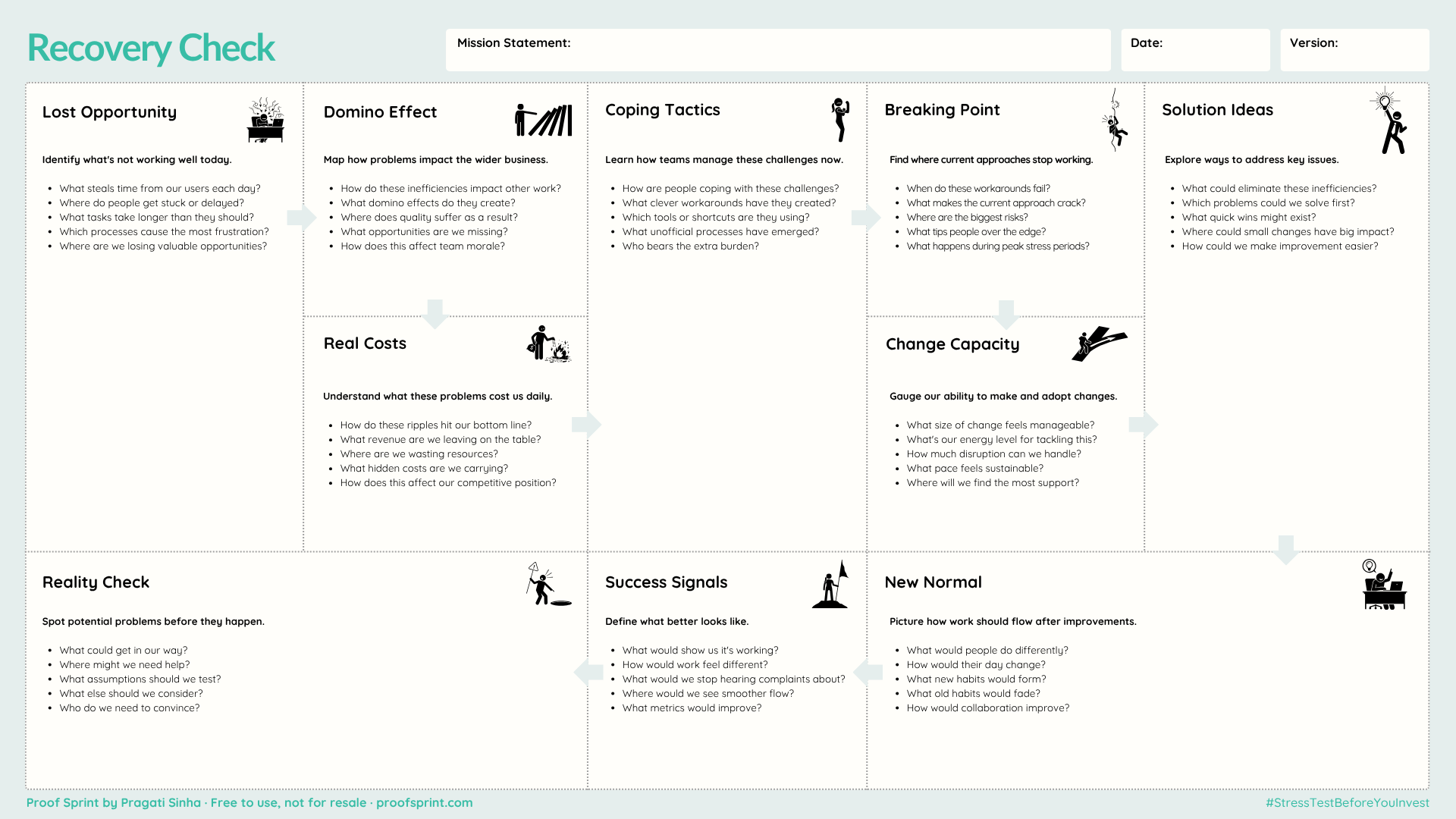
A single canvas guides the conversation. Each box earns its spot.
Lost Opportunity records the hours, sales, or goodwill that drift away every day.
Domino Effect shows how one snag in Ops delays Finance, Support, and finally the customer.
Real Costs puts numbers on the pain so budget owners pay attention.
Coping Tactics lists the scripts and side spreadsheets that keep the lights on.
Breaking Point marks when those quick fixes will fail.
Change Capacity checks if people and politics can carry the repair now.
Solution Ideas suggest fixes sized to the wound.
New Normal describes daily work once the leak is sealed. If it sounds like today, aim higher.
Success Signals define proof the fix works, like cycle time falling or tickets dropping.
Reality Check surfaces hidden links, expiring licences, and key staff who might be away.
Print the canvas, open a Miro board, or sketch the grid on a whiteboard. Invite those who feel the strain and those who sign the budget. Walk left to right in two short passes.
First pass, write what the group already knows.
Second pass, fill gaps with quick facts or mark them for follow-up.
Stop when every box has at least one clear statement.
Stand back, take stock of what you have, and ask which single fix buys the most relief in the next sprint. Pick the problem, assign a name, and capture the action. Store the canvas where everyone can see it, then review after each repair.
Legacy pain stays invisible until someone writes it down. Recovery Check makes the leak visible, counts it, and links every repair to a simple measure. Teams gain a shared understanding, a ranked list, and proof the work matters.
That is enough to win the quiet race for another lap.
Until next time,
Pragati
Curious how this plays out on real projects? Join a free Proof Lab.
For business analysts, product thinkers, and leaders who know: Shipping isn't the hard part. Knowing what's worth building is.
Comments
Nothing yet. Say the first thing.
Sign in to join the conversation.