
Thanks to AI Meets Girlboss for teaching me to create these amazing videos. Now I need to learn how to make them look unrealistic! 😅
Most of the bad AI outputs I have reviewed were not caused by a bad model. They were caused by a vague brief that gave the model no choice but to guess. When your requirements describe what you want without defining the decisions the system needs to make, you are not writing specifications. You are writing suggestions.
I hit this exact wall building the collaboration workspace inside DraftKit. I described access rules in plain English, got back something that looked right, and shipped it without ever specifying the edge cases.
Three days later, a creator reported that a removed collaborator could still see workspace content. The AI had implemented the logic based on what it inferred was most likely, not what I actually needed. I had never told it what happens at the edge, so it decided.
Every fix I made inside Lovable after that was downstream of the real problem. Before I typed a single instruction into my build tool, I needed to have already defined the decisions.
The reason this prompt works is that it forces you to think in logic gates before you think in features. A logic gate is a condition: if the user is not a workspace member, deny access and redirect to an error page. A feature description is an intent: users should only see content in workspaces they belong to.
Both sentences describe the same behavior, but only one is buildable without guessing. The AI can execute a defined gate. It cannot reliably infer one from an intent statement.
This prompt also surfaces hallucination risks before they are written into the codebase. By asking the model to identify where it might deviate from your intent, you get a risk map of your own feature spec before the first line of code exists. That is the part most PMs skip entirely.
Hallucination debt is what accumulates when AI fills in undefined decisions with its best statistical guess. Each guess is small. Across a full feature backlog, it adds up to weeks of debugging logic that was never wrong from the AI’s perspective.
Role: AI Product Architect.
Context: I am moving from a descriptive PRD to a technical logic spec.
Task:
1. Analyze the [Insert Feature Idea] and identify the 3 most critical "Technical Logic Gates" (if/then paths).
2. Write a system prompt for a "Functional Ghost" that executes this logic.
3. Identify the potential "Hallucination Debt" risks where the AI might deviate from my product intent.
Input: [Insert Feature Draft].
Paste your current feature description into the [Insert Feature Draft] field. Do not clean it up before running it. Rough, informal input produces better gap analysis because the model has to surface the ambiguity you would otherwise skip over.
Run this in Claude or in a Cursor chat window before opening your build tool. The three logic gates it returns become the first thing you paste into Lovable or your AI coding agent, ahead of the feature description. The “Functional Ghost” system prompt goes directly into your CLAUDE.md or your project instructions file.
✅ Use this before any feature involving access control, state transitions, or multi-user interaction.
✅ Use this after you have shipped something that looked right but produced unexpected behavior at the edges.
✅ Skip it for pure UI changes or visual updates where no product decision logic is involved.
What did I learn? 🤔
A “Functional Ghost” is a system prompt that encodes your product logic as standing instructions. Instead of re-explaining the rules in every session, the ghost enforces them automatically. If you are building in Lovable or with any AI coding agent, think of it as a permanent rule layer that sits above every individual prompt. I keep a running Functional Ghost for DraftKit’s access and billing logic in my CLAUDE.md and update it every time a new decision is made.
Find More Prompts Like This
This prompt is part of the Prompt-Led Product Vault, a growing library of battle-tested prompts I use when building AI products, auditing existing ones, and leading technical PM decisions.
Every prompt in the Vault comes with useful examples, the logic behind the structure, and a real usage example.
Requirements clarity has always been a PM’s core job. In an AI-led build cycle, it is also the only security layer you actually control.
Models do not ask clarifying questions when your brief is ambiguous. They fill the blank with the most statistically reasonable answer.
The PM who defines the decision tree before the build starts does not spend three days debugging access logic that was never specified in the first place.
If you want help running this across your current product backlog before your next build sprint, reach out at hello@elenacalvillo.com.
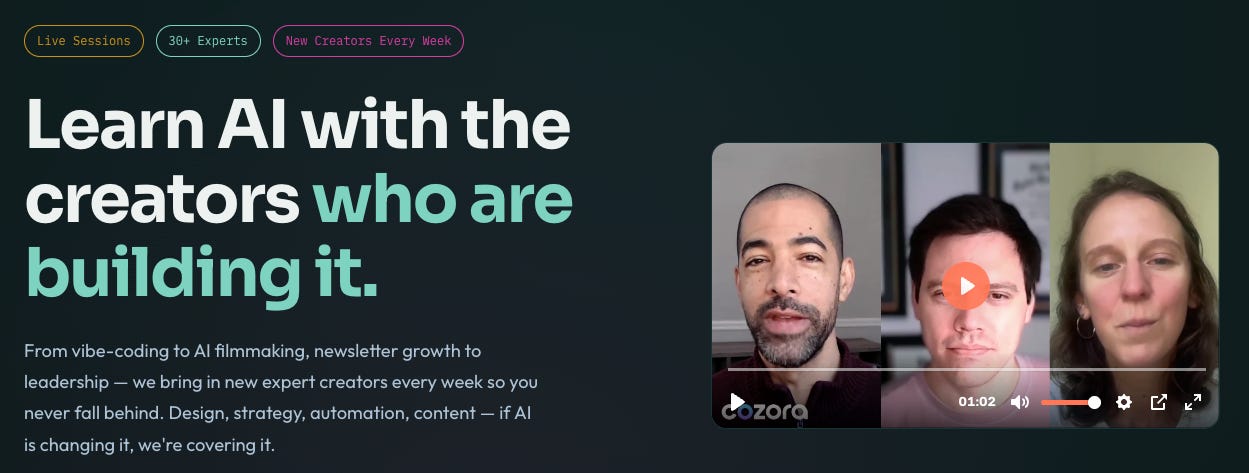
Stop chasing AI certificates. You don’t need another badge to prove you know your stuff. You need to build the thing!
At Cozora, we focus on building the skills you actually use at work. These are the high-paying skills that matter right now. It’s about execution, not theory.
I want to make sure you have the right tools to build, so here is the deal:
Paid subscribers: 50% off (monthly or annual)
Free subscribers: 10% off
Stop collecting credentials and start building systems. 🚀
Comments
Nothing yet. Say the first thing.
Sign in to join the conversation.