
I spent an hour this month reading the free vs paid AI tools pricing pages line by line instead of skimming the comparison tables, and I came away convinced most of us upgrade for the wrong reason. The paid tier almost never sells you a new ability. It sells you more room to run the same process you already had, which means if your process was the problem, you just bought a faster way to repeat it.
Here is the moment I want you to recognize, because I have been in it.
It is the fourth week of the month. You are mid build, you have something working, and there is a stakeholder demo in two days. Then the banner appears. Out of credits. Out of usage. Upgrade to continue.
So you upgrade, because $25 is cheaper than explaining why the demo slipped.
Two weeks later you are stuck again, and this time it is not the limit. The prototype is tangled. You cannot remember why you prompted it that way.
The upgrade bought you more attempts at a process that was already failing you, and I keep watching PMs treat that as a spending decision when it is a judgment decision.
The real Lovable rate card, including where the volume discounts actually start
What each type of prompt costs in dollars, not credits
Which Claude features are genuinely gated and which ones you already own
The correction tax, and why it is bigger than your subscription
The diagnostic to run before your next upgrade
Hey, I’m Elena! 👋
AI Product Manager, builder, and founder of DraftKit.app and the AIAdventChallenge.com. I write Prompt-Led Product, a newsletter for PMs who are tired of just writing requirements. This is for the product leader who wants to actually ship. The kind where you stop managing tickets for a second, open a prompt, and build the logic yourself.
Built by you. Led by your product taste. 🚀
If you’re new here, welcome! Here’s what you might have missed:
Strategy: How Reforge Transformed From Education Company To Multi-Product Platform
Builds: I Built a Product Brain MCP to Stop Carrying Context in My Head
Join a community of builders from companies like Reforge, Product School, OpenAI, Lovable, Pendo, and Miro shipping AI products.
Start with what surprised me when I stopped trusting the upgrade prompt and read the source.
On Claude’s free plan, Anthropic lists memory across conversations, file creation with code execution, web search, Slack and Google Workspace connections, and remote MCP integrations. That is the piece that changes what you can build. It sits on the free tier.
On Lovable, the free plan includes a daily grant of 5 build credits capped at 30 a month, plus 20 Cloud credits monthly. Lovable also states that workspaces support unlimited members on every plan, because plans are priced by credits, not by seats. Inviting three collaborators does not change your bill. It changes how fast the shared pool drains.
Sit with that. The collaboration is free. The fuel is what costs money.
Lovable prices in credits. Credits are not dollars, and that gap is where the confusion lives.
Open the credit selector on the Pro plan and the tiers read like this: 100 credits for $25 a month, 200 for $50, 400 for $100, 800 for $200. Work out the per credit rate on each and you get the same number four times. Twenty five cents. Flat.
The first volume discount does not appear until 1,200 credits, and it is two percent. It climbs to ten percent at 5,000 credits, which is $1,125 a month. So unless you are running a genuinely large operation, moving up a tier buys more credits at exactly the price you were already paying. There is no loyalty curve in the first four tiers.
Now price the prompts. Lovable publishes example costs in its own pricing FAQ: restyling a button is 0.50 credits, removing a footer is 0.90, adding signup and login flows is 1.20, and building a landing page with images and five sections is 1.70.
At twenty five cents a credit, that is thirteen cents, twenty three cents, thirty cents and forty three cents.
Sit with those numbers, because they reframe the whole anxiety. The free tier grants 5 build credits a day capped at 30 a month, which at the Pro rate is $7.50 of build capacity, or roughly seventeen landing pages.
The reason people burn through that in an afternoon is not that Lovable is stingy. It is that a vague prompt turns one task into eleven corrections, and every correction is charged at the same rate as the thing you actually wanted.
This is the number that matters and it is the one nobody puts on a pricing page.
Say a feature should take eight prompts and it takes forty. That is thirty two extra credits, which is eight dollars on Pro and sixteen on Business. For one feature. In one sitting.
Do that four times in a month and the redo loop has cost more than the subscription. You will not see it, because it never arrives as a line item. It arrives as a credit balance that ran out sooner than expected, which reads like a capacity problem and gets treated with an upgrade.
I went into the structural version of this in The Dark Side of AI Prototyping. This is the same failure with a price tag attached.
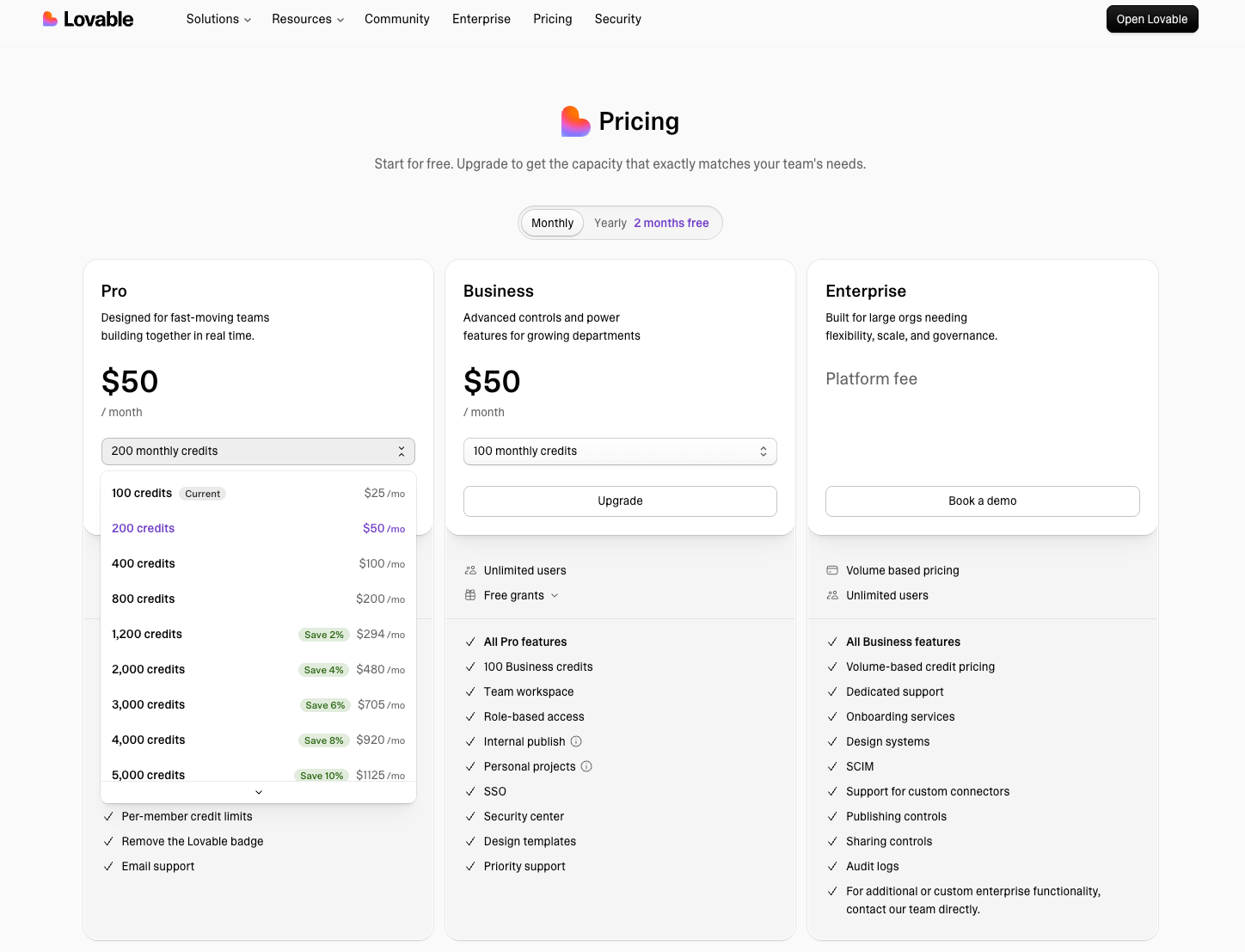
I checked this at all nine credit tiers because the first two looked wrong and I assumed I had misread the selector.
100 credits: $25 on Pro, $50 on Business.
800 credits: $200 against $400.
5,000 credits: $1,125 against $2,250.
Every tier, without exception, a clean 2.00x.
What the doubling buys is SSO, role based access, a security centre, design templates and priority support. Real things, if you need them. What it does not buy is one extra credit of build capacity at the same spend. If you moved to Business for the output, you halved your output.
I read the full feature comparison across Free, Pro, Max 5x and Max 20x, and this is where I have to correct something I believed and have probably repeated out loud.
The context window is 200k on every individual plan. Free, Pro, Max 5x, Max 20x. Identical. If you upgraded because you wanted the model to hold more of your work in its head at once, that is not what you bought.
Memory across conversations, connectors and remote MCP, skills, web search, artifacts and code execution are all on the free plan. MCP stands for Model Context Protocol, an open standard that lets an assistant talk to your real tools and data instead of whatever you paste into the box. That is the thing that most changes what you can build, and it costs nothing.
But some gates are real, and I was too glib about this in my own head. Free runs Sonnet and Haiku only. Opus and Fable are paid. Claude Code, Cowork, Design, Science, Projects and Research are all paid. Priority access during busy periods is Max only.
Those are genuine capability differences, not volume.
So the honest summary is not that paid tiers are a con. It is that the expensive assumption and the actual gate rarely line up. People pay for a wider context window that was never gated, and skip the model upgrade that would have actually helped.
I built the full rate card as a resource so you do not have to redo the arithmetic:
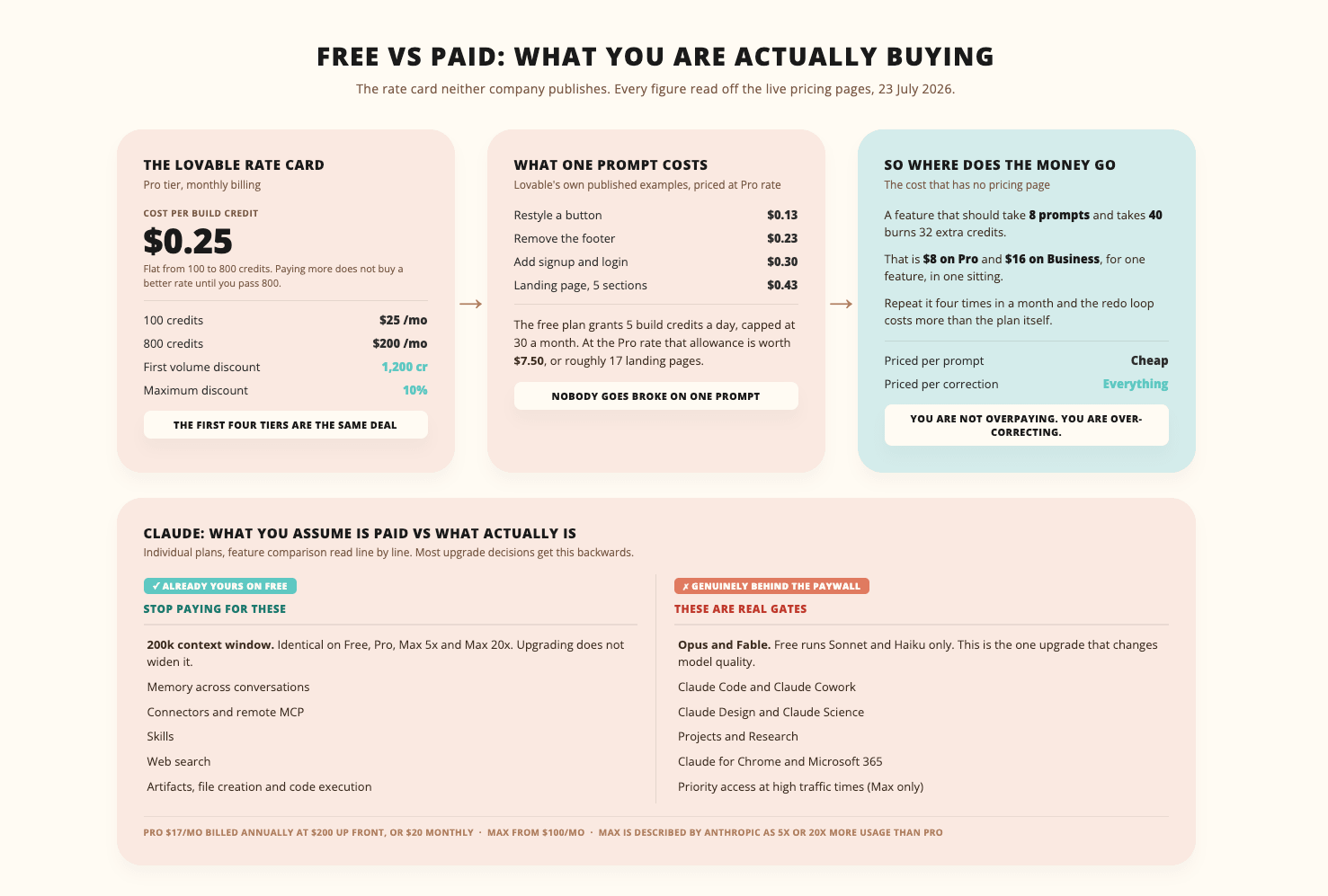
Per credit math, the dollar cost of each prompt type, the Claude gate map, and the diagnostic below, on one page you can keep open while you plan a build.
Four steps, in order. If you fail one, stop there.
✅ Name the deliverable the limit actually stopped. If you cannot name it, you did not hit a capacity problem. You hit a focus problem, and more credits will not fix it.
✅ Open your last twenty prompts and count the corrections. How many were fixes to your own previous instruction? That ratio is the real diagnosis. Above half, the upgrade funds the loop.
✅ Check whether the thing you want is actually gated. Read the comparison table yourself rather than trusting the banner. On Claude, MCP and the context window are not behind it. You may already own what you are about to buy.
✅ Ask what you will conclude if you hit the ceiling again next month. If the answer is upgrade again, you are on a treadmill, and each step costs more than the last.
Not cancel anything. That advice sounds bold and helps nobody.
I would spend one hour before the next build naming what I am making, saving the prompt that produced the version I liked, and deciding in advance what done means. That hour is free, and it attacks the correction loop directly, which is the only line item large enough to be worth attacking.
This is the same lesson I got the expensive way in I Built a $15K App for $0. The constraint was not the obstacle. It was the thing that forced me to think before I typed.
Then if you still hit the ceiling doing focused work on a named deliverable, upgrade without guilt. That is a genuine capacity problem, and capacity is exactly what these tiers are good at solving.
Open your last twenty prompts and count the corrections. What number did you get?
Drop it in the comments, I read all of them. I want to know whether my ratio is unusual or whether we are all quietly funding the same loop.
If you want me to run this audit on your own build stack before your next renewal, reach out at hello@elenacalvillo.com.
Comments
Nothing yet. Say the first thing.
Sign in to join the conversation.