
I’m proud to announce that our commemorative Stories250 magazine is finally here. Published on July 28, 2026, it’s available worldwide through Lulu. Purchase your copy at cost, here:

There’s nothing quite like seeing your name in print. When it comes as part of a collaborative publication, you get a piece of that feeling of being something larger than yourself. The magazine is now here:
Available for purchase through Lulu1
An electronic copy is available now at the Internet Archive at archive.org/details/stories250-magazine-07282026. See below as well.
And physical copies are on their way to collections at
The Genealogy Center at the Allen County Public Library in Fort Wayne, Indiana.
The American Library of Congress with the Copyright Office registration.
When I announced the project in July 2025, it hadn’t even occurred to me to produce a publication. By Spring 2026, it was clear that we needed2 a commemorative deliverable. When I proposed the magazine, I figured we’d have maybe 20 articles and 100 pages, but submissions kept rolling in. After we surpassed 40 or 50 articles, I knew I wanted the final product to give a satisfying “thunk.”
Boy, did you deliver. The final version includes 60 articles and over 20 contributors in a magazine layout with glossy paper that spans 540 pages. Drop it, and you get a very satisfying “ka-thunk.” (Watch your toes.) I hope it’s as delightful for all of you as authors and for your families as it was for me to produce.
In recent years, I’ve become very particular about how I read books. Some books I hold; others I read online as ebooks, audiobooks, or sometimes a combination. I honestly haven’t picked up a true magazine since my last dental visit. It’s amazing how our expectations have changed.
QR codes everywhere
As I shared while working on the project, I started to notice subtle differences in the ways I consume written material. The magazine was an unexpected delight to browse. You hold it in your hands and flip through the pages, each time landing on something new.
Since reading is a little uncomfortable in such a large format, I added at least two QR codes to each article. One each for
The author profiles (typically your /@handle pages on Substack.)
The link for the article itself.
I also wanted the magazine to have “legs” so it could walk along and continue to grow, so the last page includes QR codes that link to collection pages for each contributing author. As new pieces are written and tagged with Stories250 or some similarly relevant phrase, they’re added to each collection page as the authors requested.
Organization
In retrospect, I was lucky that this whole project started with the timeline. I knew how to build a timeline from my Lafayette project and readily asked each author to reference a date range for each post. The date ranges meant different things to different authors, but I just decided it didn’t matter. As the magazine grew, we discovered some interesting comparisons as different authors wrote stories about the same periods or regions. Though I anticipate changes to the page, the tools will remain on the Stories250 for the foreseeable future:
Since the timeline defined an order, I made sure the magazine's organization followed the same order. It was also a useful tool for final checks. The Stories250 web page followed the same logic with the placement of embedded articles based on time.
Table of Contents & Index
Though structurally useful, the timeline was meaningless for anyone looking for a family member’s stories, so I decided that the table of contents had to be ordered by authors. Though it was a little sloppy in retrospect, I settled on first names since we were all using online names and handles. You’ll notice the table of contents begins with our Annes. Also, to keep myself sane, all pages of the PDF match the page numbers on the printed page.
Classic wayfinder tools like a table of contents are more important than ever in something as big as this. I’d been involved in maybe a hundred or more textbooks and technical publications since 1975, so I knew how hard these can be to produce. Much to my relief, it turned out to be a terrific use case for AI.3
My goal here was to make sure that everyone who wanted a copy could get one. This was all a proof of concept, and I didn’t want to pad the expense for you, libraries, and others who might be interested. Instead of padding the cost with a margin, I priced it as low as I could without losing money. The number came out to just under $35 here in the US, and a bit higher in Canada, Australia, New Zealand, and Great Britain. With international distribution and local printing from Lulu, shipping is minimal and shouldn’t include duties. I see you, New Zealand. 👀
Maybe just print your own?
To make sure everyone could get their own copy, I made it available on the Internet Archive or as a download here.
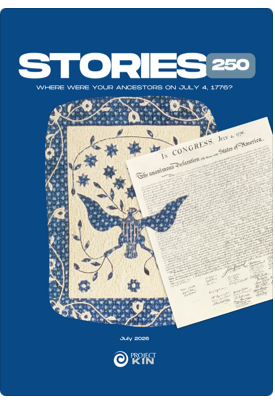
This version of the magazine is in full color and identical to the copy available for print through Lulu. Magazine Copyright © 2026 by Barbara Tien for Projectkin and the individual work of the noted authors and creators. All rights reserved. Individual Contributions: Each individual article, blog post, and image included in this magazine is the property of its respective author. Contributions are reprinted with the express permission of the copyright holders. All rights to the individual works are retained by the original authors.
I’d encourage everyone to use the linked PDF above to save a copy to your archives. Whatever happens, you’ll have your own. It’s also fun to explore the whole magazine in color or selectively print certain sections if you’d like. It’s up to you. Let me know if you want the uncompressed copy (it’s over 1GB).
It’s been a privilege to embark on this little adventure with all of you. What an amazing journey. It feels good to have commemorated the moment together.
Now we can close the book and move on to Migration Stories.4


I want to thank each and every one of you who came along with me on this project. You trusted me with your materials, tolerated my nudges, and put together the quality work that makes us all proud and will inspire your family and descendants.
Contributing authors: Anne Wendel , Anne Young, Bill Moore , Carole Kuge Kawamura, Dai Davies, Deborah Carl, Diane Burley, Erin Hoover, Garry E Moore, Heather Rojo, Helene McClanahan, Jane Chapman, Kyla Bayang, Linda Stufflebean, Lori Olson White, Dr. Mary M. Marshall, Maureen Taylor, Randy Seaver, Geneaholic, Rick Leonard, Rita McConnell, and Tad Callin.
Finally, I want to thank Jill Morelli for the publishing workshop during the NGS annual conference in May 2026. You gave me the confidence I needed to do this. I’m a terrible student and made up my own rules, but I couldn’t have done it without the feather you gave me that told me I could do it. Dumbo would be proud. I hope this will help all of you realize that you can do it too.

Lulu.com offers a complex array of purchase mechanisms and discounts that can be confusing. All offers of this magazine are made at the single-unit production cost. No profit, royalty, or margin added. This was a learning experience for my ᓚᘏᗢ and me at Projectkin. Observations for the most thrifty among us:
The best offers seem to come to free Lulu account holders who get near-weekly discount codes in exchange for tolerating their marketing campaigns.
A direct buy button that is relatively easy to embed but doesn’t accept discount codes.
The Lulu Direct Store, where a large number of the materials published by Lulu are available
For this project, I decided not to publish this on Amazon using either KDP or what Lulu calls Global Distribution. Lulu seemed to have a better reputation for magazine production than KDP. The Global Distribution mechanism from Lulu (which has added availability through Amazon) did not offer the option of black/white interior pages. Color interior pages would have been cost-prohibitive in this print-on-demand model.
You might even say I wanted a commemorative deliverable. Maybe I’d spent too much time in grocery checkout lines.
It took a bit of experimenting, but I landed on a straightforward workflow that leaned heavily on Canva. Scribner is probably a better production tool, but this magazine is highly visual, and I know Canva very well. It worked and has an AI integration. Drop me a note if you’re interested in the details.
Before you ask, yes. Now that I know how to produce a magazine, I’m absolutely open to producing more materials in the future. I don’t see that a periodical is in my future, but special-occasion commemoratives feel pretty natural. I have a short list of things I’d do differently, but again, we can discuss that privately if you’d like.
Comments
Nothing yet. Say the first thing.
Sign in to join the conversation.