
Welcome 👋🏽
This newsletter is the first part of a multi-part series on how I intend to play the AI trade over the next decade.
Part 1 is the trigger.
Part 2 will be the ETF trade.
Part 3 will be the individual stock trade.
I’ve been discussing the AI buildout quite regularly over the last few years, and I’ve already had exposure to names like IREN, TSLA and the SMH index..
They were great trades.
IREN and SMH would have been even better holds.
So the point of this series is not, “how do we get into the AI trade ASAP?”
The point is:
How do we participate in one of the biggest structural trades of the next decade without aping assets that have already gone parabolic?

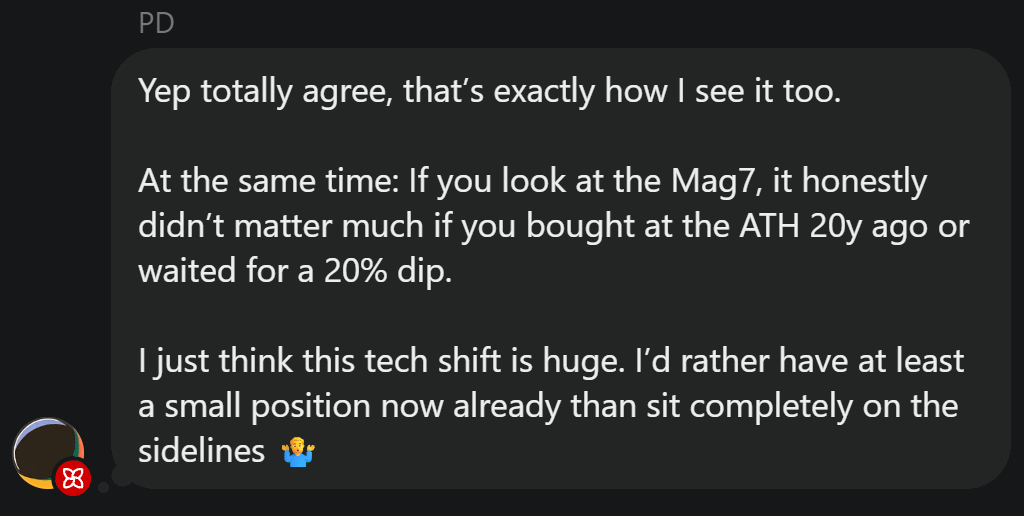
That said, I happen to wholeheartedly agee with this take by PD in the community chat as it takes the Fear of Missing Out (FOMO) psychology out of the picture to a large degree.
So, what’s the play?
The AI CAPEX story is real. The buildout is real. The demand for compute is real, but the obvious chip trade has already gone parabolic.
From here, I’m not asking
“what do we buy?”
I’m asking:
“when do we buy it?”
and for that….

The first phase of the AI trade was straightforward: buy compute.
That meant GPUs. Semiconductors. Nvidia. TSMC. ASML. Broadcom. AMD. Micron. Equipment. Memory.
The next leg is broader. This time we need to:
buy the AI industrial buildout.
“Great anecdote Einstein, but what does that actually mean?”
It means
➡️ Better models require more compute.
➡️ More compute requires more chips.
➡️ More chips require more data centres (WE ARE HERE)
➡️ More data centres require more power.
➡️ More power requires grid upgrades, transformers, cooling, storage, transmission and generation.
➡️ More AI adoption requires more cloud, storage and cybersecurity.
➡️ More robotics adoption requires more sensors, batteries, actuators, factories, logistics, warehouses and physcial infrastructure.
Eventually, AI stops being a tech trade and starts becoming an economy-wide CAPEX cycle.
I think that’s what most folks are missing - the sheer amount of infrastructure and resources required to make LLMs the dominant “brain” or “workhorse” in our society.
One of my core investment rules is:
avoid allocating in a trending market
Especially when assets are at all-time highs, have already put in multiples, and everyone is talking about them.
To me, there is a big difference between being right on the thesis and being right on the entry. I know my thesis is correct, now I have to wait for the right entry.
So, what are we waiting for?

Comments
Nothing yet. Say the first thing.
Sign in to join the conversation.