
Kyle Gawley is the founder of Gravity who successfully built a no-code platform for creating SaaS products. Here's a detailed breakdown of how he achieved product-market fit, reached his first $1,000, and continued to grow from there.
Kyle started by identifying a specific problem within the SaaS community—many entrepreneurs and small businesses wanted to build SaaS products but lacked the technical skills or resources to do so. He saw the growing trend of no-code tools and decided to create a platform that would enable users to build SaaS products without writing any code.
Kyle's next step was to build a minimum viable product (MVP). He focused on creating a simple, functional version of Gravity that included core features like user authentication, billing integration, and basic app templates. This allowed him to test his idea quickly and gather initial feedback from users.
Here is a timeline fro idea to reaching 50K$
Ideation- Yr 2020
MVP Development - Q1 2021
Initial Launch - Q2 2021
First 1000$ - Q3 2021
Scaling phase- Q4 2021
Reaching 50,000$ Milestone - Yr 2022
To attract early users, Kyle leveraged several strategies:
Community Engagement: He participated in online communities like Indie Hackers, Makerpad, and Product Hunt, where he shared his journey and gathered feedback.
It was a mixture of get involved in a lot of discussions, not just discussions about boilerplates. I was making sure that I logged onto Indie Hackers every day and answered a couple of questions about different things.
- Kyle Gawley
Content Marketing: Kyle wrote blog posts and created tutorials that demonstrated how to build SaaS products using Gravity. This content helped establish him as an authority in the no-code space and drove organic traffic to his website. His major advantage was the niche he was operating in. Nobody was building a Next.JS boilerplate and therefore was able to get up to number one in SEO relatively easy just picking the right keywords.
Social Media: He actively used Twitter to share updates, engage with potential users, and build a following. By being transparent and sharing his progress, he created a sense of community and trust.
Kyle's initial marketing efforts paid off as he began to attract early adopters. He offered a free trial to encourage users to try Gravity, and many of these users converted to paid plans. Here’s a step-by-step breakdown of how he reached his first $1,000:
Launch on Product Hunt: Kyle launched Gravity on Product Hunt, which brought in a significant amount of traffic and early users. The positive feedback and exposure helped build credibility.

Engagement and Support: He provided excellent customer support and engaged with users directly to understand their needs and improve the product based on their feedback.
Referral Program: Kyle implemented a referral program, incentivizing existing users to refer new customers. This helped to organically grow his user base.
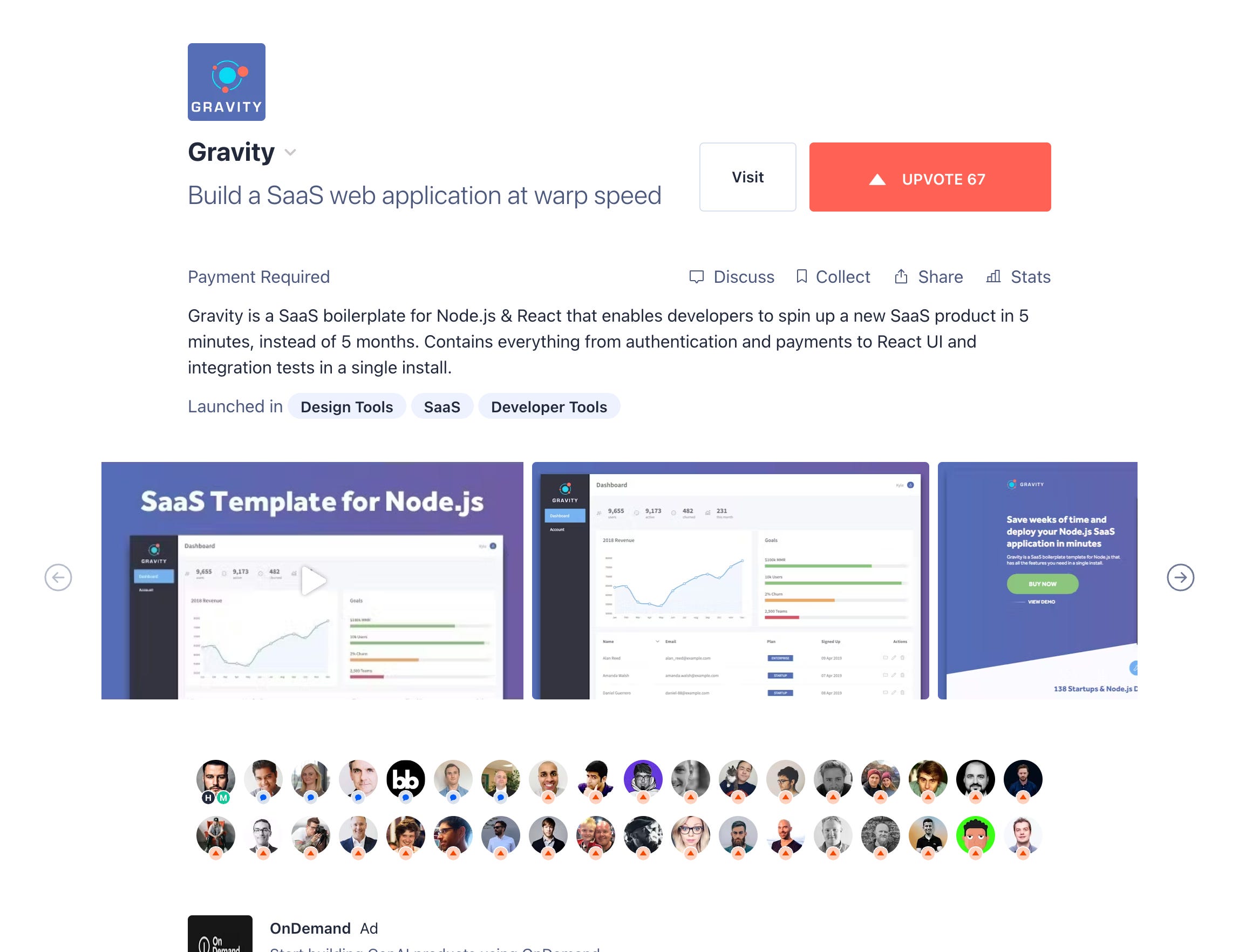
After reaching the first milestone of $1,000 in revenue, Kyle focused on scaling his business:
Continuous Improvement: He regularly updated Gravity with new features based on user feedback. This helped retain existing users and attract new ones.
Collect feedback and build better products with ProductLogz
Partnerships and Integrations: Kyle formed partnerships with other no-code tools and platforms, integrating Gravity with popular services like Zapier. This expanded the platform's functionality and appeal.
Kyle began by identifying tools and platforms that complemented Gravity’s no-code capabilities. He looked for partners that shared a similar audience or offered functionalities that would enhance Gravity's value proposition. Key considerations included:
User Base Alignment: Choosing partners whose users would benefit from using Gravity.
Complementary Features: Integrating with tools that added essential features to Gravity.
Market Reach: Partnering with platforms that had a strong presence in the no-code and SaaS communities.
Integration Partnerships
Zapier: By integrating with Zapier, Gravity enabled users to connect their SaaS products with thousands of other apps, automating workflows and extending functionality.
Integromat: Similar to Zapier, Integromat integration allowed more advanced automations and integrations, appealing to a technical audience.
Stripe: Integrating with Stripe facilitated seamless payment processing for Gravity users, simplifying billing and subscription management.
Content Partnerships
Guest Blogging: Kyle wrote guest posts for popular no-code and SaaS blogs, sharing insights and tutorials on building SaaS products with Gravity. This not only drove traffic but also established credibility.
Collaborative Webinars: Partnering with other no-code platforms for joint webinars provided mutual exposure. These webinars focused on solving specific problems using both Gravity and the partner’s tool, demonstrating the combined value.
Affiliate Partnerships
Affiliate Programs: Kyle set up an affiliate program, incentivizing influencers and bloggers in the no-code space to promote Gravity. Affiliates earned a commission for every referral that converted to a paying customer.
Influencer Partnerships: Collaborated with influencers who had significant followings in the entrepreneurial and no-code communities. These influencers showcased how they used Gravity to build their projects, driving interest and sign-ups.
Content Expansion: He continued to invest in content marketing by creating more in-depth tutorials, case studies, and success stories from users who built successful SaaS products using Gravity.
Webinars and Workshops: Kyle hosted webinars and workshops to demonstrate how to use Gravity effectively. These sessions provided value to users and converted attendees into paying customers.
SEO and Paid Advertising: He optimized his website for search engines and experimented with paid advertising campaigns to drive targeted traffic to Gravity’s website.
$1,000 Milestone: Achieved through a combination of community engagement, content marketing, and a successful Product Hunt launch.
$10,000 Milestone: Reached by continuously improving the product, forming strategic partnerships, and expanding content marketing efforts.
$50,000 Milestone: Scaled through webinars, workshops, and optimizing both organic and paid marketing channels.
Community Engagement: Indie Hackers, Makerpad, Product Hunt.
Content Marketing: Blog posts, tutorials, case studies (WordPress, Ahrefs).
Social Media: Twitter for updates and engagement.
Webinars and Workshops: Zoom, Teachable.
SEO and Paid Advertising: Google Ads, Facebook Ads, Google Analytics.
Customer Support and CRM: Intercom, HubSpot.
Kyle Gawley's success with Gravity is a testament to the power of identifying a clear problem, building a focused MVP, and engaging with the community. His growth strategy involved a mix of content marketing, community engagement, excellent customer support, and continuous product improvement. By listening to his users and iterating on their feedback, Kyle was able to achieve product-market fit and scale Gravity to a successful no-code platform for building SaaS products.
Comments
Nothing yet. Say the first thing.
Sign in to join the conversation.