
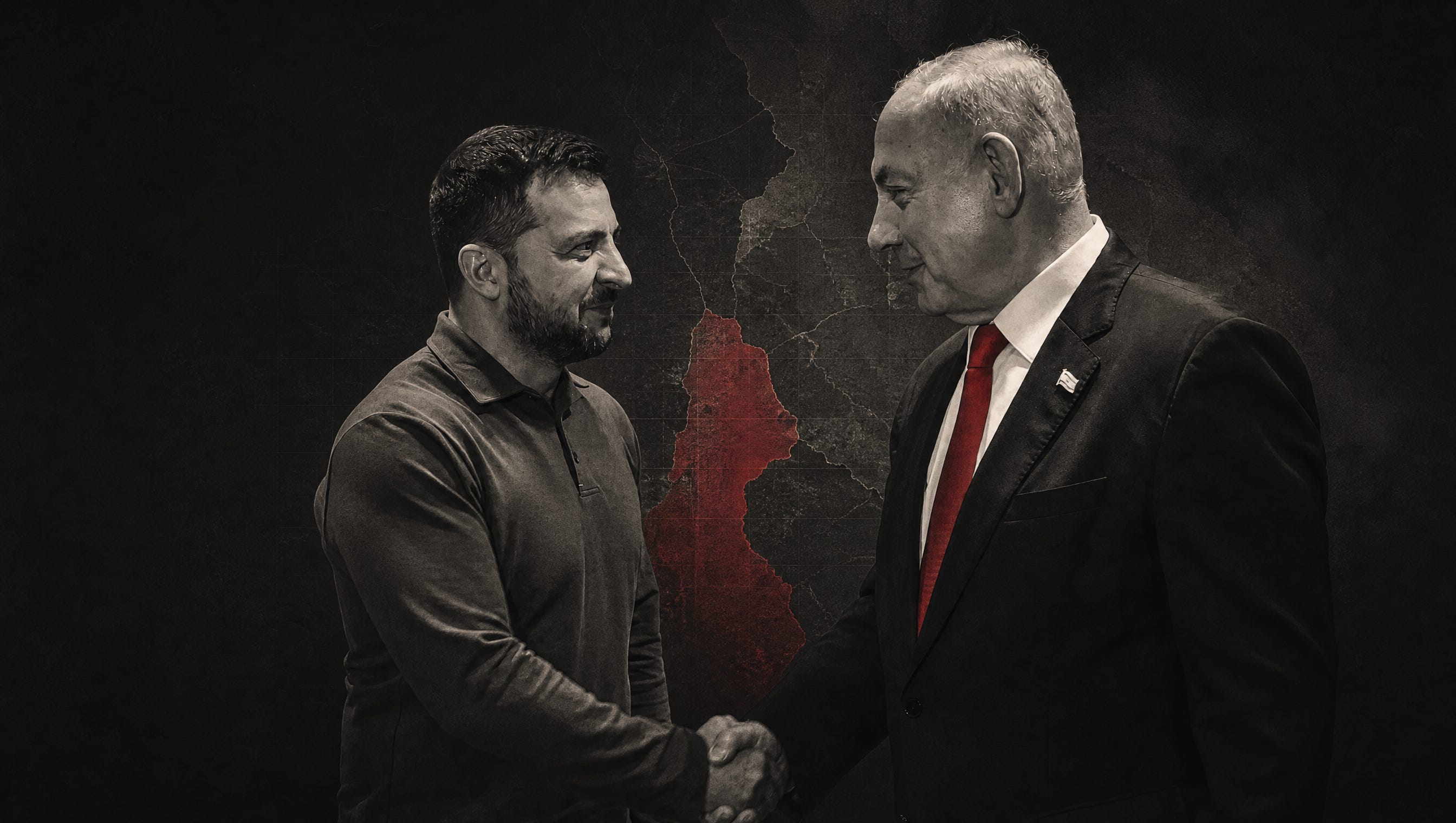
On the morning of July 25, a Ukrainian strike hit ships carrying Iranian military cargo across the Caspian Sea — ammunition, artillery shells, drone and missile components bound for Russia. The Caspian has no history as a battlefield. It is a closed sea, bordered by five states, with no naval tradition of external intervention. Iran’s Foreign Minister Araghchi announced the strike cannot go unanswered. The same week, Zelensky and Netanyahu were both in Washington meeting Trump, the Senate was voting on Russia sanctions, and the United States was running a live negotiating track with Tehran under a time ultimatum. Something structural became visible in that convergence.
Co-belligerency threshold doctrine holds a specific claim: a supplier crosses from patron to combatant in the other side’s operational calculus the moment its supply line becomes a valid military target. The doctrine does not require a declaration of war. It does not require the supplier’s consent. It requires only that one actor in the conflict decides the supply line is legitimate — and acts on that decision. Ukraine just acted on that decision.
This is not an observation about Iranian intent. Iran has been supplying Russia with Shahed drones, artillery shells, and missile components since at least 2022. That supply relationship has been documented, sanctioned, and denounced at the UN Security Council repeatedly. What changed on July 25 is not the supply. What changed is the targeting logic. Ukraine has now placed Iranian military cargo — wherever it moves, by whatever route — inside its operational envelope. The Caspian, long treated as a sanctuary precisely because none of the bordering states had reason to contest it, is no longer a sanctuary.
The doctrine’s real teeth are in what follows: once a supply line is targeted, the supplier faces a binary. It absorbs the loss as a cost of doing business, which signals that the line can be struck again. Or it retaliates, which converts the supplier from patron to active combatant — and activates every downstream consequence of that conversion. Araghchi chose his words carefully. “Cannot go unanswered” is not a rhetorical formula. It is a doctrine announcement.
Comments
Nothing yet. Say the first thing.
Sign in to join the conversation.