
The concept of sacred space is foundational to religious studies. Every religion, no matter how old or young, divides the world into two spheres: The sacred and the profane. The sacred imbues the world with meaning and structure. The profane, however, is homogenous, without value. Religious studies, at least in its early days, sought to understand how people perceive this difference—their subjective cosmos.
Mircea Eliade was the thinker who most famously theorized religion along these spatial lines. For him, religion is largely an exercise in navigating the world-making power of the sacred. Where the sacred appears, space is transmuted. The spring is not just a spring; the mountain is not just a mountain. These places become centerpieces for the entire cosmos, windows into a higher world.
He called such a centerpiece the axis mundi, the center of the world. These axes mundi give structure to the entire cosmos by providing a central point of reference. You know where everything else is in relation to the axis mundi. And the closer you are to the center point, the more sacred the space becomes.
Moreover, the axis mundi does not just tell you what matters on the mortal plane. It is also a “cosmic pillar” that connects you to the transcendent worlds of heaven and the underworld.1 That’s partly why the axis mundi is so important: It makes possible traffic between the realm of the gods, the realm of mortals, and the realm of the dead.
The axis mundi is not literally the center of the universe; it is the center of one’s subjective cosmos. Remember, religious studies is not interested in whose cosmos is actually real—that’s a matter for theology. What matters is how the world appears to a certain religion. The axis mundi is a skeleton key to a religion’s worldview.
This concept is everywhere in video games, yet it is hardly ever discussed.2 In today’s post, I want to give a few examples of axis mundi and show how they contribute to their games’ symbolic infrastructure.
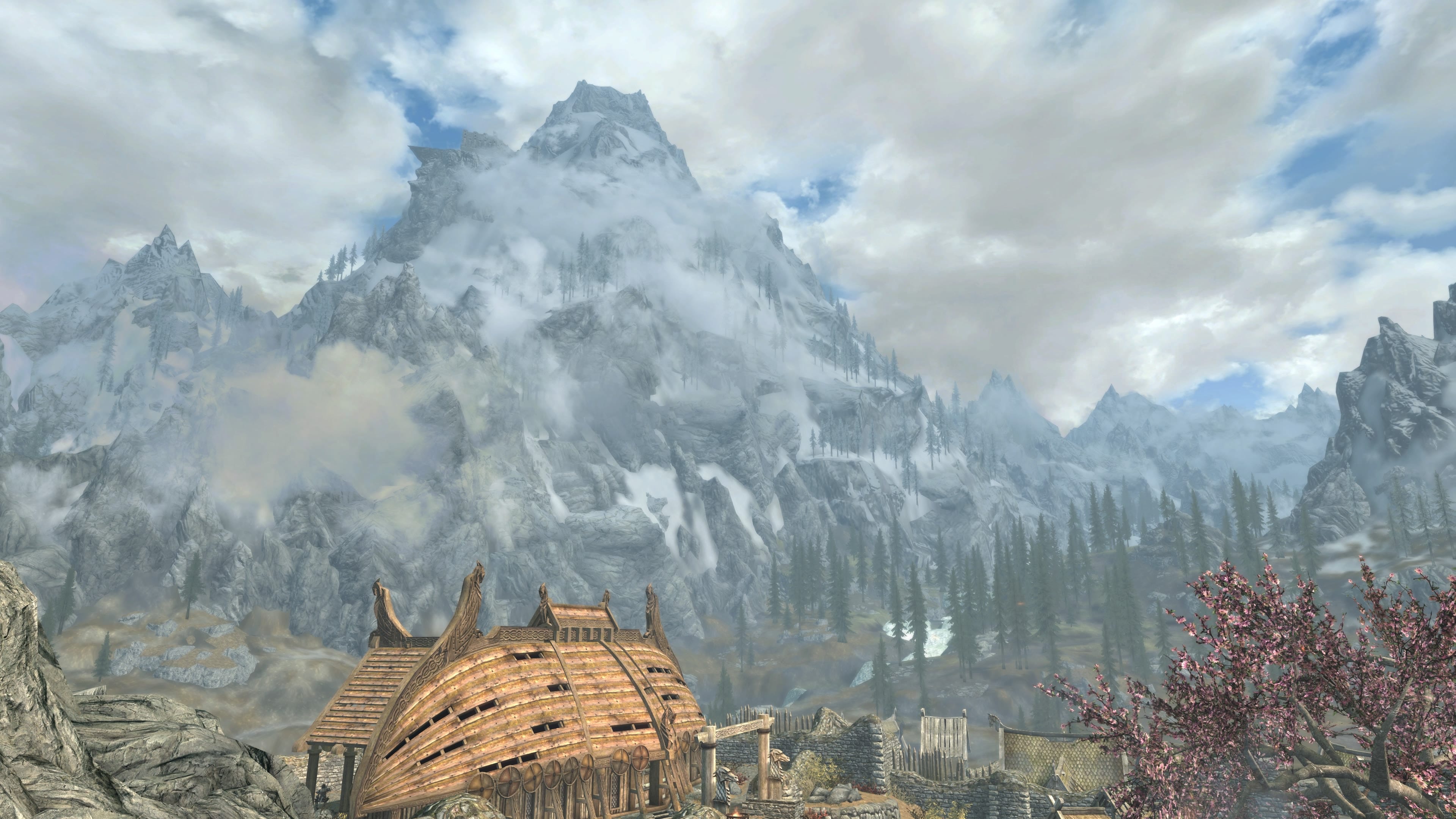
The Elder Scrolls V: Skyrim is one of the classic games centered around an axis mundi. Skyrim is full of tall mountains, but the tallest mountain is the Throat of the World. This is not only a geographically central point; it is a sacred space. The ancient Greybeard order makes their home on its rocky peaks. There they practice the Way of the Voice.
The Throat of the World is a classic example of the Cosmic Mountain variant of the Cosmic Pillar archetype. Like all Cosmic Pillars, it centers the world and connects the profane to the sacred. But unlike some other types of Cosmic Pillar, the Cosmic Mountain has certain important features.
Cosmic Mountains are importantly mineral. They are natural and immovable. There is no threat of change. They are also incredibly tall, which makes them ideal locations for communing with the gods. Hence, mountains have long been conceived of as the home of the gods, or at least places to meet with them. Moses meets God on Sinai, the Greek gods dwell on Mount Olympus, and the Watchers of Jewish myth descended on Mount Hermon. Mountains are the meeting grounds of the divine.
In Skyrim, the idea that mountains are the abodes of gods is shown through the figure of Paarthurnax. This ancient dragon is the “deity” of the mountain. He dwells at the very peak of it, guarding knowledge of godlike power.
The Throat of the World serves an important symbolic function for Skyrim. It symbolizes the ascent from profane to the sacred. As an open world game, it is easy to get lost in “profane” pursuits—looting dungeons, fighting bandits, killing bears. But these profane activities primarily happen along a horizontal axis. The Throat of the World is a vertical axis, an area set apart from the profane concerns of everyday life. It is specially dedicated to plot-relevant events in the main quest.
To ascend the Throat, the player must embrace the Dragonborn’s divine powers. It is not enough to be good with a bow or a sword. The Dragonborn must master the Thu’um to dispel the winds guarding the peak. They must leave the profane behind and enter the sacred realm.
Thus, the Throat of the World is a Cosmic Mountain version of the axis mundi. It centers the world by elevating the player out of the profane world and into the sacred world of gods and dragons. This symbolizes the player character’s growth from being an ordinary, profane mortal to being a sacred Dragonborn.
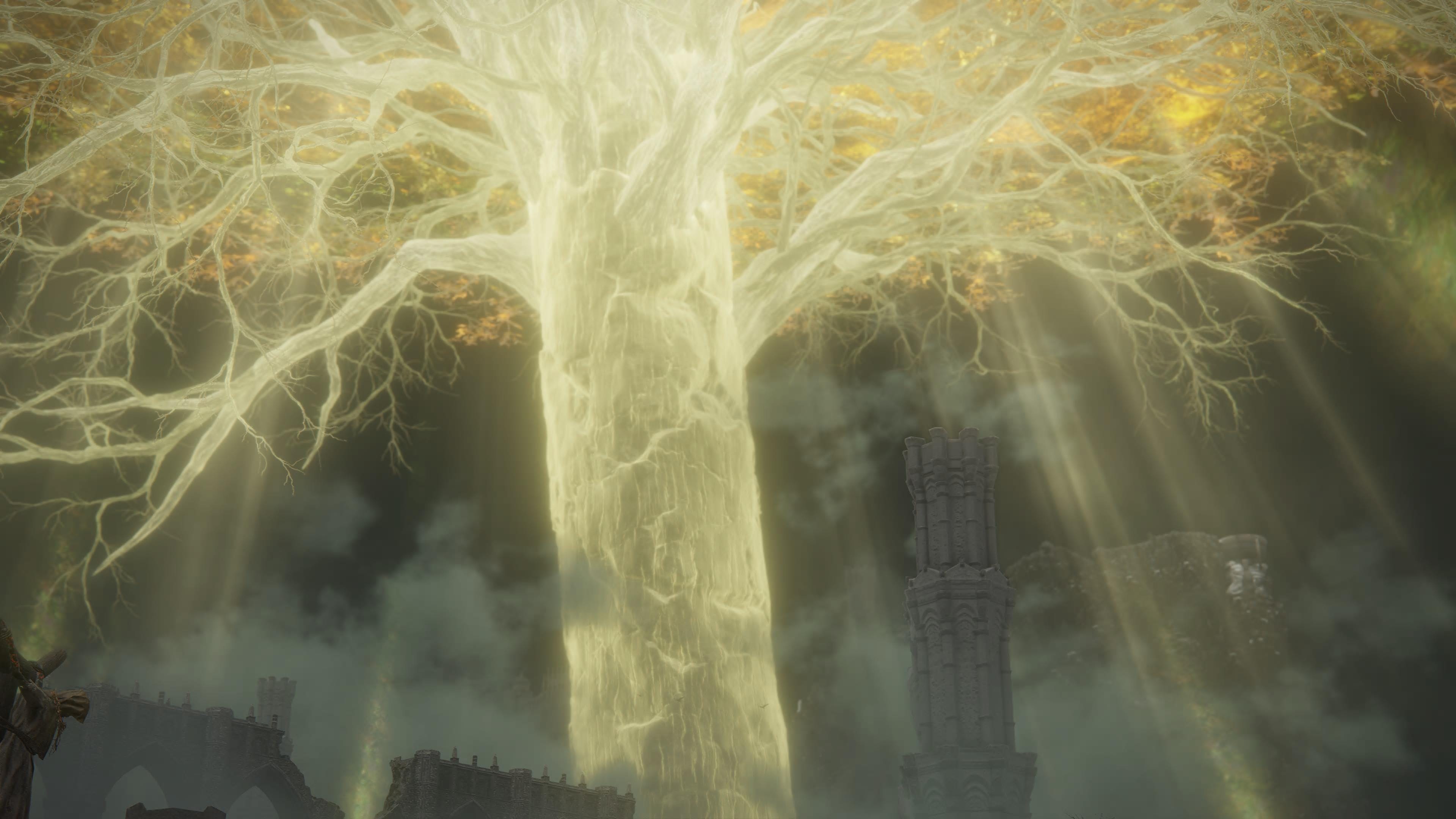
A more recent example of a game relying on an axis mundi is Elden Ring. The game is almost synonymous with the Erdtree, the giant glowing tree visible from nearly everywhere. This tree is yet another type of Cosmic Pillar.
Like Skyrim’s Throat of the World, the Erdtree is a link between the abode of the gods and the mortal races of the Lands Between. Divine beings like Marika, Godfrey, and Margit once made their home at the Erdtree.
But unlike the Throat of the World, the Erdtree has a much stronger connection to the Underworld. We see this in the concept of the “Erdtree Burial.” The heroic dead were interred in tombs where their bodies would gradually be absorbed by the Erdtree’s roots. In time, they would be reborn with the Erdtree’s dew, the Lands Between’s own version of samsara.3
The reason for this stronger connection to the Underworld has to do with the fact the Erdtree is a World-Tree variant of the Cosmic Pillar. Unlike Cosmic Mountains, which are static and unchanging, World-Trees are cyclical. They change with the rhythm of the seasons. Trees “die” in winter and are reborn in the spring. The cycle of the World-Tree mimics the cycle of life and death, destruction and renewal. Thus, World-Trees not only have a connection to life-giving power, but also death.
The two obvious World-Trees in historical religions are Yggdrasil and the Biblical Tree of Life. Both of these trees have profound connections to life and death. Yggdrasil is the foundation of the Norse cosmos, connecting the various realms—including the realm of the dead. The Tree of Life in the Bible is the source of eternal life. Those who have access to the Tree will live indefinitely; those who lose access are doomed to die.
The Erdtree plays on both of these concepts to explore one of Fromsoftware’s favorite themes: Stagnation. Like all World-Trees, the Erdtree was meant to go through cycles of rebirth. This would have signaled the changing of the political order.4 But Marika prevented the Erdtree’s renewal by destroying the possibility of its death.
Marika evidently hoped removing the Rune of Destined Death from the Elden Ring would preserve her reign. Instead, the Erdtree stagnated, entering a state between life and death. Its life-giving power ceased. Undeath spread throughout the Lands Between. Without the Erdtree’s cycle of rebirth, the cosmos could not be renewed. Neither could Queen Marika’s regime.
The game’s solution to the problem of stagnation is purification. For the cosmos to be reborn, the Erdtree must die. The World-Tree’s stagnation must be purged by fire. This is not a permanent death, but it will restore the concept of death that Marika removed, enabling the World-Tree symbol to operate properly.
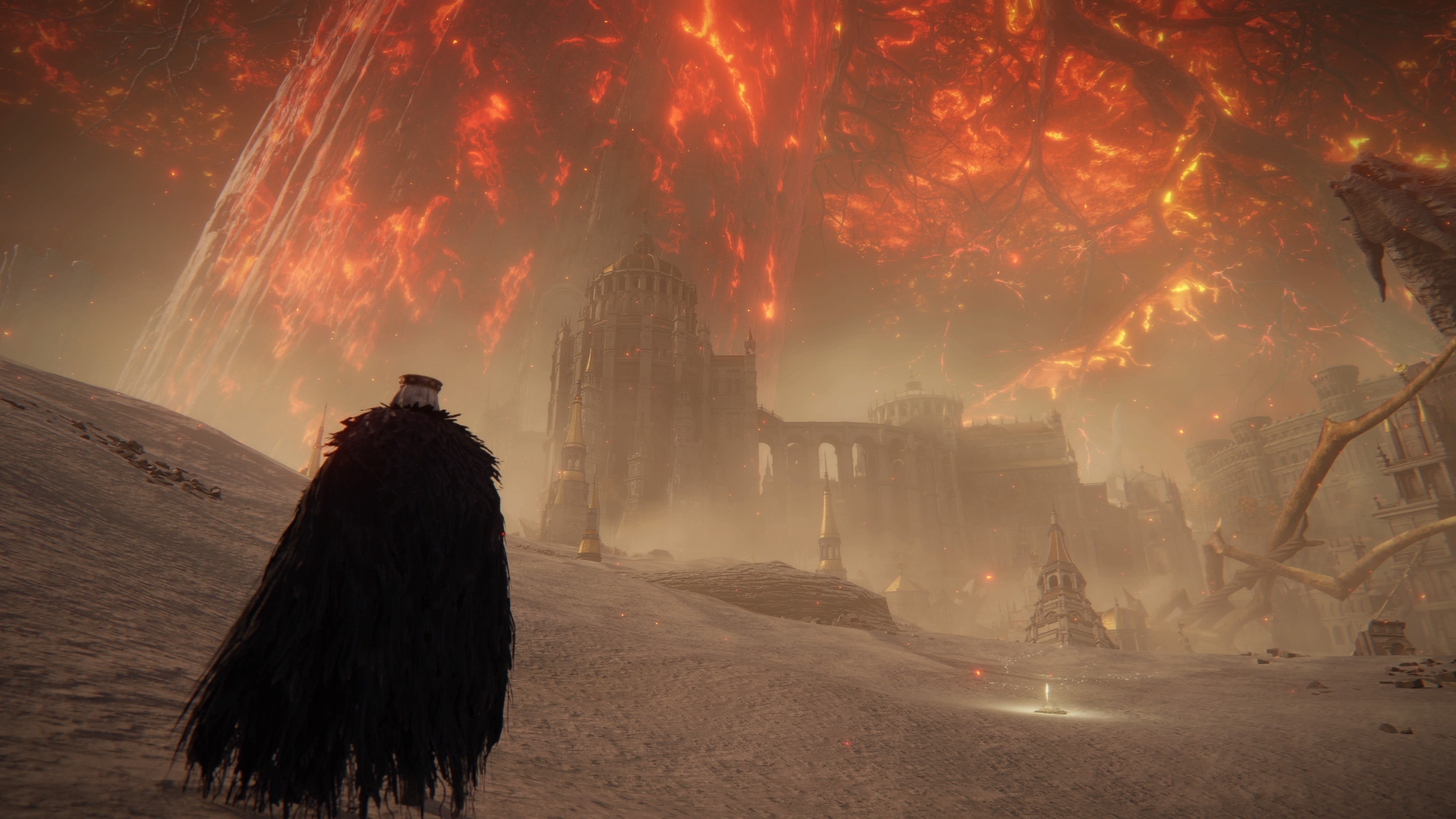
Elden Ring thus provides a unique spin on the concept of the axis mundi. Miyazaki uses it not only as a means of orienting the world, but as a symbol of what is wrong with the world. The whole story of the game is contained in this one place—a masterpiece of spatial narrative.
I intend to write a longer treatment of sacred space in Elden Ring, but this will do for now.
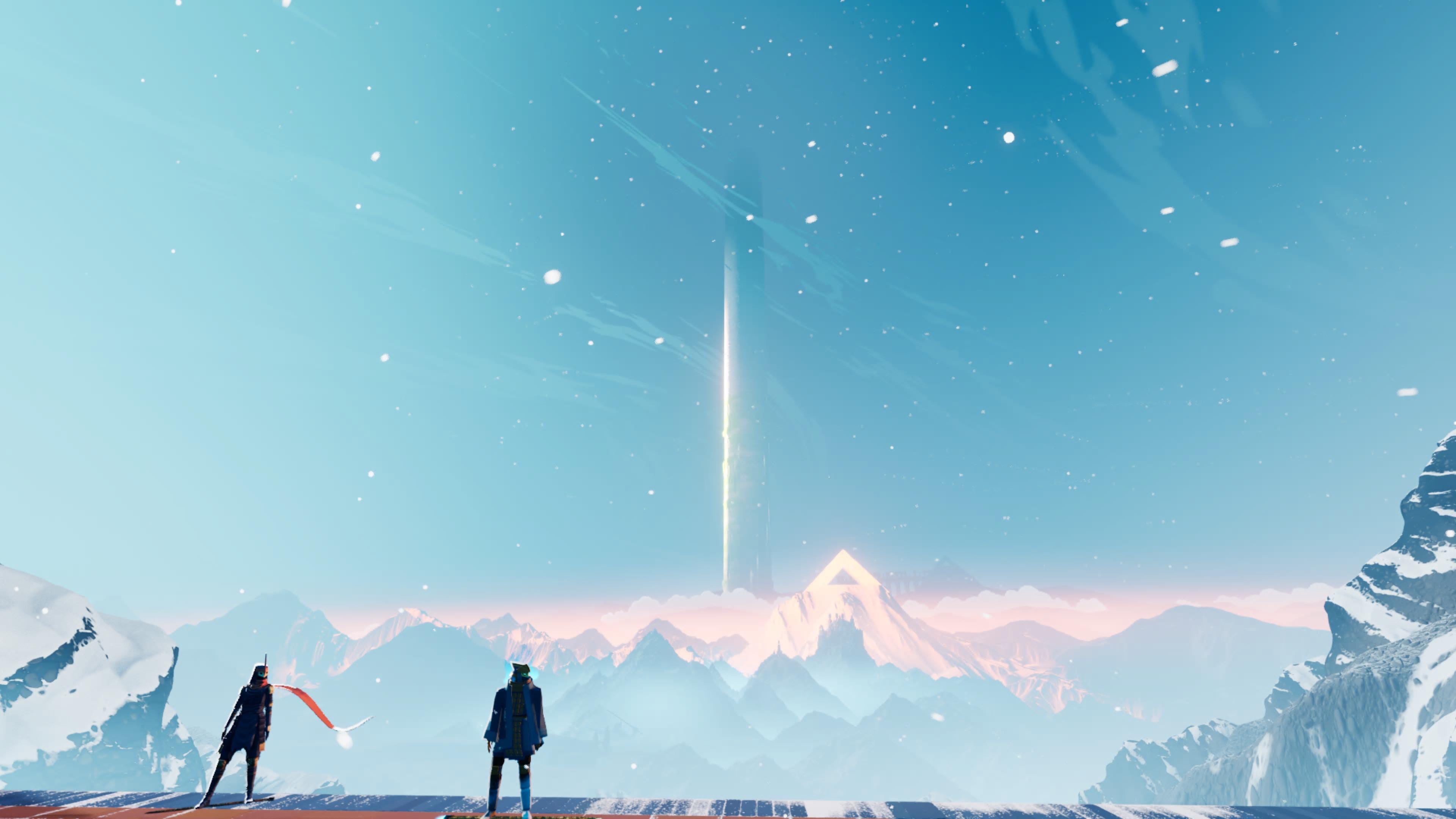
The last example of an axis mundi I will show comes from Sword of the Sea. This is a much simpler game than Skyrim or Elden Ring, but it is nonetheless an interesting case. It shows how even non-open world games can use an axis mundi to great effect.
Sword of the Sea is a game about renewing an ocean world destroyed by a cataclysmic battle of the gods. The player character must surf through the ruins, unlocking sources of water and bringing life back to the desert.
Its version of the axis mundi is a vast Tower stretching all the way to the heavens. It is a literal Cosmic Pillar, a central point that founds the world. The player spends the whole game making progress toward it. Here is where the whole quest culminates; here is where the entire cosmos can be renewed to its former glory.
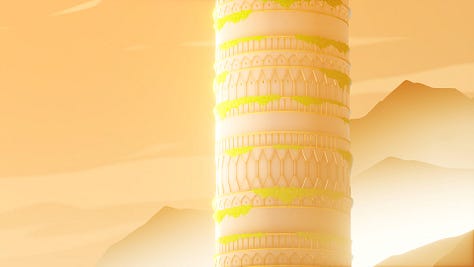
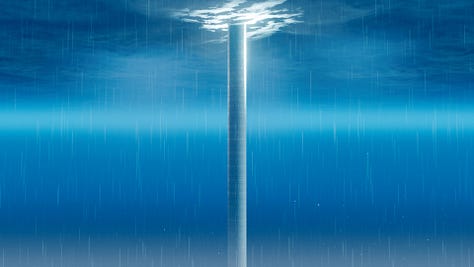
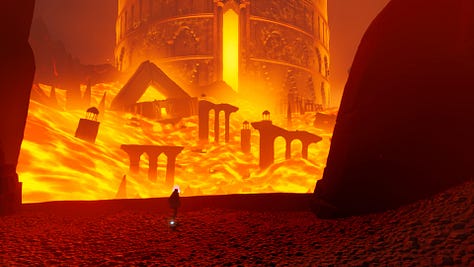
Unlike Skyrim’s Cosmic Mountain and Elden Ring’s World-Tree, Sword of the Sea’s Cosmic Pillar is constructed. What makes it an axis mundi, not just another building, is that it was built by the gods. It therefore has a connection to the sacred realm that lesser buildings do not have.
The fact that the axis mundi is a building plays into the game’s core theme of renewal. Mountains do not need renewal, and trees renew themselves. But ruins must be rebuilt. That’s why the player is important: It is their responsibility to restore what was broken.
Eliade is one of my favorite thinkers for a reason. I think his theories of symbolism and religious experience hold up, despite widespread criticism. However, his theory of the axis mundi could use a bit of tweaking.
For all its utility, the axis mundi concept seems to struggle with accounting for multiple sacred places. There can only be one “center of the world” at a time, but this is hardly ever true. Just think about Christianity. Many places could qualify as Christianity’s axis mundi—Calvary, Mt. Sinai, Mt. Zion, Eden, etc.
To account for this plurality, I re-theorized the axis mundi as what I call “cosmic sources.” A cosmic source is like an axis mundi, but it does not exclusively bear the world-making power of the sacred. There can be many cosmic sources, or just one.
I think cosmic sources make better sense of video games, too. While the Throat of the World has a strong claim to being the central point of Skyrim’s world, there are other places that can fit that claim. After all, the Dragonborn goes to Skuldafn in order to reach the afterlife. It makes more sense to say both the Throat of the World and Skuldafn are cosmic sources than that the game has a single axis mundi.
Cosmic sources are an incredibly useful tool in game design, especially for open world games. The problem with most open world designs is that they are de-centered. Everything feels the same. Cosmic sources fix this by anchoring the world around points of significance—places that “found the cosmos.” If a player ever wonders where they are supposed to go, they can just walk in the direction of the giant glowing tree.
My re-theorizing of the axis mundi is very slight, however. The core concept of Eliade is still right: Sacred spaces provide a center to reality that grounds our experiences.
Whatever else religion is, it is about space. It divides our experience of space between the sacred and the profane. It organizes our experiences by giving us a center point that acts as the world’s foundation, what Eliade called an axis mundi.
These central places unlock the symbolic infrastructure that creates our world. Everything orbits around them. The desert matters because of how close it is to the mountain, and the mountain matters because that is where we go to meet God. This is the religious logic that imbues our environment with meaning beyond day-to-day survival.
Video games, perhaps uniquely in media, let us play with sacred space. Game designers can create different organizations of space with different religious symbols. Whether they use a Cosmic Mountain, a World-Tree, or some other kind of Cosmic Pillar, they can present us with a vision of what the world might look like if something else were sacred.
This is a valuable exercise for no other reason than that it forces us to ask what we consider sacred. What is our axis mundi? Do we even have one? What gives meaning to our spaces beyond the daily grind?
If you cannot answer those questions, then it might be a sign that you are trapped in the profane. Perhaps it is time to turn the mind to higher things.
See The Sacred the Profane for his full exposition of this concept.
Michael Nitsche talks about this topic very briefly in Video Game Spaces: Image, Play, and Structure in 3D Worlds. The topic deserves deeper treatment.
I cannot remember which lore hunter first made this connection—it may have been SmoughTown, who I strongly recommend.
This observation is not original to me, but as far as I know, situating it in the context of Eliade is.
Comments
Nothing yet. Say the first thing.
Sign in to join the conversation.