
In 1985, Neil Postman published his now-classic text Amusing Ourselves to Death: Public Discourse in the Age of Show Business. His argument was essentially that the pervasive influence of television entertainment had warped public discourse. TV, by its very nature, incentivizes turning everything into show business—politics, religion, journalism, and more.
In 2026, Postman’s argument has to grapple with a new medium: Video games. Today, virtually everything is a video game. Politics, sports, art, religion, and journalism are all mediated through interactive technology. The contemporary audience is a participant, not a passive consumer of information, as in Postman’s day.
My thesis here is something like Postman’s: The proliferation of AI, prediction markets, and gamified designs have created a trend of absolute gamification1 that is changing life and culture.
Gamification is the practice of turning some activity into a game. It’s nothing new. What is new is the scale and pace of gamification. Today, gamification is totalizing, comprehensive, and irresistible—in a word, absolute.
The absolute nature of contemporary gamification has the consequence of forcing every sphere of culture into the mold of video games. That is, everything has to be interactive, engaging, and designed around a gameplay loop. This is transforming vast parts of our culture in ways we have yet to reckon with.
Too few are grappling with the consequences of absolute gamification on our world. This post is meant to briefly introduce the topic and hopefully inspire conversation about it.
I described absolute gamification as totalizing, comprehensive, and irresistible. It is totalizing because it seeks to unite diverse domains of human experience. It is comprehensive because it tries to subsume every aspect of an activity into the game. And it is irresistible because once the game is established, it is nearly impossible to dislodge. What follows are three examples of absolute gamification at work.
The earliest example of absolute gamification actually predates the internet: Education.
It is easy to forget that the education sector is the oldest and most thoroughly gamified sphere of culture. The goal of education is learning. However, to facilitate learning, educators constructed a game around it: Grades, credit hours, degree plans, GPA, etc. These systems subtly altered what it means to be educated. Now, the goal is more about maintaining a 4.0 GPA than actually learning.
Thus, the game of education has entirely subsumed the practice of education. Diverse domains of study—physics, literature, mathematics, history, and more—are all united under a single scoring system. The grading system is how we sort the winners from the losers.

Reality is not always as cut and dry as the numbers suggest. Some geniuses have low GPAs. Many 4.0 students are not that bright. However, someone is likely to judge the 4.0 student as smarter. Why? For no other reason than that she scored higher in the game of education. Her actual command of the subject matter is secondary to her ability to play the game.
Education is thus an example of absolute gamification at work. It is a sphere of culture where the actual activity—learning—has been comprehensively subsumed into a game. This is not automatically a bad thing. When the game of education and the act of learning are aligned, the game supports the activity. But when they are not aligned, such as in cases of grade inflation, the game becomes parasitic on the activity itself.
Despite the parasitic nature of absolute gamification, no one is ever going to quit the game. No one would take a school seriously if it did not give grades. The game of education has become irresistible: If you want to educate, you have to play it.
Education is thus one prominent example of absolute gamification. It is a sphere of culture where a game has so thoroughly subsumed it that we cannot imagine it without the game.
Prediction markets are another alarming example of absolute gamification. Increasingly, politics and current events are being swallowed by these platforms and their games. Platforms like Polymarket allow users to bet on the outcome of the U.S.—Iran War. Right now, Kalshi will let users bet on whether Kash Patel will be fired. Even Substack has gotten in on the game, allowing users to embed prediction markets directly into posts, like so:
Technically, prediction markets are just an evolution of another very old game: The stock market. But unlike the stock exchange, which gamified buying and selling companies, these platforms gamify current events themselves.
Turning history into a game of chance is rife with problems. What happens when politicians, journalists, and key decision makers are more interested in playing Polymarket than making responsible decisions? Imagine going to war, raising taxes, or deciding school policy on the basis of prediction markets.2 Imagine reporting some stories and not others to slant the odds in your favor. Imagine CEOs making improbable decisions not in stakeholders’ interests, but because it profits them to act erratically.
Prediction markets turn history into an interactive medium. Anyone who wants to place a bet can. And like any good game, it rewards the winners for playing well, thus inviting more play, sustaining the gameplay loop. In the process, it also misaligns the incentives for key players. For they know that their unique position allows them to play the game like no one else.
The absolute gamification of current events is a catastrophe because it distracts from the significance of the events themselves. Serious matters deserve recognition in their own right. Hijacking them with a game blurs the matter at hand, making it hard for decision makers to see past the game. And like all states of absolute gamification, once the game is sufficiently embedded, it is nearly impossible to dislodge.
Prediction markets are not yet so thoroughly embedded as the education system. However, it is not impossible to imagine a world where public discourse, policy, and prediction markets are so thoroughly intertwined that it is easy to mistake playing the game for doing the activity. Hopefully, the problem will never progress that far, but prediction markets are still an example of absolute gamification in its early stages. They comprehensively subsume an activity into a gamified system.
However, both the education sector and prediction markets pale in comparison to the rise of artificial intelligence. This technology is what has accelerated the scale and pace of gamification to new heights.
AI is the interactive technology par excellence. It is engaging, interactive, and designed to keep the user in the loop. And unlike other games, it is infinitely versatile. AI can have a conversation about virtually any topic and can create almost anything the user can imagine.
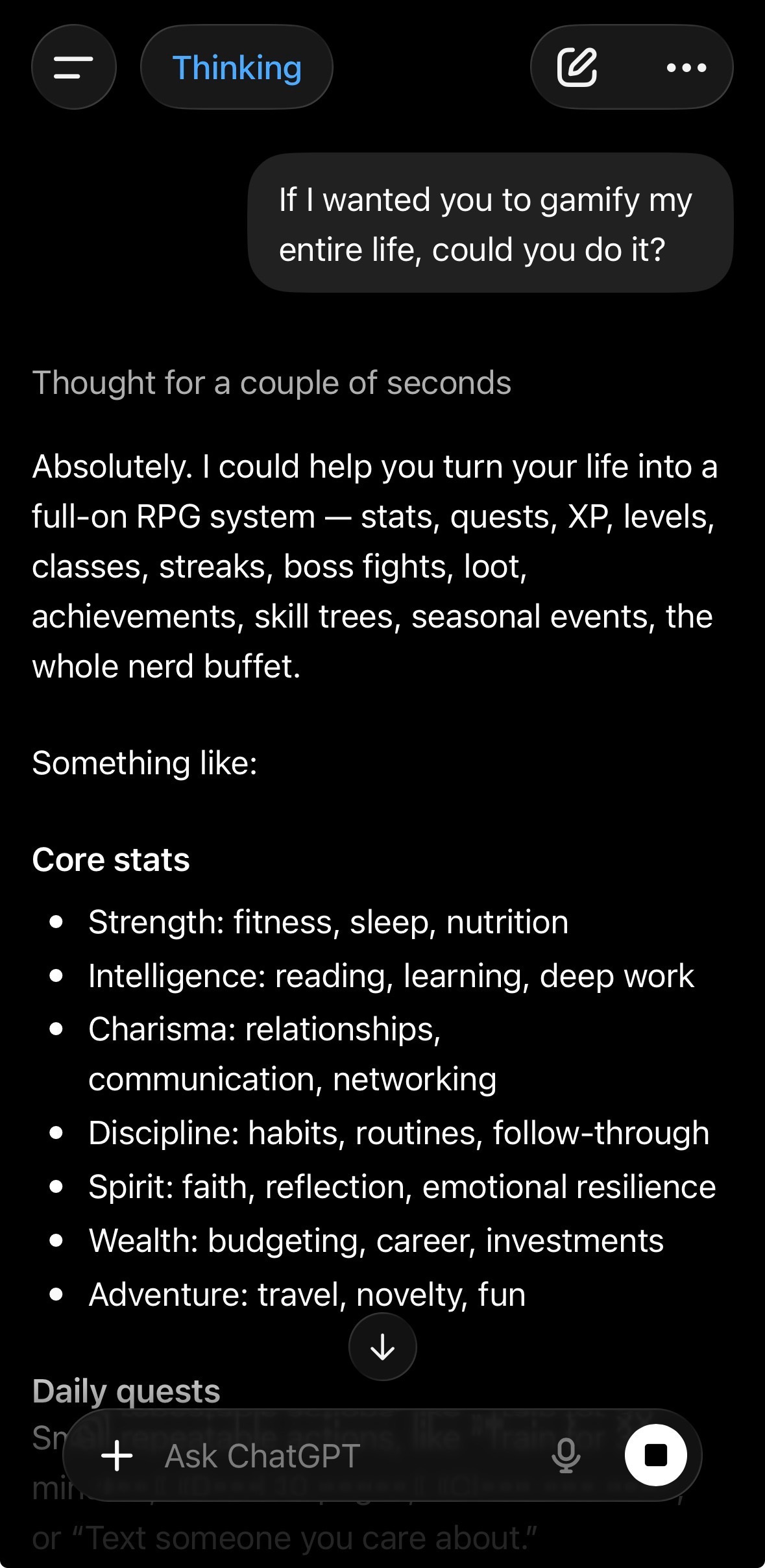
The sheer versatility of AI means it is totalizing in a way few technologies are. AI can unite countless domains of experience—personal finance, healthcare, relationships, personal education, artistic endeavors, business, etc. The more information the user feeds it, the more comprehensive the AI’s game becomes. And the more a person’s life is built around AI, the harder it becomes to stop using the tools.
AI media production tools are also making it possible to do things previously were only possible in video games. Deepfakes are one example of this. Now, AI can digitally impose a “skin” over your own video to let you “play” as fictional characters, even in real photos. Alternatively, it is easier than ever to transport yourself into a fictional narrative.



We are also witnessing the rise of a whole class of legitimate NPCs, the AI agents that will increasingly populate our world. These NPCs fill roles like Customer Service, screening our calls, doing basic data analysis, some forms of therapy, coding, and dozens of other tasks formerly constrained to humans.
The proliferation of these AI-features makes our world more and more resemble a video game. The individual is a customizable player-character in a world filled with AI NPCs. As these conditions advance, the world as a whole will enter a state of absolute gamification. Everything from identity to dating to career to spirituality will become a video game. The medium is that versatile.
Beyond versatility, AI also can process information at a pace and scale previously unheard of. This enables the creation of super-games: Multiple games strung together. All the little games, like education, finance, gambling, and so on become linked together under the singular interactive system.
On a personal level, super-games can emerge when AI power-users essentially upload their whole life and use it to optimize their routines. The “Claude Boys” phenomenon is a good extreme example—boys who outsource all of their decision making to Claude.3 But even users not so committed can become absorbed in super-games, sometimes unwillingly. The employee who uses AI for different aspects of his job is essentially constructing a super-game around his career.
The macro scale, however, is where super-games become truly dangerous. Big Data, and now AI, has made it possible to connect vast swaths of public life. For example, think of how many spheres of activity are now mediated through interactive media. The same person files taxes through TurboTax, dates on Hinge, applies to jobs through Workday, buys groceries through Instacart, and keeps up with friends on X. All of these are games, interactive media systems designed to smooth over the difficult parts of life. And all of them can be connected into a super-game by AI.
Whoever sits at the center of the super-game has immense power. Individuals like Zuckerburg, Bezos, Altman, and Amodei are so wealthy because they control the infrastructure that makes these games possible. They sit at the center of networks where multiple games come together. Jeff Bezos, for example, sits at the intersection of shopping, reading, and web development. He created interactive media systems for each of these, then tied them together—Kindle for reading, Amazon.com for shopping, and AWS for tying them together with others into a super-game. This has allowed Amazon unprecedented power over the book market.
As AI makes it easier to gamify aspects of life and even easier to tie these games into super-games, it is at risk of absolute gamification on an incredible scale. Whoever controls this game will have unrivalled power to surveil and coerce individuals.4
You may be wondering, “But is it such a bad thing if everything is gamified?” After all, there are lots of cases where gamification makes it easier to do something.
I am not going to categorically say gamification is altogether bad, but I do want to offer some tools for judging good gamification from bad. Those tools are parallel and perpendicular games.
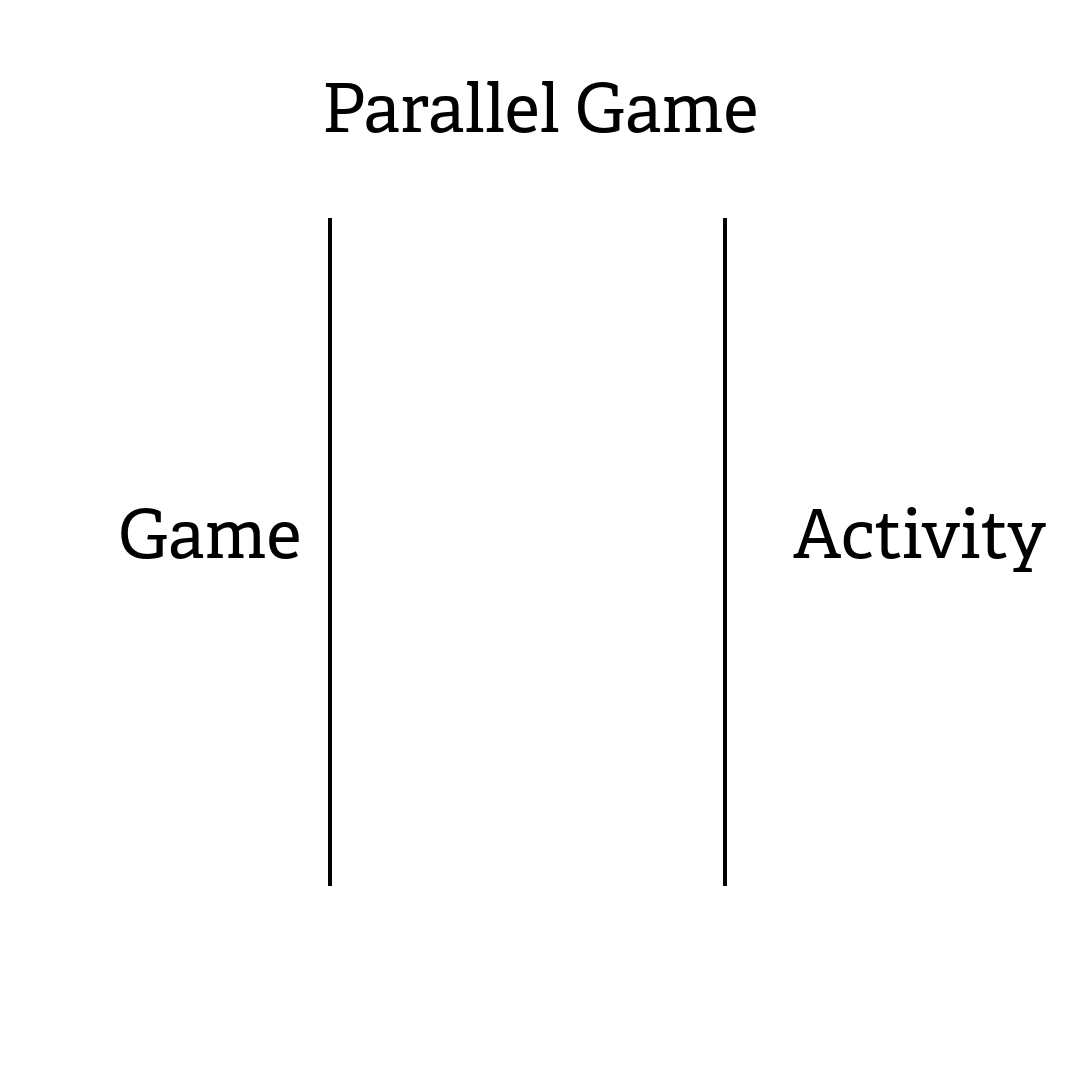
A parallel game is a game that supports the activity it is designed around. It interacts with the activity in a virtuous cycle, aligning player incentives with the goal of the activity. The game is “moving in the same direction,” as it were, with the activity itself.
Grading, when not driven up by inflation, is a great example of a parallel game. Grades incentivize students to learn because it gives them a symbolic representation of their mastery. They know how well they are doing through their grades. Grading, then, is a good example of a game system that supports its associated activity: Learning.
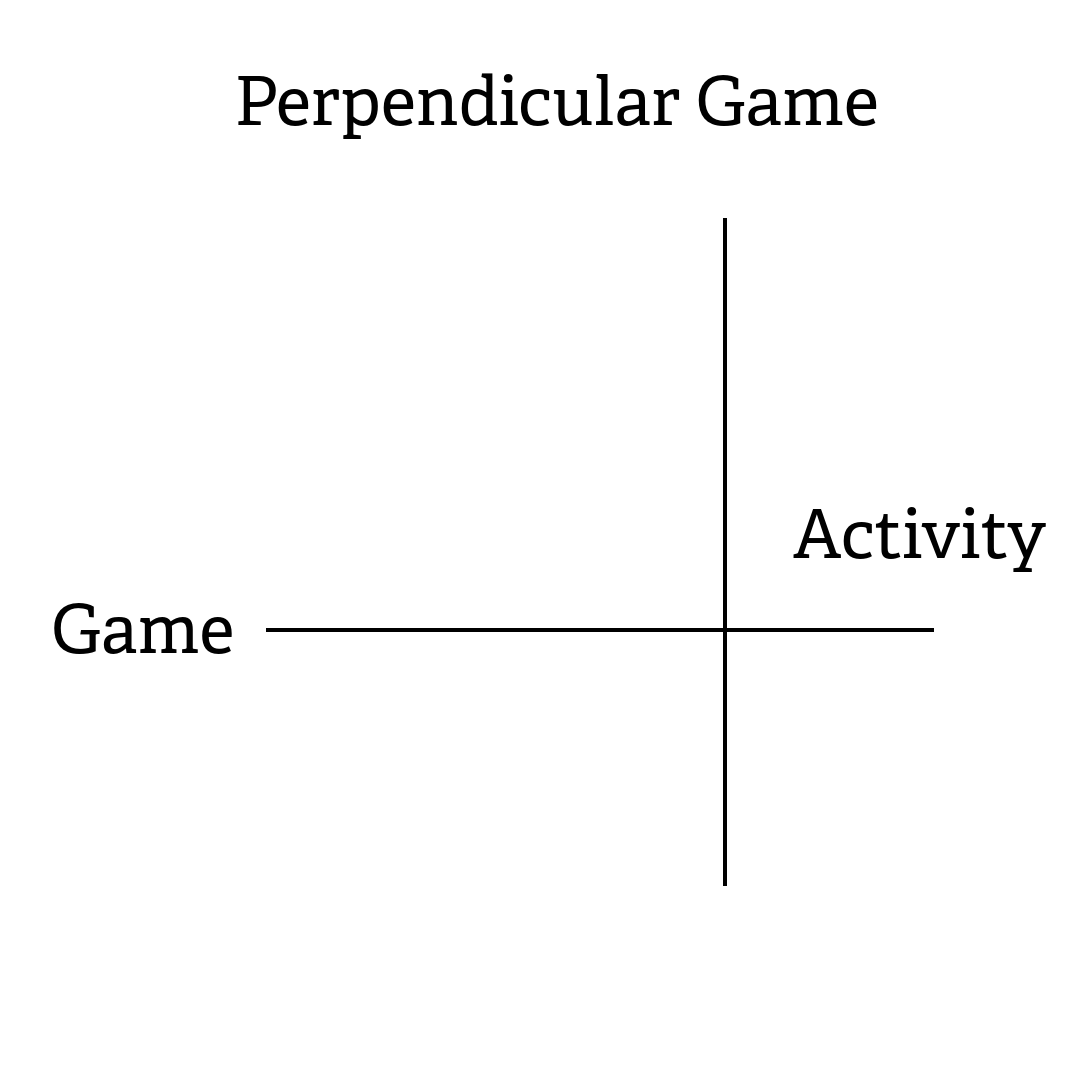
But not all games are equally virtuous. The opposite of a parallel game is a perpendicular game, a game that is at cross purposes with the activity it seeks to gamify. These games are parasitic on their associated activity. Instead of helping players better perform the activity, they distract from it. Indeed, they might even make players worse.
The business world is rife with perpendicular games. Think of all the privately owned businesses that, once they become public corporations, suddenly go downhill. Often, the need to raise shareholder value drives executives to make decisions that look good to investors but are in fact bad for the business. This happens when the game of the stock market (selling stocks at a higher price than you bought them) is perpendicular to the activity of the business (excelling at providing a good product or service). Winning the game means draining the activity of value.
In the video game industry, the perpendicular game of stock performance often drives shallower, safer video game designs. It makes video games uninteresting to appeal to the broadest possible player base, which shareholders believe will produce the largest return on investment. But this logic is parasitic on what video games are actually about: Playing with fun and unexpected ideas! Winning the “game” of shareholder value often produces worse play.
These examples are not absolute. As noted, grading can become a perpendicular game, and the stock market has been a parallel game for many companies. But that is what is so dangerous about gamification. Even well-designed systems can drift, ultimately becoming parasitic on what they were meant to support.
If the trend of absolute gamification continues, we should ask ourselves what kind of game our culture is becoming. Is our world becoming a world of parallel games, where every activity has a commensurate game to support it? Or is it a world of perpendicular games, where gamified systems drain value from every activity? And to answer those questions, we need to ask another: Who is designing these games and are their interests aligned with ours?
I have tried to be nuanced about the impacts of absolute gamification, pointing out benefits as well as drawbacks, but there is one aspect that I think is an unqualified negative: The demise of the “magic circle.”
The Magic Circle is an important term used in Game Studies to describe the boundary line between the world of the game and the external world. It has roots in the work of Johan Huizinga, but it was developed by later theorists like Eric Zimmerman.5
When players enter a game, there is a certain sense in which they leave the “real world” behind. This is not unlike the literary concept of the Willing Suspension of Disbelief. Just like a reader suspends their understanding of reality to accommodate a narrative, the player temporarily adopts the rules of the game. They temporarily occupy another world, functioning according to assumptions about reality.
The Magic Circle has never been an absolute boundary, but it has historically been a real one, and that matters. It matters because games give players an opportunity to briefly step outside of the assumptions of real life. They create an imagined space from which it is possible to see the world through different values, different beliefs—a different worldview.
By exploring different Magic Circles, the player expands their ability to imagine different ways the world could be.6 What does it look like if the world is governed by another set of values? What would it look like if monarchy was the only legitimate form of government, for example? What are the consequences of a world built entirely on lies? Games can expand our ability to think about questions like these.
The danger of absolute gamification is that it merges the real world with the game world, thus destroying the Magic Circle. The player loses the distance necessary to appreciate and critique the actual world. There is no escape from the game, so there is no opportunity to step outside of it and imagine a better one. This is a genuine loss.
One might draw an analogy between absolute gamification and Plato’s Cave. In the Republic, Plato describes the ordinary world as like being chained to a cave wall. The prisoners can only see shadows cast on the wall, so they mistakenly assume that the shadow of a thing is the thing itself.
The philosopher is one who escapes the cave. He goes outside and sees the things themselves—actual trees, actual animals, and crucially the sun. Only then does the philosopher understand the unreality of the cave’s shadows.
Absolute gamification is essentially the cave swallowing the real world. It destroys the distinction between the shadows and the things themselves, between the game and the game’s adjoining activity. It thus keeps prisoners trapped, at the mercy of those controlling which shadows are cast against the wall. I think anyone can understand how dangerous that is.
The proliferation interactive media has created a trend toward absolute gamification, in which spheres of culture are captured entirely by game systems. Although the trend of absolute gamification began before AI, the rise of technologies like AI and the spread of prediction markets have accelerated the trend. Almost everything is mediated through interactive technology.
The net effect of absolute gamification is that the world begins to resemble a video game. The individual is a customizable character. Once-human roles are now occupied by AI NPCs. And people are being given different behavioral incentives, based on the rules of the game they now inhabit, rules decided by an elite few.
The cost of absolute gamification is immense. If this trend continues, we will increasingly have less ability to think about subjects on their own terms. We will be forced to confront big questions about politics, religion, and culture through the lenses the games imposed on them, rather than how they show themselves.
There is a lot more to say on this subject. However, I hope everyone will begin thinking about how to adapt to this changing reality.
P.S.— This post is unlike my usual content. However, I am launching another Substack dedicated to more general media analysis. It will feature more content like this. If you are interested, stay tuned.
Note on style: I am trying bolding/italicizing key terms to make them easier to identify. Please do not mistake this for AI-generated copy. I do not use AI to draft my content.
Honestly, the Wikipedia article on this topic is quite good. I recommend it if you are interested in further exploring the topic.
I wrote my dissertation largely on how this impacts the moral imagination. I did not use the term magic circle exactly, but the general idea is still there.
Comments
Nothing yet. Say the first thing.
Sign in to join the conversation.