
I was trained in Germany, in a tradition that took Paul very seriously and read him with enormous care. I worked through the letters backward and forward. And when I finally sat down to write the first chapter of Christ and Empire, I found that the research was overturning almost everything I had been taught.
This is not a comfortable thing for a theologian to admit in print. But I have come to think it is the single most useful place to begin, because the Paul I had inherited is the Paul most people have inherited. A Paul that is largely a fabrication of empire.
You know the one. A staunch conservative. Opposed to women in leadership. Preoccupied with regulating sex. Preaching a religion whose payoff is getting to heaven when you die. He is the reason a great many thoughtful people have quietly decided that they can love Jesus and skip Paul, and I understand the impulse. If that were the whole of him, I would skip him too.
The trouble is that this Paul cannot account for the most basic fact of Paul’s life: he kept getting arrested.
It may be obvious, but it helps structure everything else.
Paul wrote in and out of prison. He was, in his own accounting, a fool, weak, poor, homeless, and a victim of torture. He was eventually executed by the Roman state. Jesus, a generation earlier, was executed by the same state using a method that Rome reserved specifically for people it considered politically dangerous — not for thieves, not for the immoral, but for those who threatened the order of things.
Now hold that against a religion of personal morality and life after death. If Paul had been preaching that individuals should behave themselves and would go to heaven when they died, Rome would not have cared. Rome had no particular objection to that. Empires can absorb an enormous amount of private piety without losing a night’s sleep. In fact, they love that kind of piety because it keeps people compliant.
The usual explanation is that Rome misunderstood Paul and his mission. If they just knew the truth, they would know that the Christians were harmless and the persecution was a tragic error, a case of imperial paranoia meeting an inoffensive spiritual movement. I want to suggest the opposite. Rome understood exactly what it was looking at. The Romans were not stupid about power; it was the thing they were best at. When they identified Paul as a problem, they were reading him more accurately than most of his later interpreters have.
So what did they see?
Jesus is Lord.
This is the oldest Christian confession we have. It predates every book in the New Testament, including Paul’s own letters, and Paul is quoting it rather than inventing it. To our ears it sounds conservative, even reactionary. Lord evokes hierarchy, deference, submission. It sounds like presidents and CEOs and managers and the world’s first trillionaire.
But kyrios was not a vague religious honorific in the first century. It was an official title of the Roman emperor, and in the eastern part of the empire, where Christianity first took root, it was applied without ambiguity to the absolute monarch. Its use was growing precisely as the emperors’ power was growing, and increasingly it carried divine connotations alongside political ones. Caesar as lord meant a specific thing: top-down power, conquest, military violence, and an economy of patronage tilted permanently toward the wealthy.
So when Paul says Jesus is Lord, there are only two possibilities.
Either Jesus is Lord the way the emperor is Lord — which makes very little sense of a man who spent his life in and out of Roman custody. Or Jesus is Lord in a way completely unlike the emperor, which is a direct collision.
And notice that our modern escape hatch is unavailable. We would like to say that Jesus is Lord of the religious sphere and Caesar is lord of everything else. It’s tempting to find a tidy division of labor that lets everyone go home and give Thomas Jefferson an understanding nod. That distinction did not exist in Paul’s world. The separation of religion from politics, and of religion from economics, is a modern philosophical achievement, and reading it back into the first century is the single most effective way to render Paul harmless.
If you doubt this, run the test on the passage most often used to prove the opposite: Give to Caesar the things that are Caesar’s, and to God the things that are God’s. We hear a division: religion over here, taxes and politics over there. But ask a faithful Jew of that period what belongs to God, and the answer is not some things. The answer is everything. Which leaves precisely nothing for Caesar. The line is not a compromise. It is a joke, and the joke is at the emperor’s expense.
Here is where I want to complicate the story, because the point of rescuing Paul from the conservatives is not to hand him to the liberals.
A liberal would have avoided this fight.
Think about it practically. Paul had a hundred titles available to him. Prince of Peace. Lamb of God. Lover of Souls. Any of these would have communicated devotion, none would have caused offense, and all of them would have kept him out of jail. If your goal is to advance a religious movement without unnecessary friction, you simply do not reach for the emperor’s own vocabulary. You find something else, and you get on with the work.
Paul reached for it anyway. Repeatedly. And not only with lord.
Savior and salvation were what the emperor was said to provide. He put it on statues and coins. It was he who fed the people, secured the grain supply, and kept the peace. To call Jesus savior was not a devotional flourish; it was an announcement that provision and flourishing were going to come from somewhere else entirely.
Justice had an imperial iconography that we have inherited wholesale — Lady Justice with her blindfold, her sword, her scales, a claim to perfect neutrality that still stands over the entrances of American courthouses. The justice of the God of Exodus is not blindfolded. That God hears a specific cry, sees a specific misery, and takes a side.
Faith — pistis — did not primarily mean believing improbable things. It meant loyalty, allegiance, the pledge. Faith was a question about whom you were actually with. Caesar or Jesus. It was a question about this world.
And the cross, which is now jewelry, was an instrument of political terror. That the early Christians took the state’s own method of executing subversives and made it their emblem is a fact so strange that familiarity has entirely worn it smooth.
This is not accommodation to empire. It is not avoidance of empire either. It is a systematic occupation of the empire’s vocabulary, and it is why I say Paul is as radical as Jesus. Jesus’ mission was mostly in Galilee, at the margins of the imperial world. Paul was working in the belly of the beast, city by city.
Let me finish with the passage that convinced me, because it is the one everyone thinks they already understand.
First Corinthians 12. The church as a body, with many members. This is read at weddings and ordinations and denominational gatherings, and it is almost always understood as a plea for tolerance and mutual appreciation.
Paul did not invent the image. The body politic is an image of society as an organism, in which each part is in its proper place. It was a stock piece of Roman imperial rhetoric, and it was used to justify hierarchy. Some parts govern; some parts labor. Everyone should accept their function. Paul takes that image and turns it inside out.
Start with verse 21. The eye cannot say to the hand, “I have no need of you,” nor the head to the feet, “I have no need of you.” That is not a sentimental line. That is the class struggle of the empire, stated precisely: the top informing the bottom that it is not needed. Suppressed wages. People made superfluous. Labor treated as though it did not matter.
There are three ways to respond.
The conservative response is organic hierarchy. The head is above the feet. Conservatives know perfectly well that the head needs the feet, and they simply insist on the proper ordering.
The liberal response is organic harmony. We all need each other, so let’s get along. Let’s take the boss to lunch. If he doesn’t take me to lunch, I’ll take him.
Paul’s response is verse 22, and it is neither: the members of the body that seem to be weaker are indispensable.
Not also valuable. Not deserving of respect. Indispensable! They are that member without which nothing else functions. This is not a rearrangement of the body so that everyone feels better about the arrangement. It is a reshuffling from the bottom up.
Those of us who lived through the COVID pandemic have a word for this that we discovered and then, with remarkable speed, forgot. Essential workers. That is what Paul is describing, and it is why I want to press past the familiar language of a preferential option for the poor toward something more precise: a preferential option for the indispensable. For the people the empire cannot function without, and whom it therefore works very hard to keep invisible.
Then the conclusion, verse 26. If one member suffers, all suffer together with it. If one member is honored, all rejoice together.
The labor movement arrived at the same sentence by a different road: an injury to one is an injury to all. That is not a recipe for a pleasant congregation. It is a proposal for reorganizing the world, and it is why the empire was worried about Jesus, and about Paul, and about Mary before either of them.
The Roman Empire is gone, whatever certain people are currently attempting to revive. What is still here is the alternative: power rebuilt from the bottom up, not merely because people would like it that way, but because that is where God is at work. And what is most intriguing to me and seals the deal for why I think Paul is so important is that this is still happening today. We just need to unsee it, talk about it, and join in.
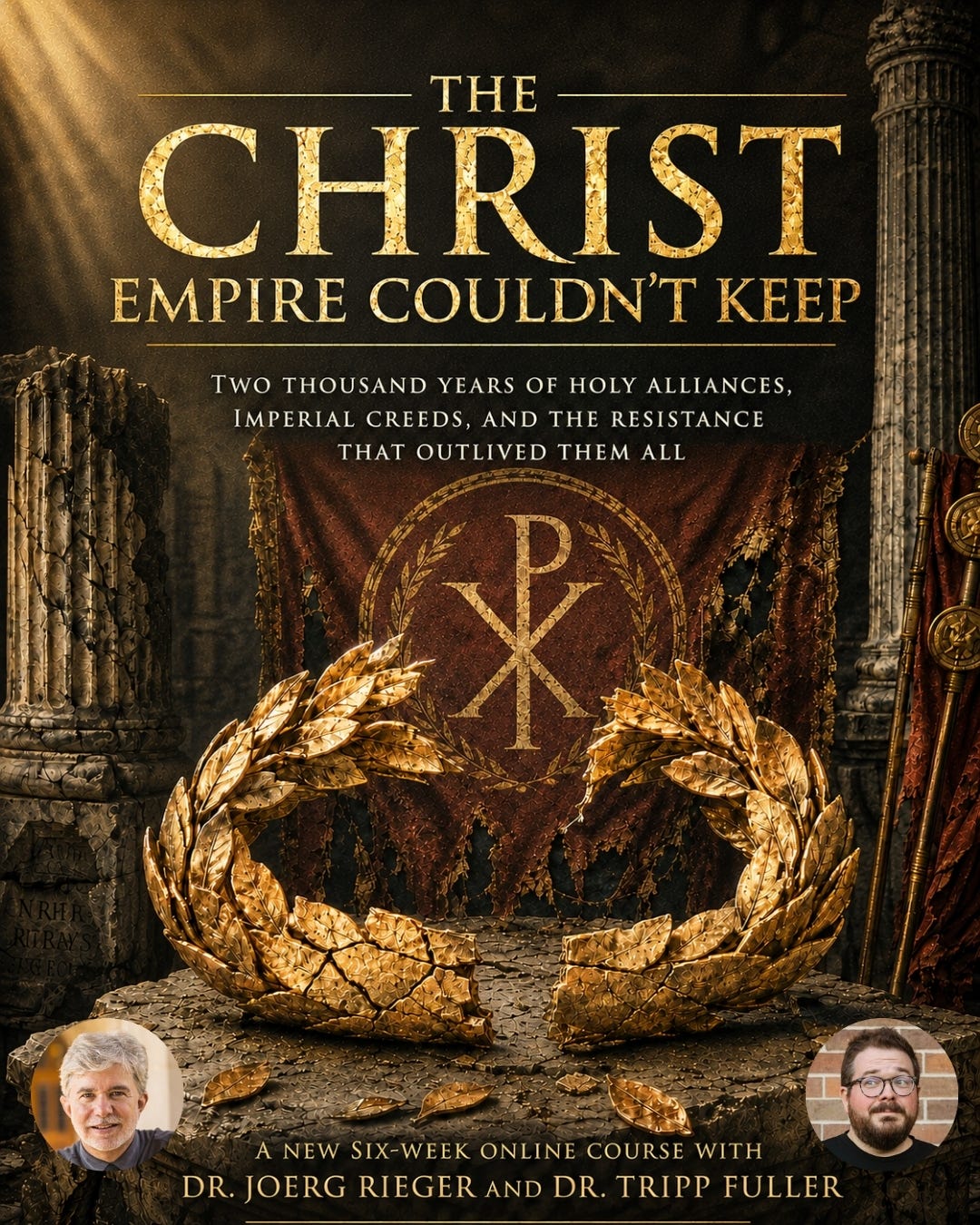
Ever notice how Christian nationalism gets talked about like it’s some bizarre new glitch in the faith? It isn’t — it’s a 2,000-year-old arrangement wearing new clothes, and once you see how the pattern works, you can also spot the Christ who keeps slipping free of it. Join theologian Joerg Rieger and Tripp Fuller for The Christ Empire Couldn’t Keep, a free six-week online class tracing the holy alliances, imperial creeds, and stubborn resistance that have shaped Christianity from Paul to the present.
6 Pre-Recorded Lectures - Joerg Rieger walks through one era of the Christ-and-empire story each week, drawn from his landmark book Christ and Empire: From Paul to Postcolonial Times.
6 Live Q&A Conversations - Bring your questions and think out loud with Joerg and Tripp, live each Thursday (replays if you can’t make it).
Read the Book Together
We move through Christ and Empire: From Paul to Postcolonial Times one era at a time, at a pace you can actually keep.
A Real Community - Join fellow pastors, seminarians, and curious troublemakers in the class group, with all replays on the Resource Page for at least a year.
It’s free to join, every session is recorded, and it kicks off Thursday, August 27th!
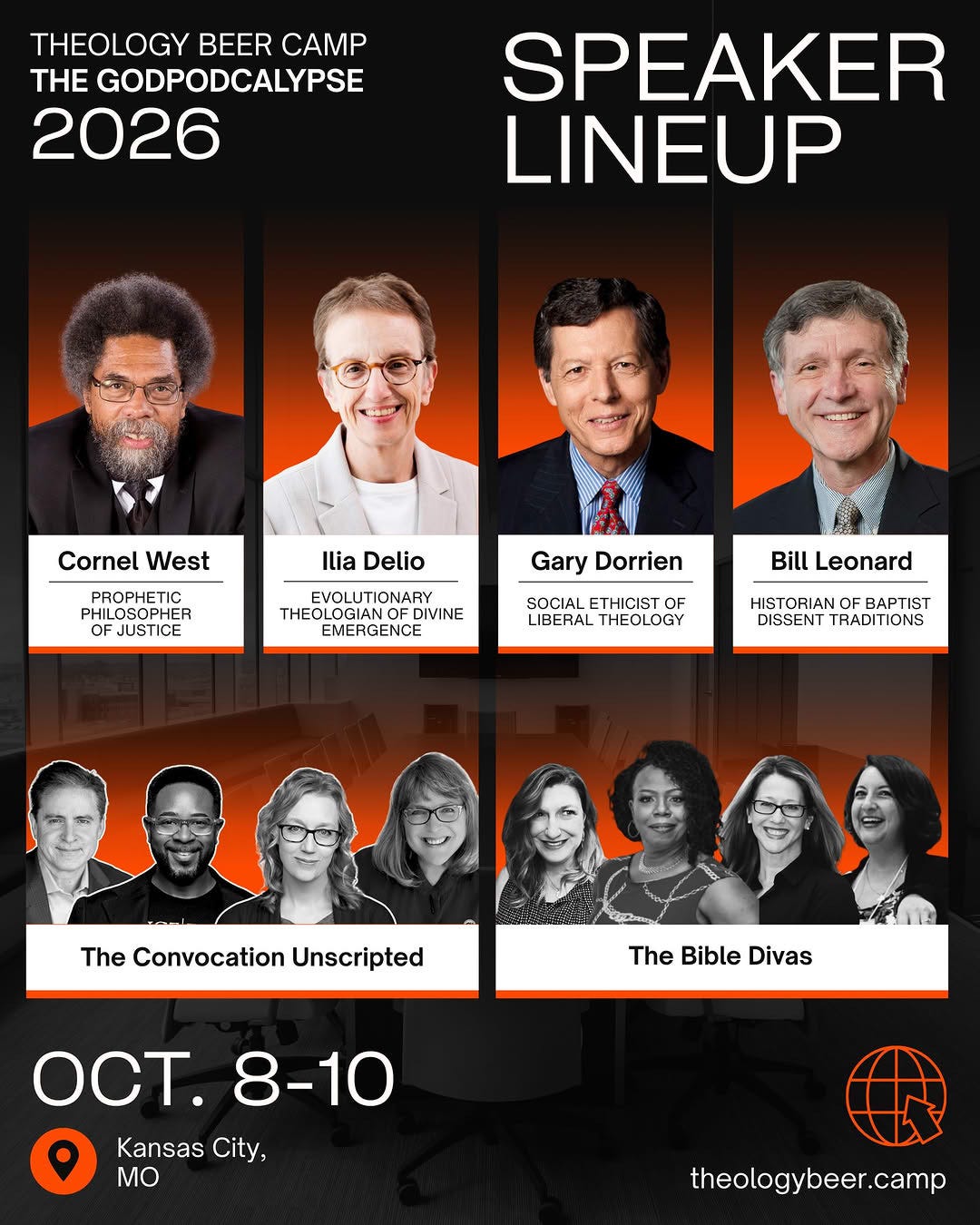
THEOLOGY BEER CAMP
October 8-10, 2026 - Kansas City, MO
Theology Beer Camp is a unique three-day conference that brings together of theology nerds and craft beer for a blend of intellectual engagement, community building, and fun. Organized by Homebrewed Christianity, this event features a lineup of well-known podcasters, scholars, and theology enthusiasts who come together to “nerd out” on theological topics while enjoying loads of fun activities.
We’re excited to share details about our Pre-Event experience. Think of it like a theological pre-game.
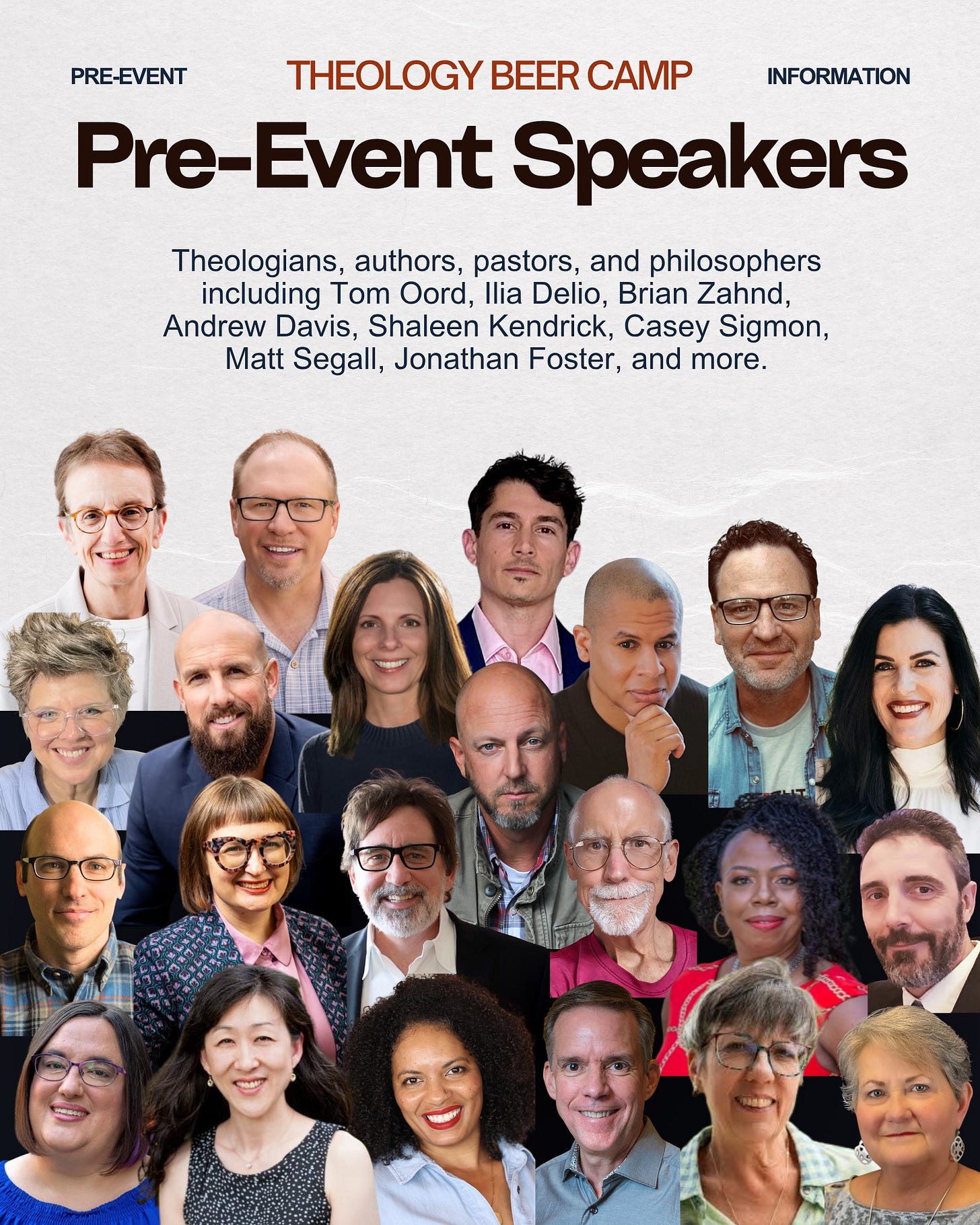
Led by Thomas Jay Oord and Jonathan Foster, we’re bringing you a fantastic lineup of scholars, authors, pastors, and practitioners. This workshop-style gathering is a focused deep dive into Open and Relational Theology before the main event begins.
Think of it as:
A relational head start on Beer Camp
A chance to explore ideas in greater depth
An opportunity to meet people and start building connections before the larger gathering begins
Topics include:
God and an evolving universe
Open and relational approaches to ministry
Theology centered on love and relationship
Process thought and contemporary spirituality
Faith, creativity, freedom, and the future
The Pre-Event takes place on October 8 from 9am–4pm and is available as an add-on registration.

Available for iOS and Android
Comments
Nothing yet. Say the first thing.
Sign in to join the conversation.