
Jamie Smith is a Reformed philosopher — one of the first to put a Catholic mystic in the title of a book and then proceed to argue that it was the contemplative tradition that brought him back to a flourishing form of faith on the far side of a series of nerdy dead ends. Make Your Home in the Luminous Dark is his most personal and, I would argue, most beautiful book. It began the day, more than a decade ago, when Jamie was in the depths of a severe depression his analytical philosophical training could not think its way out of, and his wife came home from a garage sale with a battered used copy of The Dark Night of the Soul and told him he should read it. What that began — St. John of the Cross, Teresa of Avila, Meister Eckhart, Merton — is what this book bears witness to. It is a book about the mystics saving Jamie’s faith. It is also a Reformed philosopher’s argument that the cultural liturgies project he is best known for needs a prior undoing before its formative work can do anything at all. As I told Jamie in the hour, this is a book that made me feel uncomfortable about how much I enjoyed it. We covered the apophatic/cataphatic distinction with the twist Jamie puts on it, the way certainty is still Cartesian even when it calls itself pious, the trad-wife/manosphere as snorting modernity while claiming to have escaped it, Charles Taylor’s Cosmic Connections as the real sequel to A Secular Age, and what to do when Distraction Inc. has fully occupied the inner room. The platform is the plantation. Come sit with this one and check out the book.
Highlights from the conversation
The garage-sale Dark Night of the Soul that started the book. Jamie’s decade-long journey into the Catholic contemplative tradition began when he was in the depths of a severe depression his analytical philosophical training could not think its way out of, and his wife came home from a garage sale with a battered used copy of The Dark Night of the Soul and told him he should read it. Neither of them knew, at the time, what that would mean. What it meant is the book — Make Your Home in the Luminous Dark — and the line Jamie now uses regularly with straight faith: the mystics saved my faith.
The twist on the apophatic. Continental philosophy’s re-engagement with negative theology (via Derrida’s How to Avoid Speaking, Marion’s God Without Being) tends to read the mystics’ injunction to silence as a rule against transgressing God’s otherness. Jamie, coming back to the mystics not as a graduate student but as a survivor, offers a different read. The silence is not a prohibition on speech. It is an incubator for attention. Not rule: receptivity. Borrowing Fred Moten’s term, he calls it an anepistemology — a mode of being that transcends the subject-object binary, in which silence becomes a discipline you submit to in order to receive presence.
Both certainty and skepticism are still Cartesian. Jamie’s diagnosis of two failures that both wound the church: philosophy’s quest for certainty (God as an object we can master with concepts) and religious fundamentalism (which borrows philosophy’s tools for anti-intellectual counter-modernity). Both domesticate the divine. Both leave us as the source of everything, still holding the scaffolding. And, Jamie argues, a certain form of continental apophaticism just becomes high-powered pious skepticism on the same Cartesian field — the mystics never left the field they were pretending to be on. The mystic move is not to master God with concepts, nor to give up on speech in the face of God’s otherness. It is to be known and held by the God who has emptied Godself into the cross.
The trad-wife problem is that modernity is already in the lungs. The nostalgic retrenchment currently marketing itself as a return to pre-modern Christianity does not know how modern it is. Jamie invokes Hegel’s Phenomenology of Spirit on the enlightenment/faith confrontation — faith doesn’t realize how much it’s inhaled. It has just been snorting modernity this whole time. The trad-wife phenomenon is impossible; the manosphere is a modern selection presenting itself as ancient. Wendell Berry on Catholic steroids. The mystics could not have known they were bearing witness to a third way. We can pick up their spirit precisely to imagine what faith could look like without either Cartesian mastery or Cartesian anxiety.
Charles Taylor’s Cosmic Connections is the real sequel to A Secular Age. Jamie’s read of Taylor’s late book: it is a work of autobiography as much as philosophy — Taylor telling the story of the Romantic and post-Romantic poets who helped him back to faith by inviting him to inhabit the world in a way that refused the binary of enlightenment vs. faith. The third way through Taylor’s closed spin on one side and the nostalgic dogmatic retrenchment on the other. Jamie’s own extension: the mystics are the deep well from which those poets drank. Tripp’s addition: Taylor’s chapter on the good lands directly on the Black social gospel tradition — the faithful inheritance of both modernity and Christianity from a community that came to America and to faith under conditions of exploitation. Howard Thurman as the mystic Cornel West is downstream from.
Distraction Inc. and the platforms as plantation. Jamie’s term for the current attention economy — with the sharper argument that fascination has replaced contemplation as the default mode of our being in the world. Tripp adds Kevin Hart’s fascination-vs-contemplation distinction and Corey Walker’s line from earlier this year at Wake Div: the platforms are the plantation. Jamie loves it, extends it with Eugene McCarraher’s enchantments of mammon. Neither the Jonathan Haidt just-get-the-phones-out-of-school framing, nor the technology-is-neutral framing, gets at what has actually happened. The inner room — where the Sermon on the Mount says the door closes and the Father is met in secret — has been algorithmically occupied. The muscle for closing the door has atrophied. This is a discipleship crisis, not a screen-time problem.
About our guest
Dr. James K.A. Smith is Professor of Philosophy at Calvin University in Grand Rapids, Michigan, where he holds the Gary and Henrietta Byker Chair in Applied Reformed Theology and Worldview. He earned his PhD at Villanova University under John D. Caputo. He served as editor of Comment magazine (2013–2018) and as editor-in-chief of Imagejournal (2019–2024). His new book is Make Your Home in the Luminous Dark. His previous books include the Cultural Liturgies trilogy — Desiring the Kingdom, Imagining the Kingdom, and Awaiting the King — as well as You Are What You Love: The Spiritual Power of Habit, How (Not) to Be Secular: Reading Charles Taylor, On the Road with Saint Augustine, How to Inhabit Time, and his early philosophical work Speech and Theology. He writes at Quid Amo on Substack.
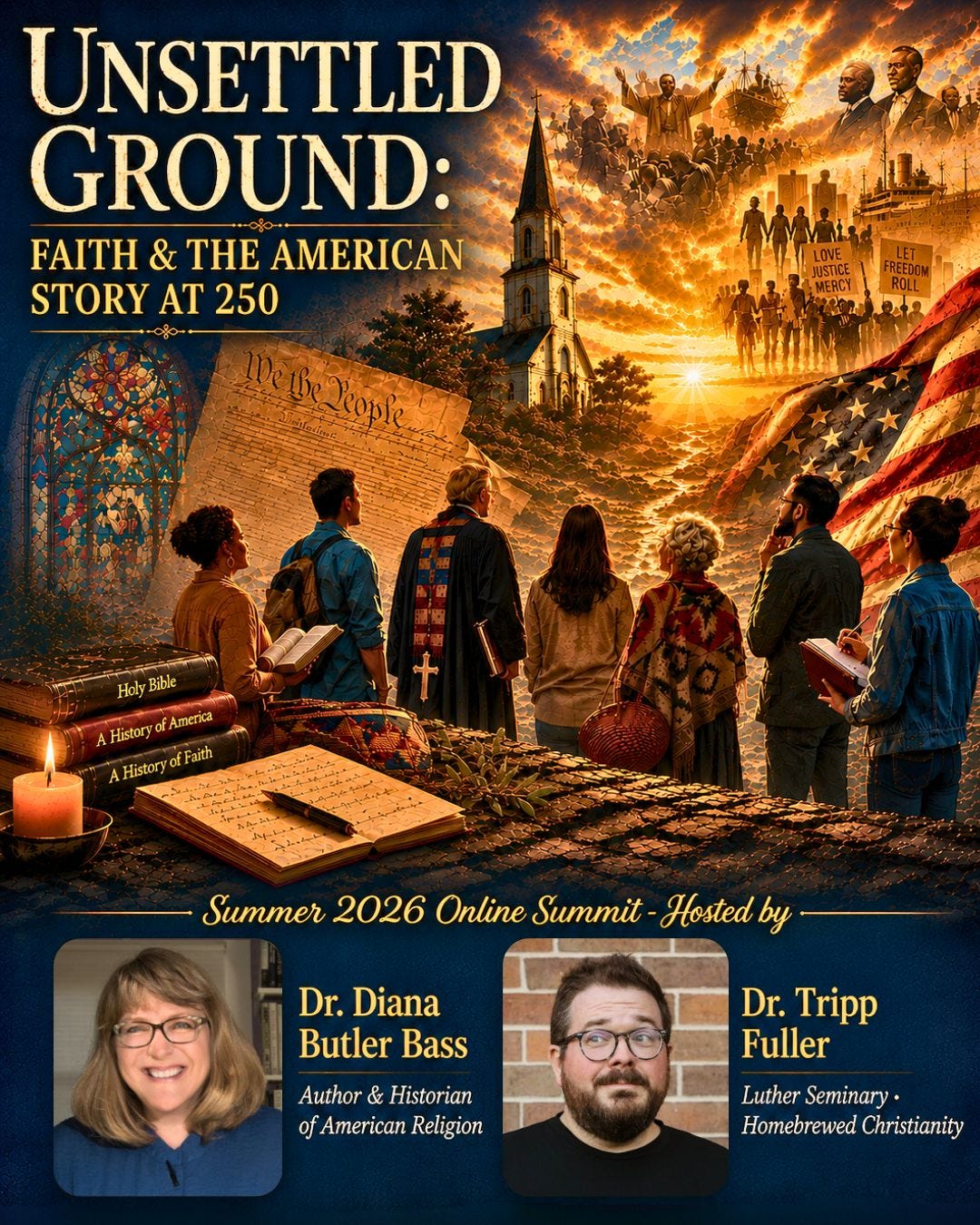
This summer, Diana Butler Bass and Tripp Fuller are hosting Faith at 250 — an online summit gathering leading religion scholars, church historians, and theologians to reflect on America’s 250th anniversary. With the current administration leveraging the semiquincentennial toward a narrow rendering of the church’s history and witness in America, and a flood of Christian nationalist celebrations on the horizon, we wanted to create something different. Each contributor — including Randall Balmer, Juan Floyd-Thomas, Bill Leonard, Elesha Coffman, Corey Walker, Jennifer Harvey, Reggie Williams, Andrew Root, Adam Clark, Glenn Jonas, Kevin Carnahan, and Jonathan Wilson-Hartgrove — offers a lecture on whatever they are carrying into this moment, whether that’s a deep read on a chapter of our religious past, a close look at a particular tradition or movement, or a forward-looking meditation on the challenges ahead. No one was asked to fit a theme. The result is a chorus, not a single argument.
Every talk is roughly 30 minutes — designed so a group can watch together and still have time for real conversation — and each comes with a companion discussion guide and resource list pointing you to the scholar’s books, articles, and projects. Whether you’re a pastor planning programming for your congregation, a facilitator leading a book club or adult ed class, or an individual learner who wants to think more carefully about faith and the American story, this summit was built for you. Diana and Tripp will also host live conversations with several contributors throughout the summit. Head to www.TheologySummit.com to register and get access to every lecture, livestream replay, and discussion guide.
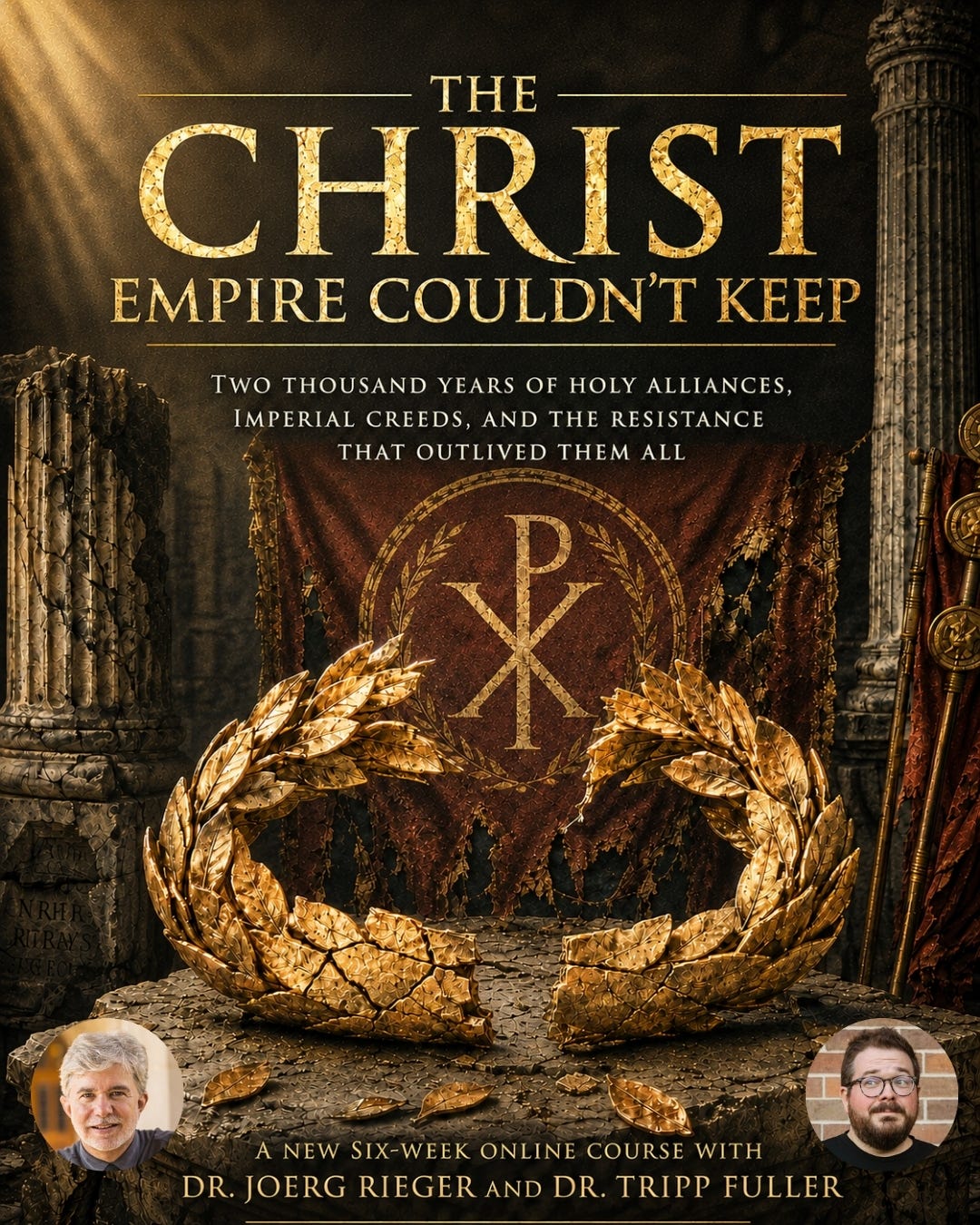
Ever notice how Christian nationalism gets talked about like it’s some bizarre new glitch in the faith? It isn’t — it’s a 2,000-year-old arrangement wearing new clothes, and once you see how the pattern works, you can also spot the Christ who keeps slipping free of it. Join theologian Joerg Rieger and Tripp Fuller for The Christ Empire Couldn’t Keep, a free six-week online class tracing the holy alliances, imperial creeds, and stubborn resistance that have shaped Christianity from Paul to the present. You’ll get six lectures from Joerg, six live Q&As, weekly readings from his book Christ and Empire, and a community of fellow troublemakers thinking it through together.
It’s free to join, every session is recorded, and it kicks off Thursday, August 27. Grab your spot at HomebrewedClasses.com.
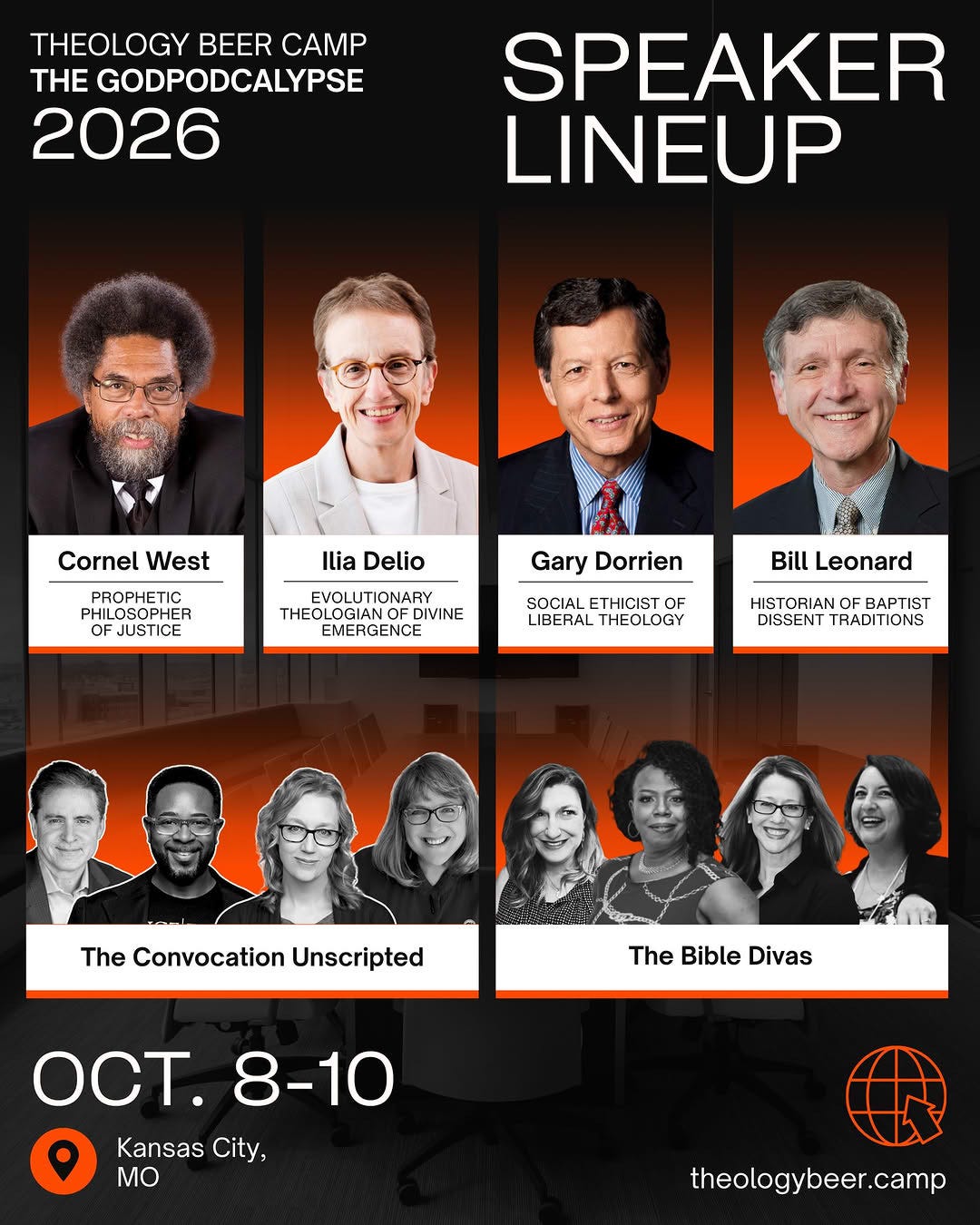
THEOLOGY BEER CAMP
October 8-10, 2026 - Kansas City, MO
Theology Beer Camp is a unique three-day conference that brings together of theology nerds and craft beer for a blend of intellectual engagement, community building, and fun. Organized by Homebrewed Christianity, this event features a lineup of well-known podcasters, scholars, and theology enthusiasts who come together to “nerd out” on theological topics while enjoying loads of fun activities.
We’re excited to share details about our Pre-Event experience. Think of it like a theological pre-game.
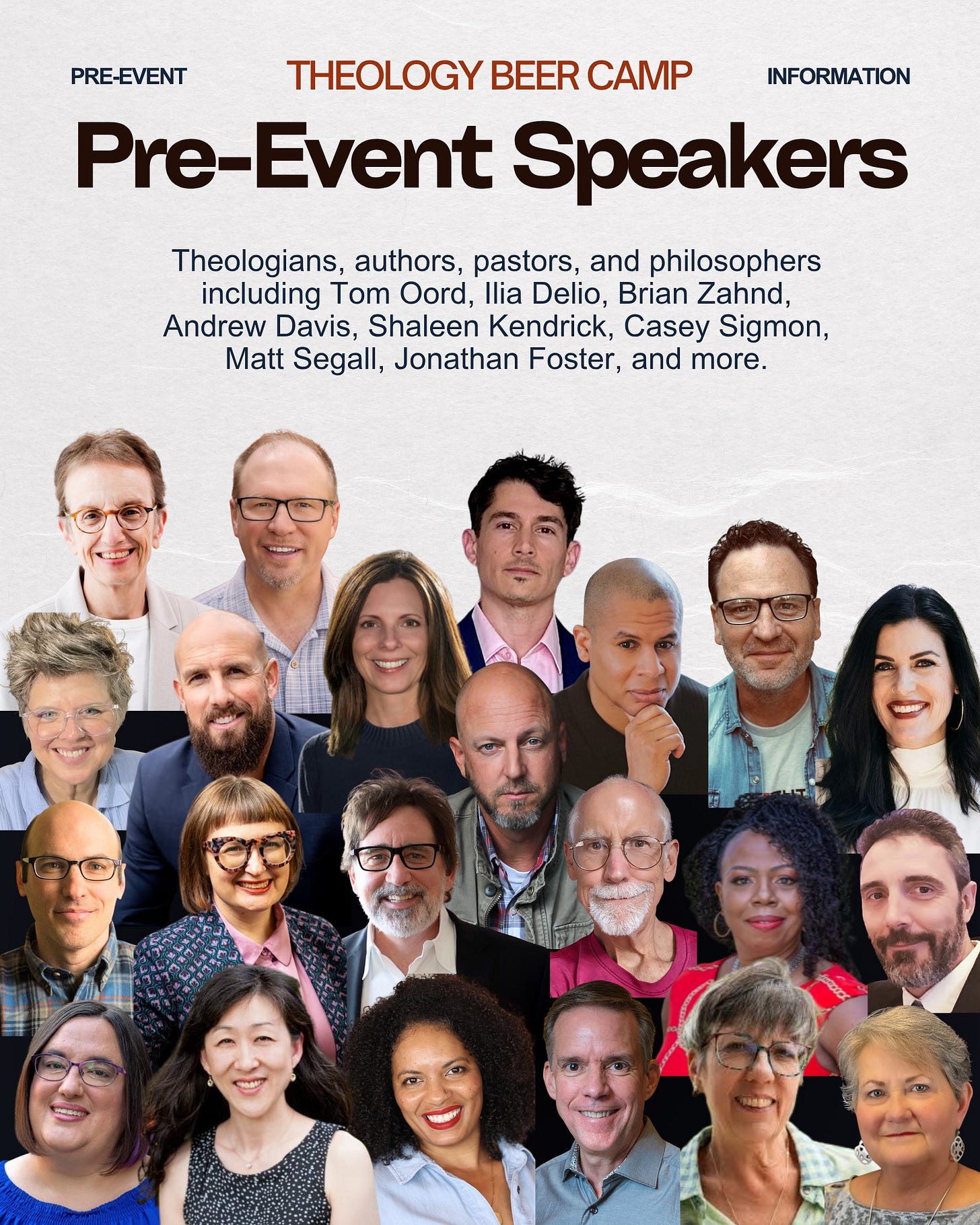
Led by Thomas Jay Oord and Jonathan Foster, we’re bringing you a fantastic lineup of scholars, authors, pastors, and practitioners. This workshop-style gathering is a focused deep dive into Open and Relational Theology before the main event begins.
Think of it as:
A relational head start on Beer Camp
A chance to explore ideas in greater depth
An opportunity to meet people and start building connections before the larger gathering begins
Topics include:
God and an evolving universe
Open and relational approaches to ministry
Theology centered on love and relationship
Process thought and contemporary spirituality
Faith, creativity, freedom, and the future
The Pre-Event takes place on October 8 from 9am–4pm and is available as an add-on registration.
Available for iOS and Android
Comments
Nothing yet. Say the first thing.
Sign in to join the conversation.