
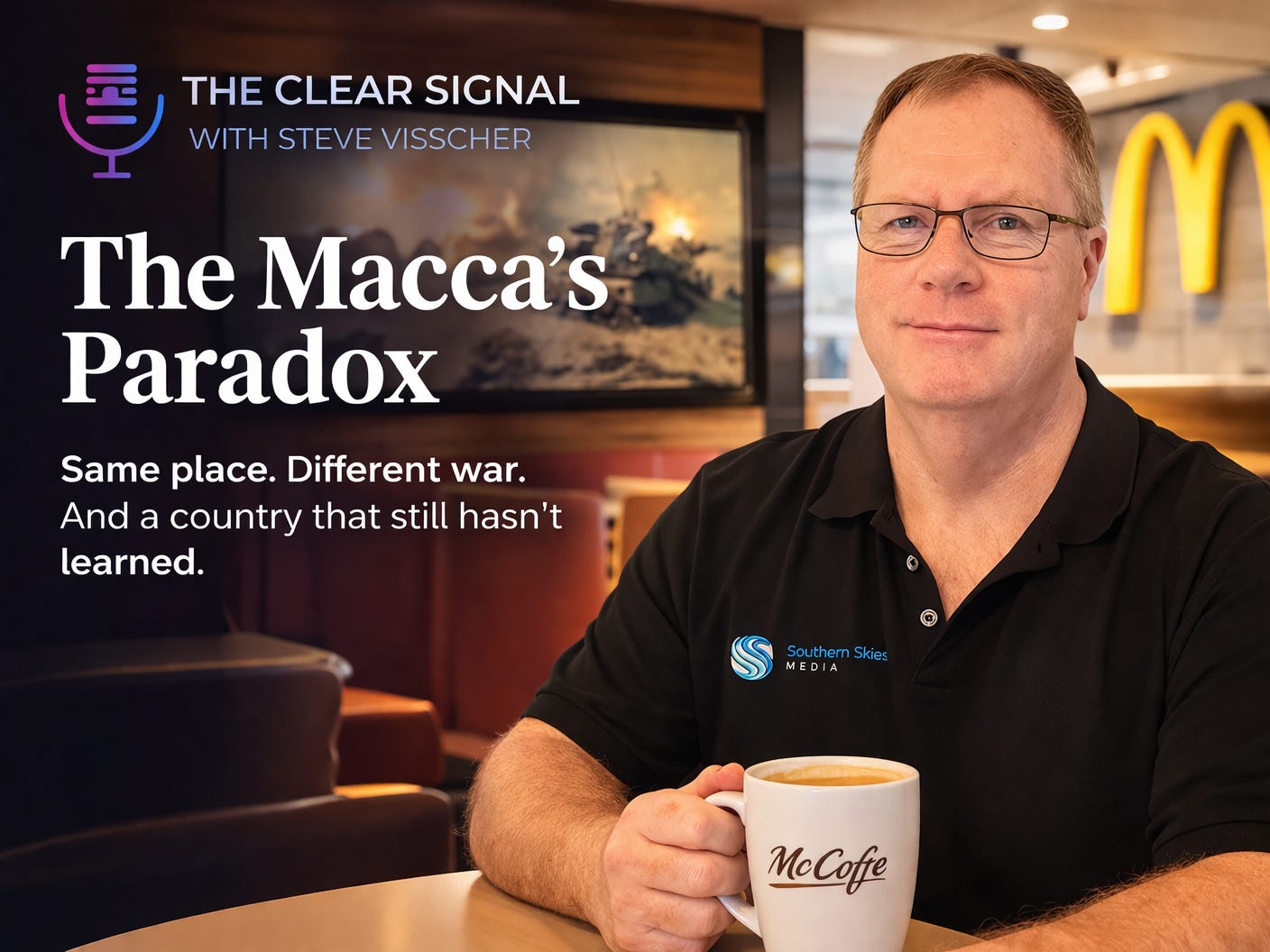
Standing in the foyer of a local fast food outlet is not where you’d expect to experience a sense of déjà vu - at least not when it comes to high-stakes geopolitics.
And yet, a week or two ago, that’s exactly where I found myself.
If nothing else, it somewhat confirms the old adage - the more things change, the more they stay the same.
In another time, but in the very place I now stood, a younger - and thinner - version of myself had a job here working evening shifts, at what was then a newly opened store in Rowville, east of Melbourne. At the end of each night, a group of us would gather around the manager’s small portable television, watching coverage of the first Gulf War on what was, to us, an unfamiliar network called CNN.
Thirty-six years ago, the concept of 24/7 coverage like this was quite fascinating to us.
Back in the present though, my wife and I now found ourselves standing in this store, grandson in tow, for a quick coffee break. And looking to the large flat screen TV on the wall, we found ourselves witnessing the opening coverage of the latest Western intervention in the Middle East, as US forces once again entered the theatre of armed conflict, this time over Iran.
It was almost as if the universe had placed me back at that exact spot right at that moment.
To many of us, the prospect of conflict in this region of the world is unsettling. And rightly so. But thinking back in my case, three and a half decades have passed, and it seems to me that this region is simply, and tragically, spiralling once again on a never-ending cycle.
The similarities are there this time around, and although many things appear to repeat on a decades-long loop, there are a few things that differ. In Australia, the first thing we all noticed was the spike in fuel prices. It was the same in 1990 - the values differed, but the concept was the same. Conditioned as we are these days to paying $1.70 or more for a litre of unleaded, seeing prices jump north of $2.30 was expected, but still disturbing. Back then, with my newly minted driver’s licence, I could get change from $20 when filling my ’78 Mazda Capella with petrol at the rate of 57 cents per litre. It jumped to 80 cents or more.
Going into the final decade of the 20th century, Australia was about to embark on a journey of significant economic and structural change. And despite the warnings from commentators and industry leaders alike across the ensuing decades, those who have held the reins of political power have continued guiding us down a path that has led us to wholesale losses of sovereign manufacturing capability, persistently high energy prices, and now, as we are seeing in real time, an inability to sustain a secure domestic liquid fuel supply.
Thinking paradoxically, there’s one thing we seem particularly good at not doing in this country - learning. And it’s only in times of crisis, such as we see now, that this all becomes exposed. Just a few short years ago, when the tyranny of COVID lockdowns and global supply chain disruptions quickly hit home, we decried the fact that we couldn’t even so much as manufacture our own face masks. Consumer goods, once so easily ordered from the factories of China - often replacing the domestic industries we once prided ourselves on - began to dry up. It was an outrage, cried the commentariat.
And our leaders of the day vowed to restore some of this lost industrial capacity in strategically crafted sound bites.
But did any of that much-vaunted restoration really take place once the dust settled and life returned to normal?
In 1990, a Gulf War-inspired jump in the global price of crude oil was annoying, but it didn’t leave Australia overly exposed beyond the increase in the per-litre rate. Domestic supply, though, remained plentiful. With a population of just over 17 million, eight refineries processed crude from predominantly local sources, and life went on largely as normal.
The difference in 2026, despite the multitude of warnings from industry experts and others, is stark. More than 27 million people now call Australia home. Despite the strong policy push toward electrification, liquid fuels still underpin the nation’s transport networks and supply chains. Yet today, those fuels are produced by just two ageing domestic refineries. Once largely energy independent, Australia now imports more than 80 percent of its fuel, primarily from Asia.
Worse still, onshore reserves have been allowed to dwindle to historic lows, despite international agreements requiring at least 90 days’ supply. At the beginning of this conflict, we held barely a third of that amount onshore.
And in the wash-rinse-repeat way these things always seem to go, the political class now grandstand and take potshots at each other, which is all good fodder for the daily news cycle, but does little to address the problem. A problem which cannot be solved quickly and is all of their making, no matter which side of the political fence they sit.
They are all complicit, and we are all fools if we continue to accept it.
It is often said that the best way to get through life is to focus on those things that fall within our ability to control, rather than stress about those things we cannot. As things currently stand, the war in the Middle East and the global economic tsunami it has unleashed are all things well beyond our control. What we can control now though, is our collective ability to learn.
Maybe just this once.
This new war carries familiar undertones. Certainly, the names and narratives may change - different leaders, different justifications - but the underlying drivers remain strikingly consistent.
Energy. Global supply. Strategic control.
But it will, at some point, conclude. And in a relatively short time after, things will hopefully settle, oil will once again flow through that now well-known strait, and its price will fall, just as it did back in 1991.
Australians must learn from this shock of constrained oil supply, and in ways we did not, for example, when another crop of visionless politicians oversaw the demise of domestic automobile production, along with almost of all the secondary industries that supplied it.
We must demand more than hollow words from our political class this time around, lest we find ourselves even more exposed the next time a similar crisis comes along.
To borrow a line from one of my favourite science fiction series:
All of this has happened before. And it will happen again.
Of that, there is little doubt.
For now though, as I sat there in the Rowville McDonald’s, the only thing I could control was how much I was enjoying the coffee - and the quiet joy of watching my grandson explore every square inch of the playground, blissfully unaware of the stresses and strains of a life still so far off in his future.
Come to think of it, back in 1990 you couldn’t buy a cappuccino from Macca’s.
That’s one positive change I think I’ll gladly hold onto.
No posts
Comments
Nothing yet. Say the first thing.
Sign in to join the conversation.