
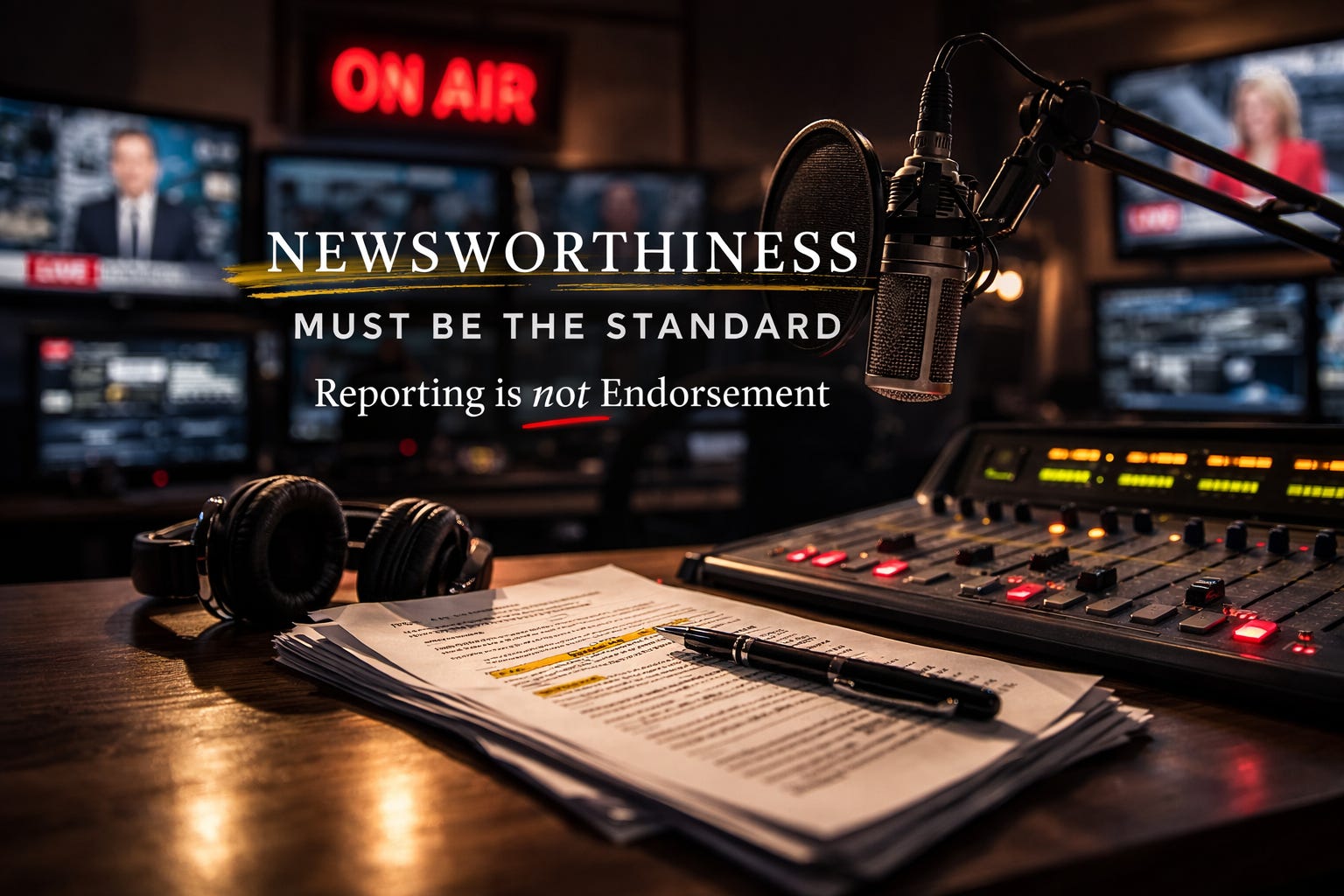
I’ve heard it said recently that newsreaders should not give certain political figures a platform by including them in news coverage.
The comment came in a discussion over whether to run a particular news item that day, given the political figure it centred around was one the presenter found objectionable.
It prompted me to ask what I considered a simple, yet crucial question: Was the story newsworthy?
For a newsreader, this should always be the overarching standard. Personal views should not determine the coverage, no matter how much that challenges us.
How do we put partisanship aside so that we can make a clinical decision on whether to run a story? For those who hold strong views, that challenge can be significant. But it runs the risk of compromising that judgement call, and can lead to the temptation to censor; to cross a line between presentation and commentary.
If we as newsreaders wish to think of ourselves as engaging in the craft of journalism, then we need to be clear about where this line is drawn. In short, the distinction between journalism and activism matters more now than it ever has.
The business of news media is one that comes with a responsibility that can sometimes be lost on those who practice it. To sit behind the microphone and present the news is a privilege; one given to comparatively few.
In radio terms – particularly talk radio - roles can often be thought of as sitting under the broad banner of journalism. I see it differently.
As a decades-long consumer of this medium, and having worked within it for the past nine years, I would categorise it into three specific camps: journalism, commentary, and news presentation.
And perhaps for the sake of simplification we could merge the first two under the one heading – journalism.
However, news presentation is not journalism. Rather, it is a critical subset. It is a singularly different craft which plays a significant role in keeping the listening audience informed, without seeking to influence their point of view one way or the other.
It is a philosophy I push myself to follow any time I’m constructing a news bulletin. And like anybody else, I have my personal views one way or the other, making the challenge equally as real.
Almost everybody has a view on politics, formed on the key pillars of tradition, upbringing and personal experience. The advent and constant development of social media in particular has given consumers a means not only to soak in an opinion that suits their preferred viewpoint, but to indulge on one hand in discussions to further reinforce it, and on the other to deride those whose views are divergent. It is confirmation bias in its purest form, writ large.
One might argue that this is merely an extension of what was once nightly dinner table debate - and perhaps even a healthy thing. Yet it has also led to a heightened intolerance of opposing views.
It logically follows that this experience finds its way into newsrooms and media more generally, but herein lies the challenge for new presenters. Indeed, it highlights what is perhaps one of the most critical skills to learn in what is, after all, a craft. A craft that is distinct from that of journalism and commentary. Unemotional reportage.
These days, many media outlets sit along clearly defined partisan lines. This has only served to heighten the left/right dividing line of modern politics and has led to increasing public scepticism about media standards. As newsreaders, we sit at the beginning of a chain of information and have a real opportunity to set ourselves apart.
Excluding a person from coverage because we disagree with them risks allowing emotion to override editorial judgement. The logical extension would be that we should give a platform to the political figures and opinions we personally approve of.
Applying this methodology would have, for example, severely altered my approach to bulletins I presented throughout the covid years; a period to which I hold very strong views - none of them overly complimentary to the political figures who were controlling our lives at the time.
But to have done so would not only have been irresponsible, it would have been unprofessional. I had to continually challenge myself to assess each story on its newsworthiness, setting my own emotions aside.
Australia’s political landscape is in flux. Trust in traditional parties is waning while newer parties are finding a stronger foothold. Whether that lasts in longer term is anyone’s guess, but for now, it is incumbent upon newsreaders to understand more people wish to hear what these once fringe politicians have to say. They have no desire to hear our personal views and resent any perceived exclusion from the national conversation.
It’s this resentment which has contributed to a significant shift in news consumption habits and a rise in what was once termed “new media”. Some in the mainstream worry that this shift allows audiences to seek commentary that further reinforces their existing biases.
The most effective response, however, is not to narrow the flow of information. It is to widen it, and to keep news presentation just that - delivered without commentary, inflammatory language or censorship.
For those who wish to express their views, biases and analysis, there’s no shortage of avenues in which to do so. Blogging platforms, independent publishing and podcasting provide ample opportunity for opinion, interpretation and advocacy.
That work has its place, and is distinct from the discipline of reading a news bulletin. Just as it should be.
—
This article also appeared in Radio Today
https://radiotoday.com.au/why-newsworthiness-must-be-the-standard/
No posts
Comments
Nothing yet. Say the first thing.
Sign in to join the conversation.