
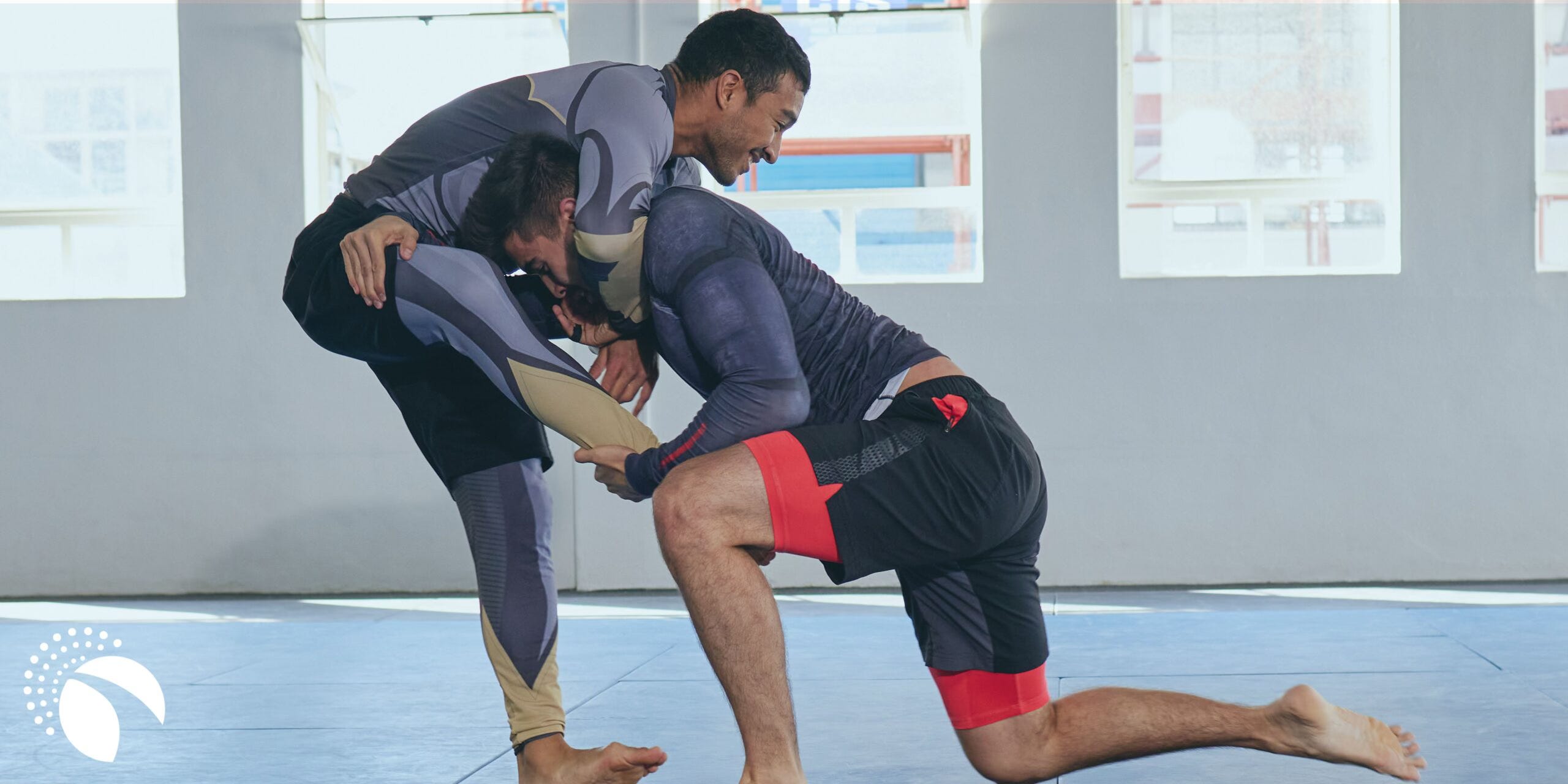
If you train jiu jitsu, or any impact sport or martial art, you need to keep mobility front of mind in your training. I wrote an article a while back on mobility for jiu jitsu, where I defined mobility, discussed why it's important, and what to focus on to improve your mobility for Jiu Jitsu. And, while that article did provide some guidance on a framework for training and increasing mobility, it wasn't a "program". Since a few people have asked me recently for a specific program to train mobility for grappling, I figured I'd put one together and share it here.
First, I want to review the framework that I used to put this program together, mainly so you have the context for this Jiu Jitsu mobility program and can understand why I chose certain exercises over others. This isn't a perfect program, but it provides good general guidance.
If you train Jiu Jitsu or grappling and experience some sort of chronic pain or consistent issue, this program won't replace specific medical advice and guidance provided by a licensed clinic (that's my disclaimer: if you have an injury or pain, schedule an appointment with your local doctor or physical therapist). With that out of the way, let's dive in.
Ok, so what should you focus on in your jiu jitsu mobility program? Well, research shows that these body parts are most affected by pain or discomfort in jiu jitsu athletes [1]:
Lumbar Spine (90%); low back pain
Knees (90%); knee pain
Wrist/Hands (60%); mostly wrist pain, though many people that train in the gi experience pain at the finger joints
So, that being said, I'd focus your mobility program on those regions of the body, definitely as a preventative strategy. If you are already experiencing pain or limitations in another area of the body, work those in as well.
OK, here's an example or starter mobility program you can incorporate in your jiu jitsu training to maintain/improve mobility targeting the 3 most common areas that feel pain before, during, or after a jiu jitsu training session. I recommend trying to incorporate this both before &/or after a training session.
This exercise can be graded up, or down by doing this against a bench, the wall or the ground. Doing this exercise on your hands and knees will provide the most stretch and require the most stability. As you put less body weight through your wrists, it becomes easier.
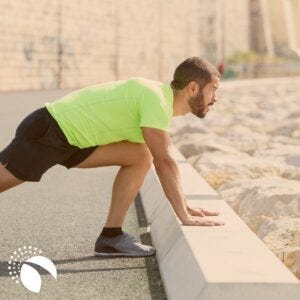
To complete this exercise:
Start on your hands and knees (or against a wall/table/bench to make it easier). Rotate your wrists so that your palms are on the ground and your fingers point towards your knees (rotate your wrists towards the outside.
Next, lean away from your wrists (if you're on your hands and knees, you can do this by sitting your butt back on your heels). Don't push into pain; you should feel a stretch.
Move in and out of this position 10-15 times, holding each repetition for 15-30 seconds.
This exercises two major areas: the spine & the shoulder.
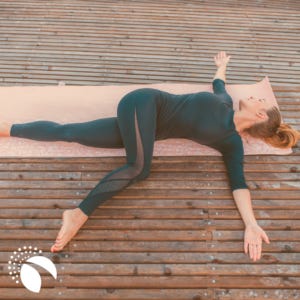
To complete this exercise:
Lay on the floor on one side. Flex your top hip to about 90 degrees, like you're about to step up with that leg.
Flex both shoulders to 90 degrees, so that your arms are straight out in front of you.
take your top arm and begin to reach up and toward the other side of your body, keeping the back of your hand against the floor the whole time. You're basically making an arc over your head with your top arm. Keep your top leg and hips still, while your upper body & thoracic spine twist towards the direction of your moving hand.
Do this slowly, taking 5+ seconds to complete the arc. Hold the end position for 3-5 seconds. Repeat 10-15 times.
Roll to your other side and complete the same sequence with your other leg/shoulder.
This exercise targets the hip flexors, glutes, hamstrings, and lumbar spine. If you've got low back pain or stiffness, especially from a tight muscle like the piriformis muscle, this exercise can help relieve the pain.
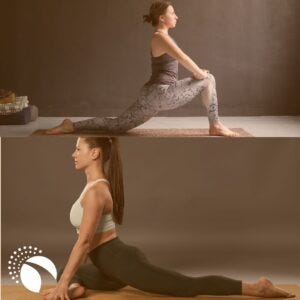
To complete this exercise:
Start in a kneeling lung position with one knee up and one knee down
Squeeze your glutes/hamstring of your back leg so you feel a stretch at the front side of that leg (your hip flexor)
Move in and out of this stretch 10-15 times, holding for 15-30 seconds
Drop your front leg to the ground so that it is bent at a 90 degree angle in front of you
Keeping your check up and your hips square, pull your body forward over your leg. This should push the side of your front leg towards the ground
Move in and out of this stretch 10-15 times, holding for 15-30 seconds
Come up into a squat and position, however low is comfortable for you, and hold for 15-30 seconds
Repeat on the other side
This full-body squat warm up that targets all the major parts of your body. It involves your thoracic spine, lumbar spine, upper back, hips, and ankles. It's also really good at targeting your low back in a dynamic way.
To complete this exercise:
Start standing straight up. Lift your arms up over your head and reach down towards your toes.
Once you touch your toes (or get as low as you can), bend your knees into a deep squat.
When you're down in the squat position, reach one hand at a time up and over your head, turning to that side.
Touch your toes and straighten your legs so that when you get to the top, you're bent forward, still touching your toes (you'll feel the tightness in your low back and hamstrings here!)
Raise your arms up and reach back as far as you can
Repeat 10-15 times
On the strength side of things, I'm going to recommend 2 resistance training exercises that I think every jiu jitsu athlete should incorporate into their regular exercise routine: the deadlift & the overhead press. Now, this is just the bare minimum. But, if someone asks for critical exercises or muscle groups to target, these are the two I'd give them.
You can definitely get in the weeds with exercise programs for BJJ. In fact, there's evidence to suggest that a 3-block exercise routine involving resistance training, metabolic training, and technical training may provide an ideal routine to improve performance and prevent injury in jiu jitsu [2]. And, if you really want to focus on strength alone, you can do static-dynamic exercises like pushups, sit-ups, & pull-ups to improve strength and performance in your BJJ game [3].
But, again, if you're only going to do a couple of resistance exercises, I recommend the deadlift & the overhead press.
So why is the deadlift one of the exercises I recommend to jiu jitsu athletes? Well, for starters, the deadlift has been shown to be an effective way to treat low back pain [4]. And, since the low back is one of the most often painful areas of the body for jiu jitsu athletes, it makes sense to build a program around strengthening and improving movement and mobility at the low back.
In addition to that, research done in the US Marine Corps showed that completing an 8-week deadlift program caused significant physiological adaptations in strength performance ... in tactical athletes [5]. This involved an 8-week program involving 3 days of lifting. Basically, the deadlift as an awesome, full-body exercise that improves strength and performance for athletes involved in combat-related activities.
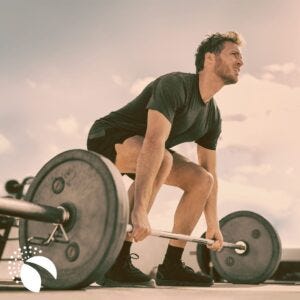
So the question is: how many reps and what type of equipment or weights should you use when incorporating deadlifts into your exercise program? The equipment part of that question depends on your goals. For example, if you want to build strength & muscle growth the following has been shown to be effective [5]: Strength/Hypertrophy Protocol:
Day 1: 65% of max weight at 4 sets x15 reps
Day 2: 75% of max weight at 4 sets x6 reps
Day 3: 85% of max weight x3 sets x3 reps
In that case, you'll want to use an olympic style weight bar with bumper plates, since your goal is to lift very heavy weights. I generally recommend getting a straight olympic bar, since it can be used for more lifts than a specialized hex bar specifically for deadlifts. If, however your goal is to build endurance or treat pain, you'll want to follow a protocol like the one below:
Endurance &/or Pain Protocol:
2-5 sets (2-3 for targeting pain)
10-20 reps (increase to 30 to address pain)
40-70% of max output (within pain tolerance if addressing pain)
Moderate-slow speed
Brief rest period between sets
For something like that, you can get away with using simple kettlebells or dumbbells.
The second exercise I recommend for jiu jitsu athletes is some form of overhead press. Why? Well, I recommend this exercise in particular because it is a good way to target the scapular stabilizers, rotator cuff, upper trapezius musculature, deltoids and triceps [6]. In short, it effectively targets the entire upper body and arm. And, in a sport where you're very likely to find yourself in a position with an arm isolated in a precarious position, having strength throughout your arm's available range of motion can help prevent injury and increase your ability of escaping that position.
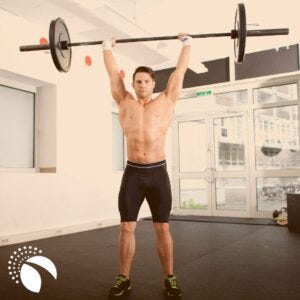
As far as what type of equipment to use, the research does suggest that using free weights I more effective than machines [6]. In fact, here's a quote from a study about it: Overhead press performed using a barbell excites muscles more than using machine to stabilize the trajectory of the external load [6].
So, ideally, you'd use a barbell, but you can also use dumbbells or kettlebells. As far as reps/sets go, I'd just follow the two protocols I laid out up above. And that's it! Hopefully this article provided some insights and at least a high-level overview of how to effectively improve your mobility & strength to either treat injured body parts or prevent injury while training Jiu Jitsu. Over the next season, we'll put out programs to address specific injuries or body regions that jiu jitsu athletes are concerned about.
[1] Lunkes, L. C., Reis, A. N., Canestri, R., & Vilella, R. C. (2024). Prevalence of musculoskeletal pain in body segments in judo and Jiu-Jitsu athletes. Brazilian Journal Of Pain, 7. https://doi.org/10.5935/2595-0118.20240010-e [2] James, Lachlan P. MSportCoach, MExercSc. An Evidenced-Based Training Plan for Brazilian Jiu-Jitsu. Strength and Conditioning Journal 36(4):p 14-22, August 2014. | DOI: 10.1519/SSC.0000000000000053 [3] TROPIN, Y., & PODRIGALO, L. (2024). Using static-dynamic exercises to improve strength performance in elite brazilian jiu-jitsu athletes. Journal of Physical Education and Sport, 24(5), 1152–1161. https://doi.org/10.7752/jpes.2024.05133. https://efsupit.ro/images/stories/may2024/Art%20133.pdf [4] Fischer, S. C., Calley, D. Q., & Hollman, J. H. (2021). Effect of an Exercise Program That Includes Deadlifts on Low Back Pain. Journal of Sport Rehabilitation, 30(4), 672-675. Retrieved Jun 12, 2024, from https://doi.org/10.1123/jsr.2020-0324 [5] Semper, L. (2024). The Efficacy of Deadlifting for Occupational Performance in the United States Marine Corps (Thesis, Concordia University, St. Paul). Retrieved from https://digitalcommons.csp.edu/kinesiology_doctorate/5 [6] Coratella G, Tornatore G, Longo S, Esposito F and Cè E (2022) Front vs Back and Barbell vs Machine Overhead Press: An Electromyographic Analysis and Implications For Resistance Training. Front. Physiol. 13:825880. doi: 10.3389/fphys.2022.825880
No posts
Comments
Nothing yet. Say the first thing.
Sign in to join the conversation.