
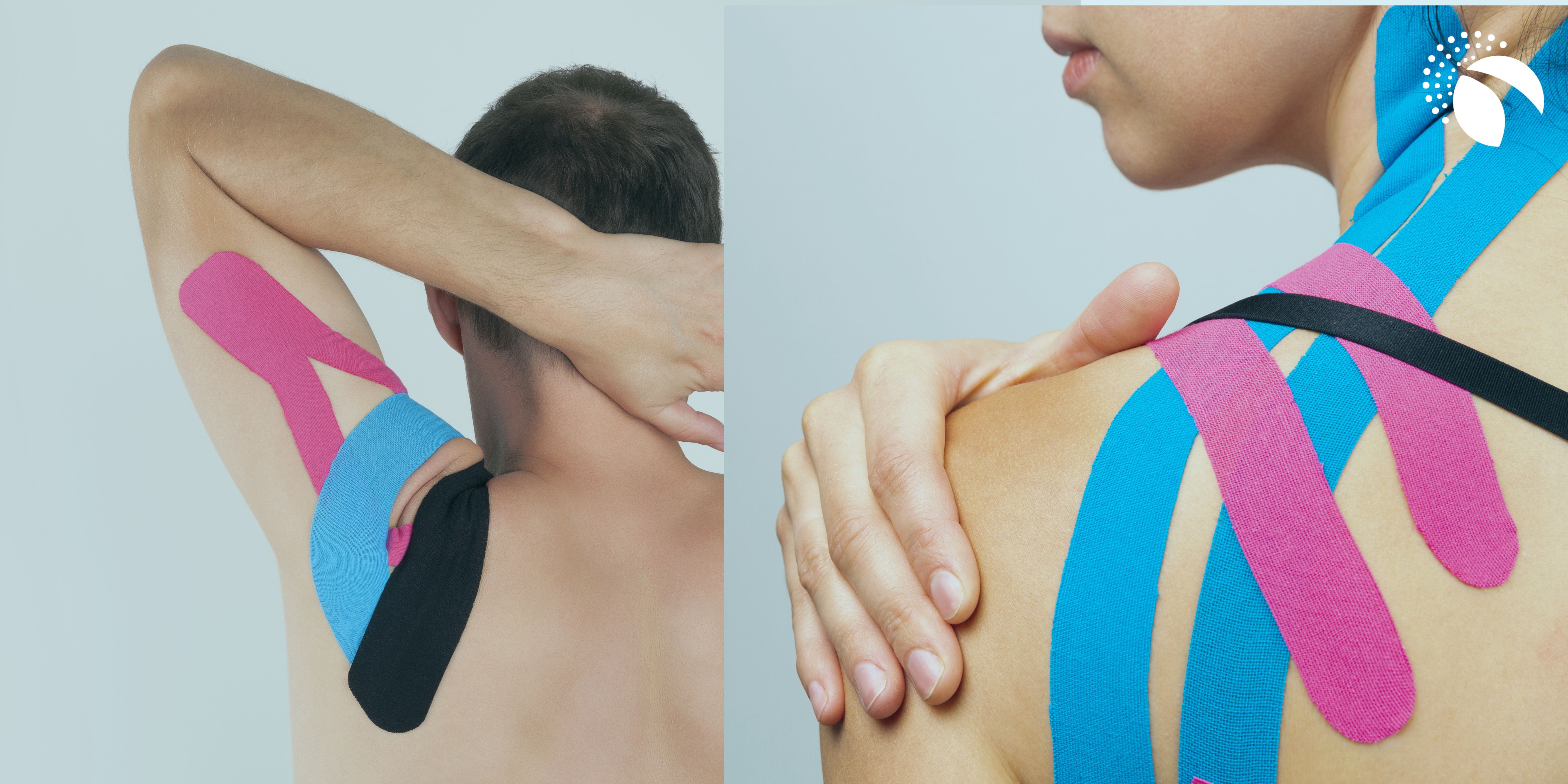
One patient gave kinesiology tape (K-tape) that nickname, and honestly — it stuck. It’s one of those tools that consistently surprises people. But what does it actually do, and should you be using it?
Here’s a breakdown.
When K-tape is applied, its elasticity creates a gentle lifting effect on the layers of tissue underneath it. That lift does a few important things:
Reduces swelling by promoting better fluid movement (edema control)
Improves blood flow to the area
Decreases pain by taking pressure off your pain receptors (called nociceptors)
Supports the surrounding structures — muscles, tendons, and joints
Here’s what makes it different from a traditional brace or wrap: it supports the area without restricting your movement. You can still use your arm, hand, or whatever is taped — which means you can keep doing functional activities while still getting some help from the tape.
There’s a meaningful body of research behind this.
For people dealing with hand and wrist osteoarthritis, a clinical study found that K-tape combined with exercise led to significant improvements in pain, range of motion, hand strength, and overall arm function. Worth noting: the exercise piece mattered. K-tape alone isn’t going to rebuild strength — but by reducing pain and swelling, it can make it possibleto do the exercises that will.
For stroke survivors dealing with upper extremity pain and limited arm function, the evidence is also encouraging. A systematic review covering six studies found that kinesiology taping helped reduce pain in the upper limb. A separate study showed that when K-tape was combined with an upper extremity home exercise program, patients saw meaningful improvements in both arm function and self-efficacy — meaning they felt more capable and confident in using their arm.
K-tape is a tool, not a cure. It works best as part of a broader treatment plan — not as a standalone fix. The research makes this pretty clear: the biggest gains come when taping is combined with functional training and a solid home exercise program.
How well it works can also depend on the condition being treated, how it’s applied, and each patient’s individual situation. That’s why having a trained clinician apply and monitor it matters.
For patients dealing with pain, swelling, or limited movement in the arm or hand — whether from arthritis, a stroke, or another condition — kinesiology tape may be a useful part of treatment. Current evidence suggests it can provide short-term pain relief, support the body’s awareness of movement (proprioception), and help patients stay functional while they heal.
To find out whether it’s the right fit, schedule an appointment or give the clinic a call. The team will take a look at what’s going on and build a plan around your specific needs — tape and all.
*Ryan Harley, MHS, OTR/L is an occupational therapist at ProActive Rehabilitation & Wellness in Augusta, GA.
[1] Farhadian, M., Morovati, Z., & Shamsoddini, A. (2019). Effect of Kinesio Taping on Pain, Range of Motion, Hand Strength, and Functional Abilities in Patients with Hand Osteoarthritis: A Pilot Randomized Clinical Trial. The Archives of Bone and Joint Surgery., 7(6), 551–560. https://pubmed.ncbi.nlm.nih.gov/31970261/
[2] Tan, B., Jia, G., Song, Y., & Jiang, W. (2022). Effect of kinesiotaping on pain relief and upper limb function in stroke survivors: a systematic review and meta-analysis. American Journal of Translational Research., 14(5), 3372–3380. https://pmc.ncbi.nlm.nih.gov/articles/PMC9185082/
[3] Yang, S.-W., & Choi, J.-B. (n.d.). Effects of kinesio taping combined with upper extremity function training home program on upper limb function and self-efficacy in stroke patients: An experimental study. Medicine., 103(30). https://doi.org/10.1097/MD.0000000000039050
No posts
Comments
Nothing yet. Say the first thing.
Sign in to join the conversation.