
When I was a teenager, I remember watching my mother pick up a book at a bookstore and, instead of opening to the first page, she turned to the index. I asked what she was doing, and my stepfather explained, “She’s looking to see what kind of book it is.”
I don’t think I fully understood what he meant until this past month, when I got to review the draft index for The Art of Fighting. My editor, Jake, told me that it would be arriving in a digital package, along with specific instructions. And that I’d have a week to review, make any changes, and send it back to them.
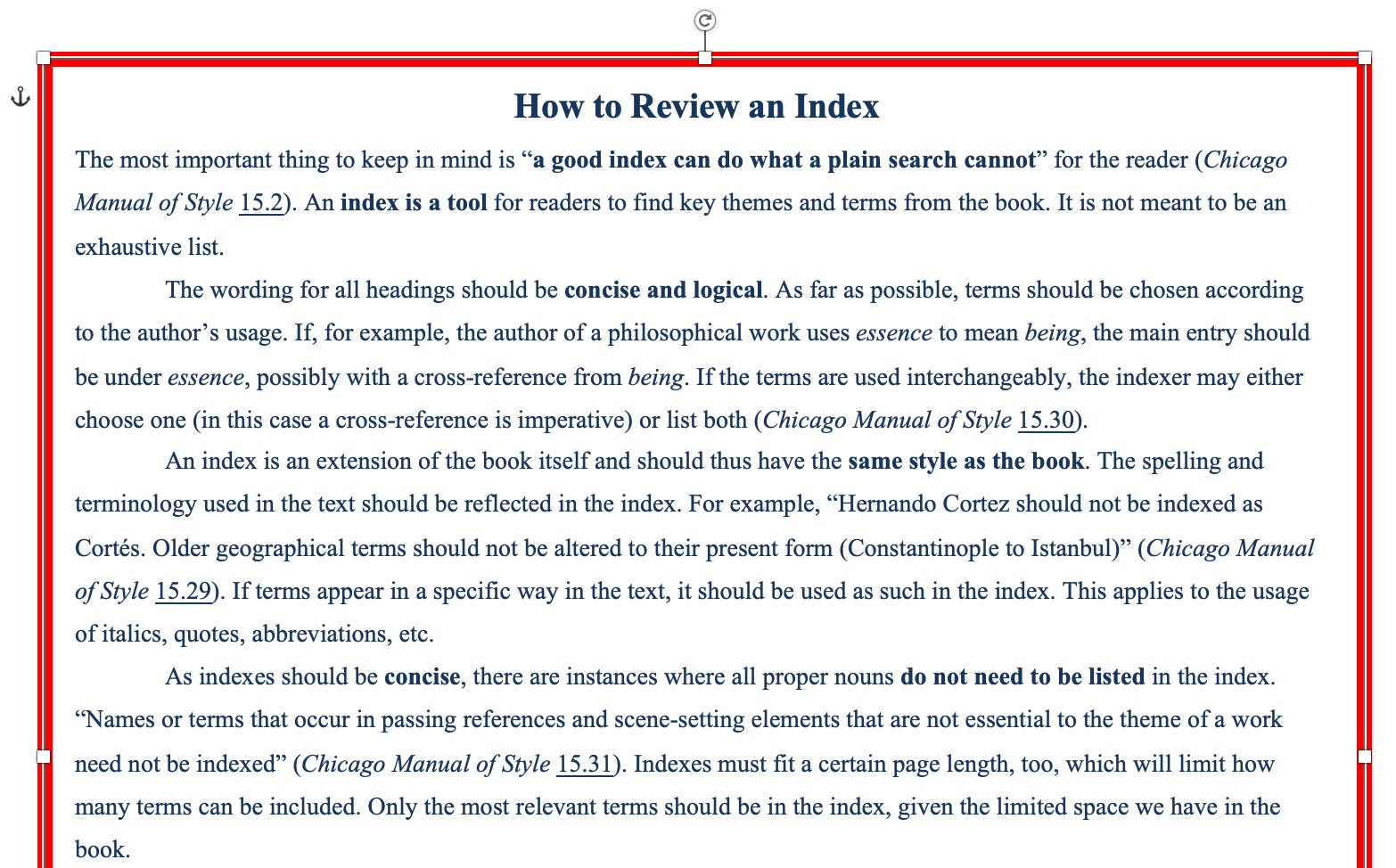
When the email came, before getting to the draft index, I was amazed to find a super thoughtful guide: “The most important thing to keep in mind is ‘a good index can do what a plain search cannot’ for the reader (Chicago Manual of Style 15.2).”
Then: “An index is a tool for readers to find key themes and terms from the book. It is not meant to be an exhaustive list.”
As I read these delightful instructions, it began to dawn on me that even indexing is an art.
And then I scrolled past the instructions and found something remarkable: my index.
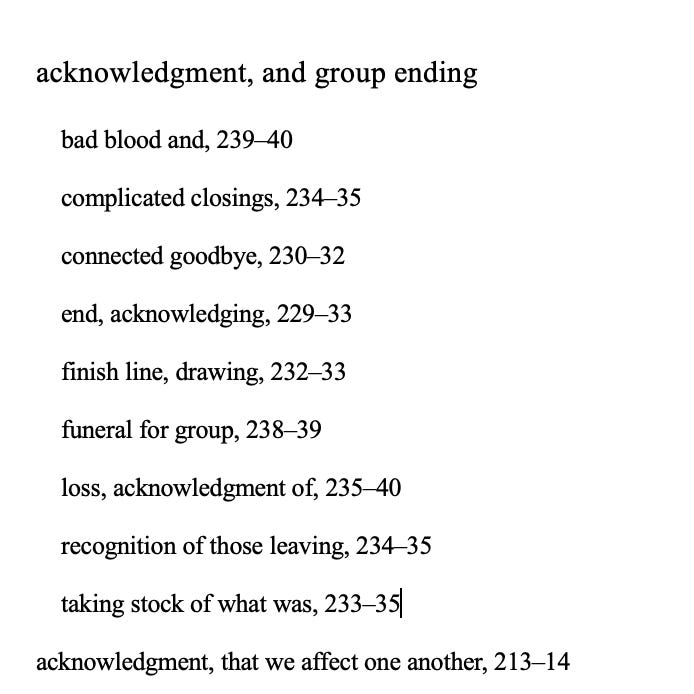
The indexers had sat with my book and codified and alphabetized what they believed were the core ideas in my book, and how people might search for them. Before me, in an itemized list, were the concepts I’d spent the last six years conceiving of, putting into words, and distilling into the simplest and most precise form that I could to grab the reader by the lapel. All with page numbers neatly beside them. 🤯
Another entry:

I gasped. If this book were boiled down to a simple conceit, it would probably be this sentence: “acknowledgment, that we affect one another.” By choosing to engage in it, you are admitting that I affect you and you affect me. And that admission is a fundamentally vulnerable act. Conflict is an act of intimacy. It was amazing to see this idea just sitting there in a list.
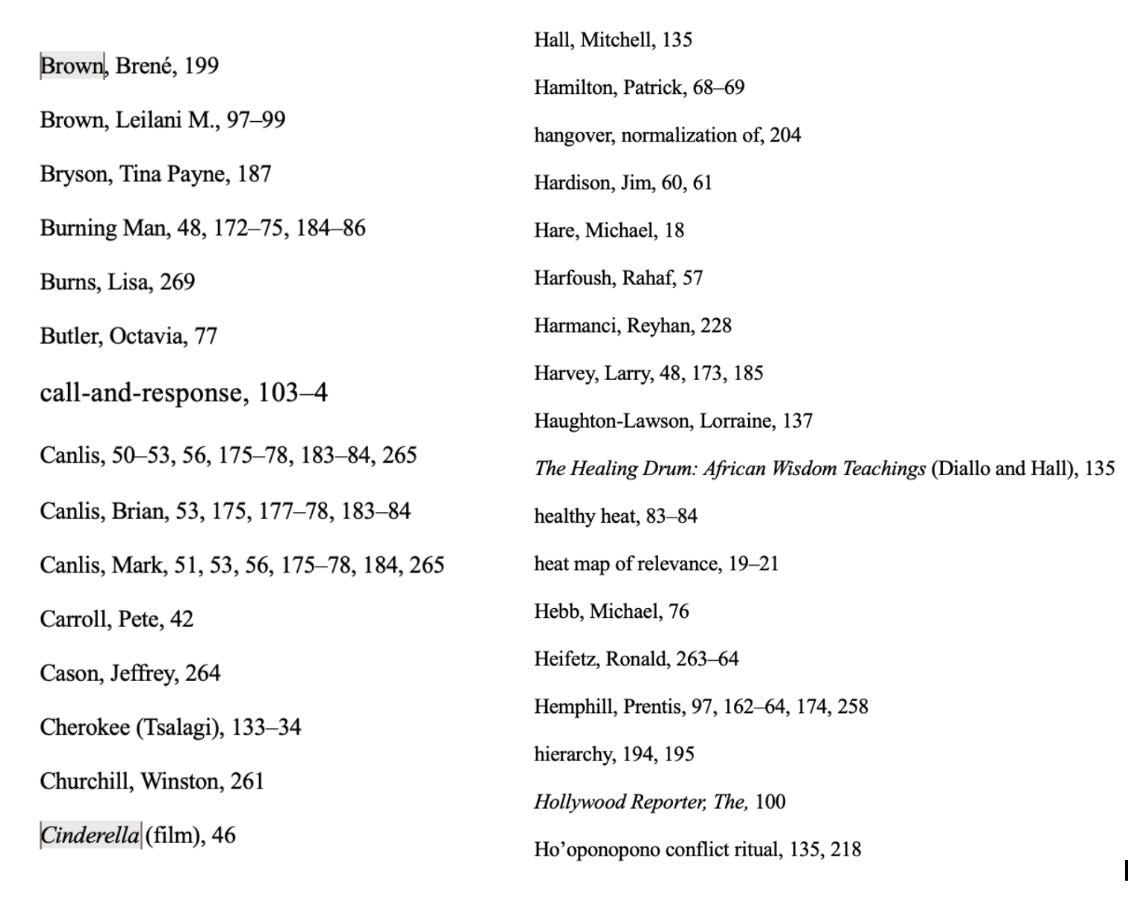
I kept scrolling, and as I did, I became a bit teary. (Some of you were with me when I did this during our virtual co-working hour. Thank you for joining me.) In this document were the names of the dozens of people I interviewed, the authors I read, the cases I studied, the pseudonyms I chose (which I had the indexer remove), the Disney Movies I analyzed, the reality TV shows I parsed, and the people whose lives and ideas have been living in my head for the past six years. It felt like a family reunion.
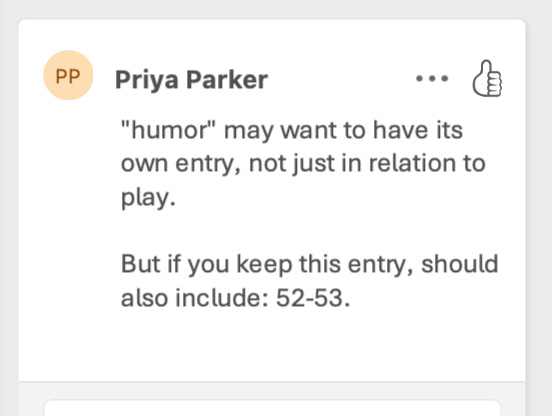
What should get its own category? What is a subsection? They had shelved “humor” under the category “play.” But they are so different!, I thought. I inserted a comment that “humor” should get its own category.
“Power,” too, I thought, should get its own category.
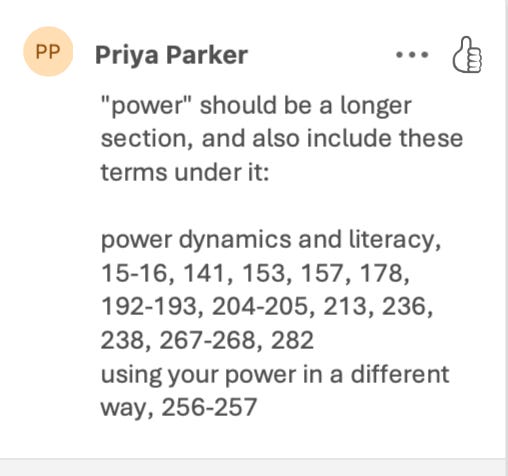
My book is about group fights. And I write about groups that other people assume are monolithic (a Super Bowl-winning football team, a 120-year-old swim club, a taiko drumming circle) to show that every group fights. To figure out who they are, what they’re about, where their boundaries are, and what makes them tick, groups have to fight. So, when it comes to the index, I had to decide: do I name those groups? Or is the whole point to surprise and disarm and let the pages reveal themselves?
Throughout the book, I talk about fights between friends, but there wasn’t a category for “friend.” So I suggested we add one.
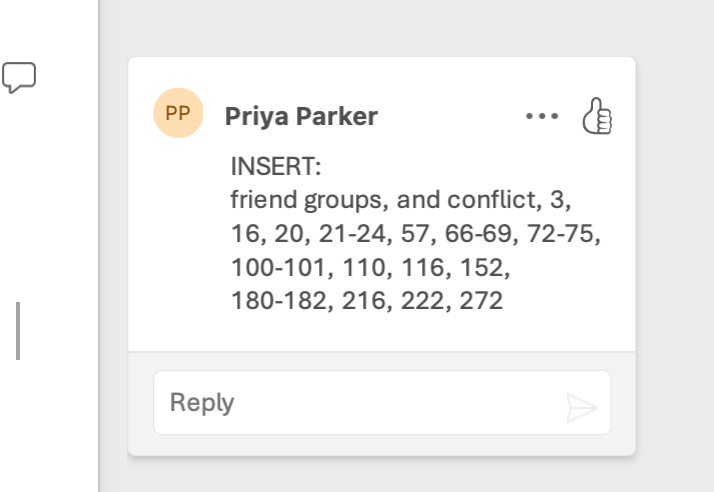
Above all, an index is an act of meaning-making. What matters here? What does the reader need to turn to quickly? And who decides?
I submitted my suggestions.
And it got me thinking: if you were to INDEX a year of your life, what would be on that list? :)
Warmest,
Priya
P.S. And if you want to see the full beautiful index in all her glory, you can pre-order The Art of Fighting here, and it will be on your doorstep on September 8th.
No posts
Comments
Nothing yet. Say the first thing.
Sign in to join the conversation.