
Happy December! I’m pleased to share that I’ll be spending my holiday season over at the Education Department as a member of the Accountability in Higher Education and Access through Demand-driven Workforce Pell (AHEAD) Committee. This group is charged with “negotiated rulemaking”—constructing regulations to implement key components of the One Big Beautiful Bill Act (OBBB) that pertain to higher education.
The committee, which meets for two weeklong sessions in December and January, will eat up a good deal of my time for the next several weeks. I’ll do my best to keep up my writing schedule, though I will refrain from public comment on the specific issues we’re tackling on the AHEAD Committee until negotiations have concluded.

I do, however, want to share some thoughts on the outcome of a previous negotiated rulemaking committee. In November, this committee reached consensus on a definition of “professional degree.” The definition matters because students in professional degree programs will gain access to higher federal loan limits under OBBB. And schools whose programs ended up outside the “professional” definition are pretty salty about it.
Under OBBB, graduate students in professional programs can borrow up to $50,000 per year ($200,000 in aggregate), while other graduate students can borrow $20,500 per year ($100,000 in aggregate). The goal of this bifurcation is to give students in high-cost but lucrative programs like medicine or dentistry sufficient borrowing capacity. But it would be ridiculous to allow all graduate students to access loan limits designed for doctors and dentists. No one should borrow $200,000 for an MFA, for instance.
But where do you draw the line between standard and professional programs? As I wrote last month in a piece for AEI, the committee adopted the following definition by consensus:
Professional degrees require at least two years of post-baccalaureate coursework (or six years of postsecondary education overall) and must provide preparation for a licensed occupation. The critical limitation is that only the following degrees, along with closely related fields, qualify as professional: Pharmacy (Pharm.D.), Dentistry (D.D.S. or D.M.D.), Veterinary Medicine (D.V.M.), Chiropractic (D.C. or D.C.M.), Law (L.L.B. or J.D.), Medicine (M.D.), Optometry (O.D.), Osteopathic Medicine (D.O.), Podiatry (D.P.M., D.P., or Pod.D.), Theology (M.Div., or M.H.L.), and Clinical Psychology (Psy.D. or Ph.D.).
Degree programs that fall outside this definition are automatically classified as standard.
It was a tricky line to draw, but ultimately I think the committee made the right call. Most students in programs classified as “standard” already borrow within the $20,500 annual limit.
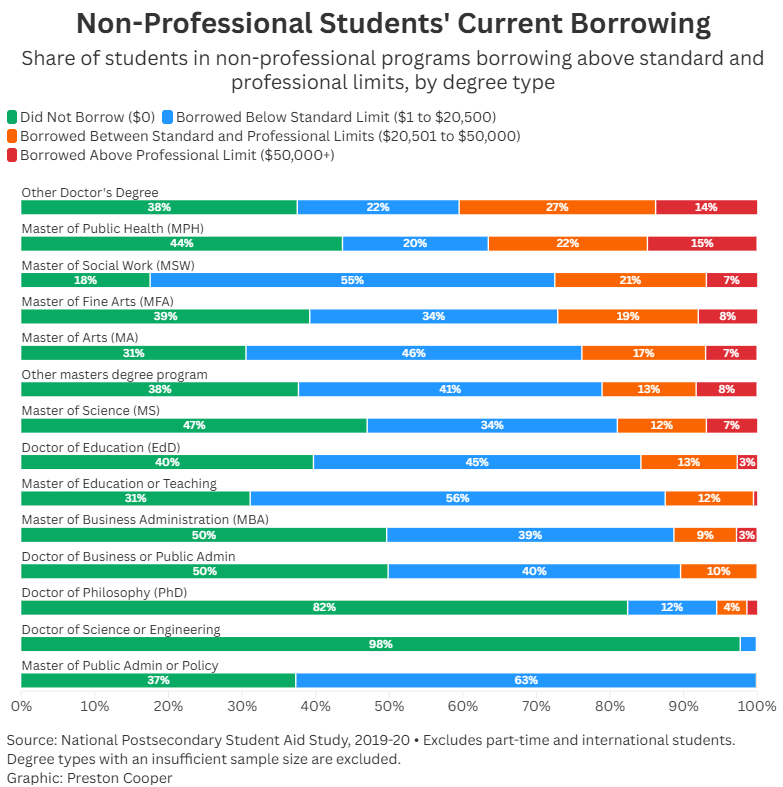
Social work schools, for instance, clamored to be recognized as “professional.” But 72 percent of master’s-level social work students borrow within the standard $20,500 limit. The limits will encourage students in more expensive programs—such as the University of Southern California’s infamous $115,000 social work degree—to shift towards lower-cost options. USC students can drive 15 minutes down I-10 and find a similar social work program at California State University-Los Angeles for around one-quarter the debt burden. That in turn will encourage expensive schools to lower prices—or lose students.
If you have friends or family who are nurses, you’ve probably had an earful about something they saw on TikTok—the Trump administration now says nurses aren’t professionals? What gives?
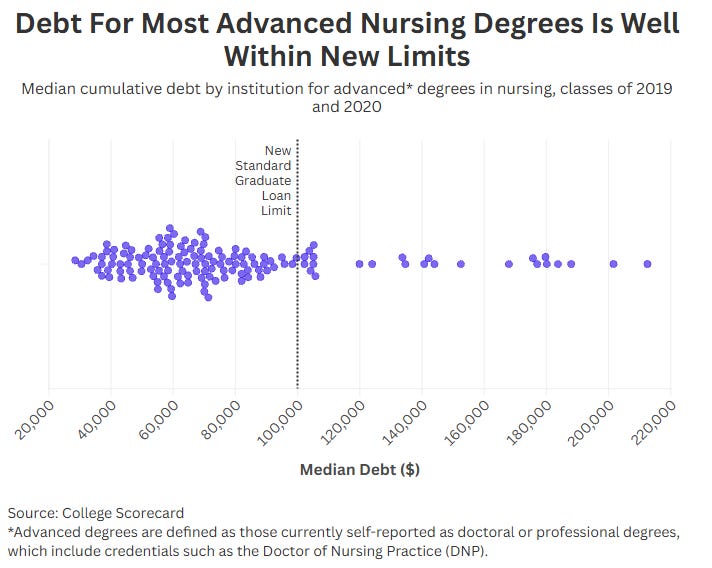
The Department’s definition of “professional” degrees does not include advanced nursing programs such as the Doctor of Nursing Practice (DNP). This does not mean that nursing isn’t a profession—it simply means that advanced nursing students will be allowed to borrow at standard loan limits. This will lower student debt for nursing students—a decision the American Association of Colleges of Nursing predictably decried as “devastating.”
As I wrote in another recent post for AEI:
Contrary to claims that this decision will restrict access to the nursing profession broadly, the higher loan limits would have applied only to a small subset of advanced nursing degrees. Undergraduate nursing degrees like the Associate Degree in Nursing (ADN) and the Bachelor’s of Science in Nursing (BSN) would not have qualified for professional loan limits under any circumstances. Master’s programs like the Master of Science in Nursing (MSN) would not qualify as professional under any reasonable reading of the law. Only advanced degrees like the DNP were under serious consideration for professional limits.
Moreover, students in most advanced nursing programs already borrow well within the standard loan limits. Among 140 programs with data, median debt is below the aggregate cap for 115 (see chart; click for an interactive version). Only ultra-expensive nursing programs will be affected by the new limits—and that’s a feature, not a bug. A primary goal of the new policy is to curtail loan subsidies to institutions charging far too much, thereby encouraging students to consider lower-cost options.
Drawing the line between standard and professional programs requires a delicate balance, and naturally any graduate school left on the “standard” side would be upset—no matter where the line gets drawn. But readers should remember that the standard-vs-professional classification is not a judgement on the inherent worth of any profession, but rather a technical determination about how much debt is appropriate for different programs. Take it from me: a person whose own graduate degree (a PhD in economics) ended up on the non-professional side of the line.
A Christmas wish list for higher education reform. Is a second reconciliation package in the cards? Some lawmakers hope so. Over at RealClearEducation, Beth Akers and I offer our wish list for this second bite at the apple. We call for strengthening accountability for colleges by incorporating a measure of price, fully eliminating Parent PLUS loans, and overhauling the student aid system to cut back on borrowing for first-year students.
New data show student borrowers falling behind. We should remember why the government has an interest in limiting student debt: borrowers often can’t afford to pay it in full. New data from the Education Department present a sobering picture: nearly 12 million borrowers are in default or delinquent on their federal loans. By dollar amounts, nearly half the loan portfolio is in a nonpayment status. I run through the data in a piece for AEIdeas.
For short-term workforce education, field of study matters. As the Education Department moves forward with implementing Workforce Pell Grants for short-term programs, I write up a great new paper from Peter Riley Bahr and my friend Rooney Columbus. Using data on Texas community colleges, the authors find that short-term, noncredit education boosts earnings on average—but there’s huge variation by field of study. The results highlight the importance of guardrails in Workforce Pell, such as the requirement that programs’ graduates meet a minimum earnings benchmark.
The U.S. faces an air traffic controller shortage—and training is a bottleneck. The New York Times reports on efforts to expand ATC training programs to more institutions, and the challenges those efforts have faced.
Public universities should have their own accreditor—and the aspiring Commission for Public Higher Education is up to the job, writes Mark Becker for Inside Higher Ed.
Programmatic accreditors—those which recognize specific programs rather than entire institutions—ratchet up credential requirements for skilled occupations, leading to degree inflation and higher college costs, argues Diane Auer Jones.
Artificial intelligence will upend entry-level work—and educational institutions need to adapt, writes Bruno Manno of the Progressive Policy Institute.
The collapse in students’ academic preparation at UC-San Diego was inevitable, as “every force in American education has been working toward this moment,” writes my colleague Robert Pondiscio of AEI.
I appeared on Full Measure with Sharyl Attkisson for a segment on the One Big Beautiful Bill Act. Watch the full thing here.
We took a family vacation up to Alaska over Thanksgiving. The Last Frontier treated us to some spectacular views of the Northern Lights just outside our hotel. I was also excited because with the addition of Alaska, I have now set foot in all fifty states! Time to get moving on Canadian provinces, I guess.

Comments
Nothing yet. Say the first thing.
Sign in to join the conversation.