

If the last few years of student loan policy have a watchword, it’s uncertainty. Four years of paused payments, an ill-fated loan forgiveness initiative, and a new repayment plan—the SAVE plan—that briefly took effect before dying through the collaborative efforts of all three branches of government. But thanks to legislative action, the future of student loan repayment is starting to take shape. Starting this summer, a new repayment plan will come online—charting a new course for student loan repayment over the coming years.
I recently published an op-ed in the Washington Post discussing the Trump administration’s approach to student loan repayment. The administration, in concert with Congress, has reversed most of its predecessor’s loan-cancellation agenda. But the Trump approach to student loans hasn’t been all tearing things down—indeed, the administration is actively building a new solution to some of the student loan system’s most chronic problems.
As I write in the Post op-ed:
Standard student loan repayment plans may carry high monthly payments, amounts that are often difficult for young people to afford at the beginning of their careers when their earnings are lowest. In the past, the government has addressed this problem with income-driven repayment plans, which tie payments to earnings. But this can reduce payments below accrued interest, so borrowers who keep up with their payments can still see their balances rise. Social media is replete with stories of frustrated borrowers who say they’ve made payments for years, only to owe more than they did when they started. Feeling betrayed, some give up paying completely.
Last year’s One Big Beautiful Bill Act created the Repayment Assistance Plan (RAP). RAP is an income-driven plan—it ties payments to earnings—but there are safeguards to guarantee that borrowers who keep up with their payments reduce their balances over time.
Specifically, RAP waives unpaid interest if a borrower’s payment does not fully cover accrued interest. It also provides a credit towards borrowers’ principal balances up to $50, meaning that even borrowers who make the minimum payment will always see their balances go down. As I explain in the Post:
For example, consider a borrower whose payment is $50 but faces monthly accrued interest of $125. Under a normal repayment plan, their balance would rise by $75 every month. Under RAP, the unpaid $75 in interest is waived. The government also matches her $50 payment and applies it as a credit to her principal. Instead of rising, this borrower’s balance falls by $50.
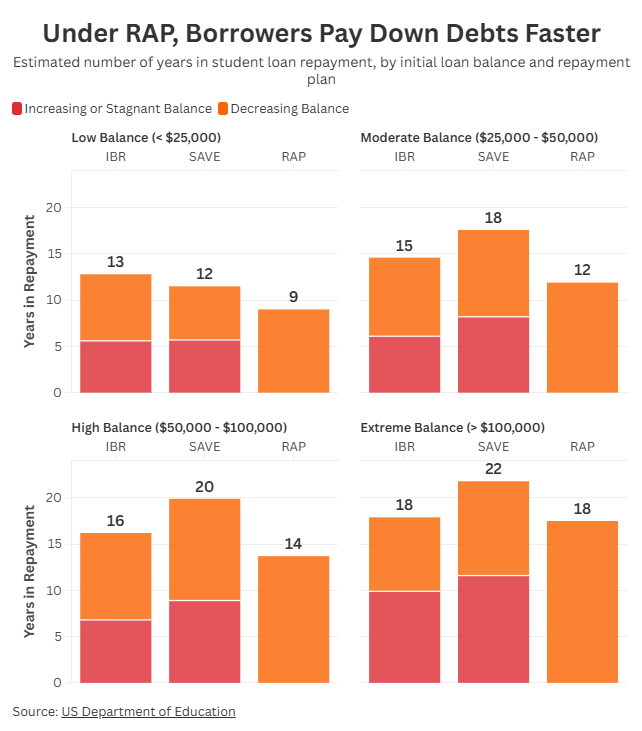
The upshot is that RAP borrowers pay down their loans faster over time. In a separate post for AEIdeas, I report on new Education Department data projecting how borrowers under RAP will pay down their loans. Borrowers with the debt of a typical college graduate (those owing $25,000 to $50,000) would take 15 years to fully pay off their loans under the legacy Income-Based Repayment (IBR) plan. Under the Biden administration’s SAVE plan, it would take 18 years. But these same borrowers will extinguish their debts in just 12 years under RAP.
Some have criticized RAP for raising monthly payments. This critique is misguided. True, borrowers will pay more under RAP than SAVE—but that’s because SAVE was a loan forgiveness plan disguised as a loan repayment plan. Most SAVE borrowers had $0 monthly payments and could get their loans canceled after a certain amount of time spent in “repayment.” Between half and two-thirds of SAVE borrowers were expected to receive loan forgiveness eventually.
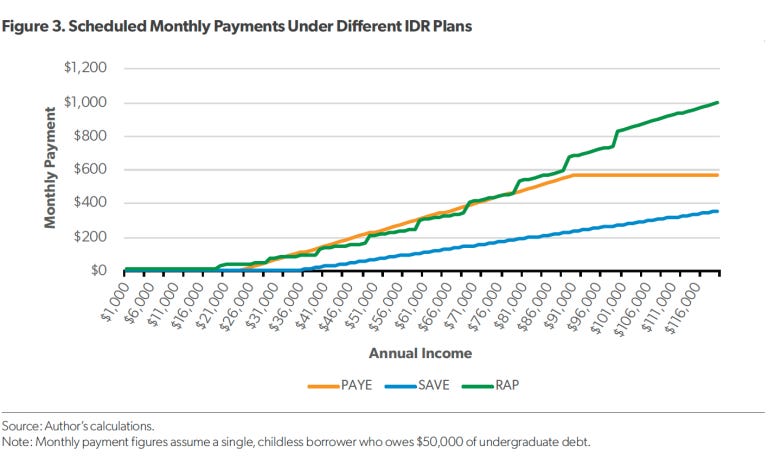
RAP is not a loan forgiveness plan and it doesn’t pretend to be. Borrowers in RAP will be expected to actually make payments on their loans. But as the following chart from a report I published last year shows, scheduled payments under RAP are roughly in line with the PAYE plan, another income-driven repayment option created under the Obama administration. Only the highest-income borrowers will pay significantly more under RAP.
By largely dispensing with loan forgiveness, RAP is also expected to save taxpayers a bundle—$368 billion through 2035, per Education Department numbers. It saves this money not by hacking away at the student-loan safety net, but by more thoughtfully distributing subsidies: helping low-income borrowers with interest and principal to stop debt getting out of control, but expecting higher-income borrowers to make fair payments. In the long run, it will help borrowers retire their debts faster and move on with their lives.
Let community colleges offer bachelor’s degrees. Iowa is considering a bill to allow the state’s community colleges to offer four-year degrees—and it’s getting considerable pushback from the state’s private colleges. But opening up the market for BAs would be a jolt of much-needed competition: community colleges charge low tuition and operate with a much lower-cost model than private schools. Where community college bachelor’s programs exist, they’ve shown good outcomes. Nothing brings down prices like market competition—and higher ed certainly needs lower prices.
Expanding “professional degrees” would just expand student debt. A misguided Congressional proposal aims to expand the definition of “professional degree” to cover nearly three-quarters of graduate borrowers—meaning these students could borrow up to $200,000 from the federal government to pay for their degrees. The current definition of “professional degree” covers just a small number of high-cost, high-salary programs like medicine and dentistry; expanding the definition could put millions of middle-class workers into unmanageable debt.
We need more residential trade schools, argues Michael Petrilli for Education Next.
Could Workforce Pell Grants be used to support apprenticeships? Wesley Whistle of New America explains.
Sadly, top firms are back to hiring only graduates of elite schools, reports the Wall Street Journal.
Baumol’s cost disease is an oft-cited explanation for high college costs—but it can’t explain administrative bloat, writes Vanderbilt Chancellor Emeritus Nicholas Zeppos.
Federal student loan subsidies have dropped to just 4 cents on the dollar (largely thanks to RAP), reports the Committee for a Responsible Federal Budget.
Progress reducing chronic student absenteeism post-pandemic has slowed, writes my colleague Nat Malkus.
A database of colleges offering free-tuition programs along with their requirements, from Danielle Douglas-Gabriel of the Washington Post.
My fiancé had a conference in Banff, Canada last month, so naturally I tagged along (and went for a snowshoe across frozen Lake Louise).

I’ll be on not one but two panels at the ASU+GSV Summit in San Diego in April. Looking forward to another bountiful dive.
Comments
Nothing yet. Say the first thing.
Sign in to join the conversation.