
Most people do not die quietly in their sleep, quickly and comfortably, at the end of a long life. That death - often portrayed in media, the one most tacitly expect - is the exception. Deaths are typically slower, more degrading, and more painful than that.
Consider, for example, the roughly 15,000 people dying from cancer in the Netherlands right now1. A tumor that began in one place has broken loose and seeded itself elsewhere - the liver, the lungs, the bones - and from there it presses on nerves, blocks bowels, and crowds out organs. Appetite goes. Weight goes. Breathing gets harder, thinking gets foggier. Pain can usually be managed, though not always, and the drugs bring their own toll - lucidity lost, constant constipation.
What can’t be prevented is the slow loss of the self. Bone riddled with cancer crumbles under ordinary weight. A tumor blocking the bowel means food has nowhere to go, so it comes back up, and what nutrition the body can still take may have to arrive through a tube or a vein. Bit by bit a person stops being able to wash, to use a toilet, to turn over in bed, without another pair of hands. Eventually, after weeks or months of this, they die.
None of this is the worst case - it is roughly the ordinary one. Good palliative care can help, and often helps a great deal. But for something like a fifth to a half of patients, some symptoms resist even the best treatment; and the hardest to control, like breathlessness, are often the most frightening.
But there is, in a few places like the Netherlands, another option. Since 2002, Dutch law has allowed patients with unbearable suffering to ask a doctor to help them end their life before their disease runs its course. After a patient has been thoroughly assessed, they may be given drugs to take themselves (physician-assisted suicide) - or, as most prefer, have the doctor administer them (euthanasia). Instead of the drawn-out version above, a quick death, at a time of one’s choosing.
Only one in nine take it.
And cancer accounts for more than half of Dutch cases2. Across all deaths in the country, assisted dying accounted for just under 6% in 2024. In the place with arguably the most settled assisted-dying system on Earth, more than nine in ten people still die some other way. Elsewhere the numbers are even lower - Belgium nearer 4%, Switzerland barely 2%, and in much of the world where it’s legal, under 1%.
More than three in four Dutch people support the right to an assisted death. So why do so few take it?
Perhaps 6% simply is the natural share of people who, at the end, want to go out under their own control. But this seems unlikely, as the rates don’t behave as if that were true: they’re still climbing in the Netherlands, they vary wildly between countries with seemingly-identical laws, and they sit below the proportion of terminally ill patients who’ve told pollsters they’d want assisted dying. Something other than preference alone is setting them.
Whether assisted dying is moral has been argued to exhaustion, and I’ve little to add to that discussion. What I want to know is this: if we gave every dying person a real choice - barriers removed, doctors easy to reach, few forms to fill - how many would take it? As the option spreads into ordinary medicine, will the number stay nearer today’s maximum of 6%, or eventually settle closer to 60%?
First: of everyone dying this year, how many could have an assisted death - never mind whether they’d want one?
For the roughly one in four who die of a fall, crash, cardiac arrest, or another form of sudden death, the question is irrelevant. Similarly, if someone doesn’t live in a jurisdiction where assisted dying is legal, the matter is already decided.
Live somewhere it’s legal, and it may still not be legal for you. Dementia is the typical problematic case here, both because it’s among the leading causes of death in the rich world, and because in most places it forecloses the option entirely. Nearly every assisted-dying law requires that a patient have the capacity to choose at the moment the drugs are given, and dementia is definitionally a disease that strips capacity away before it takes your life.3
But even if a dying person is of sound mind, and in a country where it’s legal on paper, they can still find assisted dying inaccessible in practice.
Sometimes the practice is legal but literally out of reach. In jurisdictions where only self-administration is allowed - such as Switzerland or Oregon - anyone who has lost the strength to physically administer the drugs is ruled out. Assisted dying has been legal in Switzerland since 1942, yet the rate is still only about 2% of deaths - well under the Netherlands or Belgium, where a doctor is allowed to administer (what patients overwhelmingly choose).
Sometimes there’s simply no-one to do it. The practice tends to be delivered by a small number of willing providers, concentrated in cities. Someone dying in a rural area may have no willing doctor for hundreds of kilometers. In countries like Australia, where doctors are banned from even discussing assisted dying via telehealth, this can end in absurdities. One terminally ill man in Far North Queensland, too unwell to travel, could only be assessed because a doctor flew 3,000 kilometres to see him, a second doctor flew 2,500 kilometres for the independent opinion, and then the first flew back again - some 8,500 kilometres of travel for a single patient’s assessment.
And sometimes the bureaucracy is such a burden that patients die before the paperwork is finished. Waiting periods, repeated assessments, second and third opinions - while each individually sensible, collectively they can form a gauntlet that a dying person may not outlast. Other times, it’s faith-based institutional refusal or simply a lack of trained physicians. In Spain, about a quarter of those who apply die before the process finishes. The patient in Far North Queensland mentioned above died before his medication could ever be dispensed for this exact reason.
So the pool that could choose an assisted death is already a small fraction of the pool that’s dying, even in places it’s legal. Remove the ~25% who die suddenly, and you’re at 75%. Of those, a good share lose capacity before the end - dementia alone is around 10% of deaths, and other conditions that fog the mind add more, so let’s call it ~60%. Subtract again those who can’t reach a willing doctor, or who would die waiting on the paperwork even if they applied, and we’re at somewhere between 50% of deaths under the loosest laws and 20% under the strictest.
Still, even the strictest reading of this funnel suggests a fifth of all people could make use of assisted dying, yet actual usage tops out at ~6% in the Netherlands, and runs lower everywhere else. Why such a large gap?
The obvious explanation would be that people don’t want it. But a settled preference doesn’t behave the way these numbers do. The Dutch rate went from under 2% of deaths at the turn of the century to nearly 6% now, and it’s still rising. Canada reached about 5% in eight years from a standing start. Switzerland, where you must take the drugs yourself, has risen more slowly - but it is rising. If only a small fraction of people wanted to die this way, and that share had already been reached, these systems should have already levelled off.
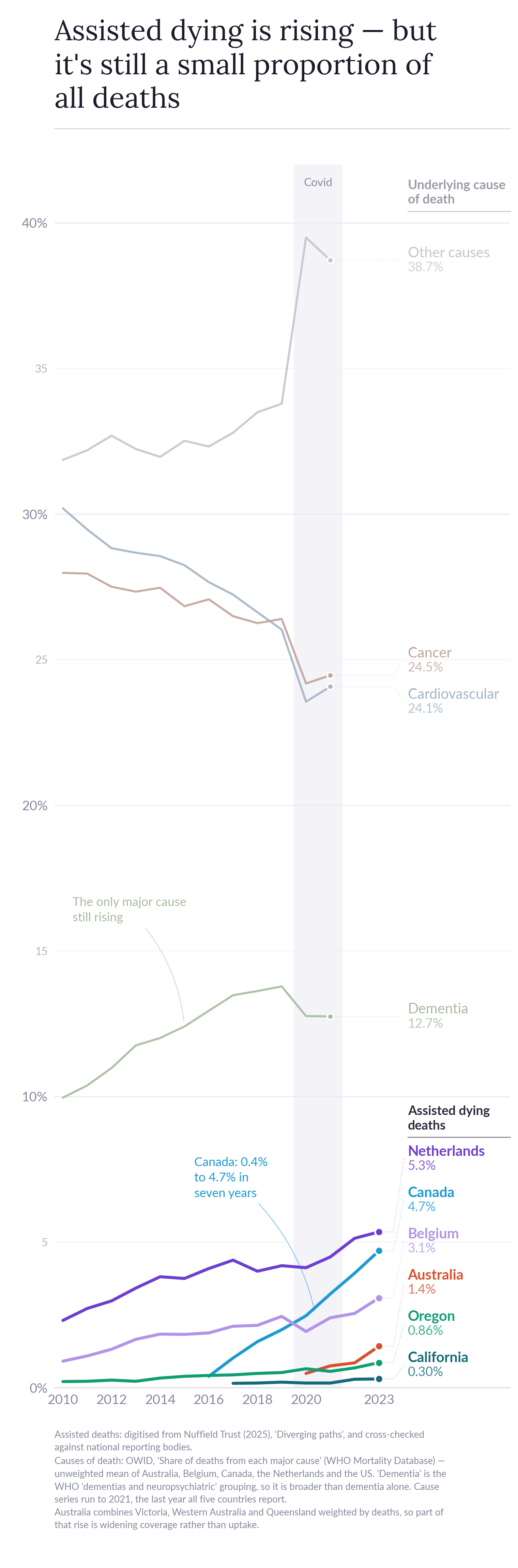
We should be careful though - a rising curve might be read by supporters as latent demand finally being met, or by critics as a practice manufacturing its own demand among people who’d otherwise never have asked. Still, twenty-eight years of surveys in Oregon have shown people’s reasons for choosing assisted dying have remained steady even as the rates have increased fourteen-fold: losing autonomy (around 90%), no longer being able to do the things that made life worth living (about 88%), and loss of dignity (64%). That’s the profile of similar people wanting the same thing, and just being increasingly able to access it.4
What these curves can’t tell us though is how many decline assisted dying because, on reflection, they simply don’t want it. Surveys of this population are few and far between. One survey of terminally ill Americans in the 1990s, before legalisation was widespread, found that most supported the idea in principle, but only around one in ten would seriously consider it for themselves. As far as I can tell, nobody has done the modern version: survey the people who are eligible today, under a real and settled law, ask them whether they want it, and why or why not.
Still, I can guess. Bringing one’s own death forward is a frightening thing to do, and I suspect that whatever their quality of life, many would simply rather not. The will to live is stubborn: even among the terminally ill in serious pain, most report wanting to go on - even though that will does rise and fall somewhat with pain and discomfort. How much of the gap is people like this, and how much is people who would choose an assisted death if it were genuinely within reach, isn’t yet known.
So where do the rates settle over the next ten years? Project the line forward and countries like Canada or the Netherlands look set to reach something like 10% of deaths. Cutting the other way, cancer and heart disease are slowly becoming more survivable, which shifts more of the dying toward dementia - and unless the rules on capacity change, that pushes the rate back down. As far as point estimates go, for countries that allow euthanasia, 10% in ten years seems a reasonable guess to me.
When we speculate about the long run though, we have to start from an odd fact: most people who choose assisted dying don’t actually want to die.
They don’t choose it because they’re finished with life. They choose it for autonomy and dignity - making the best of a bad hand, folding with grace rather than playing it out to the bitter end. Almost all of them would take a cure instead, were one on the cards. The people who decline are not so different. They also want to live life on their own terms; they’ve simply judged that what’s left is not worth letting go.
So a rising rate is not a rising appetite for death. When the Dutch figure climbs from 2% to 6% and keeps on going, it means fewer people are dying outside of their control, not that more of them want to die at all.
Given modern medicine’s limits, many die in ways no one would choose, and assisted dying is how some wrest back what control they can. But medicine is getting better. Albeit excruciatingly slowly, physicians and researchers work toward its ultimate goal: the elimination of all disease. Smallpox is gone, cancer is in decline, and every illness we beat back removes a way to die without one choosing to. Extend this far enough and we will eventually reach a strange place - the only way to die will be voluntarily. A social issue that would have to be grappled with for sure, but a world with that problem would be a far better one than ours.
Assisted dying is born of autonomy; regular suicide is born from despair. This is why public opinion can back one overwhelmingly while deploring the other. It is the same contrast that makes me care about assisted dying so much at all - because what I actually spend my time on is trying to abolish (involuntary) death, and the two turn out to be the same fight: handing people authority over their own endings.
I work on brain preservation - the idea that we might be able to pause dying and eventually revive an individual with future medical advances. You can think that’s plausible or fantastical, but the connection to assisted dying is that preservation is best performed under the conditions that assisted dying creates - a planned death, a chosen hour, a medical team ready to act, rather than a collapse and hours of decay before anyone can reach the body. Whether or not revival ever comes, a preservation done well has a far better chance than one done badly, and the well-done ones happen in a world where assisted dying is normal.
Around 48,000 people die from cancer each year in the Netherlands, and the actively dying/palliative phase of cancer is roughly 3-6 months.
Although cancer accounts for most cases, uptake is markedly higher in the rarer condition of motor neurone disease. Between 2012 and 2020, 1,014 of 4,130 Dutch ALS deaths were euthanasia or assisted suicide - a mean of 25% per year, against roughly 12% for cancer.
The Netherlands is the main exception: its Act lets a written advance directive replace a contemporaneous request, and in April 2020 the Supreme Court upheld a geriatrician’s acquittal for acting on one in a case of advanced dementia, holding that a request made competently cannot be revoked incompetently. The route is currently used sparingly - of 10,341 Dutch cases in 2025, only eleven involved patients no longer competent.
Financial and burden-related reasons rose over the same period - the share citing treatment costs reached a record 9.3% in 2024, and Oregon's recipients shifted from mostly private to ~80% government insurance. These are real and worth watching, but far too small to explain the increase: they account for perhaps 20 of the ~350 additional annual deaths.
No posts
Comments
Nothing yet. Say the first thing.
Sign in to join the conversation.