
Thank you for reading Present Forever. If you’d like to support this ongoing exploration of the offbeat and independent, please consider subscribing or upgrading:
The first time I posted about the Japanese label Gorsch was on 5 May 2023. A month earlier, I had set up an Instagram account under a pseudonym, without any real idea of what the page would become or why I needed a pseudonym at all. Looking back, I think I knew then — without knowing I knew — that I was becoming someone else, someone still unknown to myself.
I think I am that someone now, and no longer who I was back then, though I can’t be entirely sure.
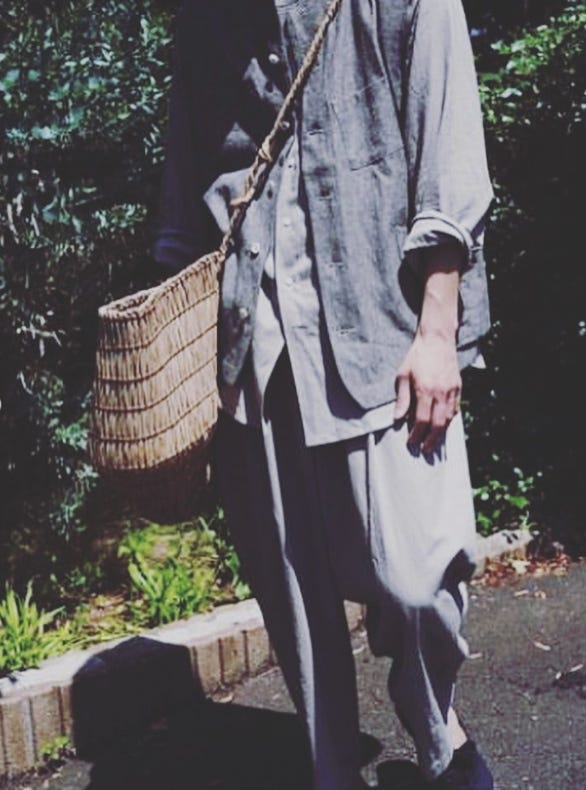
What I loved about that image from Gorsch was the down to earth feeling of gardening — something I had never done — and, above all, of doing it in clothes that looked better than anything I owned or had ever seen. I couldn’t even have imagined that such a thing existed. Whenever I’m gardening now, wearing the beat-up overalls and rubber boots hanging in my father’s shed, I sometimes think about that Gorsch image. I haven’t created a life of gardening in Gorsch, but I do feel that the image captured a glimpse of my future-to-be.
Now that I know more about Gorsch, I realize that its founder and designer — Eiichi Suzuki — also taught me a lesson through that image. He doesn’t know this, but he will when he reads this. Gorsch, he tells me, represents where he is in life right now: nothing more, nothing less, exactly that. One day he found an old treadle machine, some tailoring instruments and three garments in an attic, and learned that they had once belonged to his grandfather. He decided to follow in his footsteps, and now spends his days in a small studio “somewhere in the corner of this world.”

Gorsch started in a village in Iwate Prefecture in 2022, but today, four years later, Eiichi remains a novice. That is his approach to garments. Since garments are his life, it is also his approach to life. I take it as a reminder that you can be a novice in your own existence as well, even in knowing and being yourself. And as a novice, you will always only be who you are becoming. “I focus on the garments themselves,” Eiichi says, “to go deeper into my own sensibility. Seven days a week, I’m exploring myself through my work.”
Those garments, available at around 20 stockists worldwide, including Maidens, Neighbour and Standard & Strange, are inspired by the people around him. For SS26, Eiichi looked at Ken Sakagami, a movement artist based in Morioka, Iwate. “What he strives for,” Eiichi says, “is complete freedom of movement, down to every corner of the body.”



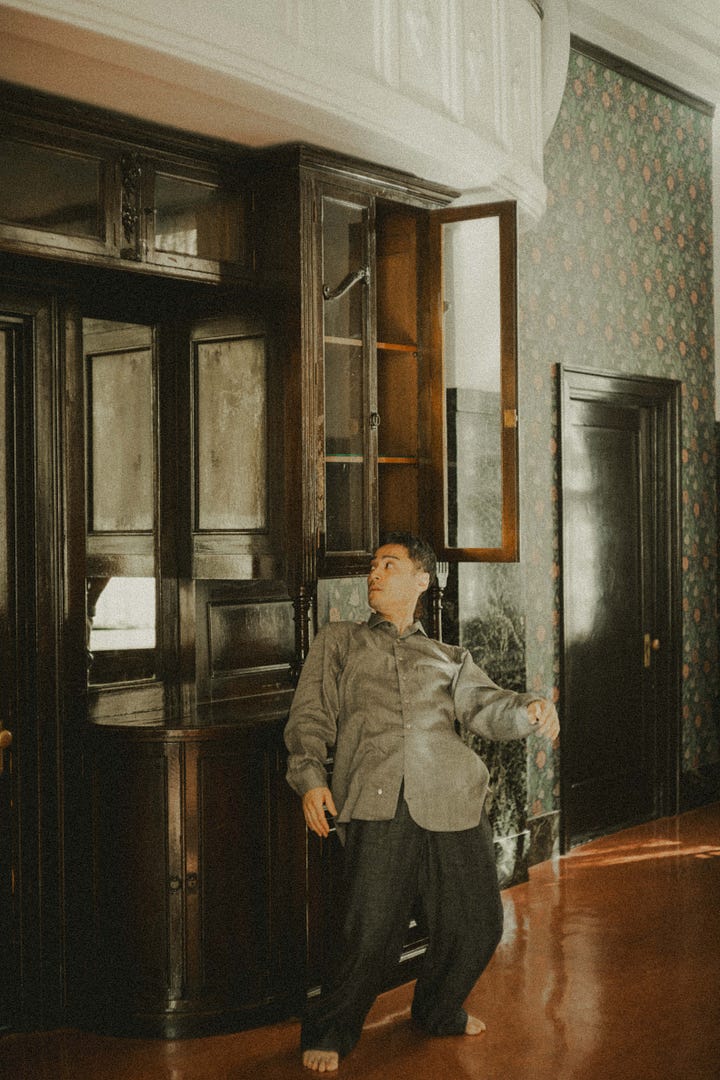
Eiichi himself participated in one of Sakagami’s movement lessons. “When I tried moving my body with conscious intent, I realized how drastically different my actions were from what I imagined. In other words, even moving our own bodies as intended is extraordinarily difficult [and] I began to wonder — what kind of movement would the fabric he wears take on? What atmosphere would it carry.” That question resulted in around 40 relaxed, generously cut items — mostly shirts, trousers and jackets, and almost all made from different kinds of linen, from pure French linen to linen-cotton-yak blends.
Eiichi and I met in the back room of a Paris coffee shop earlier this year. He was one of the designers I spoke about going to Paris Fashion Week without a showroom. The Gorsch garments Eiichi showed me were the ones he wore himself, along with a few others he carried in a bag. They were beautiful: earth-toned, slightly traditional in silhouette, with all the handmade twists and turns you could wish for. He told me about them in detail: how they’re made, why he made them the way he did, and with whom — pattern makers, dyeing artists, weaving factories, and many others, all nearby. It meant that he told me about himself, in reverse chronological order. I want to share what he said, without much editing — just his words, plain and simple, as he chose them then and there.
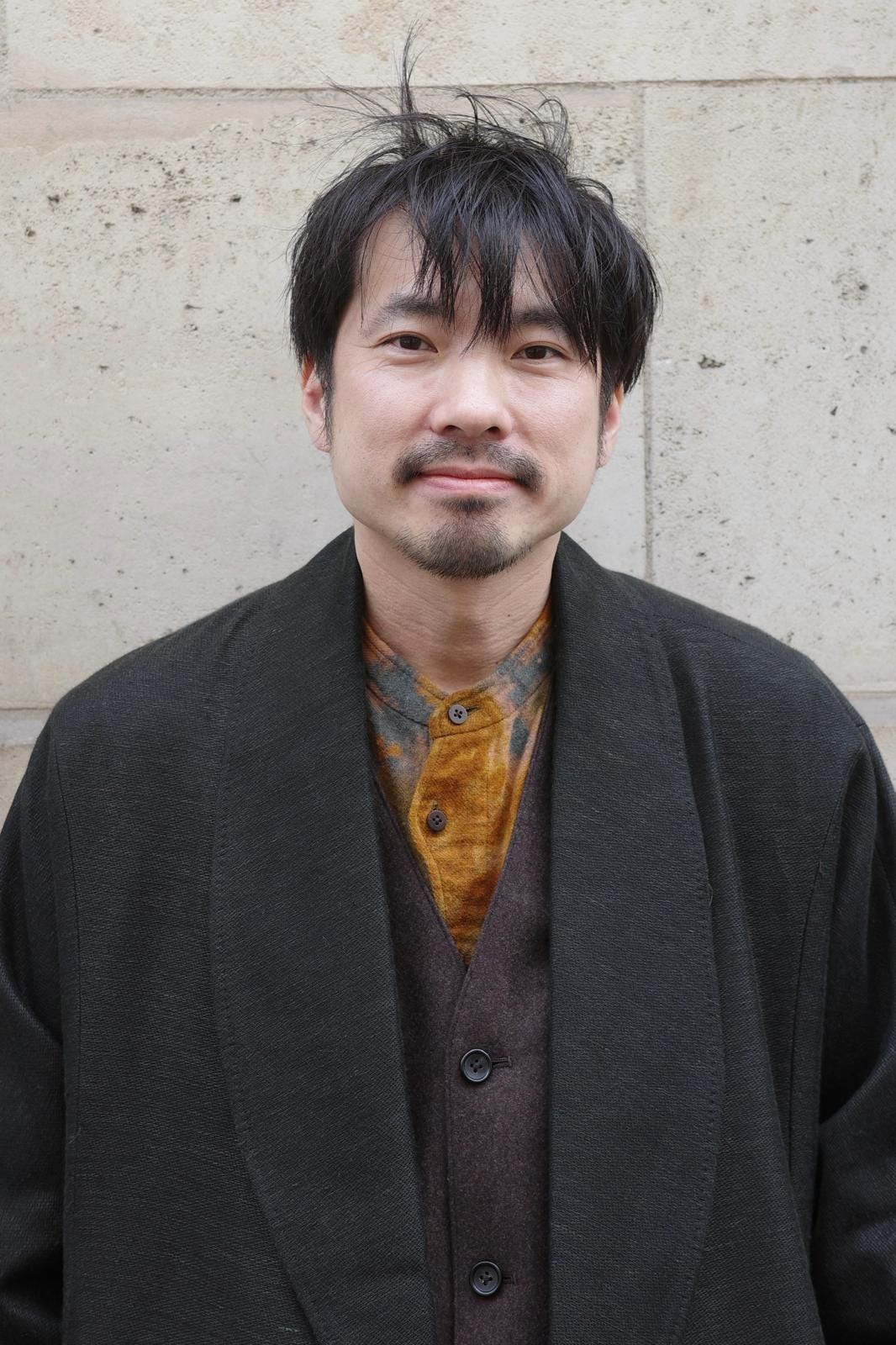
Lukas Mauve: How does it feel for you to be in Paris?
Eiichi Suzuki: I came here seven years ago. After that I didn’t leave Japan, so it’s been a long time. The last time I was here I was working for Frank Leder. I was his assistant.
Lukas Mauve: I didn’t know that. What was that like?
Eiichi Suzuki: I worked with him for three and a half years, living in Berlin at the time. It was a good experience overall. He’s really an artist. I mean, he’s a fashion designer, but in a very artistic way. I learned from him how to think like an artist. When I was in Berlin, I also asked some tailors to teach me how to sew garments by hand, which they did.
Lukas Mauve: Why did you leave?
Eiichi Suzuki: I wanted to start my own brand. I prepared for it in Berlin already. After 6 p.m., as soon as I had finished work, I would go back home and pursue my home practice.
Lukas Mauve: So your days were really long…
Eiichi Suzuki: Yes, long working days, but for Japanese people it’s normal — it’s not special to work from 8 to 12 or something like that.
Lukas Mauve: How did you meet Frank Leder?
Eiichi Suzuki: Well, first I’ve got to mention that I went to Central Saint Martins in London to study menswear. The curriculum focused on developing your own aesthetic rather than teaching it directly.
Lukas Mauve: …what do you mean?
Eiichi Suzuki: I don’t really know how to explain it. The teachers were giving a lot of advice on how to create your own vision or practice rather than actually teaching a technical skill. I thought this was very important in the beginning. However, since I had started later than my peers and was still relatively new to the field, I eventually began to feel that practical experience at work was more essential.

Lukas Mauve: Did you graduate?
Eiichi Suzuki: I didn’t. I quit in 2013 or 2014, when I was in my second year. And immediately after quitting I thought: what should I do now? I had started my studies quite late, and I was then already 30 years old.
Lukas Mauve: How did you cope with that?
Eiichi Suzuki: A friend asked me, ‘Do you know Frank Leder? I think this brand would fit you.” I didn’t know it, actually. But my friend got me in touch with Frank. I sent him an email and a portfolio and Frank just said, ‘Yeah, just come.’ And so I did.
Lukas Mauve: You said you had started your studies at Central Saint Martins quite late, in your late twenties. What did you do before?
Eiichi Suzuki: I was working for the Ministry of Foreign Affairs. I was a diplomat.
Lukas Mauve: Really?
Eiichi Suzuki: There are many categories of diplomats in Japan. I wasn’t ranked very high, just working with software.
Lukas Mauve: Where were you stationed?
Eiichi Suzuki: I was in Mexico and Bolivia, working for the Japanese embassies there.
Lukas Mauve: What was that like?
Eiichi Suzuki: I thought it was really boring. So boring. I knew I had to do something else. I even told them. Then one day I walked on some street in La Paz and I saw a tailor. I stopped to look and thought, ‘Wow, they’re making clothes.’ I didn’t really know what a tailor was. I walked in and asked them, ‘Please, could you tell me how to make clothing?’ And they said, ‘Yes, okay.’ And then I started my career.

Comments
Nothing yet. Say the first thing.
Sign in to join the conversation.