
We are currently witnessing intense polarisation and dramatisation in the political discourse, coupled with a pervasive sense of powerlessness and frustration. In an effort to feel more engaged, we turn to social media to share our views, yet things don’t seem to actually change in the IRL world.
Why does it feel so hard to influence the conditions around us and make the transition from expression our opinions to creating real change?
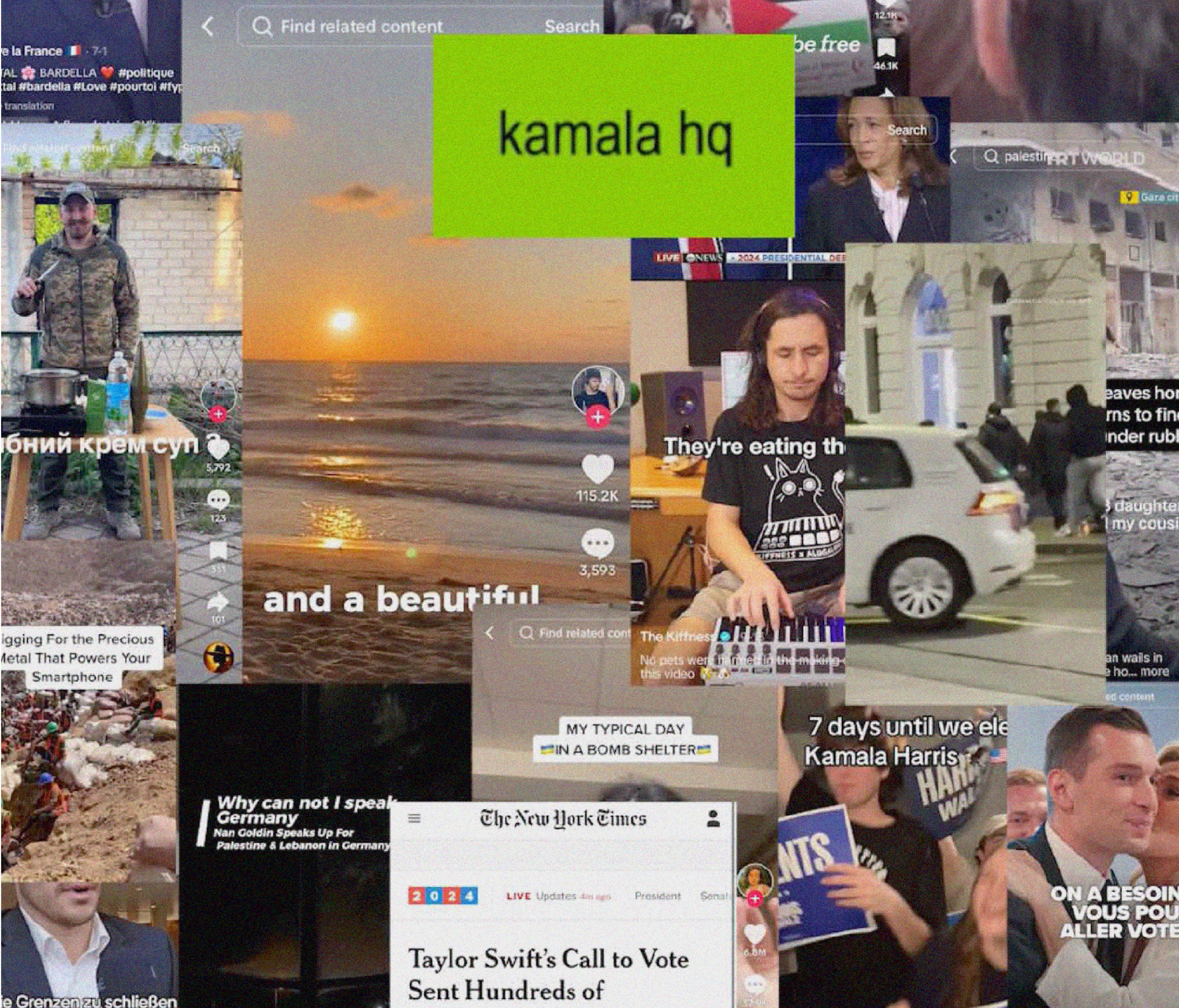
Online interactions can shape public sentiment and, in some cases, catalyse real change by mobilising people and raising awareness on key issues. The difference in today’s world is that institutions that would once instigate participative politics debates – like unions, universities or civil rights organisations – are weakened. Instead, politicians are betting on pop culture to reach voters – a BRAT campaign, chasing Taylor Swift endorsement and trusting TikTok influencers. Yet, a curious fact is that right-wing parties managed to somehow re invent the political debate and create purely political organisations – like MAGA in the USA and the Identitarian Movement in Europe –, something the left-wing parties are still lacking. In this scenario, while expressing our individual position is still extremely valuable, we may sometimes forget to ask ourselves:
What needs to happen institutionally and structurally to actually bring real change that goes beyond a statement? Are we – while we perceive ourselves as active – actually more passive than we think?
Anton Jäger, Belgian historian and political scientist, uses the term hyperpolitics, borrowed from Peter Sloterdijk, to describe the increasing politicisation of broad sections of the population, which is expressed in short-term declarations but remains politically inconsequential. He notes that waves of agitation rarely translate into collective action.
Hyper-politics is what happens when post-politics ends — something like furiously stepping on the gas with an empty tank. questions of what people own and control are increasingly supplanted by questions of who or what people are, replacing clashes of classes with the collaging of identities and morals.

Are we living in a spectator democracy, where we’re more observers and commentators rather than active participants, eroding the traditional forms of political engagement?
Jäger points out that Hyper-Politics is characterised by a new relationship between the public and the private; it is dynamic and intense, it polarises, but remains relatively diffuse in terms of substance. Some parallels to the fluidity of the online world and the accelerated internet age with its short cycles of hype and outrage can hardly be overlooked. Political engagement works completely differently than it did for long periods of the 20th century. It is more individualistic, more short-term, more volatile and less coherent.
At the same time, we observe that symbols and drama become more important than in-depth political discussion. This leads to a focus on media-effective productions that are intended to generate short-term attention.
In his latest book “Moral spectacle: Why the right attitude has become a status symbol and why that doesn't make the world a better place ”(2024), Philipp Hübl critically examines today's society, in which moral convictions are often used more for self-expression than for actual moral action.
“We are all constantly engaging in reputation management. For some time now, we’ve been seeing a new level of moral self-representation, especially in the digital public sphere” Philipp Hübl, Philosopher and Publicist @ Zeit Wissen Podcast
When algorithms dictate the type of content we are shown based on our preferences, "posting" becomes very different from "acting". At a time when digital communities are becoming increasingly isolated, we need a reinvention of popular dialogue in which empathy is respected to foster a greater sense of community rather than an individual perspective on the world.
How do we manage to enter into dialogue and then not stop at the point of expressing an opinion, but actually achieve structural transformation? How can our will and the need for change become stronger than the satisfaction of our moral vanity? There is no simple solution to this, but it is worth thinking about. What is your take on all this – where do we go from here?
No posts
Comments
Nothing yet. Say the first thing.
Sign in to join the conversation.