
I've been asked the same question probably a hundred times since the hearing. Some version of: how does a man who ran twice, across two states, get a bond at all? Why didn't the judge just hold him?
Fair question. Here's the answer, and it isn't the judge's fault.
The judge couldn't.
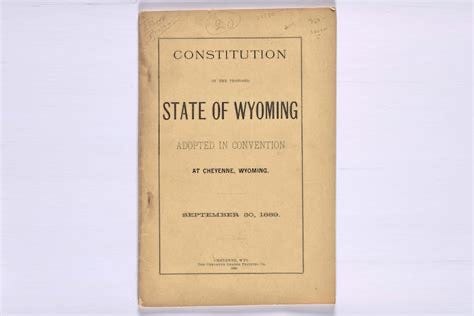
Wyoming Constitution, Article 1, Section 14. It's in the Declaration of Rights, and it's been there since statehood in 1890:
“All persons shall be bailable by sufficient sureties, except for capital offenses when the proof is evident or the presumption great. Excessive bail shall not be required, nor excessive fines imposed, nor shall cruel or unusual punishment be inflicted."
Read the first twelve words again. All persons shall be bailable.
Not may be. Not at the court's discretion. Shall be.
There is exactly one exception written into it: capital offenses — cases where the death penalty is on the table — and even then only when the proof is evident or the presumption great. In Wyoming, that means first-degree murder. That's the list. It's a short one.
Whatever you think of the charges John Smallbone is facing, and I've written plenty about them, they are not capital offenses under Wyoming law. Which means a Converse County judge has no constitutional authority to hold him without bond. None. It doesn't matter how serious the charges are. It doesn't matter that he already ran. The provision doesn't have a "unless he's really bad" clause, because it wasn't written to have one.
If a court can't deny bail, it can do two other things, and both happened Friday.
Set the number high enough that it functions. The state asked for $1,000,000, cash only. The judge granted it and said on the record that his only question was whether a million was enough.
Attach conditions. No contact with the victims, their families, or anyone under 18. Stay sober. Daily in-person reporting to the Sheriff's Office, between 8 and 10 at night, to prove he's physically in this county.
That's the whole toolbox. That is a judge using every inch of room the constitution gives him.
Notice the same provision also says excessive bail shall not be required.
So there's a floor and a ceiling. A court can't hold you without bail in a non-capital case, and it also can't set a number so absurd that it's a denial of bail wearing a costume.
Where the ceiling sits depends on the defendant. Flight risk. Danger to the community. History. And a man who has now failed to appear in two states after a quarter-million-dollar cash bond gives a judge an enormous amount of room before anybody could seriously call a million excessive.
That's not a loophole. That's the system weighing what he actually did.
Here's the other thing worth understanding about how this works.
Within the framework we've got, the court's answer to a defendant who runs is a bigger number. That's the lever. It's most of the lever.
Watch it happen in this case. His first bond was $250,000 cash. Somebody paid it, and he left the state. So the second one is $1,000,000 cash only, plus daily in-person reporting and a stack of conditions.
If he somehow made this one and ran again, the next one would be higher still. That is exactly what a judge would do, and it's what a judge is supposed to do — each failure to appear is evidence, and evidence of flight justifies a bigger number without it becoming "excessive."
It's a blunt instrument and it works slowly, but it does work in one specific way: it prices him out. At some point the number exceeds what anyone around him can raise. A quarter million got walked through the door of the Converse County Detention Center in June. A million is a different proposition.
Remember also that a high flight risk and not necessarily a high get-away risk. Smallbone has already proven he is not very good at running — twice now.
Some of you are going to read this and think the rule is wrong. That's a legitimate position and I'm not going to argue you out of it. The federal system works differently — federal judges can order pretrial detention outright in certain cases. Wyoming chose otherwise, in 1890, and hasn't changed it.
And there's another road, which several people have raised with me today: make these crimes capital offenses.
Because look at how Section 14 is written. The exception isn't a list of bad crimes — it's capital offenses. Change what qualifies as capital, and you change what falls inside that exception.
Idaho did exactly that. In March 2025, Governor Brad Little signed House Bill 380, creating a new charge of aggravated lewd conduct with a minor 12 or younger and making it death-eligible where prosecutors can prove at least three of more than a dozen aggravating factors. It took effect July 1, 2025. The Idaho House passed it unanimously. Only five senators in the entire state voted no. Florida and Tennessee have passed similar laws.
Now the part you need to know, because anyone arguing against you will lead with it.
The U.S. Supreme Court has already said this is unconstitutional. In Kennedy v. Louisiana (2008), the Court held that the death penalty cannot be imposed for the rape of a child where the victim did not die. Idaho's legislature passed HB 380 knowing that. They passed it anyway, openly expecting a court challenge, with the stated position that the Supreme Court got *Kennedy* wrong. As of today, no one has been executed under any of these laws and the precedent still stands.
So would making child sex offenses capital in Wyoming let a judge hold a defendant without bond? Honestly — nobody knows. It's an untested question. You'd have an offense the legislature labeled capital, carrying a punishment federal precedent says can't be imposed. Whether that counts as a "capital offense" for purposes of Article 1, Section 14 is something a Wyoming court would have to decide, and it would be litigated hard.
I'm laying out the argument, not telling you it wins. It's a real road and Idaho has walked it. It's also a road that runs straight into the Supreme Court, and it may end there.
But understand what changing it takes. This is not a statute a legislator can amend over a session. It's the constitution. Amending it requires two-thirds of both houses of the Wyoming Legislature and then a majority of voters at a general election.
If that's what you want, that's the road. It runs through Cheyenne and then through a ballot, and it starts with your own legislator.
What it doesn't run through is a district judge in Douglas who followed the law he swore an oath to.
I'll say this because I think it's worth saying, even to a room this angry.
That provision protects him this week. It has protected a lot of people in this state who were innocent, or overcharged, or arrested on somebody's bad word, and who would otherwise have sat in a cell for months waiting to prove it. Rights are inconvenient in exactly the moments we most want them to be.
Right now the practical question isn't whether he has a bond. It's whether anyone can pay it.
The last one was $250,000, and somebody walked it in.
This one is a million, cash only.
Wyoming Constitution, Article 1, Section 14 is public and takes about ten seconds to look up. I'd encourage you to read it yourself rather than take my word for it.
No posts
Comments
Nothing yet. Say the first thing.
Sign in to join the conversation.