
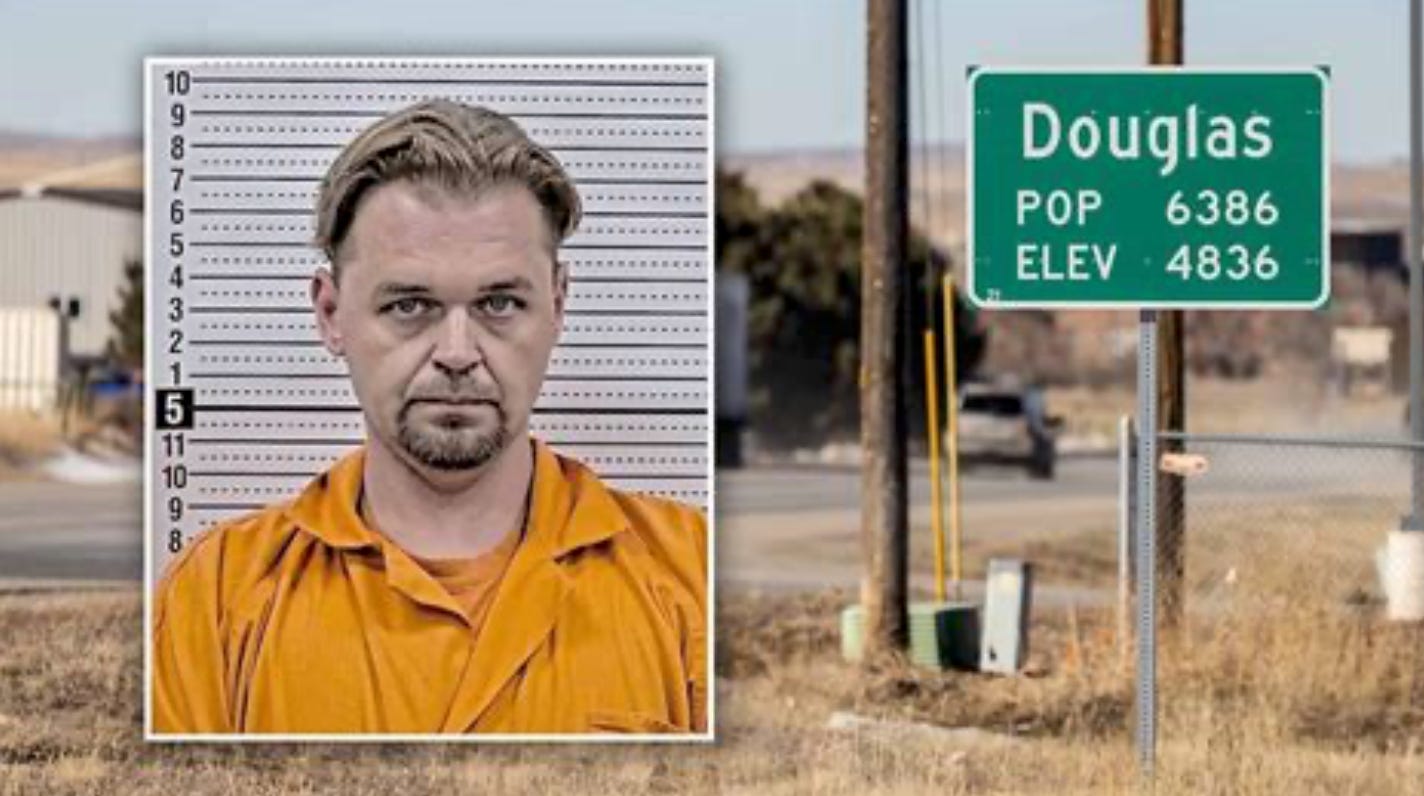
DOUGLAS — One of our witnesses lasted through five or six counts.
That was Monday afternoon, in a Converse County courtroom, at a preliminary hearing docketed for 3:30 p.m. that ran until close to 7.
She had come to hear the state lay out its case against John Charles Smallbone, the 38-year-old Douglas man this publication has covered since the first affidavit landed in May. She got through the opening charges. She got through the investigator’s testimony on the first one. Then she walked out.
“I couldn’t listen anymore,” she said.
The second witness lasted a great deal longer. He sat through every one of the counts — the evidence attached to each, what each image or video depicted, hours of it. Then the state moved on to reading the statutes that permitted each charge, and somewhere around halfway through that, he left too.
He had heard enough.
Between them, that is the whole of it. Nobody this publication spoke to made it to the end of that hearing. The gallery held roughly seven people when it started, and by both accounts it thinned from there.
What struck the second witness was who wasn’t in those benches. Not the families — he understood about the families. It was everyone who had spent months on Facebook saying how they felt about this case.
“There was hardly anyone there,” he said, “for all these people that are up in arms.”
Thanks for reading! This post is public so feel free to share it.
Smallbone did not have to let this happen.
In Wyoming, a felony case starts in circuit court, and before it can move toward trial the state has to clear a preliminary hearing. The judge isn’t deciding guilt. The judge is deciding whether there’s probable cause to believe a felony occurred and that this defendant committed it — a far lower bar than beyond a reasonable doubt, with relaxed rules of evidence.
A defendant can waive that hearing. Many do. Waiving means the state never puts a witness on the stand, never recites the counts, never describes the evidence. The case moves along and the public learns nothing.
Smallbone did not waive.
So the state had to prove it up. Everyone was in place by the 3:30 p.m. call, but the hearing did not go on the record until 4:15. That gap is ordinary practice in Converse County — defense counsel and the prosecution conferring off the record, then telling the judge they’re ready. Once it started, the judge told the room they’d be there a while, because there was a lot to get through. There was: the hearing worked through the entire charging document, one count at a time, before turning to the statutes underpinning each one. It ran the better part of three hours, ending not long before 7 p.m.
It worked. Two counts did not make it through. The other 81 were bound over to district court.
Nothing about this case is going behind a curtain. A criminal trial in Wyoming is a public proceeding. The gallery is open, the filings are open, and the press can sit in the same benches that were nearly empty Monday. If this goes to trial, more sworn testimony will be heard, not less.
What changes is who does the talking, and at what cost.
A preliminary hearing runs on relaxed rules of evidence. Hearsay is allowed. That is why the state could put one investigator on the stand and have him recount, count by count, what children told him and what he found on a phone. The children never had to walk into that room.
At trial, that ends. A defendant has the right to confront the witnesses against him, so the state has to put the people themselves on the stand — including the girls. They will be examined and cross-examined by the same defense that spent Monday suggesting a 12-year-old invented what she saw.
Wyoming has been building guardrails around exactly that. Under a law that took effect last year, a witness under 18 in a sexual assault or incest case can testify by real-time closed-circuit video from outside the courtroom, if the court finds after a hearing that being in the same room as the defendant would cause substantial emotional distress or keep the child from communicating. Other accommodations don’t require a hearing at all: questions phrased in an age-appropriate way, breaks whenever the child needs them, a support person clearly visible and close by, a therapy dog or a comfort object. Separately, Wyoming law restricts the release of victims’ names in sexual assault cases, and courts in these cases routinely order that minors be referred to by initials — which is precisely what happened Monday.
The evidence itself is handled differently too. Images and videos depicting child sexual abuse are not passed around a courtroom or handed to reporters. That material stays in law enforcement custody, and any display is tightly controlled and limited to the people who have to see it. Nobody in the press has viewed it, and nobody will. What the public gets is what a sworn officer says about it on the record — which is exactly what the public got Monday.
So the reporting from here looks different. Less narration of an entire case by one witness in one sitting. More: motions, rulings, a jury, and eventually children giving testimony that this publication will cover without naming them or describing what was done to them in any greater detail than the record requires.
And there is one more possibility, the likeliest one statistically. Most cases like this never reach a jury. If Smallbone pleads, there is no trial, and the factual basis a judge reads into the record at a change-of-plea hearing is a fraction of what was said out loud Monday afternoon.
That is why Monday mattered. Not because the courthouse doors are closing — they aren’t. Because it may turn out to have been the one time the whole of it was said, in public, at length, with anyone free to walk in and listen.
Seven people did.
The lead investigator, a lieutenant with the Converse County Sheriff’s Office who wrote the original probable cause affidavit, was on the stand for hours.
For each count the questioning followed the same pattern: the evidence attached to that count, what the image or video depicted, and then which statute allowed the state to charge it that way. The videos were described using only the minors’ initials.
“I know them all,” the second witness said, “so it was very disturbing.”
The material fell into two categories, and both were laid out.
The first was made in Smallbone’s own house — a single-wide trailer outside Douglas. He had placed cameras inside it. One was in a child’s bedroom. The count the state took up first involved a video from that room of a girl being sexually abused involving the family dog. She did not know the camera was there. The investigator testified that a second girl present had glanced up at it several times; the girl in the video never did.
Seven more recordings were of Smallbone and his wife. She told investigators she did not know she was being filmed either. Every video involving a victim, the investigator said, was made without that person’s knowledge or consent — a house wired to record the people living in it and visiting it.
The second category came from outside. Most of the images and videos underlying the charges were found on Smallbone’s personal cell phone and tablet: child sexual abuse material bought in bulk from strangers, which the investigator described in detail count by count.
Then there was the hardware. Computers. Multiple phones. Hard drives. Thumb drives. Laptops. Tablets. A bag in the master bedroom holding an assortment of recording devices — different kinds of cameras.
The first witness said the investigator had a hard time with it. He was visibly shaken. At one point the prosecutor acknowledged it out loud, telling him he understood it might be difficult to speak about the videos.
That is worth sitting with. This is a career law enforcement officer doing the ordinary work of laying out a case, and he could not do it easily. If a seasoned investigator struggled to put it into words, nobody in that gallery had a chance.
None of it would have surfaced but for a girl in the back of a car.
On May 9, a 12-or-13-year-old was riding back from a birthday party in Casper. Smallbone was in the vehicle with her, along with others.
He tugged her leg to get her attention. Then he held up his phone at an angle where only she could see the screen. Typed into a notepad app were the words “if you suck me, I’ll lick you,” according to the affidavit of probable cause.
Consider her position. She was in a moving vehicle. She could not get out. She could not turn to another adult and point at the screen, because by the time anyone else looked there would be nothing to see. There was no text to screenshot and no thread to hand to a parent — he had typed it into a notes app on his own phone, and that is where it stayed. Investigators never recovered it.
She told her mother anyway.
Her mother reported it to the Converse County Sheriff’s Office. That report is the reason the cameras were found, the reason the devices were seized, and the reason there are now eighty-one felony counts in Converse County District Court.
The defense is contesting fewer than half the counts. The rest are effectively conceded — not because anyone agreed to anything, but because of the evidence attached to them.
What the defense is fighting is the girl in the car.
Investigators never recovered those notes from Smallbone’s phone. So the defense’s theory is that she made it up.
The same approach was applied to a second allegation. The affidavit says Smallbone also silently mouthed words to the girl — “I want to see you naked” — during the interactions that day. The defense asked how she could be the only person who saw it, and whether the state seriously intended to rest on a child’s ability to read lips.
The investigator’s answer: the kitchen is very small. It’s a single-wide trailer.
And the defense put the question to the courtroom directly: are we just going to take the word of a 12- or 13-year-old?
That is the case in one sentence. Eighty-one counts, most of them backed by files pulled off a phone and video pulled off cameras in his own house, and the fight is over whether a seventh-grader is lying.
Two counts did not make it to district court. It is not yet clear which two, or whether they failed for lack of probable cause or were withdrawn by the state.
Testimony also went to where some of the material came from.
The investigator described Smallbone using Telegram — the encrypted messaging platform — to buy bulk quantities of child sexual abuse material, receiving samples and then taking delivery of large batches of image files onto his phone. He was also described as searching for and attempting to purchase images on the dark web.
And the investigator testified to something that ought to stop this county cold: Telegram is based in Dubai, and the company is unwilling to work with law enforcement.
Telegram was founded in 2013 by Pavel and Nikolai Durov, brothers born in St. Petersburg, Russia. Pavel Durov left Russia in 2014 after refusing government demands over his previous company, the social network VK, and moved Telegram’s operations to Dubai in 2017. He holds Emirati and French citizenship.
In August 2024, French authorities arrested Durov at an airport outside Paris and placed him under formal investigation over criminal activity on the platform — including drug trafficking, money laundering, and the distribution of sexually explicit images of children. He has denied the charges. He was permitted to return to Dubai in March 2025 with the investigation ongoing.
So this is the picture. A man in a single-wide trailer outside Douglas, Wyoming, was allegedly able to buy images of abused children through a mainstream app on his phone. The investigating agency’s position is that the company on the other end will not help them. And the company’s founder is himself under investigation in France, in part over exactly this category of material.
That is not a Converse County problem. But it landed in Converse County, on a lieutenant who had to describe the results out loud in a nearly empty courtroom.
Smallbone met the second witness’s eyes a few times early on, then looked away and kept his face toward the bench for the rest of the hearing. Timid, the witness called him. He was not smiling.
His mother was.
She sat in the gallery and stayed leaned forward toward the defense table, working to catch her son’s eye each time he turned. She smiled at him. When the judge called a five-minute recess, she walked out of the courtroom still smiling, a few steps behind a woman who was leaving because she could not listen to any more of it.
She had posted publicly that people ought to stay quiet until they know the whole story.
Her son’s history is not a rumor and it is not new. It has been on paper for nearly a quarter century, and it is laid out below.
Nearly a quarter century of quiet brought us to today.
John Smallbone was convicted in 2002, in Douglas County, Colorado, of sexual assault on a child by a person in a position of trust. He was 12 years old at the time of the 2001 offense. While in treatment, according to the probable cause affidavit in the current case, he disclosed sexual contact with at least seven other children — five of them younger than he was.
He registered as a sex offender in Wyoming in 2014. It was later determined he was not required to register here, because Colorado had adjudicated him as a juvenile. The record came off the board.
He then lived in the Douglas area for years — his former landlord estimated about a decade in a trailer on the property. He played Santa Claus for as a part of the events coordinator for ABATE, a local motorcycle rights organization that is since mostly defunct. He played the Easter bunny for the city, and was thanked by the mayor. Nothing stood between him and other people’s children: no check, no flag, no conversation.
“We need to be mad that the powers that be in this town let him near our kids without a background check,” the second witness said, “and now we need to follow through and make sure there is justice for not just the local victims but everyone involved.”
That is what enabling looks like in practice, and it is not a single failure. It is a registry that let a documented history vanish on a technicality. It is every arrangement, year after year, in which a man was handed access to children and nobody thought to ask. It is a mother who sat through the reading of the counts against her son after publicly telling her town to hold its tongue. And it is a defense whose central argument is that a seventh-grader made it up.
The people who had years to speak didn’t.
And remember what was avoidable. A camera in a child’s bedroom. A dog. A phone screen tilted toward a girl who couldn’t get out of the car. None of that is the price of an unlucky county. It is the price of a documented history that Wyoming took off its own books on a technicality, and of all the years in which nobody with the power to ask a question asked one.
This publication has covered the Smallbone case from the first filing, and has had someone in the room or on the record at nearly every stage: the initial charges; the $250,000 in cash carried into the Converse County Detention Center on June 24 to bond him out; the Colorado arrest and the Larimer County hearing that let him walk on a personal recognizance bond because the extradition paperwork didn’t reach the magistrate in time — a hearing this reporter watched by video; the July 28 arraignment he did not attend, telling the judge through his public defender that he feared for his life; the arrest in San Francisco roughly four hours later; the California proceedings, covered by a volunteer who went and took notes on our behalf because there was no remote option.
He was returned to the Converse County jail on Aug. 20 after two days on the road.
All of it led to a room where the state finally had to say out loud, on the record, count by count, what it says he did — and where almost nobody came to hear it.
Monday moved it up. Eighty-one felonies, bound over to Converse County District Court — where the last time Smallbone was scheduled to appear, he didn’t.
No posts
Comments
Nothing yet. Say the first thing.
Sign in to join the conversation.