
In the last couple of weeks I shared 9 hates and a fear. This was part of an exercise based on the writings of Ray Bradbury to uncover your unique viewpoint on the world. Because, as a writer, you can’t be Stephen King. Or JK Rowling. Or (non-fiction wise) Malcolm Gladwell. Or Morgan Housel.
You can only be you.
The sooner you embrace that…and start writing as you….the sooner your writing will be unique. And that turns you into the ‘business term’ of A Category Of One.
No-one in the world can be a better version of you…than you are. So embrace that. And build an audience who resonate with your unique take on the world.
But how do you do that, I hear you say.
I’m glad you asked that, my fellow writing droog.
Because I’m going to tell you. And it’s both simple. And hard. At the same time. Which, ultimately, is the joy and pain of being a unique writer.
So let’s dive in. It all starts with…
There’s two ideas about how people write about flow that piss me off. (And note - ‘piss me off’ is a strong emotion…I’m writing about something that annoys me…which means emotion. We’ll cycle back to this in #2.)
The first is this: that writing in flow is about increased productivity. And it is…but that’s not the primary goal.
The second thing that pisses me off: the advice is give that you should write in flow. But no-one really tells you how.
Sidebar: I’ve put together a course on this…with a 28 day plan to make writing in flow…email me directly by checking out the details here:https://deliberate-practice.com/contact/ and I’ll send you some details. Or don’t and work it out yourself. I’m cool either way.
Here’s the Number#1 reason why you should write in flow: it’s the conduit to writing from your authentic self, from your subconscious brain, from the ‘well’ you’ve created by mixing your experiences, your readings, your thoughts and so on.
Ray Bradbury says - and for those who know, it’s one of the best pieces of writing advice ever:
You must sprint to outpace your conscious brain.
And it’s true. One of the ways to write in flow - to build this conduit to your authentic self - is to write so fast that your conscious brain can’t intervene. Don’t go back. Don’t correct spellings. Just let the words fly out of your fingers onto the (virtual) page.
That’s a given.
Like any skill, you can train yourself so that it’s a repeatable process. (See Sidebar above about my HOW TO WRITE IN FLOW program).
Don’t believe me: go watch someone play jazz. Not once. But two or three nights on the trot. What you’ll see and hear is that, while there are things that are similar from night to night, that a jazz soloists’s performance of the same song on three consecutive nights is always different.
That’s because jazz improvisation is the closest thing that I know to writing in flow.
Ask a jazz musician what they’re playing and the answer you’ll get back isn’t anything to do with the scales they know, or anything technical. It’s some variation of: I played what I felt. Or: I played what I heard in my head.
Where this connects to writing: mostly a jazz soloist doesn’t just step up to the mic and play. But he steps up to the mic and plays within the constraints of specific songs. Which have melody and harmonic structures and rhythmic structures that act as guide.
The connection to writing: I’m writing in flow now, but I’ve got the constraints of writing non-fiction, and the constraint of writing an Introduction, a Ride-Out, and four sub-headlines to guide what I write.
So this piece - while I pre-planned the 10,000 foot overview while I was walking with my B4LF (which is also a flow activity for me) - has a constraint. But I’ve no idea of the words that will come out of my fingers. I’m letting my subconscious brain provide them….and I’m just transcribing.
Note: I talked about jazz improvising. Maybe I’m one of the few writers who’s also been a working musician. That’s a big part of my lived experience, and it’s a natural connection for me to make in a way that someone who is NOT a musician in a field where improvisation is the norm wouldn’t make. It’s part of my uniqueness. So it bleeds out into my writing if I’m writing from my authentic self.
Sidebar: one of the book projects on my list is to take a book that few (if any) of you will have heard of, let alone read….and distil the lessons for writers from it. Because the book is about jazz improvisation…so it’s about flow. Another note: if I’m the only person in the world who ever learns from the writing of that book….I give no fucks if anyone else ever reads it. The value to me will be in the process of writing those thoughts down and setting them on paper.
So writing in flow is the first key to writing authentically. The second is….
Writing is a form of telepathy. At this moment - as you’re reading these words - I’m talking directly to you. You’re hearing my voice in your head.
That’s telepathy.
Only….it’s common for writers to neuter what they are writing, and make it ‘safe.’ To strive to make their writing accessible to as many readers as possible. Which is choosing to turn their writing into a commodity.
And stripping the power out of it.
So first thing: stop writing for thousands of people. Even if you’ve already got an audience of thousands of people. Hone in on just a few people from your audience. And write directly to them.
Reframe your writing like this: don’t think of it as ‘content’ for an audience, but think of it as a letter to a dear friend. Or a love letter. You wouldn’t write such a letter and homogenize it the way most writers neuter their writing.
Think of how you email with close friends.
That’s exactly how you should write.
Because only you write like that. And sure, if you’re writing directly to someone there will be nuances that crop up due to the relationship between the two of you. But your audience will either get those nuances - and dig them, because they’re unique and one of the things that the use of AI will bring is a slew of writing that’s like a mannequin dressed in Versace and Gucci (but doesn’t possess a beating heart and a brain that buzzes with dreams and hopes) - or they won’t. And if they won’t….you give them a chance to ask questions. And your answers are a direct communication to another human being!
Man, if you join the dots and see where AI is going…and see that it’s human nature that people who can’t write will use AI to pump out lifeless content - content that’s grammatically perfect and has the simulacrum of real writing, but lies on the page as dead as dogshit - then you’ll see that you can’t compete on quantity.
But AI can’t compete on humanity.
The writers to fear won’t be the ones who use AI to write. But will be the ones who learn how to use AI to 10X their productivity.
And even then….they can’t compete with you. If you’re writing authentically.
Which means: writing in flow; writing to a specific person.
Seth Godin, talking about minimum viable products, said something like: “…start off by selling to one person. When you’ve found one person….find a second. And then a third. And then ten. And then hundreds. And then - hopefully - thousands.” The exact words of the quote aren’t important….because going off to look for them will break me out of flow and what I’m writing to YOU…right now, right here….what’s important is the meaning.
So there’s another lesson: you don’t need for everything you write to be perfect. If you - dear reader - understand the point I’m making, then that’s all that needs to be written. That point: write to one person….there are 8 billion people in the world and there will be more people in the world just like the person you are writing to.
BTW: forget avatars. They are computer simulations of a real person. If you need to, find someone to write to, email them, ask them what they want to know about and answer their questions. Or do it on the phone, get AI to transcribe it….and your raw, unique thoughts are on the page that you can turn into an article. Or a newsletter. Or part of a book.
Sean D’Souza calls this concept: the target profile. Hat tip to him. Go find his writings and podcasts about it. It help your transformation into an authentic writer.
Final note: you can write for multiple people in your audience. It doesn’t always have to be the same person. But for each piece of content ask yourself this question: who do I know who this content is best for. And write it just for them.
Now you’re blending two types of uniqueness: writing from your authentic self (in flow) to a specific person. Do that and you’ve negated 99.9% of the content generated by ‘pseudo-writers’ using AI.
So: we’ve got: to write authentically you need to write in flow and write to a specific, single person. (In fact one of the biggest writing reframes you can do is to actually write your content as a fucking letter (or email) to a specific person….and then strip out anything that’s too personal. Or better still: leave it in.)
That gives us: who we’re going to write to; and how we’re going to do it. It doesn’t give us the ‘what’ - as in: what we’re going to write about.
For that we need to make some lists.
I said I’ve been digging deep into the writings and interviews of Ray Bradbury recently, one of his pieces of advice to find your authentic writing voice is to make lists. The 10 things you love. The 10 things you hate. The 10 things you fear. The 10 things you dream about. And then write about those things.
Lists are not only the way you access the topics that matter to you, and that then define you as a writer, but you can also use them as a way to test out content ideas if that matters to you. (Personally, if I have something to write about….and the idea hits….then I try and get that fucker on the page before it flies off. But you might be different).
If you have some kind of morning journaling or morning free writing habit, making these lists is a great task for that. If you don’t have that kind of habit, why not? Maybe I need to write about that, because it’s such a useful tool for a writer to write privately to themselves every morning.
Back on track.
So I’d start out making a list of all the topics that you want to write about, that you not only feel you can write about, but you’re passionate to write about. For me it would be (in no specific order…it’s just a list falling out of my fingers):
Deliberate practice (and deliberate play)
Writing - both fiction and non-fiction
Writers (I love reading interviews/listening to interviews with writers)
The Hero’s Journey
Story Structure in general
Flow
Online business stuff
A new topic for me - how to use AI not to write, but to make me a more productive writer. (And I write at least 2000 words every.single.fucking.day….so if I only doubled that…wow. What if I could 5X that? or 10X that. I have a list in my daily journal - which gets duplicated every day - of possible books to write. Currently there are 40 entries in that list.)
Learning
Teaching
There’s probably more. But that will do to illustrate my point.
So let’s take a topic - deliberate practice is top of the list. I’ve been reading about (and teaching) deliberate practice since 2008. I’ve written two books about the specific application of deliberate practice for learning the bass guitar. So…it’s one of my favourite topics.
Here’s a tweet I just wrote and published:
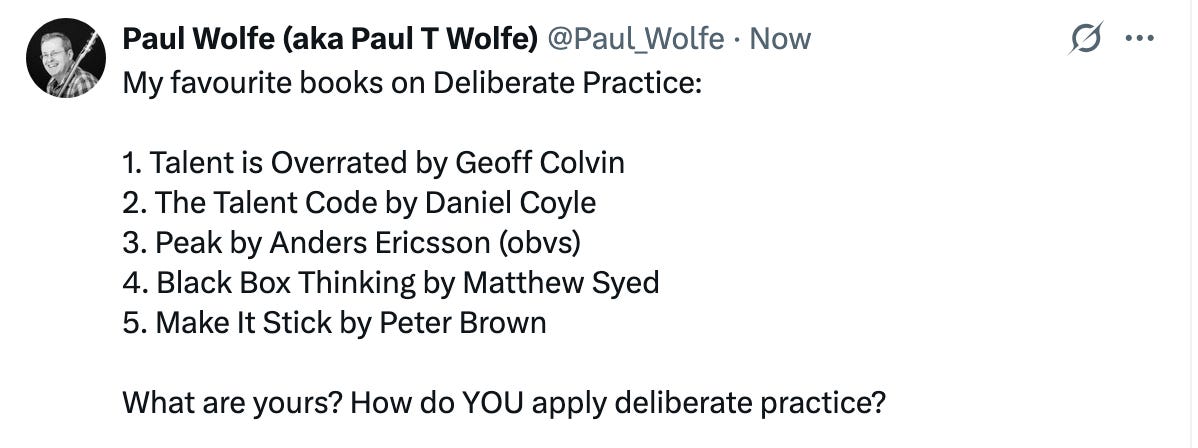
Now I could take that list of 5 books and turn that into an article. With the biggest learning from each book. Although each book is so rich in ideas that picking one idea would be hard. But let’s say I did.
Then I could write an article for each of the books and three biggest learnings from each of the book.
Or I could create an article about each of the biggest learnings from each books. Let’s say I pick three for each book…that’s 15 articles on deliberate practice. If I make sure each article has a detailed action plan on how YOU can implement it - and say you’re a writer and I didn’t write general articles, but I slanted them as letters written to people I know who want to improve their writing…I’m pretty sure those 15 articles could be bundled together into a mini-book and sold on Amazon. Or sold from my website. Or used to build an audience.
Just as you have your unique strengths and weaknesses, you also have your own unique goals. If your writing isn’t leading you towards those goals…then you need to stop, tie the knot, and course correct.
Point is: that one tweet could lead to an article…then to a series of five summary articles, then to a series of 15 details implementation articles….which could be compiled into a book, or filmed as a streaming video course, or whatever you want to do.
Make a list of 10 topics. Repeat that exercise. And you’ve got potentially hundreds of articles to draw from. Write those articles for specific people, send them to them, ask for their questions…and answer those questions with individualised letters….and bingo….that might be another hundred pieces of content you can create.
And note: you’re writing from your unique voice (the who), in flow (the how) and about specific topics (the what).
Every one of those pieces will be authentic. And cement your ‘category of one’ position. Do them over multiple topics that interest you…and you create a niche of one. No pseudo-writer with AI will ever compete with that.
Interestingly. When I was ‘free writing’ about my lists (yesterday and this morning) a slant on ‘online business’ cropped up that I’d never thought about before….
The further learning (which I’ve not tacked on) is that the online business build around my writing then supports have the time to write fiction.
So I’ve been involved in online stuff since 2008 to 2009.
And my peculiar - but not unique - form of resistance is that if I’m working on something, or thinking of working on something, I consume a shit ton of content on that subject.
So I’ve read and studied a bunch of marketing stuff. I even made a list of my 5 favourite ‘business and marketing’ courses and books. By favourite, I mean the most influential to me.
Here they are, in chronological order of when I was exposed to them:
Sean D Souza : Website Masterclass (which is not about building a website!)
Sean D’Souza’s Three Prong System
Perry Marshall’s 80-20 Sales and Marketing book
Andre Chaperon: Sphere of Influence.
Peter Spaepen: Tiny Is Mighty (sadly….you can’t get this anymore…Peter passed away in 2020 before I ever got chance to meet him…but he lives on in his writings. For those of us fortunate enough to have access to them.)
The one thing that connects these courses and ideas together for me - and partly this is done by taking pieces I like and building mental representations about them, and equally discarding pieces I don’t like - is that they’re all built around my unique take on ‘1000 True Fans’ and how you can make a business out of your writing.
And also what I realized - when I tallied some figures - was that I’ve made a business out of my writing for the last 15 years without having massive audiences. (Never larger than 15,000. Less than half that at the moment). And without dick swinging…I can authentically say (and prove) that I’m a 7 Figure Writer.
Here’s what I would also say: I don’t give a fuck about being a 7 Figure Writer. I’ve come to terms with my ‘enough.’ (Another hat tip to Sean D’Souza).
What’s more important is that I write every day. That I build my next business around writing. And I carve out the freedom and time to write fiction.
That’s it.
And it will all be done by writing in flow. To specific readers. About specific topics.
You might notice a different tone in this week’s newsletter.
Two reasons: the first is that as I’ve been reading and writing about Ray Bradbury - more on that next week - I’ve decided that his thoughts on authenticity are 100% spot on and I’m moving in that direction; the second is that I got back from one of the most hellish experiences in the world at 5AM this morning - 10 hours in A&E (accident and Emergency) and I’m running on 4 hours sleep, three cups of coffee….and flow.
So I’m too tired to self censor. And cut out the swear words. Or unusual formating. (Which I’ve done before). If you don’t like it, my recomendation is to unsubscribe.
Because the final learning for this issue is this: a reader you can write to now….literally start writing in a minutes time….is your younger self. You want to generate a ton of content: write 50 Lessons To Your Younger Self. Write it authentically. In flow. Swear. Use weird formating. Let your true self hang out and dance on the page. Give all the AI pseudo writers the middle finger and be you.
No one can compete with the true you.
No-one.
No posts
Comments
Nothing yet. Say the first thing.
Sign in to join the conversation.