
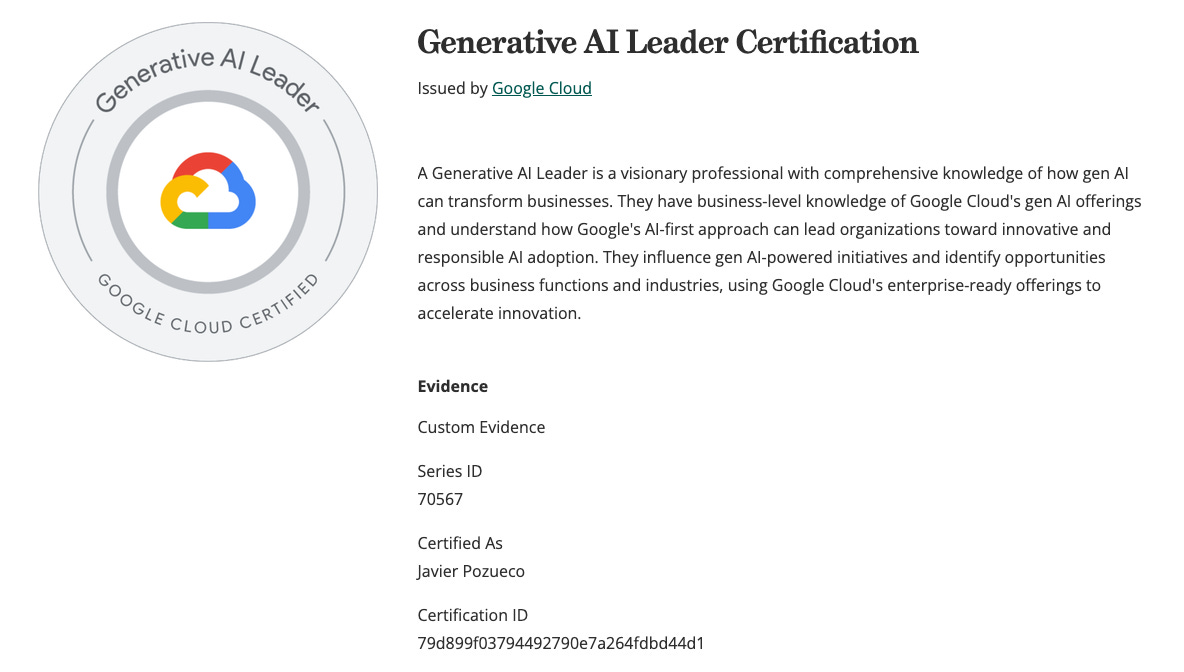
Generative AI is reshaping how organisations innovate, automate processes, and create value. As a result, there is a growing demand for professionals who understand not only the capabilities and offerings of generative AI, but also how to apply them strategically, responsibly, and in alignment with business objectives.
The Google Cloud Generative AI Leader certification is designed to address that need. It is intended for professionals in any role, regardless of their technical background, and validates their knowledge of generative AI fundamentals, Google Cloud’s generative AI offerings, techniques for improving model outputs, and the business strategies required to successfully drive AI adoption across an organisation.
This Google certification covers four key areas that provide a solid foundation for understanding and applying generative AI in an enterprise environment:
The core concepts and fundamentals of generative AI
Google Cloud’s portfolio of AI products and services
Techniques for improving the quality and reliability of model outputs through effective prompting and optimisation
The business strategies required to successfully plan, implement, and scale generative AI solutions within an organisation
Generative AI is built on several foundational technologies, and understanding how they relate to one another is essential for anyone looking to apply AI effectively.
At the highest level is Artificial Intelligence (AI), the broad field focused on enabling machines to perform tasks that typically require human intelligence. Within AI, Machine Learning (ML) allows systems to learn patterns from data rather than relying on explicitly programmed rules, while Deep Learning extends ML by using multi-layer neural networks to solve highly complex problems.
These advances led to the development of Foundation Models, which are large pre-trained models trained on vast and diverse datasets that can be adapted to a wide range of tasks and specialised domains. Among these are Large Language Models (LLMs), a type of foundation model specifically designed to understand and generate human language. Together, these technologies form the backbone of today’s generative AI systems.
Users interact with foundation models through prompting, where instructions are provided to guide the model’s output. The quality of those instructions plays a significant role in the results, which is why prompt engineering has become an essential skill. By designing effective prompts, users can significantly improve the accuracy, relevance, and reliability of AI-generated responses.
Generative AI solutions consist of several interconnected layers. At the top are AI-powered applications, which provide the user experience and are often enhanced by agents capable of autonomously using models and external tools to accomplish specific objectives. These are supported by AI platforms, which provide APIs, model deployment, and data management capabilities. At the core are the models themselves, while the underlying infrastructure, including GPUs, TPUs, storage, and networking, provides the computing power required to train and serve these models efficiently.
Google Cloud offers a comprehensive portfolio of generative AI models designed for different use cases. Gemini is a multimodal model that supports conversational AI, reasoning, content generation, and question answering. Gemma provides lightweight, open models that developers can customise for local deployments and specialised applications. For creative media, Imagen generates high-quality images from text prompts, while Veo creates realistic videos from text descriptions or still images. Together, these models enable organisations to build a wide range of AI-powered applications, from conversational assistants to image and video generation.
Google has adopted an AI-first approach by integrating generative AI across its ecosystem while providing an enterprise platform that prioritises security, responsible AI, and flexibility. To support AI development, Google also provides a rich set of tools, including extensions for connecting models to external services through APIs, functions for executing specific actions, data stores that provide access to organisational knowledge, and plugins that extend AI assistants with additional capabilities and third-party integrations.
For day-to-day productivity, Google offers a comprehensive suite of AI-powered tools built around Gemini. The Gemini app assists with writing, summarising, translating, coding, and image generation, while Gemini Advanced adds enterprise-grade capabilities and security. Gemini for Google Workspace brings AI directly into applications such as Gmail, Docs, Slides, and Meet, whereas Gemini for Google Cloud helps developers and cloud teams write code, analyse BigQuery data, manage cloud infrastructure, and improve security. Complementing these tools, NotebookLM acts as an AI research assistant that analyses user-provided documents, generates summaries, answers questions, and helps users explore ideas while remaining grounded in the original source material.
While these productivity tools enable end users to take advantage of generative AI, Google Cloud also provides a comprehensive platform that allows organisations to build, customise, and deploy their own AI solutions.
At the centre of this platform is Vertex AI, Google’s unified machine learning platform. Vertex AI provides the infrastructure, pre-trained models, MLOps capabilities, and development tools required to build, fine-tune, deploy, and scale machine learning and generative AI applications. It also includes services such as Vertex AI Search for enterprise search and recommendation systems. For development, Google AI Studio provides a free environment for rapid prototyping, while Vertex AI Studio enables teams to build and deploy production-ready AI applications at scale.
Beyond the core platform, Google Cloud offers specialised enterprise solutions such as the Customer Engagement Suite, which includes conversational agents, AI assistance for contact centre agents, and conversation analytics. Gemini Enterprise further extends these capabilities by enabling organisations to build intelligent search and conversational experiences that can securely access and understand information from internal enterprise data sources. Together, these services provide organisations with a complete AI platform, enabling them to move from experimentation to production while maintaining enterprise-grade security, scalability, and governance.
Obtaining high-quality outputs from generative AI models depends not only on the model itself, but also on how it is prompted. Effective prompt engineering includes techniques such as zero-shot, one-shot, and few-shot prompting, which differ in the number of examples provided to guide the model. It also includes role prompting, where a specific persona is assigned to influence the model’s tone, expertise, and behaviour. More advanced approaches include prompt chaining, which breaks complex tasks into multiple interactions, and reasoning techniques such as Chain-of-Thought (CoT), ReAct (Reason and Act), and metaprompting, enabling models to solve problems more systematically and produce more reliable outputs.
Beyond selecting the right prompting technique, prompt engineering can also be streamlined by creating reusable workflows. Prompts can be saved as templates for recurring tasks, conversations can be continued to preserve context, and user preferences can be stored to provide more consistent responses. Google further supports this through Gems, personalised AI assistants within Gemini that combine tailored instructions, reusable prompts, and guided interactions to automate common tasks and improve productivity.
While effective prompting is essential, achieving reliable results also requires understanding the limitations of foundation models and the parameters that influence their behaviour. Model performance depends heavily on the quality of the training data, meaning biased or incomplete datasets can lead to inaccurate or biased outputs. Other common limitations include knowledge cutoffs, where models lack awareness of events after their training date, hallucinations, where they generate plausible but incorrect information, and reduced performance on edge cases that differ from typical training examples. Developers can improve model behaviour by adjusting sampling parameters such as temperature, top-p, output length, and safety settings, while techniques such as fine-tuning and larger context windows further help adapt foundation models to specific tasks and improve response quality.
Even with well-designed prompts and carefully configured models, human oversight remains essential for many real-world applications. Human-in-the-Loop (HITL) integrates human expertise into machine learning workflows by reviewing, validating, and improving model outputs both before and after deployment. This approach is particularly important for content moderation, where human judgement can identify harmful or context-dependent content that automated systems may miss, as well as for high-risk domains such as healthcare, finance, and other applications involving critical decision-making. By combining human oversight with AI capabilities, organisations can improve accuracy, reduce bias, strengthen accountability, and continuously refine models based on real-world feedback.
Before launching a generative AI project, organisations should first evaluate both their business requirements and available resources. Key considerations include the expected scale of adoption, the level of model customisation required, how users will interact with the solution, data privacy requirements, acceptable response latency, and connectivity constraints, together with the availability of skilled personnel, budget, and implementation timelines.
A successful generative AI strategy combines top-down leadership, which defines the vision and business objectives, with a bottom-up approach, where employees identify practical use cases and provide continuous feedback. Organisations should prioritise initiatives that deliver measurable business value, encourage experimentation, invest in data and AI capabilities, establish responsible AI governance, measure outcomes against business objectives, and continuously refine solutions based on user feedback and performance. Together, these principles provide a structured framework for planning, deploying, and scaling generative AI successfully.
As organisations move from strategy to implementation, Responsible AI and Secure AI become essential for ensuring that AI solutions are both trustworthy and resilient. Responsible AI promotes the ethical development and use of AI throughout the entire lifecycle, from data preparation and model training to deployment and continuous monitoring, with the goal of minimising bias, increasing transparency, and reducing the risk of harm. Secure AI complements this by protecting AI models, data, and applications from security threats.
Google Cloud supports these principles through its Secure AI Framework (SAIF) and secure-by-design infrastructure, complemented by services such as Identity and Access Management (IAM) for access control, Security Command Center for security posture management, and workload monitoring tools that help organisations build, deploy, and maintain secure AI systems. Together, these capabilities enable organisations to adopt generative AI with confidence while maintaining strong governance, security, and compliance.
The Google Cloud Generative AI Leader certification provides a comprehensive introduction to generative AI from a business perspective. Rather than focusing on implementation or coding, it assesses your understanding of the core concepts behind generative AI, Google Cloud’s AI ecosystem, prompt engineering techniques, and the strategic considerations required to successfully adopt AI within an organisation.
The exam consists of 50 to 60 multiple-choice questions to be completed in 90 minutes and is available both online and at authorised testing centres. No technical background or prior Google Cloud certifications are required, making it suitable for professionals in a wide range of business and technical roles. Success depends less on memorising product names and more on understanding how Google Cloud’s AI services fit together, when they should be used, and how they support responsible, secure, and scalable AI adoption.
For anyone preparing for the certification, I recommend studying each of the four exam domains in depth, reviewing the official study guide, and completing Google’s sample questions to become familiar with the exam format and the style of questions. In my experience, this certification provides an excellent foundation for understanding how organisations can evaluate, implement, and scale generative AI solutions using Google Cloud. It is a valuable starting point for professionals who want to build a solid conceptual understanding of enterprise generative AI before progressing to more technically focused Google Cloud AI certifications.
Generative AI Leader Certification:
https://cloud.google.com/learn/certification/generative-ai-leader
Generative AI Leader Certification Exam Guide:
https://cloud.google.com/learn/certification/generative-ai-leader#exam-guide
Vertex AI Documentation:
https://cloud.google.com/vertex-ai/docs
Gemini Documentation:
https://cloud.google.com/gemini/docs
Responsible AI at Google Cloud:
https://cloud.google.com/responsible-ai
Secure AI Framework (SAIF):
https://cloud.google.com/security/ai
Google Cloud. Prompt Design Guide:
https://cloud.google.com/vertex-ai/generative-ai/docs/learn/prompts/introduction-prompt-design
No posts
Comments
Nothing yet. Say the first thing.
Sign in to join the conversation.