
Many organisations have become better at naming exclusion. We have gender equality strategies, disability inclusion plans, LGBTQIA+ commitments, cultural inclusion frameworks, accessibility standards and safeguarding policies. These have not appeared by accident. They are the result of sustained advocacy, political struggle and the insistence of people who refused to remain invisible. However, people do not encounter organisations one identity at a time. A person doesn’t enter a health service with a disability on Monday, is queer only on Tuesday, culturally marginalised on Wednesday and poor when the program budget is being designed. They arrive as a whole person, carrying a life shaped by relationships, geography, economic circumstances, community attitudes and institutional power. Yet, our organisational systems often meet them in silos.
In 2020, I co-authored Out of the Margins, an analysis of disability and diverse sexual orientation, gender identity, gender expression and sex characteristics in humanitarian and development contexts. The paper drew on available literature and interviews with people and organisations across ten countries. It found that people at the intersection of disability and diverse SOGIESC experienced significant barriers, discrimination and violence, while also being overlooked by disability inclusion efforts and diverse SOGIESC inclusion efforts. We identified a recurring pattern. People could encounter homophobia or transphobia within disability services, and ableism within LGBTQIA+ spaces. For example, a queer focused service could be welcoming in its language and inaccessible in its building. Organisations of Persons with Disabilities (OPDs) could understand ramps, communication support and assistive equipment, while still assuming that everyone was heterosexual, cisgender and embedded in a conventional family structure.
Sometimes the barriers appeared before a person reached the service at all. They might not have the equipment or support needed to leave home. A family member or caregiver might control where they went, who they met or whether they could attend. They might stay away because they already knew, or strongly suspected, that only one part of who they were would be accepted. Only three of the organisations interviewed intentionally focused on people at the intersection of disability and diverse SOGIESC, and one of these was from a perspective of a worker, not someone accessing the service. This is one of the central problems of inclusion organised in silos. A space can be inclusive in one respect and exclusionary in another. An organisation can be doing important work and still leave some people stranded between its commitments.
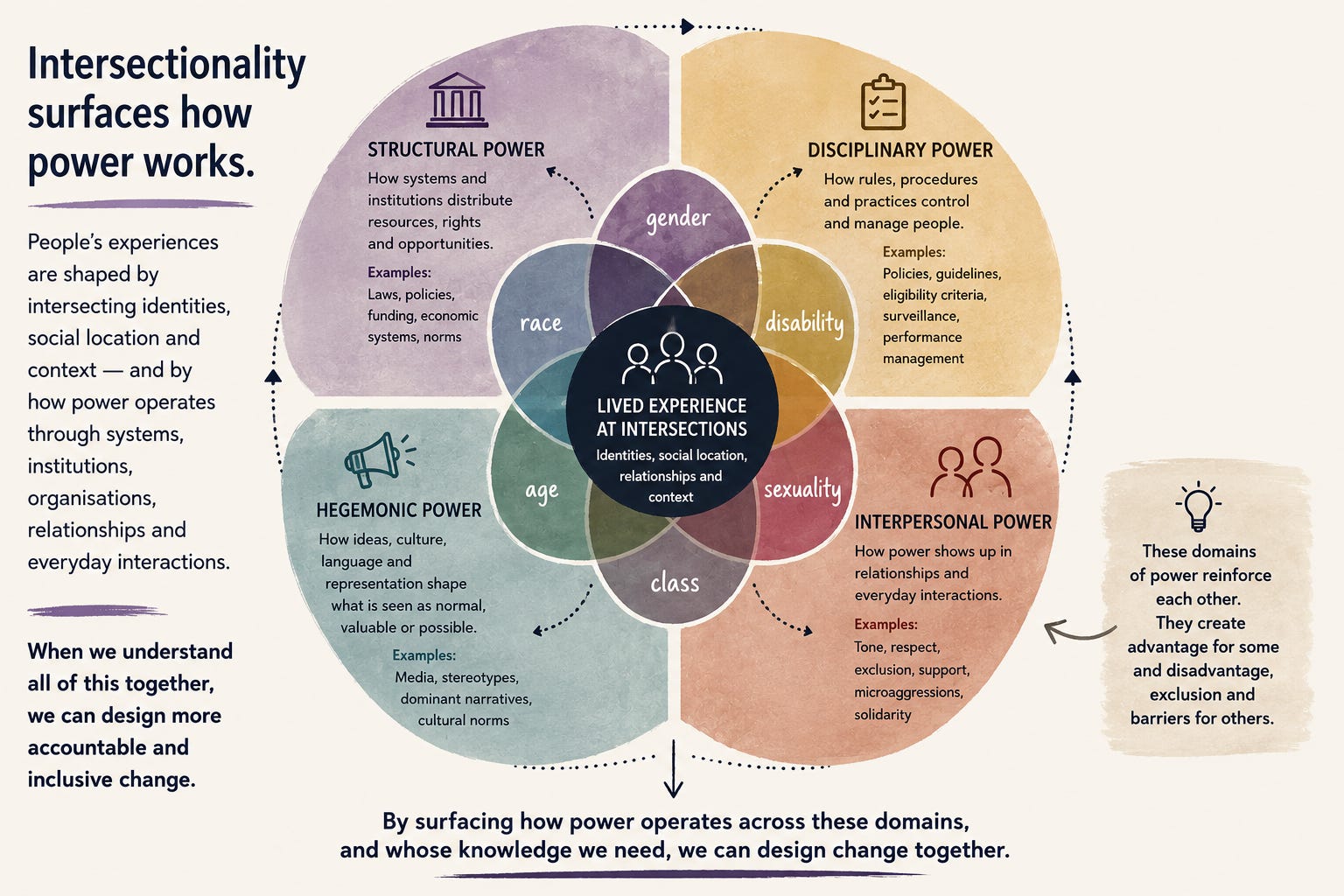
Intersectionality is often introduced as a way of recognising that people hold multiple identities. We are encouraged to think about gender, disability, age, race, sexuality, class, culture and location, rather than treating any one category as a complete account of somebody’s life. That’s useful, but not enough. Intersectionality is not simply a longer or more sophisticated list of identities. It is an analysis of how interlocking systems of power shape lived experience. It helps us examine why the same policy, service or institution can operate differently for different people, even when they appear to share some of the same identities.
An additive approach acknowledges that a person may face discrimination based on disability and gender, or race and sexuality, and then treats these as separate layers of disadvantage. This is better than ignoring one of those dimensions altogether, but it can still leave the organisation itself largely untouched. Disability is considered. Sexuality is considered. Race is considered. Another group is added to the list. The language expands, while the way the institution works remains much the same.
An intersectional approach asks a different question. What happens when disability policy, transport rules, family authority, gender norms, economic dependence and frontline discretion all meet in the life of one person?
Out of the Margins includes the story of Masi, a person in Fiji with a physical disability and diverse gender and sexuality. Masi had a disability identification card that entitled them to free bus travel. Yet bus drivers sometimes refused to let Masi board, or demanded payment, because of how they perceived Masi’s gender expression and sexuality.
The discrimination Masi experienced did not arrive in neat, separate pieces. A right attached to disability was being denied because of discrimination connected to gender expression and sexuality. Masi had the card. The entitlement existed. But that did not guarantee that the right would be respected in practice.
This is where looking at different forms of power becomes useful. Structural power created the formal entitlement to free travel. Disciplinary power was present in the systems and everyday practices through which that entitlement was administered. Hegemonic power shaped ideas about whose bodies, identities and expressions were considered normal, respectable or deserving. And interpersonal power was exercised by the bus driver who could recognise Masi’s entitlement, refuse it, or use that interaction to discriminate and humiliate. These were not four separate experiences. They were operating together in one ordinary bus journey.
This is what intersectionality makes visible. Exclusion rarely comes from one policy, one attitude or one bad interaction. It is often produced by systems, rules, cultural ideas and relationships working together. This is also why changing one policy is rarely enough.
An organisation may have an inclusive policy while staff continue to act on discriminatory assumptions. A service may improve physical accessibility while its intake process requires people to disclose information that could put them at risk. A program may invite people to participate without considering how they will get there, whether they need an interpreter or support person, or whether the space is socially as well as physically safe. One door opens while another remains closed.
Organisations can also divide people’s experiences across different teams. Disability goes to the accessibility adviser. Sexuality to the LGBTQIA+ network. Violence to safeguarding. Transport becomes an operations issue. Poverty belongs to livelihoods. Culture to localisation. Participation to community engagement. Each team may understand one part of the problem and be doing important work. But who is looking at how all of these things come together in the life of the person trying to access the organisation?
The person becomes responsible for connecting the pieces. They must explain how inaccessible transport interacts with poverty. They must disclose how family control affects participation. They must work out whether safety, communication, mobility, identity or support falls within the remit of one team or another. The person becomes the integration mechanism for an institution that remains fragmented. This doesn’t mean targeted strategies or specialist expertise should disappear. Disability inclusion cannot be folded into a broad diversity statement and considered complete. Nor can gender equality, racial justice or diverse SOGIESC inclusion. Each requires specific knowledge, accountability, resources and sustained relationships with representative organisations and movements. But targeted work must be connected, otherwise, people whose lives cross institutional boundaries can remain visible to every framework in part and fully understood by none.
In Out of the Margins, people at the intersection of disability and diverse SOGIESC were repeatedly described as hidden. Some concealed their sexuality or gender identity within disability organisations. Others concealed their disability within LGBTQIA+ spaces. People monitored their behaviour, avoided services, or shared only the parts of themselves that felt safe to reveal.
Organisations can mistake this invisibility for absence. They may say they have never encountered people at a particular intersection, and assume the population is very small, outside their mandate, or simply not using their services.
But being hidden is not the same as being absent. People may not disclose because it is unsafe. They may not attend because the space is inaccessible, or because past experience has taught them that one part of who they are will be accepted while another is ignored or rejected. They may also be missing from organisational data because the questions do not capture their experience, or because the categories force them to fit themselves into boxes that do not reflect their lives.
When organisations cannot see people in their data or services, it is easy to conclude that they are not there. The absence of evidence then becomes a reason not to act, rather than a reason to ask why people are missing.
An intersectional approach treats invisibility as something to investigate. It asks who technically qualifies for a program but is still unable or unwilling to participate. But it also asks who has been made ineligible by the way eligibility itself has been defined. Who appears to fit the purpose and intended population of a service, but falls outside its administrative boundaries because they do not have the right residency status, Medicare card, address, identification or other form of institutional recognition? It looks at the rules that appear neutral but rely on particular kinds of documentation, mobility, income, literacy, family support or social recognition. And it asks whether those requirements are actually necessary to the purpose of the service, or simply how the institution has learned to organise access. It pays attention to where people are expected to disclose an identity or prove a particular status in order to receive help, and what that disclosure or proof may cost them.
None of this can be resolved through a better checklist alone. Intersectionality is not a tool for predicting somebody’s experience from their identity. An intersectionality tool cannot tell us how a person will experience a service. A demographic profile cannot substitute for lived knowledge. The purpose is not to make more elaborate assumptions about people. The purpose is to recognise where our knowledge ends.
A grounded analysis separates evidence from assumption. It identifies what remains unknown and whose knowledge is required. It treats community participation not as a consultation exercise after the important decisions have already been made, but as necessary to understanding how power works in practice. This shifts inclusion from declaration to inquiry. Rather than asking only whether different groups have been named, organisations need to examine how rights and resources are distributed, how rules are interpreted, what assumptions shape decisions and how power is exercised through everyday relationships. They need to notice where one person’s experience has been divided across different teams, strategies and specialists.
The recommendations in Out of the Margins called for intentional organisational mechanisms, accessible and safer services, representation and leadership, collaboration between disability and SOGIESC organisations, and the active participation of people at the intersection in developing responses. The paper placed “nothing without us” at the centre of that work. But participation cannot be the final stage, where people are invited to validate an analysis the organisation has already completed.
People living at the intersections of institutional categories may not be able to identify exactly which policies, rules or systems are producing exclusion. But they know where they encounter the barriers. They know where something becomes difficult, unsafe or impossible, where a right that exists on paper does not work in practice, or where a service that is supposedly available does not feel available to them.
This is where lived experience and technical expertise need to come together. Lived experience can show us where systems are not working as intended. Technical and practice expertise can help trace those experiences through policies, procedures, funding arrangements, organisational responsibilities and wider systems of power. Neither should be expected to do the work of the other. The analysis becomes stronger when different forms of knowledge are brought together to understand what is happening and what needs to change.
Intersectionality therefore demands more than recognising who is represented, included or missing. It asks organisations to look at how different systems, rules and forms of power come together in people’s lives. It asks whose knowledge is needed to understand what is happening, how lived experience and technical expertise can work together, who has authority to make sense of the problem, and who is involved in designing the response. People’s lives are not too complex. Our institutions are often too fragmented to recognise them. When someone falls between our inclusion strategies, the answer is not simply to add another group to the list. It is to understand how the gap is being produced, and work together to change the systems creating it.
These questions are at the centre of my upcoming Intersectionality in Practice: Understanding Power, Lived Experience and Designing Change workshop series. Across three facilitated online sessions, participants will examine how structural, disciplinary, hegemonic and interpersonal power shape people’s experiences of programs, services and organisations.
Using a practical intersectionality matrix, participants will explore what is known, what is being assumed, whose lived expertise is missing and how analysis can be translated into accountable changes in practice.
Including the excluded requires more than broadening the list of people we intend to reach. It requires us to understand how our systems decide who can enter, participate, belong and exercise power.
If you want to go deeper into how power operates in everyday practice, Unpacking Power: From Analysis to Praxis begins on 8 October. Across seven facilitated online sessions, we’ll explore how power works within ourselves, relationships, organisations and systems, and how we can turn that analysis into practical change.
Find out more and register here
Want to bring intersectionality into your everyday practice? Intersectionality in Practice: Understanding Power, Lived Experience and Designing Change is a three-session online series beginning 2 November, exploring how lived experience, technical expertise and power analysis can come together to understand exclusion and design more accountable responses.
Find out more and register here
Power to Praxis is a reader-supported publication. Everything I publish here is open access, and I intend to keep it that way. There are no paywalls because I want these ideas, questions and resources to be available to anyone who finds them useful.
If you enjoy reading Power to Praxis, find value in the work, and are in a position to become a paid subscriber, I’d really appreciate your support. Paid subscriptions help make it possible for me to keep writing and sharing this work openly, including with people who may not be able to pay to access it.
No posts
Comments
Nothing yet. Say the first thing.
Sign in to join the conversation.