
Over the weekend, a post I wrote on LinkedIn about the removal of the language of gender and gender equality from the Queensland Office for Women website attracted a number of anti-trans comments. I deleted them, reported them and blocked the people posting them, and I will continue to do that. But as the comments kept appearing, I realised that simply deleting them wasn’t enough. I wanted to say something about why this matters to me, and why I find the increasing attempt to position the rights of cisgender women and trans people in opposition to each other so troubling.
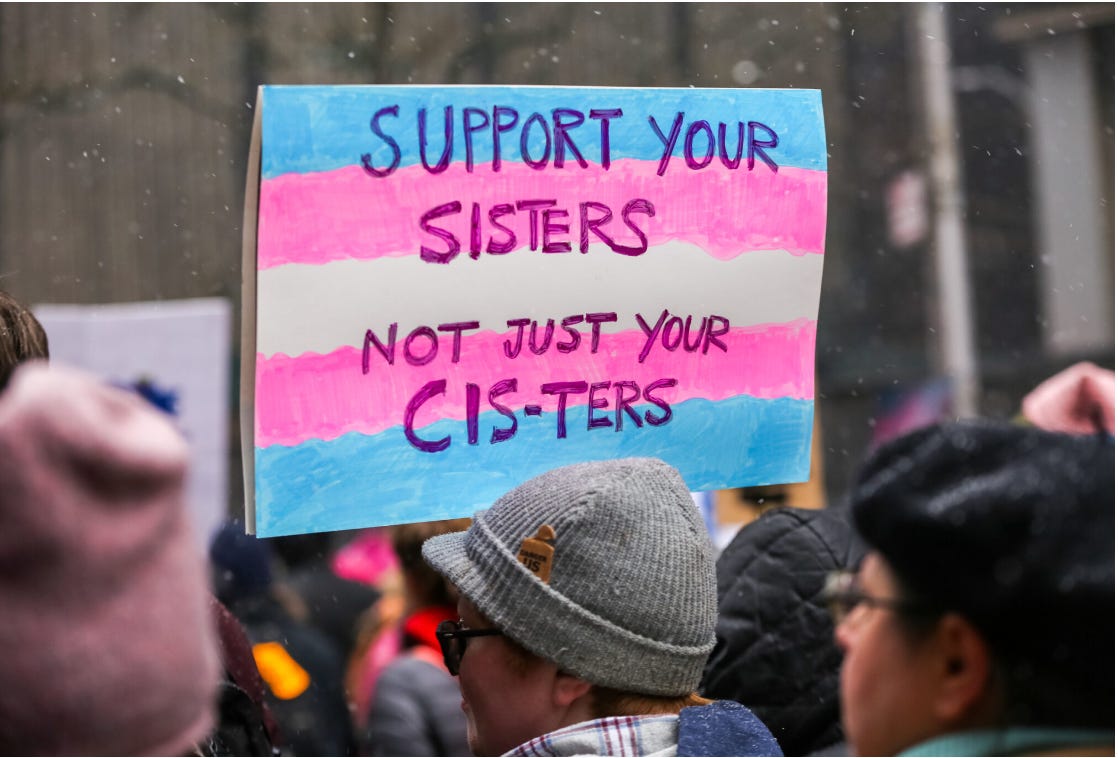
I am a cisgender woman, a feminist and a proud member of the queer community. Trans women are my sisters, and trans men and gender-diverse people are part of communities I love, work alongside and stand with. Their dignity, safety and freedom are not matters I am prepared to debate. There is plenty of room for disagreement, complexity and difficult conversations in spaces connected to me and my work, but that does not create an obligation to provide a platform for the denigration or dehumanisation of trans people. Anti-trans hate is not welcome on my LinkedIn page, on this Substack, or in any other space for which I am responsible.
I think it is particularly important for me to say this as a cisgender woman because I simply don’t accept the argument that the interests of cis women and trans people, particularly trans women, are fundamentally opposed. I don’t recognise my life, my feminism or my politics in that argument. Trans women and cis women have much more in common than the political rhetoric of this moment would have us believe, even though our experiences of gender are not the same.
We live in societies organised through gender. We navigate expectations about what women and men should be, how we should look and behave, what kinds of bodies are acceptable, whose bodies are available for public judgement, who should provide care and who should hold authority. Gender shapes who is believed, who is protected and who is exposed to violence. Misogyny is part of that story, but so are sexism, homophobia, transphobia and the enforcement of gender norms. These forces do not affect all of us in the same way, and recognising those differences is important, but they are deeply connected.
This is one of the reasons I find some of the arguments currently being made in the name of women’s rights so troubling. The women’s movement has a long history of grappling with what it means to talk about women without pretending that biology produces a single, universal experience of womanhood. Feminists have spent generations challenging the idea that our bodies determine our social roles, capacities or destinies. The fact that most cis women can bear children has been used to argue that caring is naturally women’s work. Ideas about supposedly innate differences between male and female bodies have been used to justify women’s exclusion from education, employment, leadership, politics and public life. Feminist movements fought these ideas precisely because biology has so often been used to make inequality appear natural and inevitable.
Feminism has also repeatedly had to confront the limitations of treating women as though we are a single, uncomplicated group. Black feminists, Indigenous feminists, women of colour, lesbian and queer feminists, disabled feminists and working-class feminists have pushed our movements to understand that gender never operates alone. Race, class, disability, sexuality, colonialism and other relations of power profoundly shape how womanhood is lived and how inequality is experienced. There has never been one universal experience of being a woman, and recognising those differences did not weaken feminism. It made our analysis of power better.
That history matters to me because I don’t want a feminism that responds to complexity by drawing an ever-smaller circle around who counts as a woman. I don’t believe my safety as a cis woman requires another woman to be made less safe, and I don’t believe my rights become stronger when trans people’s rights become weaker. I am deeply suspicious of a politics that encourages cis women to direct our fear towards another marginalised community rather than towards the institutions and systems that continue to produce inequality, violence and insecurity in all of our lives.
There is so much that connects us in those struggles: bodily autonomy, freedom from violence, economic security, housing, decent work, the valuing of care, freedom from discrimination, and the ability to move through the world without having our bodies, sexuality, appearance or gender constantly judged and policed. Our experiences within those struggles are different, sometimes profoundly so. Trans women experience forms of violence, discrimination and exclusion that I do not experience as a cisgender woman, just as my own experiences of gender are shaped by other parts of who I am and the world I inhabit. Solidarity does not require us to erase those differences or pretend that our experiences are interchangeable. Solidarity has never required sameness.
In fact, I think there is something dangerous about imagining that we can only stand alongside people whose lives resemble our own. Feminist solidarity has to be capable of holding difference, because otherwise it becomes very easy to decide that the freedom of people at the edges is negotiable. One of the most important things feminism has taught us is to ask whose experience is being treated as normal, whose knowledge counts, who gets to define the boundaries, and what happens to those who fall outside them. I don’t think we should stop asking those questions when the answers become uncomfortable.
For me, this is also personal. I am part of the queer community, and people I love deeply, family and friends, are part of this community too, including trans people. When trans people are being publicly vilified, when their existence and rights are treated as legitimate subjects for hostile public debate, I don’t get to imagine that this has nothing to do with me simply because I am cisgender. These are people I love. They are my family, my friends, my colleagues and collaborators, and members of a community to which I belong. What happens to them matters to me, and what happens to trans people is not someone else’s fight.
I also want to resist the idea that cis women are somehow being asked to choose, as though there is a finite amount of safety, dignity or freedom available and extending those things to trans people necessarily takes something away from women like me. I reject that premise. My bodily autonomy is not diminished by another person’s bodily autonomy. My safety is not increased by making another marginalised person unsafe, and my freedom does not depend upon somebody else’s exclusion. There is more than enough violence, inequality and injustice in the world for us to direct our attention towards without manufacturing enemies among people who are also trying to live safely and freely within systems that were not built for them.
So I want the boundary around the spaces I create to be clear. Trans people belong here. Trans women belong in women’s movements. Trans men and gender-diverse people belong in our communities and in our struggles for gender justice. I will continue to fight for women’s equality, name misogyny and sexism, and argue for policies, institutions and movements that recognise the structural nature of women’s inequality. None of that requires me to diminish the humanity, dignity or rights of trans and gender-diverse people. Quite the opposite. The feminism I believe in asks us to understand how power works, to notice whose lives are being made smaller, and to refuse the idea that liberation can be built through somebody else’s exclusion. My feminism does not require your exclusion.
To my trans and gender-diverse family, friends, colleagues and community, I see what is happening. I stand with you, and I will not allow my work, my words or my platforms to be used to make your world smaller. Our liberation is bound together.
No posts
Comments
Nothing yet. Say the first thing.
Sign in to join the conversation.