
On March 18, 2025, the Loudoun County Board of Supervisors — the local government of the world’s densest data center hub — voted to end by-right approval for new data centers. Every future application now requires special exception, with planning-commission and board hearings. Thirteen months later, in April 2026, the NAACP filed a federal lawsuit in the Southern District of Mississippi against xAI and its subsidiary MZX Tech, alleging that the company installed twenty-seven gas-burning turbines at its Memphis-area Colossus supercomputer site without an air permit. The Southern Environmental Law Center has separately appealed Shelby County’s permit for fifteen more turbines on the South Memphis site. The complaint claims the facility will release more than 1,700 tons of nitrogen oxides a year, the largest industrial source of NOx in greater Memphis.
Photo by K from Pexels: https://www.pexels.com/photo/asphalt-roadway-in-rural-valley-against-cloudy-blue-sky-4595695/
But the datacenter bonanza is not about to retreat. The buildout is on course to absorb between 6.7 and 12 percent of US electricity by 2028, up from 4.4 percent in 2023, according to Lawrence Berkeley National Laboratory. The capital expenditure of the fourteen largest publicly listed data-center operators rose from roughly $450 billion in 2024 to roughly $750 billion in 2025, and FY2027 spending expectations climbed 56 percent between August 2025 and February 2026. Wood Mackenzie reported a slowdown in newly added US capacity in the last quarter of 2025, but the slowdown is power-constrained, not opposition-constrained: developers are running into transmission and interconnection ceilings before they run into the planning boards.
The rising opposition is doing real work and that the hyperscalers are simultaneously hedging abroad, in a concentrated set of jurisdictions defined by three conditions: cheap subsidized power, permissive interconnection regimes, and sovereign actors willing to absorb the political cost of the load in exchange for AI access. The geography of that hedge is fairly limited but revealing about the geopolitics of energy and AI.
What can actually leave
The first thing to understand is which workloads can travel at all. AI compute splits into two structurally different categories. Training is the weeks-long process of producing a large model, with tens of thousands of GPUs synchronized inside a single cluster. Inference is what happens after, when the trained model answers a user query in real time. Training is latency-insensitive. The internal bandwidth between GPUs in a cluster matters; external network latency to anywhere matters very little. A training run can sit in Norway as easily as in Texas, provided the cluster has the power, the cooling, and the chips.
Inference is the opposite. Consumer AI services target sub-50-millisecond response times, which means the inference server has to be close to the user. Distance becomes physics. Trade-press estimates put inference at 80 to 85 percent of AI workloads within two years, and that figure is widely cited, though I would treat the precise percentage as directional rather than exact. The directionally important point survives any reasonable revision: most consumer AI will keep running on infrastructure inside North America regardless of what Loudoun’s board does to permitting.
This is the mechanism the externalization story usually skips. "Going offshore" does not mean Microsoft is decamping. It means training and bulk inference, the workloads that can travel, are being placed where political and electrical conditions are most accommodating, while the workloads that cannot travel stay put and absorb whatever the domestic permitting environment hands them. The split matters because the two halves are growing at very different rates and answer to very different constraints. The IEA's Energy and AI report puts inference at roughly 80 to 90 percent of AI computing today, rising to about three-quarters of total AI energy demand by 2030 as model deployment outruns model training; Brookfield's independent analysis converges on the same 75-percent figure. Most of that inference electron is consumed within fifty milliseconds of the user, in near-edge facilities built into the metros that the load already lives in. The mobile fraction — the multi-gigawatt training campuses and the latency-tolerant batch inference behind them — is the smaller share of the eventual energy bill, but it is the share that shows up as a discrete, announceable, sovereign-courtable block of demand.
The compute petrostates
The largest single concentration of announced AI infrastructure outside the United States sits in two Gulf monarchies that are converting hydrocarbon rents and ruler-level political will into AI access. I call them compute petrostates, because the analytical move is the one this newsletter has applied to LNG and refining capacity before — a sovereign-owned asset class underwritten by oil revenues and built through ruler-level deals. The Hormuz Tax (Article 9) named how fossil leverage runs through choke points. Compute petrostates name what comes next: the leverage running the other way, hydrocarbon rents purchasing seats at the frontier-AI table.
The Saudi case is the cleanest. The Public Investment Fund founded HUMAIN in May 2025 as a sovereign AI champion with a target of 1.9 gigawatts of data-center capacity by 2030 and 6.6 gigawatts by 2034. Microsoft announced an AI-powered Azure region in the country. Google Cloud has a ten-billion-dollar partnership with PIF to build, with HUMAIN, what the parties describe as a global AI hub. NVIDIA has a five-hundred-megawatt commitment over five years. Saudi Arabia’s National Infrastructure Fund and HUMAIN signed a financing framework of up to 1.2 billion dollars covering roughly 250 megawatts of operational capacity. I take the 250 megawatts as the concrete 2026 number. The 6.6 gigawatts is a 2034 target, and announced targets in the Gulf have historically slipped, sometimes by a lot.
The UAE case is different and, in one respect, more revealing. In April 2024 Microsoft invested 1.5 billion dollars in G42 for a minority equity stake, with a board seat. In November 2025 it committed to invest 15.2 billion dollars in the UAE through 2029, including roughly 4.6 billion in AI and cloud data-center capex, alongside a 200-megawatt expansion of Khazna Data Centers, G42’s subsidiary, due online before the end of 2026. This is not a normal commercial datacenter arrangement. It is equity, governance, and a multi-year industrial-policy commitment, structured through a national-champion intermediary, with US export-control approval as the negotiation lever.
The engineering-explains-it counter — that hyperscalers go where electrons are cheapest at the latency-acceptable distance, and the political wrappings are decoration — does not cover what’s happening here. Microsoft did not skip G42 for a cheaper commercial datacenter contract. It took a board seat. Microsoft has no comparable equity-and-governance arrangement with any other regional AI cloud partner — not in Sweden, not in Ireland, not in Singapore, not in any US state. The G42 structure is unique among Microsoft’s regional AI expansions. Saudi Arabia did not go to AWS for a routine cloud-region build. It founded a national champion, fed it PIF capital, and used US export-control approval as the price of admission. These are sovereign moves with engineering downstream of them, not the other way around.
The pattern is the petrostate logic running forward. Saudi PIF and the UAE’s sovereign architecture have spent two decades turning oil rents into LNG, into petrochemicals, into mining. They are now turning them into compute. The bargain looks the same: a sovereign-led national champion, the US technology partner as both supplier and risk-sharer, and an export-control negotiation as the price of admission.
The hydropower hosts
The second concentration sits in a small set of hydropower-rich provinces — Quebec and the Nordic countries — where cheap renewable power is the foundation and the sovereign instrument is the public utility rather than the ruler. This is not petrostate territory. The bargain is different.
Quebec is the clearest case, because Hydro-Québec has begun re-pricing it. In 2024 the utility imposed what the trade press describes as a de facto halt on new large data-center power procurement. It has since proposed a new rate to the provincial energy regulator that would charge data centers consuming more than five megawatts roughly 13 cents per kilowatt-hour — about double the rate charged to other large industrial customers. The peak load currently served by the sector is about 190 of the 200 megawatts assigned to it, with Hydro-Québec projecting the rate-controlled trajectory could reach roughly 1,000 megawatts by 2035. The sovereign-utility verdict is that data centers can grow in Quebec, but they will pay full freight for the privilege.
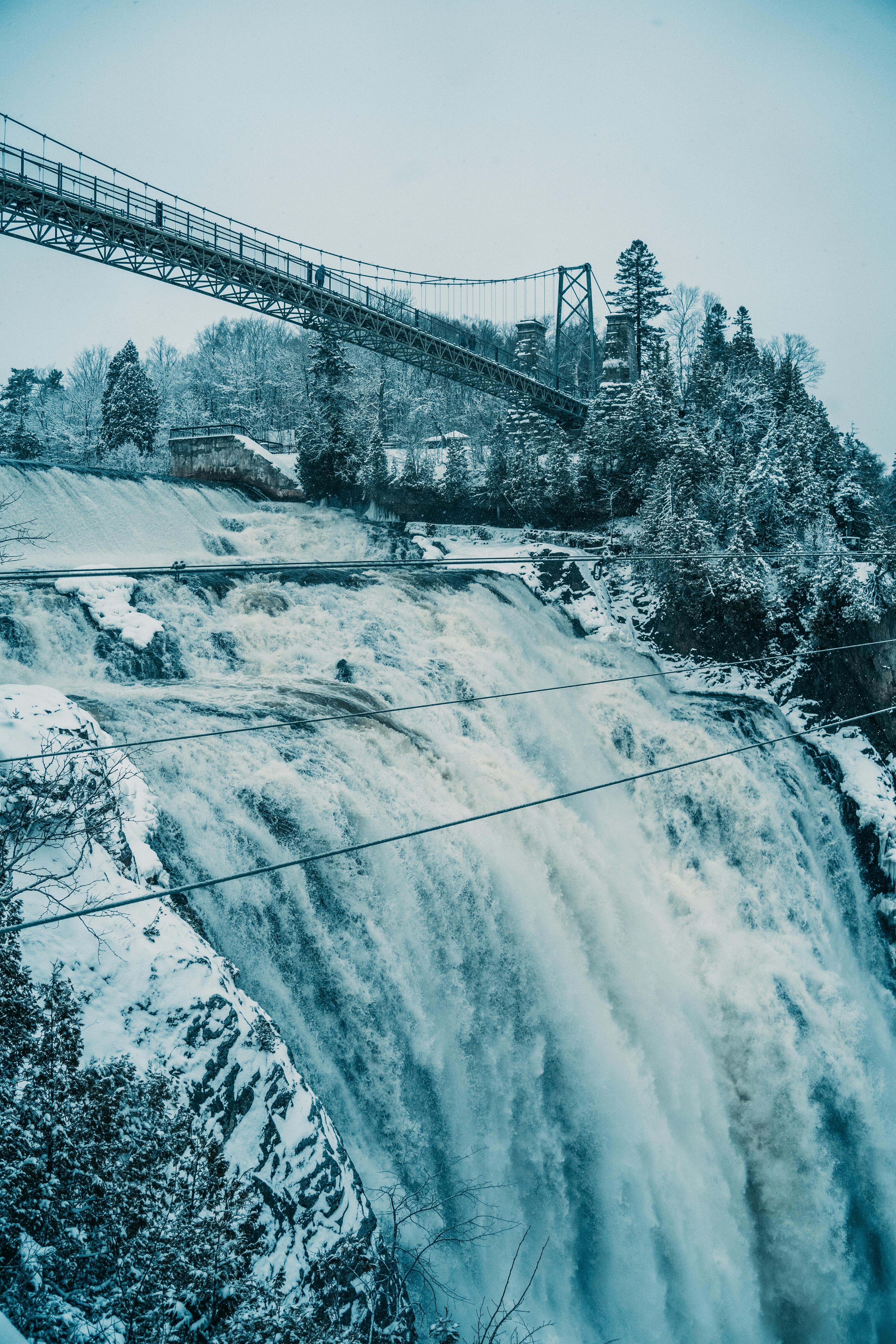
Montmorency Falls with a suspension bridge in Québec, Canada
Photo by Clément Proust from Pexels: https://www.pexels.com/photo/winter-view-of-montmorency-falls-in-quebec-29284744/
The Nordic story is healthier because the renewable runway is longer. Total Nordic data-center capacity sits around 1.3 gigawatts in 2025, with Finland, Sweden, and Denmark holding most of the upcoming pipeline. Google has signed Nordic power-purchase agreements totaling roughly 446 megawatts. OpenAI, Nscale, and Aker announced “Stargate Norway” with 230 megawatts of renewable-powered AI capacity. Brookfield committed 10 billion dollars to a 750-megawatt AI campus in Strängnäs, Sweden. CoreWeave announced 2.2 billion dollars across three Nordic sites. These are real numbers and real money, with a different geometry than the Gulf: no equity stakes in national champions, no ruler-level deals, just power-purchase agreements with state-owned utilities and large-scale renewable supply.
A scale-check makes the difference concrete. Brookfield’s announced Strängnäs facility, at 750 megawatts, would consume electricity at roughly the rate of a city the size of Madison, Wisconsin. The Saudi HUMAIN 2034 target of 6.6 gigawatts is nearly nine such cities, in a kingdom whose total installed generating capacity today is on the order of Florida’s. The Gulf bargain is sovereign-rent-funded, sovereign-political, and structurally large. The Nordic bargain is utility-mediated and structurally smaller.
The host that rewrote the bargain
Ireland is the case that demonstrates the limits of either bargain. Data centers consumed 22 percent of Ireland’s national electricity in 2024 — an extraordinary figure for a country of five million — and EirGrid’s median scenario projects 31 percent by 2034. In 2021 the regulator imposed a moratorium on new data-center grid connections in the Dublin area, where roughly 97 percent of the country’s facilities sit.

Photo by Jonathan Borba from Pexels: https://www.pexels.com/photo/medieval-bridge-in-dublin-city-center-33758931/
In December 2025 the moratorium was lifted, but on terms that materially harden the bargain. Under the new rules from the Commission for Regulation of Utilities, any new data center seeking a grid connection must install on-site generation or batteries capable of meeting its full electricity demand, must source 80 percent of its annual demand from renewables over a six-year glide, and must feed excess generation back into the grid through the wholesale market. Some analysts read this as capitulation, on the grounds that Ireland has reopened to the same hyperscalers that filled almost a quarter of its grid. I read it as hardening, because the new conditions transfer roughly the entire infrastructure cost of the next campus onto the hyperscaler, and the 80-percent renewable requirement is materially stricter than what existed before. The bargain has been renegotiated. The next time it stresses, it will likely be renegotiated again.
The spillover
Malaysia rounds out the picture, and it deserves an honest framing. Johor’s data-center capacity reached roughly 5.8 gigawatts of mixed live, under-construction, and committed capacity by mid-2025, roughly doubling in a year. Microsoft committed 2.2 billion dollars to its Malaysian expansion; ByteDance committed 2.1 billion. The primary driver is not US opposition. It is Singapore’s regulatory restrictions on its own data-center sector, which have pushed regional capacity across the Johor Strait to its closest available substitute. The Malaysian government has since announced a pause on non-AI-driven data-center development, citing water and power constraints. Johor is a regional-spillover story, not a US-substitute story, and the article that conflates the two misreads the geography.
What comes next
The pattern across all four host clusters is that every one of them is running into the same thing the United States is. Loudoun’s by-right elimination, Memphis’s NAACP suit, Quebec’s rate hike, Ireland’s renewable mandate, Malaysia’s pause — these are the same grid ceiling The Solar Ceiling (Article 10) named, in a different load. The buildout will continue. The hosts will reshape its terms. The hedge might hold. But the geography of cheap, permissive, sovereign-willing power is already a small map, and the next few gigawatts of training compute are being placed inside it.
---
References
[1] Loudoun County, Virginia, Eliminates By-Right Data Center Development — Holland & Knight (Apr 2025). https://www.hklaw.com/en/insights/publications/2025/04/loudoun-county-virginia-eliminates-by-right-data-center-development
[2] By-Right Data Centers Eliminated in Loudoun — LoudounNow (Mar 2025). https://www.loudounnow.com/news/by-right-data-centers-eliminated-in-loudoun-existing-applications-grandfathered/article_130515be-0478-11f0-ab4f-7771b6b47f71.html
[3] NAACP federal lawsuit against xAI re gas turbines — Democracy Now (22 Apr 2026). https://www.democracynow.org/2026/4/22/memphis_xai_data_center_pollution_keshaun
[4] xAI gas turbines in South Memphis without permits — Inside Climate News (Jul 2025). https://insideclimatenews.org/news/17072025/elon-musk-xai-data-center-gas-turbines-memphis/
[5] NAACP and Young, Gifted & Green appeal xAI turbine permits — Tennessee Lookout. https://tennesseelookout.com/briefs/naacp-others-appeal-xai-turbine-permits-for-memphis-data-center/
[6] 2024 U.S. Data Center Energy Usage Report — Lawrence Berkeley National Laboratory. https://eta.lbl.gov/publications/2024-lbnl-data-center-energy-usage-report
[7] Berkeley Lab Report Evaluates Increase in Electricity Demand from Data Centers — Berkeley Lab News (Jan 2025). https://newscenter.lbl.gov/2025/01/15/berkeley-lab-report-evaluates-increase-in-electricity-demand-from-data-centers/
[8] AI Data Center Build Advances at Full Speed: Five Things to Know — BloombergNEF. https://about.bnef.com/insights/commodities/ai-data-center-build-advances-at-full-speed-five-things-to-know/
[9] Newly added US data center capacity slows in Q4 2025 — Wood Mackenzie. https://www.woodmac.com/press-releases/newly-added-us-data-center-capacity-slows-down-considerably-in-q4-2025-as-market-struggles-to-keep-up-with-explosive-demand/
[10] Inference Zones: How Data Centers Support Real-Time AI — CoreSite. https://www.coresite.com/blog/inference-zones-how-data-centers-support-real-time-ai
[11] AI training vs. AI inference data centers — Iron Mountain. https://resources.ironmountain.com/blogs-and-articles/d/data-centers-ai-training-vs-ai-inference-data-centers-whats-the-difference-and-why-does-it-matter
[12] PIF | HUMAIN — Public Investment Fund. https://www.pif.gov.sa/en/our-investments/our-portfolio/humain/
[13] Saudi AI firm Humain is pouring billions into data centers — CNBC (Aug 2025). https://www.cnbc.com/2025/08/27/saudi-arabia-wants-to-be-worlds-third-largest-ai-provider-humain.html
[14] PIF-backed Humain secures up to $1.2bn for AI infrastructure — Arab News. https://www.arabnews.com/node/2630217/business-economy
[15] Microsoft invests $1.5B in G42 — Microsoft (Apr 2024). https://news.microsoft.com/source/2024/04/16/microsoft-invests-1-5-billion-in-abu-dhabis-g42-to-accelerate-ai-development-and-global-expansion/
[16] Microsoft’s $15.2B UAE investment — Microsoft On the Issues (Nov 2025). https://blogs.microsoft.com/on-the-issues/2025/11/03/microsofts-15-2-billion-usd-investment-in-the-uae/
[17] Microsoft–G42 UAE data centre expansion — Microsoft Source EMEA (Nov 2025). https://news.microsoft.com/source/emea/2025/11/microsoft-and-g42-accelerate-uaes-digital-future-with-major-data-centre-expansion/
[18] Hydro-Québec proposes new data centre rate — Hydro-Québec press release. https://news.hydroquebec.com/news/press-releases/all-quebec/hydro-quebec-proposing-regie-energie-new-rate-large-data-centres-adjustment-rate-cryptographic-use-applied-blockchains.html
[19] Powering AI: Canada’s evolving electricity grid connection policies — Osler (2025). https://www.osler.com/en/insights/reports/2025-legal-outlook/powering-ai-canadas-evolving-electricity-grid-connection-policies/
[20] Breaking Down the Data Center Surge in the Nordics — Pexapark. https://pexapark.com/blog/prmc-breaking-down-the-data-center-surge-in-the-nordics-key-players-trends-and-ppas/
[21] Nordic AI Data Centers: The Renewable Power Advantage — Introl. https://introl.com/blog/nordic-ai-data-centers-renewable-power-advantage-guide-2025
[22] Ireland Ends Moratorium on New Power Links to Data Centers — Bloomberg (Dec 2025). https://www.bloomberg.com/news/articles/2025-12-12/ireland-set-to-end-moratorium-on-new-power-links-to-data-centers
[23] CRU2025236 Large Energy User connection policy decision paper — Commission for Regulation of Utilities. https://cruie-live-96ca64acab2247eca8a850a7e54b-5b34f62.divio-media.com/documents/CRU2025236_Large_Energy_User_connection_policy_decision_paper.pdf
[24] What Ireland’s Data Center Crisis Means for the EU’s AI Sovereignty Plans — Tech Policy Press. https://www.techpolicy.press/what-irelands-data-center-crisis-means-for-the-eus-ai-sovereignty-plans/
[25] Johor’s past, present, and future — Data Center Dynamics. https://www.datacenterdynamics.com/en/analysis/the-past-present-and-future-of-johor/
[26] Johor’s data centre boom — or bust? — The Edge Singapore. https://www.theedgesingapore.com/news/data-centres/johors-data-centre-boom--or-bust
[27] Whose Water Powers the Cloud? Data Centers in Johor — The Diplomat (Apr 2026). https://thediplomat.com/2026/04/whose-water-powers-the-cloud-data-centers-and-the-right-to-water-in-johor/
[28] Energy and AI — IEA Special Report. https://www.iea.org/reports/energy-and-ai/executive-summary
Comments
Nothing yet. Say the first thing.
Sign in to join the conversation.