
I mostly write about the developing world on the receiving end of amazingly cheap Chinese solar panels (the receiving revolution), but many countries are trying to build or rebuild their own manufacturing — the United States, India, and the European Union chief among them. The United States is the most ambitious of the lot.
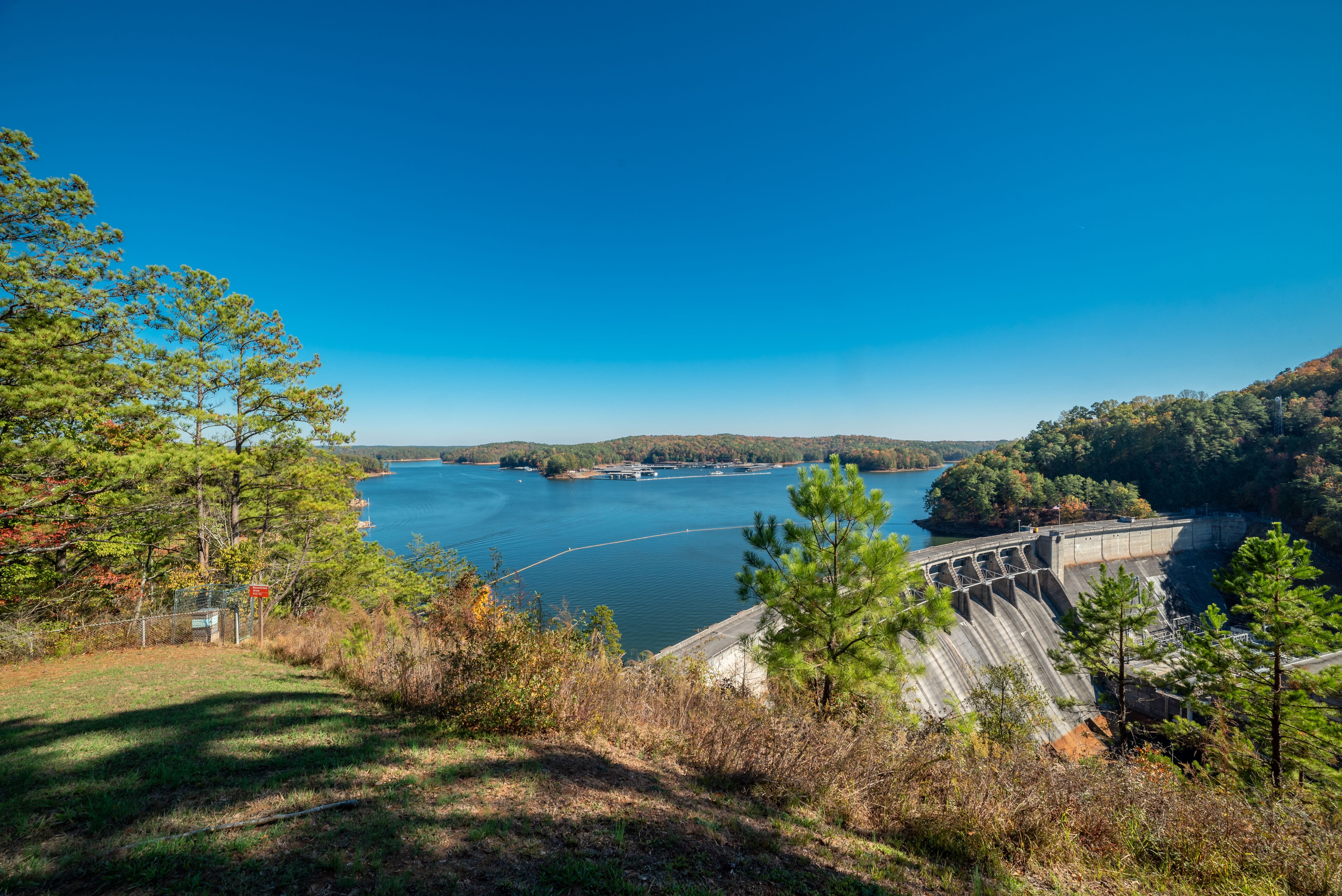
A Sunny day at Allatoona Dam next to Cartersville, Georgia. Photo by Dominik Gryzbon from Pexels: https://www.pexels.com/photo/allatoona-dam-overlook-with-scenic-lake-view-31546895/
On June 9, in Cartersville, Georgia, Qcells began producing its first silicon solar cells on a line that by the fall will be the largest solar cell factory in America. What makes the plant unusual is that the cell never has to leave the building. The same site casts the ingot (a single block of crystalline silicon, grown from molten polysilicon), slices it into wafers, turns the wafers into cells, and assembles the cells into a module — every major layer from ingot to finished panel under one roof, at 16,700 panels a day. Together with the expanded Dalton plant down the road, Qcells will turn out 8.6 gigawatts of modules a year from a single coal-country state (Georgia), enough to power roughly 1.3 million American homes.
To get a sense of the scale: China can turn out well over 1,000 gigawatts of modules a year, so Qcells’ entire American output is under one percent of that, less than a single large Chinese manufacturer ships. Even so, it is a real industrial achievement, and it is too bad arrived in the same calendar year Congress repealed most of the federal demand meant to buy what it makes.
That is the strange and infuriating shape of American renewable-energy policy: We pay the factories to produce, undercut the demand that would fill them, rewrite the tariffs every year or two, keep overpaying for the Asian panels we import anyway, and have no real plan to build the machines the whole industry actually runs on. (My own view is that we should do none of that at all and just import cheap panels from China, but that is another story…)
Five considerations from this “onshoring success” story:
1/ Qcells could not survive in an open global market, and it is barely competitive even behind ridiculous American tariffs. Strip the tariffs away and a Chinese panel is roughly five times cheaper to make than an American one. Five. Times. Cheaper.
BloombergNEF puts the cost of a fully integrated American panel, polysilicon and all, at roughly 47 cents a watt before subsidy. A Chinese module leaves the factory gate at around 9 cents, and lands on a US loading dock, tariffs and freight included, near 30 (near 3x the price most of the rest of the world pays).
The federal manufacturing credit, Section 45X, is what makes the American number survivable: seven cents a watt for the module, four for the cell, with smaller amounts for the wafer and the polysilicon, so a plant that makes all of it under one roof, as Cartersville does, can stack roughly fifteen cents off its own cost, aided by the American taxpayer. That closes about a third of the gap and brings the domestic panel to within shouting distance of the imported one (32 cents vs 30 cents). Competitive barely only as a function of a subsidy and a tariff, neither of which the factory controls.
2/ The tariffs are, of course, a problem, but the policy volatility around them is worse
The Section 201 safeguard tariff (14 percent on imported panels last year) expired on February 6, 2026. In the same stretch, the Commerce Department brought down its long-running antidumping and countervailing case on Southeast Asia, where most “Chinese” panels production had relocated. Final antidumping duties ran from 81 percent on Malaysia to 271 on Vietnam, and the countervailing rate on Cambodia came in at a barely believable 3,404 percent (U.S. Commerce Department final determinations, June 2025). But of course, the supply chain is moving again. And a fresh petition now targets India, Indonesia, and Laos, with preliminary findings due around later this summer. This is manufacturing protection by whack-a-mole. This is a tough policy environment to build a business model - and there is almost a guarantee that it will change again in the new Congress and under the next president.
3/ Washington is subsidizing the factory and defunding its customers... at the same time.
And here is where this already questionable policy turns on itself. The One Big Beautiful Bill, signed last July, kept 45X, the credit that pays the factory to produce, but terminated the residential solar credit at the end of 2025 and set the large generation credits to phase out for projects breaking ground after July 2026. So the supply side keeps its subsidy while the demand side loses one. American module capacity, much of it assembled from imported cells and wafers, already runs near 65 gigawatts a year, more than the country installs. E2, a nonpartisan business group that tracks clean-energy investment, counted some 28 billion dollars of cancelled clean-energy projects in 2025. Cartersville might be okay; it is built and running, and perhaps it will gain some efficiency as it scales. But the case for the next Cartersville is dubious at best.
4/ Nobody else has cracked this either, not Europe, not India, not Latin America
It helps to see that the hard part — competing with China’s scale — is hard everywhere. Europe set itself a target of 30 gigawatts of annual solar manufacturing by 2030 in its Net-Zero Industry Act, but leaned on capacity goals and “buy-resilient” auction rules rather than the hard tariffs and production subsidies the US and India used. It built about 5.5. Meyer Burger, a Swiss-German firm once Europe’s largest module maker, filed for insolvency in 2025, its executives blaming Chinese price-dumping for making the business impossible.
India took the opposite, harder line: a 40 percent tariff on imported modules, a procurement list that locks government projects to domestic makers, and a production subsidy. It worked, kind of. India went from almost nothing to 172 gigawatts of module capacity and 27 of cells in a few years, but still imports the wafers those cells are cut from. Two models — one built on subsidy and tariff, the other on tariff and a buy-local mandate — and both are stalling at the same altitude. Latin America barely tries (for good reasons!): Brazil, the region’s biggest market, assembles some modules but imports roughly 99 percent of them, cells and all — and by staying with cheap Chinese imports it almost certainly pays far less per watt than the US or India do behind their protectionist walls.
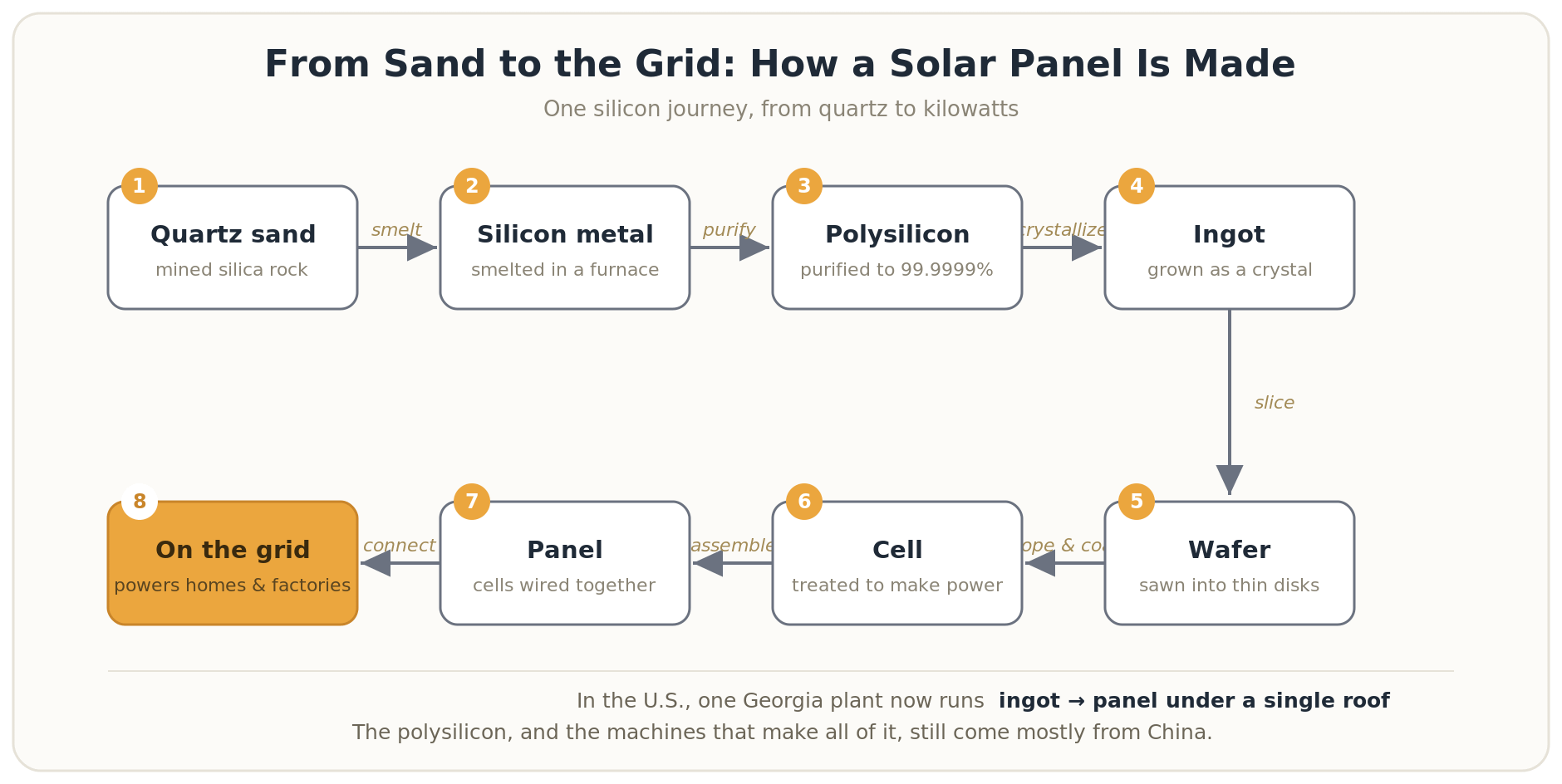
From Sand to the Grid: How a Solar Panel is made
5/ Can there be a fully onshored supply chain in renewable energy?
The Solar Energy Industries Association can now say the United States makes every layer of a solar panel, and it is technically accurate. It is also where the energy-security claim starts to wobble, because Cartersville is the exception, not the rule. Of the roughly 65 gigawatts of module capacity the country has built, only about 5.3 gigawatts of domestic wafer and ingot capacity sits beneath it, and US polysilicon feeds maybe 21. The Cartersville plant is the exception that highlights the rule: most American “module manufacturing” is really just assembly: bolting together cells and wafers shipped in from Asia. And no part of that process is truly “onshored,” because China makes 83 percent of the world’s polysilicon, 97 percent of its wafers, and houses all ten of the largest makers of the machines that cast the ingots, slice the wafers, and coat the cells. Even Cartersville, the one plant that runs every step, runs on Chinese-built tools.
The localization, in other words, is module-deep but not silicon-deep. Against a trade shock, the tariff swings and duty cases that whipsaw anyone importing finished panels, domestic capacity can offer some insurance: the US can keep stamping out modules at home, and Cartersville can even feed itself the cells. That is worth paying for.
But against a deliberate Chinese cutoff of wafers, polysilicon, and factory tools, that insurance is thin. Most American lines would starve for imported cells and wafers within months, and even the integrated plant in Georgia could not build a second line, or repair this one at scale, without machines that are made almost nowhere but China. You cannot stockpile your way out of not making the machines.
The fair rejoinder here might be that China built its own dominance exactly this way: a decade of subsidized, protected, initially uncompetitive plants, polysilicon included. Cartersville is how the US may start that climb. True enough. But China climbed with a home market that grew every year and a state that kept adding support; the United States is trying to climb with a subsidized market that just shrank and a tariff wall that is already coming down and likely to come down more.
What I’d actually watch: wafer, the polysilicon, and the tool-makers. If American wafer capacity is still a rounding error against module capacity in 2028, then “the whole supply chain” was just a rhetorical flourish. If the upstream actually closes the gap with the downstream, the bet pays off and the security is real all the way down. I would not put money on either side yet, which is the honest position when Congress funds both directions at once.
Sources: Qcells/Hanwha (Cartersville start, June 9, 2026) and pv magazine USA; BloombergNEF (US integrated cost ~$0.47/W); IRC §45X credit values; Solar Power World and Norton Rose Fulbright (Section 201 expiry); U.S. Commerce Department and Federal Register (final AD/CVD orders, June 2025); SEIA and Canary Media (US capacity by layer); IEA Solar PV Global Supply Chains and Wood Mackenzie (China shares; equipment); E2 Clean Economy Works (2025 cancellations); pv magazine and Clean Energy Wire (EU/Meyer Burger, Net-Zero Industry Act); pv magazine India / CEEW (India ALMM, PLI, capacity).
Comments
Nothing yet. Say the first thing.
Sign in to join the conversation.