
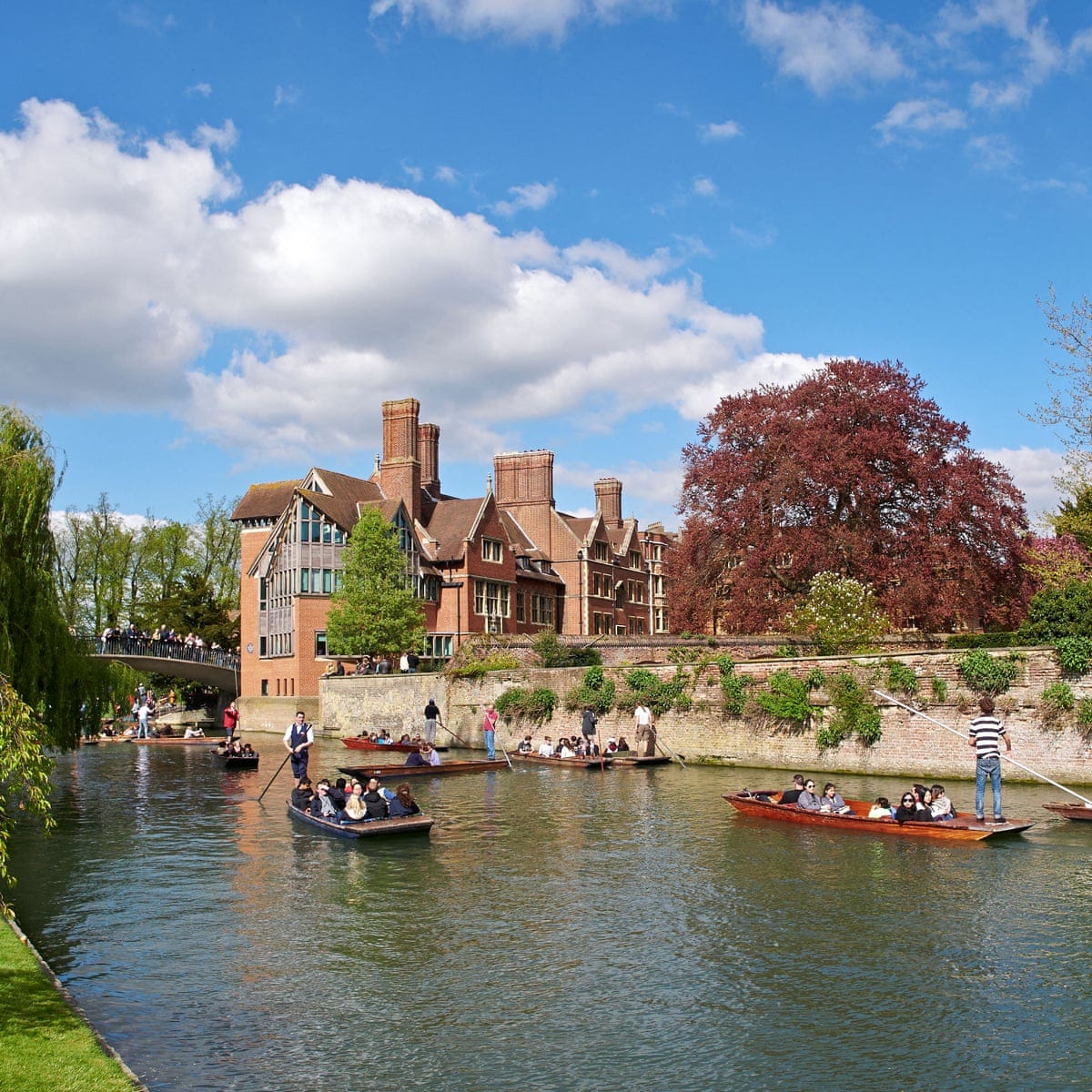
Trinity Hall College, Cambridge was last week forced to re-state its commitment to inclusive admissions after a leaked internal memo suggested a plan to focus student recruitment on a handful of elite fee-paying schools. After a week of general press pillory, Mary Hockaday, Master of Trinity Hall and former head of the BBC World Service, declared the college was “proud to support opportunity across the nation,” concluding “our commitment to that, and our students, has not changed”.
I‘ve no idea whether the offending memo was, as Hockaday claimed, a piece of loose drafting by an unreconstructed admissions officer, or evidence of something more considered. A public relations debacle was all-but-guaranteed by the inclusion, in the same or sequential sentences, of the words “Cambridge admissions”, “Eton”, “St. Paul’s” and “Winchester”, along with the unfortunate implication that students from those schools were more ready for university life than any others in the country.
Attention has focused on the socially regressive implications of a tin-eared missive. What most reactions have missed is the commentary it offers on government curriculum policy of the past decade. Trinity Hall is trying to recruit more students into classics, modern languages and music. These subjects have become virtually the exclusive preserve of fee-paying schools as their cash-strapped state counterparts have transfused available resources into the Ebacc, those subjects that contribute most towards official measures of school effectiveness. This is a more profound source of preferential treatment for the privately educated than any college admissions office could devise. The whole episode is shot through with ignominy.
But why should most people care who, precisely, gets to go to an Oxford or Cambridge college—be they brainy and rich or just brainy? To many, all of this smacks of the ‘Matthew effect’ of compounding advantage. The effect, named after the parable of the talents—“To every one who has, more will be given,” (Matthew 25:29)—refers to the tendency for initial advantages, in wealth or talent to compound over time, leading to ever more unequal social outcomes. In our book Greater Expectations, Ian Warwick and I identified fear of the Matthew effect as a key barrier to education policies that accelerate social mobility. And social mobility in the (profoundly unequal) United Kingdom remains first and foremost a function of education.
Analysis by the Sutton Trust demonstrates that elite university attendance has a levelling up effect not present in other forms of higher education. The graph below below shows the relationship between household income (the x axis) and income at age 30 (the y axis) among graduates of different types of university.
Income versus socio-economic background by alma mater (Sutton Trust)
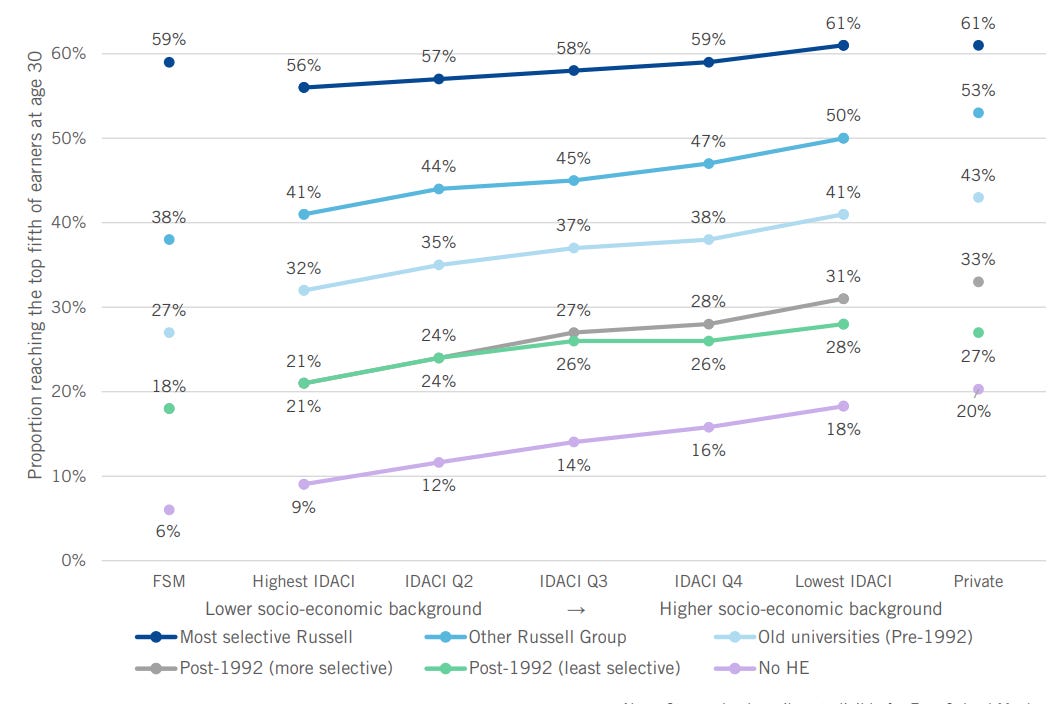
Among graduates of the UK’s most competitive universities—Oxford, Cambridge, the LSE and Imperial College—those who had received free school meals were only fractionally less likely than those who had been privately educated to find themselves among top wage earners by age 30. Strikingly, the poorest students graduating from the most competitive universities were around nine percentage points more likely than the richest students attending any other university to feature among top earners by the time they had established themselves in their careers.
It’s become far too easy to frame this development as essentially a neoliberal hypocricy, lifting individuals out of poverty but leaving communities untouched. I’m as concerned as anyone with the obstinacy of disadvantage in specific communities and regions, but as a serving headteacher I’m also acutely aware of the positive feedback loop created by socially mobile young people. In my experience, these are not young people fleeing their households; they are young people transforming their households.
Outside of that charmed circle of graduates, however, the importance of university education versus family background seemed to recede steadily. Almost everyone included in the Sutton Trust sample benefited from going to university—any university—when compared to their school leaving peers. But ‘levelling up’? Not really. On the Sutton Trust analysis, someone from a well-off home who didn’t go to university was about as likely to be a top earner as a someone from a poorer home who went to one the country’s least selective universities. The school leaver pulled fractionally ahead if the school they attended charged fees. Typically, each rung in the household income scale cancelled out a rung in the implicit university hierarchy.
Like any social scientific study, this analysis yields multiple lessons, not all of them easily reconciled. University still seems to pay off for most young people—or did, for the cohorts in the survey—but only attending an elite university seems to matter more than your family background. Attending an elite university remains perhaps surprisingly significant even for students from the most affluent homes. By contrast, attending a less competitive university offers very uncertain benefits for the wealthiest students in state schools or those in private education. Related work on degree subject adds a layer of complexity, as does class of degree achieved, but neither fully dislodges the conclusion that where a student goes to university matters more than what they do there or how well they do it.
None of the above means we should valorize elite universities as engines of social mobility. Both Oxford and Cambridge have done a better job in the past 20 years recruiting students from state schools, but neither has made much progress recruiting students from the poorest homes.1 The Sutton Trust analysis could be read as an illustration of survivor bias, signifying nothing so much as the fact that anyone able to secure a place at one of the most competitive universities in the country is probably likely to do well in later professional life. On the other hand, these findings offer a strong rebuttal to those bemoaning the impact of more inclusive recruitment on elite universities themselves. As has been found in the United States, more inclusive student recruitment has not produced less successful alumni.
At the time of writing, Oxford has just made offers to its next crop of potential undergraduates. Cambridge will do so in a little over a week. Those offers will matter to everyone who receives them—if to some more than others. The Sutton Trust analysis suggests that who receives those offers should matter to everyone.
Those disadvantaged students that do make it to Oxbridge are disproportionately likely to have attended one of just a handful of state schools. Although this is a source of understandable pride in those schools—immodestly, this includes my own—it is hardly a sign of a fully healthy education system.
No posts
Comments
Nothing yet. Say the first thing.
Sign in to join the conversation.