
I was with a group of CMOs the other day and I asked something that sounds simple but actually hits a nerve pretty fast: how many memorable minutes did your brand create this month?
Not impressions, reach or views. Memorable minutes. The kind of content people actually remember, talk about and come back to.
And you could feel the discomfort in the room, because everyone there knew exactly how to buy reach, but nobody really knew how to build that kind of relevance anymore.
We’ve been playing the same game for the past decade, optimizing everything for attention, volume, performance, feeding the machine, hitting numbers… and it worked for a long time.
But now attention is fragmented, algorithms have changed, feeds are overloaded and, to be honest, most of what brands post is either instantly forgettable or so self-centered that nobody really cares. 🤷♀️
At the same time, if you look at what’s actually working, especially on the creator side, the logic is completely different. Creators (the good ones) don’t think about one-offs, they are thinking in shows.
“Creators think of story lines with longer arcs, trying to retain audiences for long periods of time”. Dhar Mann, creator and founder of Dhar Mann Studios
They create formats that people recognize, build rituals audiences come back to, and develop worlds around them (no wonder LORE it was finalist for word of the year in 2024, losing to Brainrot). They develop characters, storylines, inside jokes and keep stacking episodes over time.
They are definitely not optimizing for reach, they are optimizing for time spent, return rate, and community building.
In other words, they are operating as showrunners.
And if you’re a CMO today, whether you like it or not, you’re moving in that direction too.
The easiest way I’ve found to explain this shift is through a ladder I’ve been using a lot lately:
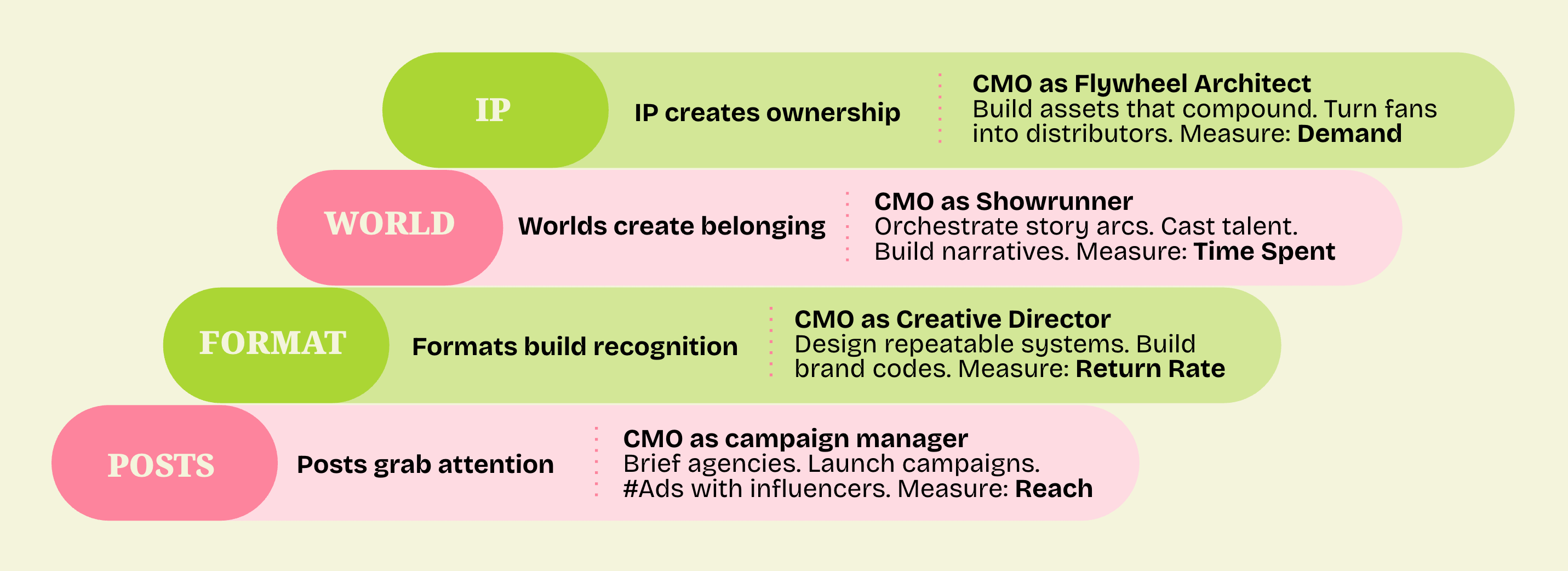
Most brands are still stuck at the bottom. Climbing this ladder is not about doing more content. It’s about changing how you think about content.
One measures reach. The other measures time spent. One chases trends. The other builds rituals.
This shift is happening faster than most orgs can adapt.
Traditional TV is fragmenting, platforms are rewarding consistent episodic content, and audiences are starving for brands that actually entertain them instead of interrupting them.
The brands that start thinking like studios today will own the cultural real estate that everyone else will be trying to buy in five years.
This is exactly what we’re going to dig into at HollyTube, a 4-day executive immersion in Los Angeles this May, inside the companies shaping this new era of entertainment.
We’re bringing together CMOs, investors and operators to learn about what it actually looks like to run a brand like a media company.
If that sounds like a room you want to be in, just hit the button bellow:
The urgency of culture is real.
The question is which role you’re going to play in it.
Sponsored by Screeneo
I’ve spent two decades in the creator economy, watching this industry grow from a scrappy experiment into a multi-billion dollar market. And one of the things that never kept up with that growth is how brands actually make partnership decisions.
Most of the time? Still gut instinct. A media kit. A quick Google. Maybe a scroll through the comments. Or because “the CMO really likes this influencer.”
That’s how you end up with a crisis that was entirely preventable. And that’s a huge problem, not just for brands, but for creators too. When a partnership goes sideways because no one did proper due diligence, everyone loses.
It’s a background check and risk analysis platform for influencer partnerships. It uses AI to automate a process that most marketing and compliance teams are still doing manually, inconsistently, and way too slowly.
In under 2 minutes per creator, it pulls public information and structures it into a risk report covering things most brands never think to check: lawsuit history, political positioning, betting involvement, negative press from the last 12 months, and brand partnership history. ALL UNDER TWO MINUTES.
The first thing I did was run myself through it. Of course.
Verdict: no risk. Totally safe, zero lawsuits, solid reputation.
Hey brands, my DMs are open 🙂

But that moment is exactly what sold me. Not because I needed to know I was clean, but because I could see how quickly a brand could know it too. With actual data, not intuition or wishful thinking.
Then I started running other creators…
Some of the most hired names in the industry right now? Not as clean as you’d think.
I’ll let you find out for yourself.
Comments
Nothing yet. Say the first thing.
Sign in to join the conversation.