
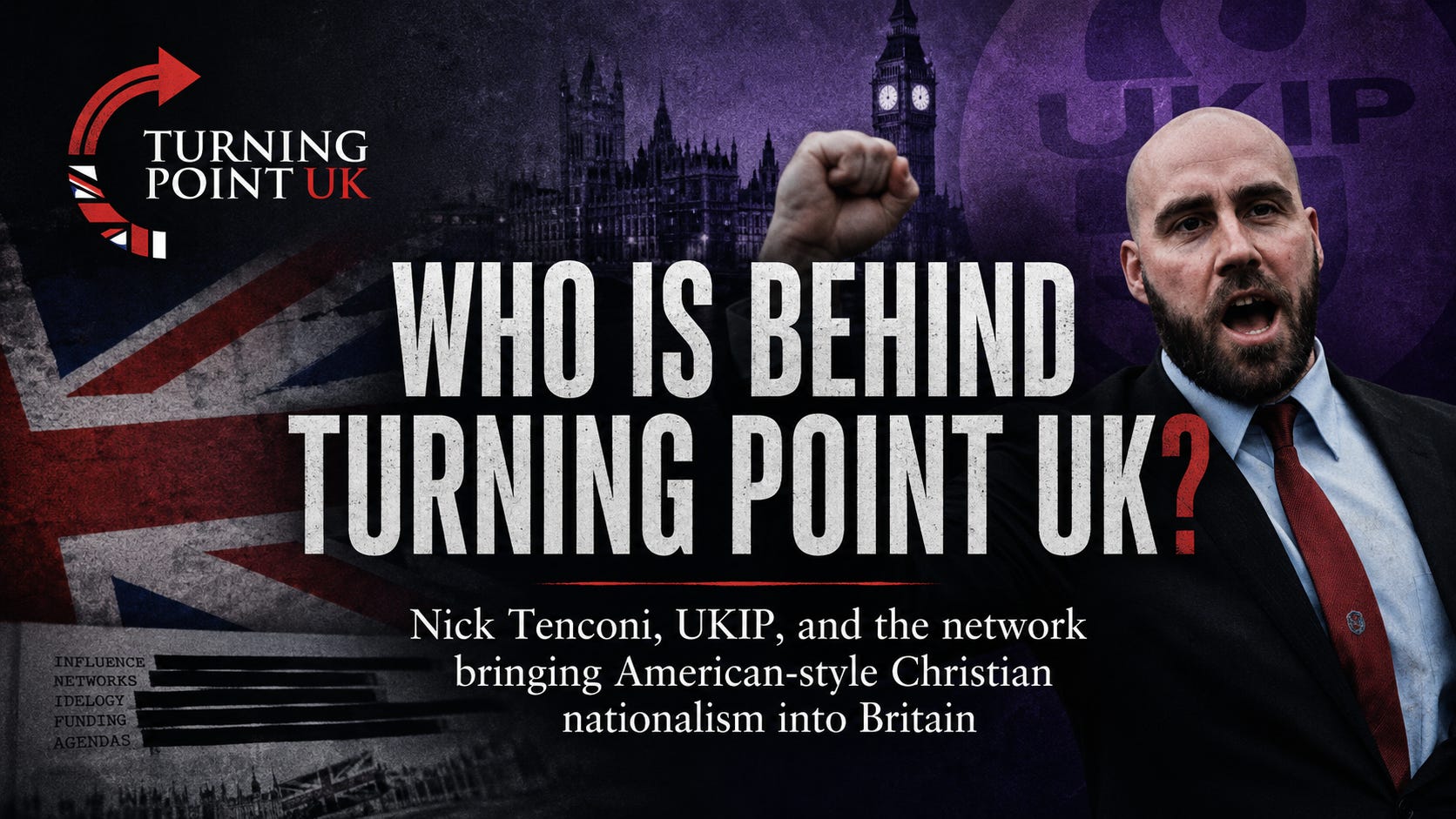
I started looking more closely at Turning Point UK because I have spent a long time studying Christian nationalism in the United States, long enough now to recognise the way it works even when the language shifts. The details change from country to country, but the underlying structure is familiar. Christianity becomes bound up with national identity. Liberalism is recast as moral decline. Immigration is treated not simply as a policy question but as a threat to the character of the nation. LGBT rights, feminism and secularism are folded into a wider story about cultural collapse, and politics becomes less about ordinary disagreement than about restoring a supposedly lost moral order.
Turning Point USA sits firmly inside that American ecosystem, so its British counterpart was an obvious place to look. The first question was straightforward enough: how deep did the relationship really go? Was Turning Point UK simply borrowing the American name, style and political language, or was there a deeper organisational or financial connection running beneath it?
That sent me into Companies House filings, Electoral Commission records, American non-profit accounts, archived websites, company histories and the sort of paperwork that makes you forget what day it is. I expected, if I am being truthful, that the investigation might eventually turn up a financial trail. Perhaps some direct American money, perhaps something more structured between the organisations.
It did not.
I found no evidence that Turning Point USA secretly funds Turning Point UK or its nearest political party UKIP, no clear financial pipeline from the American Christian right into British electoral politics, and no document showing that the British operation is directly controlled from the United States. What emerged instead was less dramatic, but in many ways more revealing: a small British network of people, companies and political organisations whose relationships become much clearer once you stop looking only at the public-facing brand.
At the centre of that present-day network sits Nick Tenconi.
UKIP has publicly described Tenconi as both its leader and chief operating officer of Turning Point UK. That single overlap tells us more than any speculative diagram ever could. It is a direct bridge between an activist organisation with roots in the American Turning Point movement and a registered British political party. Once you follow that bridge backwards, the wider structure begins to appear.
Turning Point UK did not emerge independently in Britain and then happen to discover that Charlie Kirk was already using the same name in America. Its origins were explicitly transatlantic. The British organisation launched in 2019 as a UK counterpart to Turning Point USA, borrowing the name, political model and much of the wider culture-war style. George Farmer was one of the key figures in that launch period, and Farmer’s relationship with Candace Owens connected him directly into the American Turning Point world at a time when Owens was one of the most recognisable figures in that ecosystem.
That does not mean Farmer and Owens are sitting somewhere today secretly directing Turning Point UK, and there is no evidence to support that sort of claim. Their importance is historical. They show the political environment in which Turning Point UK was created and the direction from which its early model came. George Farmer belongs to the organisation’s American-facing origins. Nick Tenconi belongs to what it has become.
The more interesting question, then, is what actually sits behind the Turning Point UK name today.
On the surface, Turning Point UK looks straightforward enough. It has a website, social-media accounts, memberships, donation links, merchandise and activists. Beneath that, however, the legal structure is less obvious.
Turning Point UK’s privacy material identifies Media & Activism Ltd as the company behind the operation. Companies House records place Oliver Anisfeld at the centre of that company’s formal control. Anisfeld therefore occupies a very different position from Tenconi. Tenconi is the public political figure, while Anisfeld sits around the legal and corporate infrastructure.
Anisfeld has interests in other media organisations too. That does not automatically drag those organisations into the same political project, and it would be misleading to describe everything he touches as part of some Christian nationalist machine. What it does show is that the corporate structure behind Turning Point UK is connected to a wider media world rather than existing in complete isolation.
Then came one of the more revealing moments in the investigation, and it began with what looked like a boring website mistake.
Turning Point UK’s privacy notice points to Media & Activism. Its terms and conditions, however, name Stand Up Media Ltd, while appearing to use Media & Activism’s company number. The company name points one way, the registration number another.
The most likely explanation is mundane. Someone copied or adapted a legal template and failed to change every detail. Websites are full of these mistakes.
The interesting part is what the mistake revealed.
Stand Up Media is not some random company left behind in an old template. It is a real communications company controlled by Jack Ross, another senior figure associated with Turning Point UK.
What appears to have been a routine website error had inadvertently exposed another company connected to the same political network.
That does not prove that Stand Up Media is secretly funded by Media & Activism, and it does not establish that the two companies operate as one entity. I found no invoice, contract or payment record proving that. But it raises an obvious question: how did the name and address of a company controlled by another senior Turning Point UK figure end up in Turning Point UK’s own legal terms?
The answer may still be entirely ordinary, but the mistake matters because it shows how much of the structure most supporters would never normally see.
Once the names are placed together, the organisation becomes easier to understand. Oliver Anisfeld controls Media & Activism. Jack Ross controls Stand Up Media. Nick Tenconi occupies a senior role within Turning Point UK while also leading UKIP. These are separate people with distinct roles, but the same small group keeps appearing across activism, media, communications and party politics.
Ross and Tenconi also appear together outside the immediate Turning Point structure. Ross founded the Vans Without Borders aid initiative, and Tenconi travelled to Ukraine with the project. Tenconi has publicly described Ross as a friend. There is nothing sinister about humanitarian work, and I am not suggesting otherwise. The relevance is simply that this is not a relationship inferred from two names appearing on the same website. There are real working and personal connections running through the group.
That is what makes the word network useful here. It describes what the evidence actually shows without pretending there is some secret command structure sitting above it all.
The financial side of the investigation was less explosive.
I spent a great deal of time going through UKIP accounts because one large category of income initially looked potentially significant. Around £174,000 stood out, and at first glance it was the sort of figure that makes you wonder whether something interesting is hiding inside it.
Most of it turned out to be bequests. Dead people had left UKIP money.
Not quite the international dark-money revelation I had imagined.
That matters because when the evidence produces a boring explanation, the boring explanation has to win. I found no public record showing Turning Point USA paying UKIP, Media & Activism, Stand Up Media or Tenconi’s own company. I found no evidence that Tenco Training was being used as a political financial vehicle, and no document proving that Media & Activism paid Stand Up Media.
There are still things the public filings do not explain. Media & Activism’s accounts include a £21,100 investment whose destination is not identified in the available filing, and its net assets moved significantly between reporting periods. UKIP’s accounts also contain substantial contractor and agency expenditure without publicly naming every recipient.
Those are legitimate questions, but they are not proof of misconduct. The more accurate description is that parts of the financial picture remain opaque. There is little to no public transparency. That’s the take away here.
Public filings tell us enough to know that money moves through these organisations, but not enough to reconstruct every relationship between them. We cannot currently say whether Stand Up Media provides paid services to Turning Point UK, whether UKIP has purchased services from people connected to the Turning Point network, whether Tenconi is paid by Turning Point UK through one of these entities, or whether there are shared resources such as staff time, media production or data.
Those questions remain open. And more deeper investigation into their finances will need to be done. However with what I did have, deeper I went, the more obvious it became that the most interesting part of the story was not financial at all.
It was Nick Tenconi himself.
Before his current political prominence, Tenconi’s public background was in fitness. His company, Tenco Training Ltd, dates back to 2014 and appears from the filings examined to have remained a small operation. His earlier work included personal training, coaching and boxing.
There is no evidence that Tenco Training itself is part of a political operation. It shares a registered address with Stand Up Media, but that address appears to be associated with an accountancy practice. Still another connection. Two small companies using the same professional address is not evidence of a secret headquarters, but it is more than a coincidence that they do share the same address..
The more interesting question is how the man behind what on paper looks like a failing fitness business became the political figure he is now.
During this investigation, I was contacted by someone who knew Tenconi personally before his rise through Turning Point UK and UKIP. I am keeping that person anonymous. Their account is useful because it describes a version of Tenconi that existed before the present political persona, but it remains one person’s recollection. Where I have not been able to verify the details, I am not presenting them as fact.
The Tenconi they remember is strikingly different from the man now speaking in the language of Christianity, nationalism and cultural collapse. They described someone who “projected as worldly but everything was a veneer”, politically reactionary and anti-woke even then, but not especially knowledgeable. Over time, they remember him becoming increasingly drawn to a more performative style of masculinity built around bodybuilding, boxing, cigars and a consciously harder public image.
Their personal judgement of him was considerably harsher. They described insecurity, financial difficulties, periods of living with his mother and housing problems. I have not independently established those claims, and I am not going to turn anonymous recollection into established fact simply because it is colourful. But I have no reason to disbelieve my source, even if I don’t have direct access to Tenconi’s background before he became a figure in the hard right Christian nationalist movement in the UK.
One detail is particularly interesting, though. The source remembers Tenconi as an atheist. While today Christianity sits at the centre of his public political identity.
There is nothing inherently suspicious about that. People change. People convert. Someone being an atheist at one point in life and Christian later proves nothing about the sincerity of their faith.
The relevant question is not whether Tenconi privately believes in God. The relevant question is what happens when Christianity becomes fused with his politics. And is his Christianity just part of the whole grift, the whole narrative of pushing Christian nationalism here in the UK.
His present public persona increasingly pulls together Christianity, nationalism, immigration, traditional masculinity and a wider story about cultural decline. That combination is where the resemblance to the American Christian nationalist ecosystem becomes harder to ignore.
Christian nationalism is not simply Christians having political opinions. Christians are entitled to political views like anyone else. The defining shift comes when Christianity stops being merely a faith and becomes part of the definition of the nation itself. The country is imagined as properly Christian. Secularism becomes decay. Minorities become evidence that the national character is being lost. LGBT rights and feminism are folded into a story about moral disorder, and political opponents are no longer simply wrong but part of the process by which the nation has supposedly been corrupted.
That machinery has become brutally effective in the United States.
Britain is different. Our relationship with religion is different, our political institutions are different and our culture is different. American Christian nationalism cannot simply be copied and pasted into Britain unchanged.
It has to be translated. That is where Turning Point UK becomes particularly interesting.
American rhetoric about “woke ideology” fits comfortably into Britain’s existing culture wars. Christian national restoration can be reframed as the recovery of a supposedly lost Christian Britain. American border panic translates easily into British panic about asylum seekers, Muslims and multiculturalism. Arguments about traditional masculinity blend naturally with hostility towards feminism, LGBT rights and progressive social politics.
The accent changes, but the political grammar remains recognisable.
Turning Point UK’s own trajectory reflects some of that shift. The organisation launched with a strong emphasis on the familiar American campus model: universities, free speech, student activism and supposed left-wing bias. The version operating today is much harder to understand simply as a student conservative organisation.
Tenconi has become increasingly visible in street demonstrations and culture-war confrontations around drag events, gender politics, immigration and nationalism. He has appeared within the same wider protest ecosystem as figures including Tommy Robinson, Laurence Fox and Paul Golding.
That needs careful handling. Appearing at the same event does not make everyone members of the same organisation, and sharing a platform is not proof of shared command or membership. But repeated proximity still tells us something about where political alliances and overlapping audiences are forming. And how the hard right, anti-immigration and politics of division and hate in the UK overlap each other.
Back to Tenconi and his move into UKIP. That is where the story becomes much more important. Turning Point UK is an activist organisation. UKIP is a registered political party. Tenconi bridges the two.
There is no evidence that Turning Point UK has formally taken over UKIP, and nothing in the public record establishes that Media & Activism, Oliver Anisfeld or Jack Ross secretly control the party. That does not need to happen for political ideas and methods to move between organisations. But they are so closely aligned, the key figures involved have such a relationship, that to all intents and purposes they’re all singing from the same hymn sheet.
People carry politics with them. They bring their contacts, their media relationships, their language and their understanding of what the political battle is supposed to be about.
Tenconi matters because he occupies both worlds.
On one side is an organisation created directly from the American Turning Point model. On the other is a British political party. Around him sits an increasingly explicit mixture of Christianity, nationalism, anti-immigration politics, traditional masculinity and culture-war activism.
That is why, after all the financial digging, Tenconi became more interesting than the balance sheets.
He is the point where the network meets electoral politics.
Seen as a whole, the structure is surprisingly compact. George Farmer belongs to the launch period and the original American connection through Candace Owens and Turning Point USA. Oliver Anisfeld sits around the formal corporate infrastructure through Media & Activism. Jack Ross sits within the communications and organisational layer through Stand Up Media and his wider work around Turning Point UK. Nick Tenconi now occupies the political junction between Turning Point UK and UKIP.
None of that requires a secret hierarchy.
Modern political influence does not always work through one organisation sitting neatly above another. It often moves through overlapping companies, media projects, campaign groups, activists and political parties, with the same individuals appearing in different places and carrying ideas between them.
That is what makes these networks difficult to see if you examine every organisation separately.
After all this research, I cannot tell you that Turning Point USA secretly finances UKIP. I cannot tell you that Tenco Training is being used to move political money. I cannot tell you that George Farmer still controls Turning Point UK, or that every person who appears beside Tenconi belongs to one coordinated movement. I also cannot establish every claim made to me about Tenconi’s earlier private life.
Those limits matter, because I only operate with the facts and evidence I have. I have to, to counter the fake news and the misinformation that pours out of the hard right in this country. I have to ethically stand above them, and the sensationalism of the mainstream media, the media bias, the whole mainstream shitshow of lies and political agenda. I have to have journalistic integrity, wherever my investigations lead me.
What I can say is that Turning Point UK emerged directly from the American Turning Point ecosystem, that its public brand sits on top of a corporate structure most people will never have examined, that an apparent error in its own legal pages revealed another communications company controlled by another senior figure, and that the same small group of people repeatedly appears across activism, media and political organisation.
Most importantly, the man publicly identified as Turning Point UK’s chief operating officer now leads UKIP.
I began this investigation wondering whether American Christian nationalism was being financially pumped into Britain. Perhaps money will eventually form part of the wider picture, because there are still things the public records do not show. But concentrating entirely on cash risks missing the more ordinary way political movements spread.
Ideas do not need to arrive with a cheque attached to them. They move through people, organisations, media platforms and political parties, changing slightly as they go and adapting themselves to the country that receives them.
American Christian nationalism was never going to arrive in Britain unchanged. It had to be filtered through British history, British resentments and British politics.
Turning Point UK is one of the places where that process can now be seen.
Nick Tenconi is standing at the point where that activist world meets electoral politics.
I went looking for a hidden pipeline. What I found was a network sitting largely in plain sight. And one we should all be wary of expanding, as this Christian nationalist hard right ecosystem grows in the UK, the more it gets a foothold, the harder it will be to defeat.
Thanks for reading! This post is public so feel free to share it.
When Does a Riot Become Terrorism: The uncomfortable question raised by Thetford
The World’s Smallest Violin for Britain’s Biggest Victim
The Ann Widdecombe Case and the Mechanics of Narrative Collapse
Bin Face vs Frog Face - Special Report: Clacton 2026 Candidate Assessment
The Political Obituary of Nigel Farage (We Hope)
Nigel Farage: The Billionaire’s Man of the People
The Fall of Nigel Farage: The Pint-Man Prophet Finds the Bar Tab
Farage’s Brexit Betrayal Myth Is Just the Same Old Con in a New Hat
Farage Is Not Demanding Democracy. He Is Demanding Advantage.
Farage vs the Evidence: A forensic dismantling of the “two-tier Britain” narrative
How Do You Bring Them Back?: The Outrage Machine, the Failure of Politics, and the Working-Class Case for Reason How do you bring them back?
The Tide Is Coming In: Migration Is History Coming Home
Don’t Let Them Turn Henry Nowak Into a Race War Poster
Is Britain Turning Far Right, or Is the Megaphone Just Too Loud?
Fear, Freedom, and the Emotional Architecture of Politics
Democracy, Populism, and the Death of the Nation-State
Reform UK and the Cult of the Outrage Machine
Normalising Hate: The Political Decay of Post-Brexit Britain
Exposing the “Grooming Gangs” Myth: White British Men and the Truth About Sexual Abuse in the UK
The Big Lie vs The Big Truth: Who Really Abuses Women and Children in the UK
Debunking Common Myths About Immigrants and Asylum Seekers in the UK
No posts
Comments
Nothing yet. Say the first thing.
Sign in to join the conversation.