
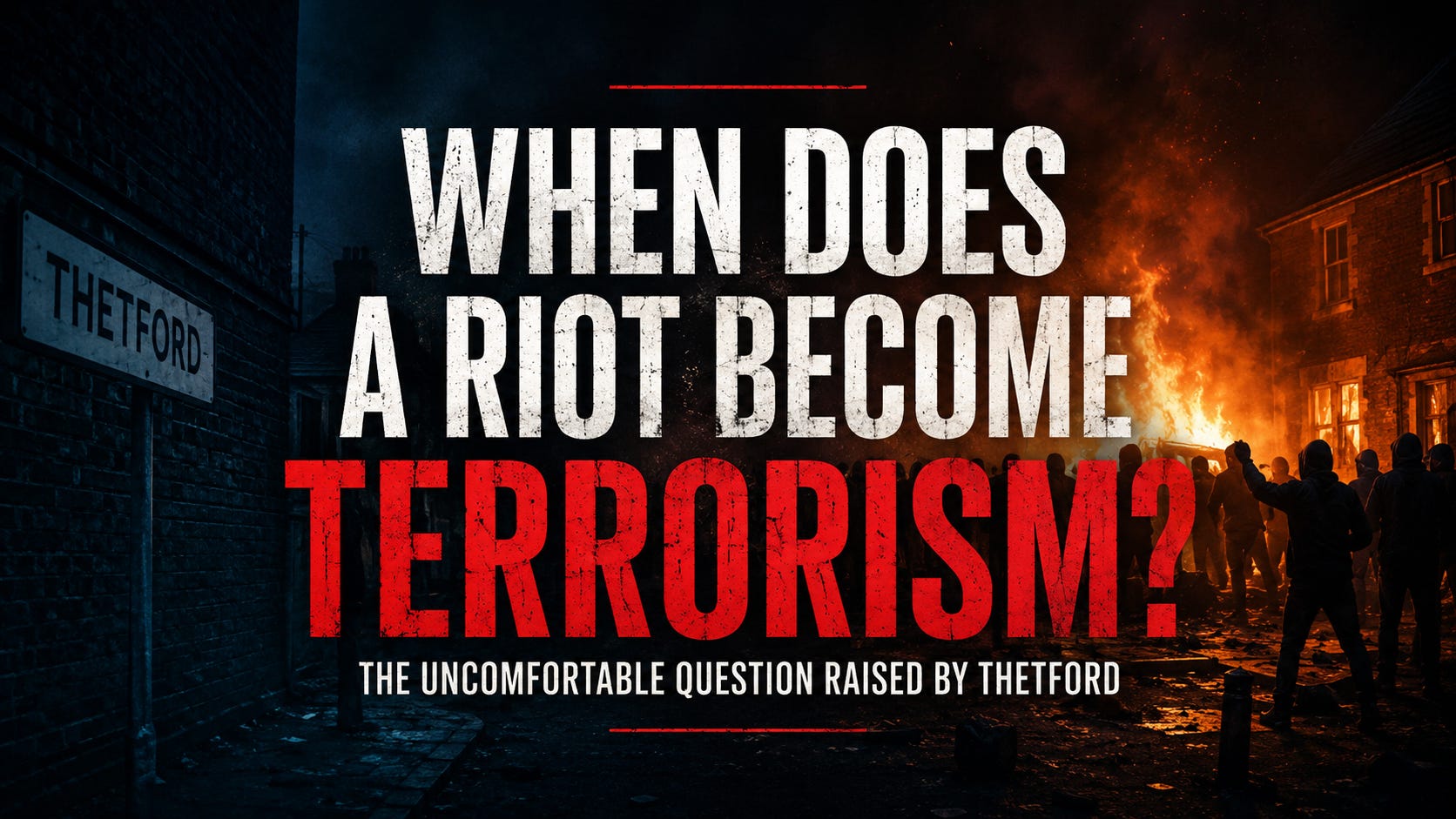
A few days ago, I watched what was happening in Thetford and called it domestic terrorism on a Threads post.
Straight out. No caveats. No legal hedging. No carefully balanced language designed to give me somewhere to retreat later. I saw mobs targeting homes they believed contained asylum seekers, people attempting to get inside, property being damaged, police officers being attacked and frightened residents having to be moved for their own safety, and I called it what it looked like to me.
Domestic terrorism.
The post went ballistic. Lots of people agreed with me. And then I sat with it.
Because lots of people agreeing with me doesn’t make me right. Outrage isn’t evidence, and however strongly I might feel about something, or how many people agreed with me, my anger doesn’t get to rewrite British law.
I’d used an incredibly serious and incendiary term, so I wanted to know whether I could actually defend it.
Was what happened in Thetford terrorism?
Not, did it look like terrorism? Not, was it terrifying? Not, were the people responsible behaving like violent racist thugs?
Was it terrorism according to the law?
So I did something social media isn’t particularly good at encouraging us to do.
I slowed the fuck down.
I got out the Terrorism Act 2000. I went through what happened in Thetford. I looked at Britain’s history of extreme-right terrorism, at organisations we’ve already proscribed, and at previous cases where Counter Terrorism Policing has had to decide whether far-right violence crossed that line.
I was perfectly prepared to discover I’d overreached. I don’t think I did. My instinct was, that I’d called it. But if I didn’t test it, I’d be as bad as the misinformation morons that litter all our feeds. In fact though, having gone through it all, I think what happened in Thetford should be treated as suspected domestic terrorism and investigated with that seriousness. Why? Well let’s slow it down and break it down.
Suspected is the key word here. It’s not the same as declaring anyone guilty of a terrorism offence. It isn’t calling for convictions without trials, and it certainly isn’t me conducting criminal proceedings from my kitchen table.
It means something much simpler. I think there is enough here for Counter Terrorism Policing to start asking questions.
And I think those questions need to go considerably further than Thetford.
Before getting anywhere near terrorism legislation, we need to separate legitimate political protest from what actually happened.
You can oppose immigration. You can oppose asylum policy. You can oppose the government’s plans to accommodate asylum seekers in your community. You can protest outside Parliament, a council building or a government facility. You can march, write to your MP, shout yourself hoarse and vote for whichever politician promises to solve it.
That’s politics.
What happened in Thetford crossed into something else.
Over several nights, properties believed to contain asylum seekers were deliberately targeted. More than 100 protesters were involved. People attempted to enter homes. Property was damaged. Police officers were assaulted. One officer was struck with a rock, another was bitten and another spat at. People inside targeted properties had to be protected and asylum seekers were ultimately moved for their safety.
These weren’t Home Office buildings. They weren’t council offices. They weren’t the structures and institutions that are legitimate things to protest against. They were people’s homes. That’s the line that was crossed.
And there was another detail that immediately bothered me.
There was a list.
Addresses linked to asylum accommodation had circulated online before properties were targeted. That matters, because it introduces something beyond a spontaneous protest becoming violent.
It introduces targeting. So what happens when we put all of that against the actual law?
The popular idea of terrorism is considerably narrower than the legal one.
Say terrorist and most people immediately construct a picture. Bombs. Guns. Organised cells. Balaclavas. Decades of politics and news coverage have also conditioned us to associate the word with particular religions, ethnicities and foreign conflicts.
The Terrorism Act doesn’t define terrorism according to what the person committing it looks like.
Section 1 of the Terrorism Act 2000 provides the test. In broad terms relevant here, the conduct must involve things such as serious violence against a person, serious damage to property, endangering life or creating a serious risk to public safety. It must be designed to influence government or intimidate the public or a section of the public, and it must be undertaken for the purpose of advancing a political, religious, racial or ideological cause.
That’s the framework. Now put Thetford beside it.
There was violence and property damage. Police officers were assaulted and attempts were made to enter homes.
Whether every incident meets the precise legal threshold of serious violence or serious damage isn’t something I can determine. That’s precisely the kind of thing investigators and prosecutors determine from evidence.
But there is plainly conduct there to examine.
Then we get to intimidation.
The Act doesn’t require the entire population to be frightened. It specifically refers to intimidating “the public or a section of the public.”
Who was being targeted in Thetford?
Asylum seekers.
Not randomly selected residents. Not whoever happened to be standing nearby. Properties were being targeted because people believed asylum seekers lived inside them, and some of those people ultimately had to be moved for their own safety.
I can’t know the intention of every person standing in those crowds. Some may have gone purely to protest. Some may have followed others. Some may have intended violence. Criminal responsibility is individual, and those distinctions matter, if we’re dispassionately going to examine this.
But when members of an identifiable group are located in their homes, crowds arrive, people attempt to enter and the occupants have to be moved somewhere else for their own protection, asking whether that section of the public was being intimidated isn’t stretching the Terrorism Act.
It’s reading it. It’s matching facts again legislation.
Then comes ideology.
Being anti-immigration isn’t terrorism. Being racist doesn’t automatically make somebody a terrorist. Protest against asylum policy isn’t terrorism. But again, there is a legal line.
But what happened in Thetford didn’t materialise in an ideological vacuum.
The unrest arose from anti-asylum mobilisation. Properties believed to contain asylum seekers were specifically targeted. The Guardian reported far-right involvement and people referring to asylum seekers as “invaders”.
So again, the relevant question is straightforward.
Were particular acts of violence and intimidation undertaken for the purpose of advancing a political, racial or ideological cause?
I think there is more than enough here to justify finding out. And I think we all know the answer to that one. Even before any investigation, there is sizable politically motivated anti-immigration ecosystem out there, that is becoming more and more threatening in it’s rhetoric and it would appear, actions.
Anyway we return to those addresses, that list circulating online. As that is key.
This may ultimately prove extremely important.
We know information identifying properties associated with asylum accommodation circulated online. We know properties were subsequently targeted.
What we don’t currently know is where that information originally came from. There are rumours and allegations circulating about that. I’m deliberately not repeating them because rumours aren’t evidence. Perhaps somebody painstakingly assembled the addresses from information available publicly. That seems unlikely.
But that’s something investigators need to establish.
Because imagine, purely hypothetically, that an investigation discovered the addresses came from somebody with privileged access to them. That’s where the internet rumours have gone. A leaked list feels most likely, but that still isn’t evidence.
But let’s imagine evidence showed that a person supplied them knowing or intending that they would be used to identify asylum seekers for intimidation or violence.
Suddenly the evidential picture changes dramatically.
You potentially have the advance identification of a particular group of civilians, deliberate provision of their locations, subsequent targeting of those locations, ideological motivation, intimidation, violence and property damage.
And if, hypothetically, whoever supplied that information happened to be connected to a certain political organisation, that would create another set of questions.
It wouldn’t make that organisation immediately responsible. Political affiliation isn’t collective guilt. A handful of supporters or members of any political party committing crimes doesn’t make the party responsible for those crimes.
The question would be how deep the connection went.
Was somebody acting independently? Were other members involved? Were political or organisational networks being used? Did officials know anything? Was anybody facilitating or encouraging what was happening?
Those aren’t allegations. They’re questions.
And saying those connections haven’t been proved is not an argument against investigating them.
Finding out whether the connections exist is what an investigation is for.
This isn’t unexplored legal territory.
In December 2016, National Action became the first extreme-right organisation proscribed as a terrorist organisation in Britain.
The Home Office described it as a neo-Nazi organisation whose propaganda repeatedly featured extreme violence. Crucially, the government also cited its promotion and encouragement of terrorism after the murder of Jo Cox when concluding that it was “concerned in terrorism”.
National Action was not the end of the story.
Britain subsequently proscribed other extreme-right organisations and networks, including Sonnenkrieg Division, Feuerkrieg Division, Atomwaffen Division and The Base.
Then there is Terrorgram.
Terrorgram is particularly interesting because it challenges the old image of what a terrorist organisation has to look like.
It is an online transnational extreme-right network. The government’s assessment says its leadership coordinated propaganda intended to radicalise people, encouraged terrorist violence and distributed instructional material. The Home Office concluded that it was both preparing for and encouraging terrorism.
I’m not saying Thetford is the same as National Action. I’m not saying whatever loose networks existed around the disorder constitute a connection to Terrorgram. I’m certainly not saying any mainstream political party is a terrorist organisation.
The comparison is about something much more fundamental.
Britain has already accepted that extreme-right ideology can produce terrorism.
Indeed, the government’s own counter-terrorism guidance explicitly recognises extreme-right-wing terrorism as a category.
So when ideologically motivated far-right violence occurs, there is no principled reason the terrorism framework should suddenly become unavailable simply because the people involved don’t resemble the terrorists we have been culturally trained to imagine.
There is an even better precedent because it shows what investigation actually looks like. In October 2022, a man threw crude incendiary devices at an immigration centre in Dover.
Counter Terrorism Policing became involved.
They didn’t begin with a predetermined conclusion.
Investigators spoke to witnesses, recovered evidence and examined digital devices. From that investigation they established an extreme-right motivation and concluded that the attack had been motivated by terrorist ideology. They also found no evidence that the perpetrator had been working with anyone else.
That’s important. They didn’t prove terrorism and then investigate it. They investigated it to determine whether it was terrorism. And that’s exactly the distinction I’m making about Thetford. And I think it meets the legal threshold, that it should be investigated as such.
This is where I think we need to widen the lens.
Thetford isn’t the first time Britain has recently watched far-right or anti-migrant mobilisation move from rhetoric and social media into real-world intimidation and violence.
During the 2024 disorder, a list containing dozens of immigration centres and advice organisations circulated online amid threats of far-right action. Thousands of police officers were deployed and immigration lawyers feared their workplaces would be attacked.
This June, addresses were again circulated online during racist disorder in Belfast. Families from minority communities described being terrified as homes and businesses were targeted.
Now we have Thetford.
At some point, treating every eruption as a completely isolated incident becomes inadequate.
Someone needs to start connecting the dots.
And yes, I think that means examining political rhetoric too.
Up to and including Nigel Farage.
This is where people will immediately start shouting that I’m blaming Nigel Farage for a riot. I’m not. I want to, I do personally think he is responsible for a lot of the hate and violence happening in this country. But, whether I want it to be or not, if somebody throws a brick while wearing a Reform T-shirt, Nigel Farage isn’t legally responsible for the brick.
That’s not how responsibility works.
But neither should political rhetoric receive some magical exemption from scrutiny when we’re examining how extremist environments develop.
Farage has publicly called for “pure, cold rage” as part of his political rhetoric. There is also a separate, documented pattern in the way he has interacted with far-right audiences online. A Guardian investigation, found some damning evidence of Farage’s connections to far-right extremism online, and his use of Cameo. Cameo is a platform where members of the public pay celebrities and public figures to record personalised video messages. Farage made thousands of these paid videos. In one, commissioned for a man convicted of violent disorder during the 2024 far-right riots, Farage told him his 16-month sentence was “absolutely outrageous”, said he had “been through the mill”, urged him to “keep believing in the right things” and finished by saying, “I’m with you as well.”
The same Guardian investigation found another paid Cameo video in which Farage unknowingly promoted an event organised by leaders of Diagolon, a Canadian far-right extremist group with neo-Nazi associations. He was also found to have repeated or alluded more than 20 times to the anti-immigration slogan “If in doubt, kick them out”, a phrase used at Tommy Robinson rallies and protests against asylum accommodation. Farage’s spokesperson said the videos were made in good faith, that he did not necessarily know who the recipients were, and that they should not be treated as political endorsements.
That makes the reason for including it much clearer: the point is not that Farage knowingly endorsed neo-Nazis. The point is that his rhetoric repeatedly travels through, overlaps with, and is consumed within the same far-right political ecosystem we are asking investigators to examine.
Farage has also publicly condemned political violence at other times.
What I am interested in isn’t simply what a politician later says they intended.
I’m interested in what audiences hear.
Political rhetoric has always exploited ambiguity. A politician can use language carrying enormous emotional force while retaining enough literal distance to say afterwards that anybody interpreting it violently misunderstood them.
Perhaps they did.
But when supporters repeatedly interpret political messages through a language of invasion, betrayal, rage, enemies and existential threat, and some of those people subsequently move from keyboards to streets, the relationship between rhetoric, networks and action becomes a legitimate subject for investigation.
Not assumption. Investigation. Look at the communications, the networks. Look at who organises demonstrations, how information moves between groups. Look at where these target lists originate. Look at whether apparently separate outbreaks share activists, organisers, channels or political connections.
And if there is no meaningful connection?
Good.
Establish that.
But don’t refuse to look because following the evidence into mainstream politics might become uncomfortable.
This is ultimately where my position has landed.
I don’t know where the Thetford address list originated.
Find out.
I don’t know whether people targeting those houses were connected only through loose social-media networks or through something more organised.
Find out.
I don’t know whether the same networks or individuals connect different episodes of far-right violence around Britain.
Find out.
I don’t know whether any politician’s rhetoric can be evidentially connected to particular organisers or particular acts.
Find out.
That’s what Counter Terrorism Policing is capable of doing in a way that journalists, campaigners and people sitting at kitchen tables aren’t. Follow the communications. Establish the relationships. Determine intent. Separate coincidence from coordination and rhetoric from instruction.
Then follow the evidence wherever it goes.
That’s what I set out to discover.
I called what happened in Thetford domestic terrorism.
Then I questioned myself. I read the legislation. I looked at the known evidence rather than the rumours. I looked at Britain’s history of extreme-right terrorism. I looked at National Action and Terrorgram. I looked at Dover and how Counter Terrorism Policing actually determines whether extreme-right violence crosses the terrorism threshold.
And after all of that?
I still think Thetford should be treated as suspected domestic terrorism.
I think there is enough evidence to take that possibility seriously.
That doesn’t mean arresting everybody involved as terrorists. It doesn’t mean banning political organisations because some of their supporters behave appallingly. It doesn’t mean starting with a conclusion and forcing the evidence to fit it. It means investigating what happened with sufficient seriousness to determine whether the statutory terrorism threshold was crossed.
And I think the investigation should follow the networks surrounding it.
The violence. The organisation. The addresses. The online groups. The political connections. The rhetoric. The people moving information between the online world and the street.
Where those connections don’t exist, say so.
Where they do, follow them.
Because Britain has already accepted that extreme-right terrorism exists. We already have legislation designed to identify it. We already have police whose job includes investigating it.
What we cannot do is reserve the word terrorism for people who conform to some comfortable stereotype while repeatedly treating ideologically motivated violence from the far right as merely another riot that somehow got a little out of hand.
I began this with an angry Threads post. I questioned it and I checked myself. I went looking for reasons I might have been wrong. I haven’t found enough to make me withdraw what I said. I’ve found enough to think somebody with considerably greater investigative powers than me should start asking the same questions.
Take the politics out of it. Take my opinion out of it.
Put the evidence on the table. Put the Terrorism Act beside it.
Connect the dots.
Apply the test.
Thanks for reading! This post is public so feel free to share it.
The World’s Smallest Violin for Britain’s Biggest Victim
The Ann Widdecombe Case and the Mechanics of Narrative Collapse
Bin Face vs Frog Face - Special Report: Clacton 2026 Candidate Assessment
The Political Obituary of Nigel Farage (We Hope)
Nigel Farage: The Billionaire’s Man of the People
The Fall of Nigel Farage: The Pint-Man Prophet Finds the Bar Tab
Farage’s Brexit Betrayal Myth Is Just the Same Old Con in a New Hat
Farage Is Not Demanding Democracy. He Is Demanding Advantage.
Farage vs the Evidence: A forensic dismantling of the “two-tier Britain” narrative
How Do You Bring Them Back?: The Outrage Machine, the Failure of Politics, and the Working-Class Case for Reason How do you bring them back?
The Tide Is Coming In: Migration Is History Coming Home
Don’t Let Them Turn Henry Nowak Into a Race War Poster
Is Britain Turning Far Right, or Is the Megaphone Just Too Loud?
Fear, Freedom, and the Emotional Architecture of Politics
Democracy, Populism, and the Death of the Nation-State
Reform UK and the Cult of the Outrage Machine
Normalising Hate: The Political Decay of Post-Brexit Britain
Exposing the “Grooming Gangs” Myth: White British Men and the Truth About Sexual Abuse in the UK
The Big Lie vs The Big Truth: Who Really Abuses Women and Children in the UK
Debunking Common Myths About Immigrants and Asylum Seekers in the UK
No posts
Comments
Nothing yet. Say the first thing.
Sign in to join the conversation.