
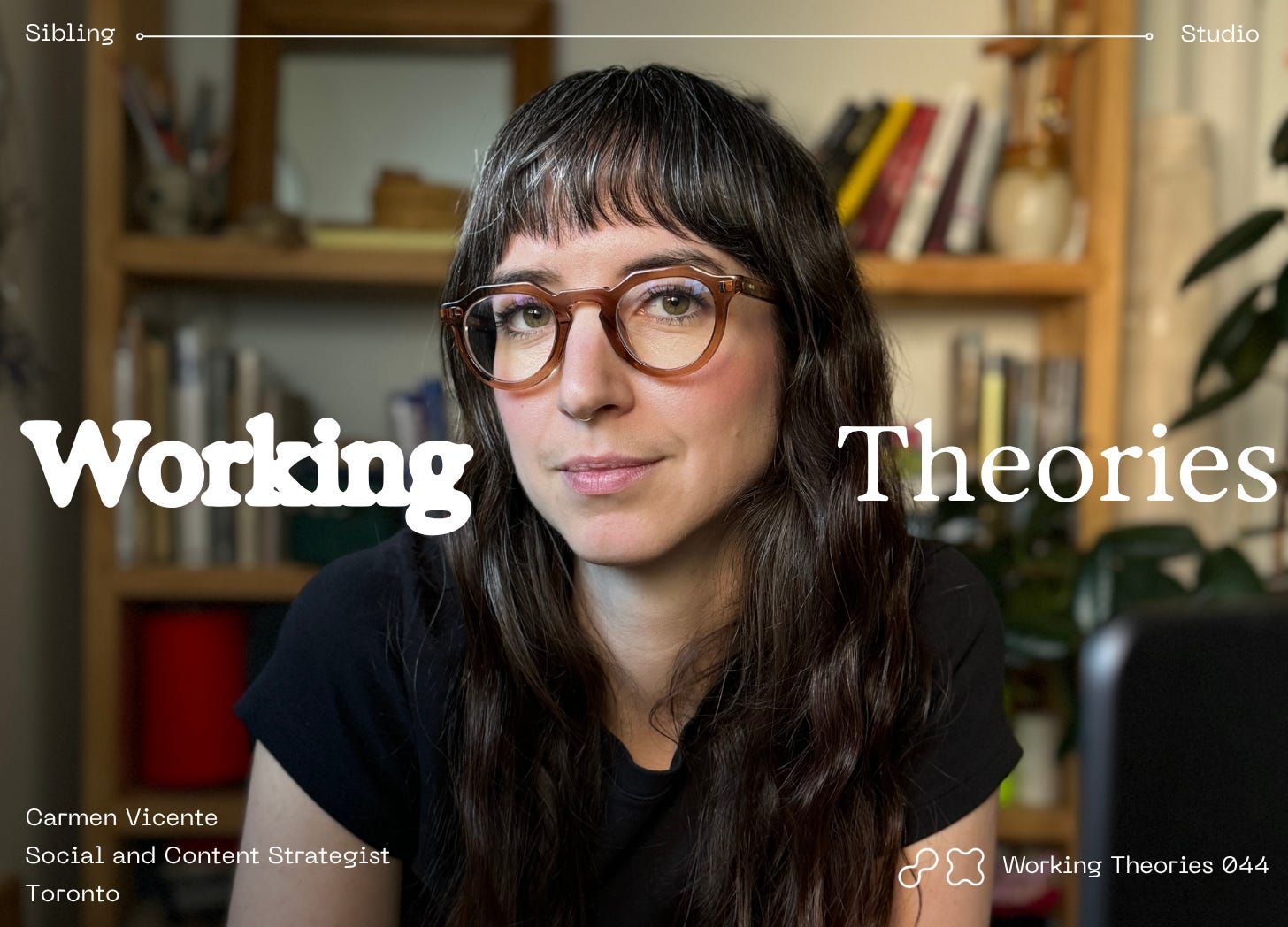
Tell us who you are.
I’m Carmen, and I’ll admit I find it hard to encapsulate what I do these days. By day I work at a tech startup leading social and content strategy, but I also create critical-leaning video essays about digital culture and algorithms on Instagram and TikTok, and write a fortnightly newsletter called Scroll Sick with cherry-picked suggestions about where to devote your attention. My goal right now is to encourage people to be more discerning about the media they consume, and act as a human algorithm.
What’s a working theory you hold right now about the industry, culture, or creativity?
My working theory right now is that we’re entering a post-Dead Internet Era, that maybe we’ll call the “Afterlife Era”. The Dead Internet Theory was originally just a conspiracy that bots and AI generated content would eventually outnumber humans online, but as of June 2026, it’s now the reality.
And instead of throwing in the towel to admit defeat, we’re still here, co-existing with the bots and the genAI influencers, for reasons that range from too addicted, to strangely hopeful, or even morbidly curious. Regardless of our motives, I think the fabric of the internet has shifted, and in this era we’ll see more distrust (elevating audience trust to the status of precious resource), a departure from overly-polished branding and campaigns in order to show proof of humanity and (“proof of effort” as Rachel Karten coined), digital fatigue, and collectively, low tolerance for derivative, formulaic, “taste-less” content that’s easy to codify and reproduce.
I see the Afterlife Era as being characterized by resistance and unrest, but ultimately uncoordinated. What I’m really interested in (and keeping an eye on for signals), is the era after the Afterlife Era.
What’s a belief or assumption in your field that you think is overdue for a rethink?
All the social media algorithms are turning “dialogical” or conversational now that LLMs are layered in, but I’m not convinced this is how we want to interact with our feeds! The tech giants are obviously framing the shift as a positive move towards “hyper-personalization”, but having to chat with my algorithm feels like another “to do” and the end result (or risk) of highly personalized content diets is ultimately echo chambers.
I worry about the loss of shared media and culture, and the prevailing trend of friction-free tech.
What’s your favourite dumb thing you’ve seen on the internet recently?
Oh man, I see a lot of dumb stuff on the internet (it’s sort of my job to seek it out, ha). There’s a woman on TikTok who sings really emphatically into her mirror, but holds her phone in her buttcrack (she is not trying to be sexy). There’s a Chrome extension someone built that helps you stop doomscrolling by programming a fat cat to laze around on your screen (very effective). This recent bit made me laugh out loud because it’s SO dumb, but so me.
I also love every ironic version of the “it’s not too late” meme.
What are your absolute go-to cultural resources?
I think about “cultural resources” a lot and really try to diversify where I get information/inspiration. Recently I’ve started going on X after swearing it off for the past 15 years of my career, because it feels like the end of the earth — but sure enough, there is interesting, contentious stuff there in and amongst total garbage. I like Noema Mag a lot for longer form articles about tech/philosophy, I’m a big Kyla Scanlon fan for economic content, I think Casey Lewis is an excellent archivist of online ephemera, and Anne Helen Petersen writes one of my favourite newsletters, Culture Study.
For futurists, I think Alyssa Yuhas and Anu Lingala are geniuses, and for tech journalism I devour everything by Jasmine Sun. My new favourite creator is Hannah Zhang, and my pal Miranda Shanahan never misses.
PPPPS - books written before the internet.
What’s a habit, tool, or ritual you swear by?
You can laugh at me for calling them this, but “raw dog walks”. I try to do daily walks in the morning with no phone/tech/wearables/ear phones/music/etc. and I consider them integral to my creative process. A lot of my work is contingent upon being able to access an endless well of new, good ideas and those don’t come from scrolling. I absorb lots of content each day, I read a ton, and yes, I scroll too much, so I need time to process all that information and digest everything. Walks are where that happens, and for me at least, it’s necessary to push through that first stage of antsy, uncomfortable boredom in order to access a deeper level of thinking.
Not that you asked, but a hill I will die on is that you have to get comfortable with boredom if you want to be creative.
What’s the biggest risk you’ve taken in work—and what did it teach you?
TL;DR — talking about my work, for free, on the internet is the biggest risk I’ve taken in work, and it taught me that unconventional opportunities arise from unconventional efforts.
For the past two years I’ve been creating content on social (TikTok, Instagram, and Substack) outside of my full-time role, and that has been a very difficult but (mostly) worthwhile endeavour. For one, it’s just so much time and effort and work, oh my god! There’s also a not insignificant part of me that doesn’t want to live a life online. And yet, every time I post something on social media I learn something, and I earnestly believe that increasing awareness of my opinions and ideas has positive, compounding effects. Plus, being an active user of social makes me feel less like a sucker.
To be honest, on paper my resume is unimpressive, I made a career pivot “late” in life, and I’ve relished IC roles— I just knew I would have to take a more circuitous route to finding meaningful work. Posting on social media has been a way for me to bypass conventional career ladders and corporate formalities, despite it sometimes making me feel like a punching bag.
You can find Carmen on LinkedIn, Instagram, Substack and TikTok.
No posts
Comments
Nothing yet. Say the first thing.
Sign in to join the conversation.