
Under the appearance of historical contingencies, the secret law that gives rhythm to spiritual history imposes itself.
-Henry Corbin
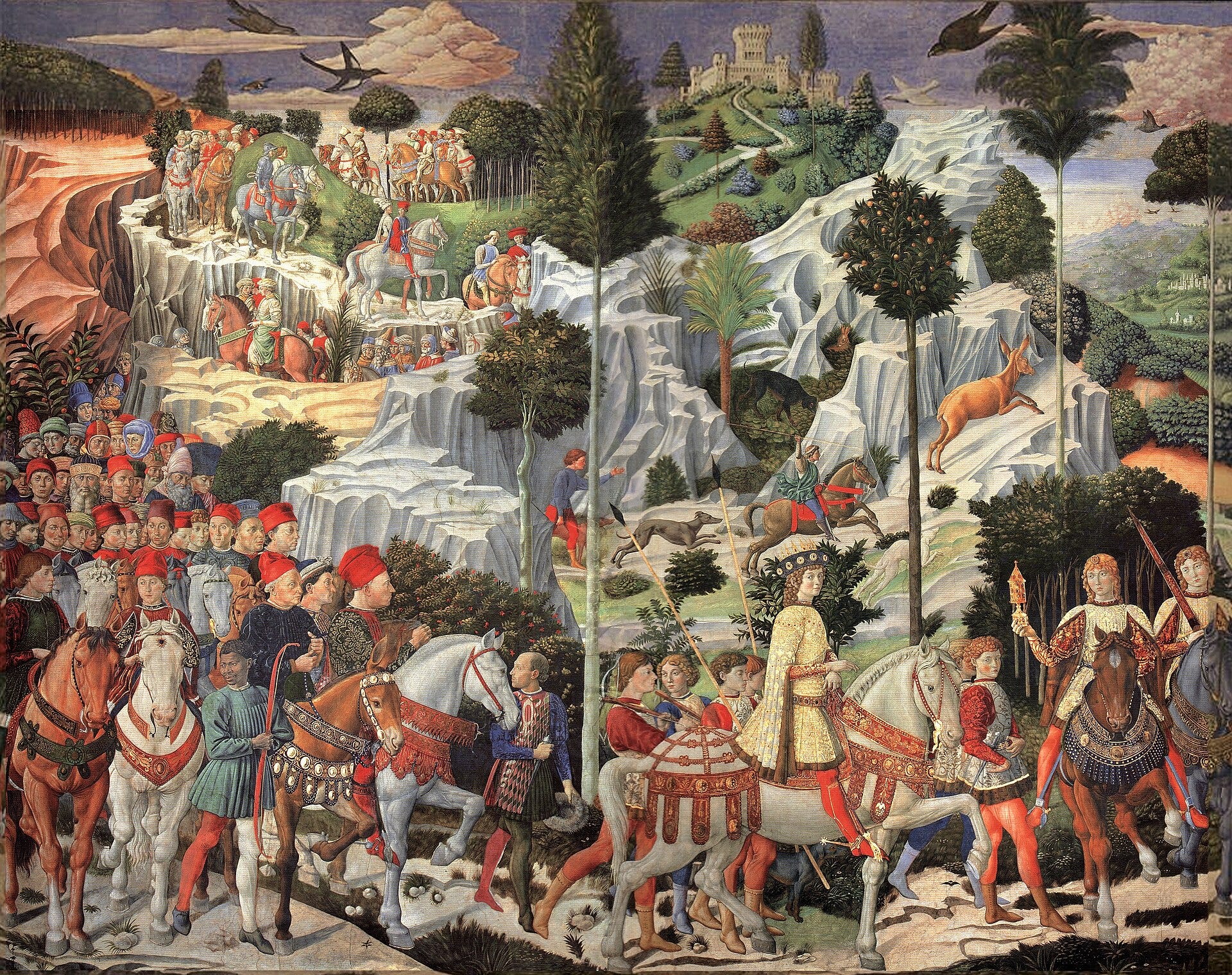
In the absence of revelation, a counter-history must be intuited and reformulated through a visionary organ—the poet’s ear. For this reason, I suppose, St Ephrem the Syrian postulated conceptio per aurem. To interpret the annals through a hermeneutic that remains mindful but not faithful to causality, through a warping of linear events, one which does not alter the words but rearranges the form into descending lines and stanzas, imposing a vertical order into the horizontal logic of the profane historian. Only then can we recognize rhythm and rhyme in the crystalline cascades of time. For the historian of today reads Dante’s Comedy as a single recumbent line.
We shall begin with a rhyme.
If anyone can be credited with initiating the Italian Renaissance, it is Gemistos Plethon. It was this brilliant Greek apostate who ferried Plato’s ghost from his Grecian graveyard to Italian soil, a soil so ripe to receive his spirit once more. As the Turk plundered his inheritance, a conquest engendered by his compatriots’ sclerosis, Plethon brought the seeds of his ancestral wisdom to a people now capable of harvesting it. And through this exchange, one mediated by the Medici court, the golden thread found a new stitch, and a richer fabric had not been felt in ages. But it was not just Plato who accompanied this sublime ferryman. Plethon brought aboard the fullness of pantheons.
The ripple of this movement, this vector, this transmigration of the gods, is incalculable in its breadth and width. This roar of renovatio and palingenesis shattered out into a million speculum shards—images, verses, ideas—beautiful and dangerous. He is the father of Hellenic Neopaganism, the grandfather of Renaissance Platonism, and the godfather of Western Esotericism. Such genealogies have been thoroughly charted, but Plethon’s own intellectual paternity is far less lucid.
But once this veil is pierced, we find that the peculiarities and the idiosyncrasies of the radical Platonist were not so alien to his near easter peers. His nature did not manifest in an absolute vacuum. Instead, we are presented with something of an equation. A distinct set of variables, odd as can be to the modern eye, but variables that repeat and conjoin to identical effect across space and time. Here, in this realm where borders and lines lacked the immutability of divine law, a witches brew of concepts and ethnoi, here in that paradox of Anatolia. For in the Eastern Mediterranean, late antiquity did not end until the conquest of Constantinople.
The first clue as to Gemistos’ origins comes from the condemnation of his greatest enemy, Gennadios Scholarios, the man who would become the first Patriarch of Constantinople under Ottoman rule.
“The sum total of his [Plethon’s] apostasy was consummated by a certain Jew with whom he studied because he was an expert on Aristotle. He [the Jew] was a follower of Averroes and of the other Arab and Persian commentators of Aristotle’s works, which the Jews have translated into their own language. Moses and the things in which the Jews believe or worship because of him [Moses] he [Elissaios] cared for least of all. This man also expounded to him [Plethon] the doctrines concerning Zoroaster and the rest. With this man, who was ostensibly a Jew but in reality a Hellene [i.e., a pagan/Hellenist/polytheist], he stayed for a long time, not only as his pupil but also in his service, being supported by him—he was one of the most influential men at the court of these barbarians; his name was Elissaeus. Such was the man with whom he completed [his formation]. Then, while trying to remain hidden, he was unable to do so; but when he began to spread his doctrines among his associates, he was sent away from the City by the most pious emperor Manuel [II] at that time and by the Church—not, however, without some destruction, because the majority did not openly denounce him, nor did they drive him away dishonorably or into barbarian land, nor in any other way did they prevent the harm that was going to come from him. Such, in brief, were the causes of that error [Plethon’s apostasy].”
When confronted with paradox in polemics, the modern mind tends to dismiss that which stinks of convoluted caricature. Contamination via a pagan jew in the Turks’ court is easy ammunition to discredit a heretical enemy, and yet, it stinks with the same internal contradictions as the old slander of “idol-worshipping Mohammadeans.” But do not be so quick to dismiss the old Patriarch’s judgment. As it was precisely in this era that coincidentia oppositorum was quotidian reality. I will spare you the scholarship and let the sceptics search the footnotes.
Plethon’s decision to study in “the land of the Turk” rather than the illustrious Constantinople is not as contradictory or eccentric as one might assume (and many have assumed). There are two possible candidates for the city he sojourned in. The first is the city of Bursa, first capital of the Ottomans, and the second is Adrianople (Edirne) in Thrace.1 In the 1380s, both cities were loci of spiritual and intellectual fermentation every bit as stimulating as they were peculiar. The Arabo-Persian medical school of Edirne offered far more to a curious student than its Venetian and Constantinopolitan counterparts. Indeed, plenty of Christians made such a voyage. And in this syncretic krater, all manner of spiritual ingredient entered this hermetic broth, Bektashis, Kabbalists, Dominicans and Greeks, a confluence of mysticism and exotic theories. Christians and Muslims studied under Jewish masters, while Jews studied under Christians, all in pursuit of new knowledge, medical or otherwise. And yet a student of the strange will see no contradiction in medicine giving birth to mysticism, as it was but 2000 years before that the great magician Empedocles founded his own medicinal school in the Mediterranean.
And then there is Bursa. The city in which al-Bistami of Antioch, teacher of Sheik Bedridden, chose to entrench himself. The city where he decided to immerse himself in the study of ‘the science of letters and the divine names,’ where he established the Brethren of Purity and the ‘recovery of a perennial and prophetic wisdom.’2 It was also a city that was by all accounts an attractive place to study esotericism.3 To desribe the dynamic as succinctly as possible, “Christians and Muslims, Greeks and Turks met on an esoteric and spiritual level and the graecophone Jews (Romaniotes) often assumed the role of mediator.”4
But what on earth do we make of Elissaios? He who was “ostensibly a Jew but in reality a Hellene [Pagan]?” There is a precise constellation that is formed in the words of Scholarios’ denouncement. “…a certain Jew with whom he studied because he was an expert on Aristotle. He [the Jew] was a follower of Averroes and of the other Arab and Persian commentators of Aristotle’s works… This man also expounded to him [Plethon] the doctrines concerning Zoroaster and the rest.” There is one name—one name and one name only that can justify such a configuration:
Shihāb al-Dīn Yaḥyā Sohravardī. Sheikh al-Ishraq. The Master of Illumination.
I had long intuited the outlines of this phantom thread in the ripples of Plethon’s words, ever since encountering Henry Corbin’s enigmatic suggestion that somehow Plethon’s project was touched by Suhrawardi’s thought. The current scholarship now supports such a prospect.5
Even the academics are beginning to intuit something peculiar in the shared nature of both projects.
Further characteristics of the mystical philosophy of Suhrawardi that are compatible with Plethon’s pagan Platonism support the picture of Elissaios as a transmitter of esoteric knowledge. Such is the inclusivity of the ‘philosophy of illumination’ of Suhrawardi, which attributes a special place to Pythagoras, the Persian sages and ‘the inspired and illumined Plato.’ This move negates the exclusivity of any particular religious revelation within history, just as Plethon does in Book I of the Nomoi. Compare, for example, two remarkably similar formulations of the idea that truth is coeval with the world. According to Plethon,‘True opinions are coeval (συναΐδια) with the universe and mankind, even if they prevail at times over many people and at times over few’. And here is Suhrawardi:
“Do not imagine that philosophy has existed only in these recent times
[i.e. the times of Pythagoras, Plato and the Persian philosophers].
The world has never been without philosophy or without a person
possessing proofs and clear evidences to champion it. [. . .]
Thus shall it be so long as the heavens and the earth endure.”
Plethon’s procession of divinities in the Nomoi may be read as evoking the radiation of Light/Being pervading and holding together all levels of reality in Suhrawardi. The complex angelology of Suhrawardi also evokes the manner in which Plethon assigns the supervision of particular aspects of the physical and intellectual world to specific deities. Further, it has been recently noted that the theory according to which Elissaios was a follower of Suhrawardi is strengthened by the prominent role of angelology in both Iranian mysticism and Romaniote Kabbala. Suhrawardi also identifies archetypes/Platonic forms with an order of luminous spheres, constructing a system analogous to the Plethonean ontological chain, in which Greek deities are identifiable with the megista gene of the Sophist and Platonic Forms. Both Suhrawardi and Plethon were aiming at creating a spiritual map with reference to imaginary beings/archetypes transcending the corporeal world.
Suhrawardi’s project saw the transposition of Zoroastrian Angels and spiritual topographies into the esoteric cosmology of Islam. He was aiming to restore something of the perennial. While Plethon was intent on reformulating theology and ontology in a neoplatonic emanatory framework in which the Hellenic Gods were once more the powers of mediation. Plethon simply goes further in his break with his religion of birth. In a Christian framework, this was the only possible option, while Islamic cosmology allows for a smoother metaphysical unity and syncretism. One may argue that there is a glaring difference. Sheikh al Ishraq simply brought in new angelic names, beings still in fundamental submission and unity too the One, while Plethon inserted genuine polytheism. Such a contention would betray a profound misunderstanding of Platonic theology.
The key can be found in one of the earliest anti-christian polemicists. Porphyry of Tyre.
At any rate, if you say that angels stand before God, who are not subject to feeling and death, and immortal in their nature, whom we ourselves speak of as gods, because they are close to the Godhead, why do we dispute about a name? And are we to consider it only a difference of nomenclature? For she who is called by the Greeks Athene is called by the Romans Minerva; and the Egyptians, Syrians, and Thracians address her by some other name. But I suppose nothing in the invocation of the goddess is changed or lost by the difference of the names. The difference therefore is not great, whether a man calls them gods or angels, since their divine nature bears witness to them, as when Matthew writes thus: "And Jesus answered and said, Ye do err, not knowing the scriptures, nor the power of God; for in the resurrection they neither marry nor are given in marriage, but are as the angels in heaven"
Plethons radical project, one which looked to overthrow the very foundations of Byzantine society in a total political and religious transformation, was unprecedented in the Christian west, but not in the Near East. If anything, it is an ideological overflow, a queer continuation of that which the heterodox Sufi orders were pursuing in the Ottoman realm.
And yet, this does not explain the central mystery of Elissaos. An Anatolian Jewish mystic submerged in Islamic esotericism is not peculiar for this temporal location; what is peculiar is his supposed Hellenic paganism. But we will return to this mystery later. For now, let us restate the queer equation.
Gemistos Plethon was initiated in Anatolia by a shadowy Jew, one who weaned him on the milk of Islamic mysticism. From here, he reformulates these currents, giving birth to a radical strain of Hellenic Neopaganism. He travels west and inculcates the wider occident with the germ of palengenesis, a surgical intervention in the imaginal realm of the western consciousness, one which alters the course of history forever. It is a paradox. European paganism seemingly revived by an encounter with the Muslims and the Jews.
It is time to finish the first line in this couplet and complete our inexplicable rhyme.
In the summer of 1900, the German adventurer Adam Alfred Rudolf Glauer arrived in Constantinople.6 He had sailed from Alexandria on the tail end of a grand adventure at sea. In Constantinople, he entered the employ of Hussein Pasha, agreeing to work in his Anatolian estates in Yeniköy for the period of a year. Estates located but a few miles from Bursa. And it is in Bursa that he began to seriously study the occult. 7
Glauers interest in the occult and the exotic was first sparked after encountering a Mevlevi sect of whirling dervishes and the Cheops Pyramid in the summer of that year, where “His companion Ibrahim told him of the cosmological and numerological significance of the pyramids,” which, “aroused Glauer’s curiosity about the occult gnosis of ancient theocracies.”8 Glauers patron, Hussein Pasha, was a sufi himself and discussed these subjects with the inquisitive German. But it was within Bursa proper that a familiar equation emerged.
In Bursa, he was introduced to the Termudi family, a clan of Greek Jews from Salonica. The patriarch of the family was a committed kabbalist who had retired to a life of studying the occult sciences and amassing a collection of alchemical and Rosicrucian texts.9 This lifestyle was maintained as his eldest son Abraham managed their bank at Bursa, and the younger son ran a branch in Salonica. The Termudis also had business ventures involving silkworm cocoons and raw silk. (note on the famous american alchemist).
The Termudis were freemasons, initiated into the French Rite of Memphis. It was here, in Bursa, in 1900, that Glauer was initiated into Freemasonry by this shadowy jewish family. Glauer would go on to inherit the entirety of Termudi’s occult library, and through the Termudis and their masonic contacts, Glauer was introduced to Islamic esotericism.10 He would go on to be initiated into the Bektashi order. Glauer was convinced that the Islamic esoteric science of names and numbers shared a common root with Germanic runes.
Glauar, like Bedreddin before him, was not only interested in the occult but also in blending his esoteric proclivities within the fires of revolutionary transformation in the Ottoman state. It is worth noting that the masonic lodge he joined may have been a local cadre of the pre-revolutionary Secret Society of Union and Progress, founded on the model of Freemasonry by Salonican Turks.
Glauer is supposed to have given lectures on esoteric subjects at his apartment in Constantinople, subsequently founding a mystical lodge in December 1910. At this time he was writing a study of the Baktishi dervishes, an antinomian mystical order widely spread and influential in Turkey and connected by legend with the origin of the Janissaries, the medieval instrument of pan-Ottoman dominion in the Balkans. A link between the Baktashi order and European Freemasonry has also been allegeded. Glauer’s political views were primarily inspired by a religious orientation: the anti-materialism of pan-Ottoman mysticism, alchemy, and Rosicrucianism, combined with a post-war hatred of Bolshevism, which he identified as the acme of materialism, led him to embrace antidemocratic ideas. His politics find an historical parallel in the support of King Frederick William II for the Goldund Rosenkreuzer Orden,which opposed the rational and modernizing forces of the Enlightenment with its mystical irrationalism in Prussia during the 1780.
Adam Alfred Rudolf Glauer is better known today as Rudolf Freiherr von Sebottendorff, the founder of the Thule Society. It was Glauer, henceforth known as Sebottendorf, who, upon returning to Germany, was introduced to the ariosophical ideas of Guido Von List. He immediately intuited a connection between his Bektashi mysticism and that of Volkish esotericism. In 1917, Sebottendorf joined the volkish order Germanenorden, an ariosphical group in steep decline, and he revived a schismatic branch in the city of Munich, the same city in which the DAP (later the NSDAP) would emerge. Sebottendorf renamed his order the Thule Society. “In the words of Goodrick Clarke, Without this man it is likely that both the Germanenorden and Ariosophy would have been condemned to oblivion.”11
And so we are presented with our bizarre historical rhyme. One separated by centuries, but bound by location and archetypal repetition. Both Plethon and Sebottendorf are initiated by shadowy Jews in Turkish Anatolia, quite possibly in the same city of Bursa, where they are then introduced to Islamic esotericism. From there, they go on to formulate “neopagan” mythologies, drawing upon the pantheons of their respective ethnic ancestors, both with an explicitly political program of the most radical nature possible. Both end up founding covert revolutionary cells to both disseminate their ideas and engage in political action.
But this is only part of the story.
Continued in Part 2…
Siniossoglou, Niketas. “Sect and Utopia in Shifting Empires: Plethon, Elissaios, Bedreddin,” n.d. doi:10.1179/030701312X13238617305617. Page 43
For a summary of the scholarship on the Suhwardian influence: “What appears to be a more complex problem is the possibility of a genuine ‘Zoroastrian’ or Iranian connection preserved by followers of the Iranian philosopher Suhrawardi (c. 1155–1191) operating on Ottoman ground. Elaborating on the editorial and philosophical work of Henri Corbin on Suhrawardi, Michel Tardieu argued that Elissaios was a carrier of Iranian mysticism and became for Plethon what Ammonius Saccas had been for Plotinus. Intriguingly, Scholarios credits Elissaios with two distinct philosophical influences, whose combination point to a follower of Suhrawardi. The first involves Zoroaster, the second Averroes ‘and other commentators’ of Aristotle: Suhrawardi was not only an Iranian mystic, but also a Peripatetic philosopher and critical reader of Aristotle. The attribution of these two influences to the same person is so peculiar, that it should not be readily dismissed as accidental: their combination is pertinent of the philosophy of Suhrawardi, even if the latter appears to have elevated Hermes over Zoroaster.”
Nicholas Goodrick-Clarke, The Occult Roots of Nazism: Secret Aryan Cults and Their Influence on Nazi Ideology. Page 137
Comments
Nothing yet. Say the first thing.
Sign in to join the conversation.