
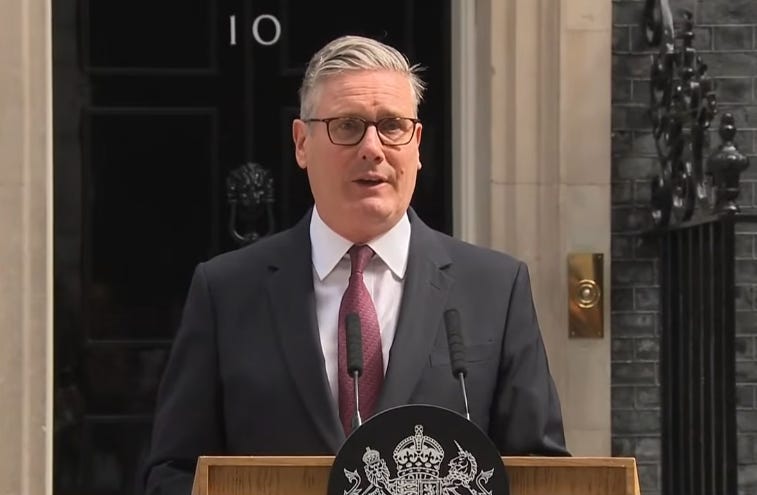
On the day Starmer resigns as prime minister and Labour leader, we have to ask: why was he so unpopular?
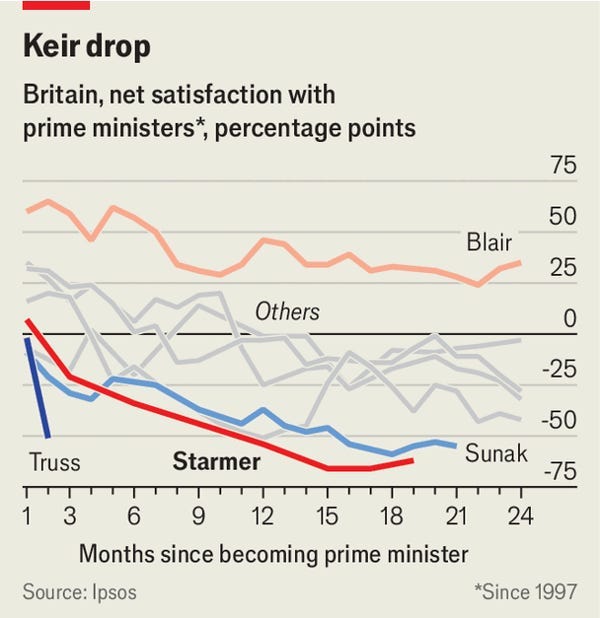
Starmer's popularity had fallen faster than any other recent prime minister, with the exception of Liz Truss who was only in the job for 49 days before being outlasted by a lettuce:
Why is this? What’s uniquely bad about Starmer? To answer this, I’ll look at what he did as leader of the opposition, criticisms from the left and right, and things I dislike about him.
To get elected as Labour leader, Starmer said he would be a continuation of Corbyn and position himself on the left of the party. As Owen Jones puts it, Starmer “conned the Labour membership into voting for him on a false prospectus”.
As leader of the opposition, Starmer steadily moved Labour to the right. Arguably this made Labour more electable (although more people voted for Corbyn in the 2017 and 2019 general elections than voted for Starmer in 2024). Many on the left of the party felt betrayed.
One of the first things Starmer did as leader was to kick Corbyn out of the Labour Party on trumped-up charges of antisemitism. This is what I personally started having serious doubts about his character: he’s a nasty authoritarian.
Following October 2023, Starmer became stridently pro-Israel, saying in effect that Israel has the right to commit genocide in Gaza. This was unpopular because most British people -- whether on the left, the right or the center -- are against genocide. Also because the job of British politicians is to advance Britain’s interest’s not Israel’s.
Owen Jones can be taken as representative of people on the left. His criticisms of Starmer include that Starmer:
targeted pensioners and disabled people
went from extolling the benefits of immigration to raiding the rhetoric of Enoch Powell and introducing one of Europe’s harshest asylum systems
shredded the international aid budget
backed Israel’s right to impose a siege on a civilian population, then claimed he hadn’t
introduced legislation which arrests grannies for holding placards opposing genocide on the absurd grounds they are terrorist supporters
self-evidently had no vision or even coherent plan for government when he took over, which is why everything fell apart so quickly
appointed Mandelson as Ambassador, claiming he’d been deceived into believing Mandelson barely knew Epstein, even though the public record at the time made clear that was obviously untrue.
While leaders are usually unpopular with supporters of other parties, they are usually fairly popular with their own supporters. But according to the Guardian, this is not true of Starmer:
The raw disapproval figures, at least, have an explanation. Leaders tend to be viewed favourably by supporters of their own party, and Starmer is not. He entered No 10 with understandably strong backing from 2024 Labour voters, but this has evaporated, seemingly the result of government blunders and a policy framing intended more to chase Reform than engage the base.
The main criticism of Starmer from the right is that he is (in Elon Musk’s words) “Two Tier Keir” who supports anti-white racism by the police, and the public sector more generally.
Obviously if a voter thinks their country’s leader is against them personally for their immutable characteristics, they are going to be against that leader.
The right also thinks Starmer has done way too little on combatting illegal immigration, people coming here on small boats, or on deporting violent immigrants.
Apart from policy differences, maybe Starmer just comes across as an unlikeable person:
YouGov’s head of politics and elections, Anthony Wells, says the leap from the polling figures to the outright, visceral dislike can be difficult to explain. “People thought Rishi Sunak did a terrible job, but there wasn’t that deep personal element you get sometimes with Starmer,” he said.
“He is deeply unpopular. The polling consistently shows it. But the reasons for it – disappointment in the scale of delivery, and the feeling he hasn’t got much of a clear purpose – are not what you would expect to drive a great dislike.”
I agree with this analysis. While I didn’t like a lot of what Sunak did, I didn’t feel a visceral sense of dislike for him.
I think the critiques from both the left and the right have a lot of truth in them.
Personally, I have had serious misgivings about Starmer ever since he expelled Corbyn from the Labour party:
Starmer [has] an authoritarian tendency that reminds me of Stalin.
I’ve felt this ever since Starmer had his predecessor as Labour leader, Jeremy Corbyn, kicked out of the party. The reason given for doing this was that Corbyn had asserted that the scale of antisemitism in the Labour Party had been overstated for political reasons.
Given the amount of factional infighting in the Labour Party, it’s easy to come to the conclusion that the real reason Starmer kicked Corbyn out of Labour was to get rid of a rival, and make it easier for Starmer to gain total control over the party. This is reminiscent of how Stalin expelled Trotsky from the CPSU.
While I don’t agree with all of Corbyn’s policies, it seems clear to me that as an individual he’s a decent person. The same cannot be said of Starmer.
Starmer is unpopular because:
he has an unlikeable personality
Starmer has made unforced errors such as supporting Israel when they commit genocide
while it is usual to be disliked by supporters of other parties, Labour supporters don’t like him either
politics is more fragmented these days, so supporters of the Labour party are a smaller proportion of the electorate
Will Burnham do any better? He’s certainly more likeable than Starmer.
Comments
Nothing yet. Say the first thing.
Sign in to join the conversation.