
July 1st marked the passage of my first full year as an attending. I thought it might be useful for me, and perhaps interesting to you, to reflect a little on my experiences over the past year.
This is a relief. Obviously.
It continues to be rewarding to introduce residents and medical students to new concepts and see them have those little moments of “Oh, huh, never even thought of that until just now.” It is also incredibly gratifying to have residents come back a few months later and go “So, I’ve been thinking about that thing we talked about last time…”
I continue to find that teaching is the best way to make sure that you actually know what you are talking about, assuming that you, like me, find that questions that poke holes in your arguments are just enough of an ego hit to push you to learn more. I have also been trying to keep in mind that, as an attending, there is a certain segment of residents who will be a bit less skeptical about my declarations of fact than they should be, which cautions me towards humility.
In the clinical setting, I’ve been finding it difficult to strike the right balance between didactic teaching and clinical teaching. I try to integrate the didactic side of things directly into patient discussions. Maybe we spend an extra 30 minutes in morning rounds to discuss some of the finer details of antidopaminergic selection. That sort of thing. Otherwise, my goal has been to set aside time for ~1h of didactic teaching a week on a topic that has been relevant to our clinical work, though sometimes it’s just whatever I’ve been interested in lately. I have not really done the whole “assign a topic to the resident to have them present on” generally because they seem to have enough work as it is and I feel a little guilty piling on even more.
When I was a resident, I got feedback forms about my attendings, the rotation, etc. etc. Most of the time, I was only filling out these forms with specifics if there’s something I really liked or (more commonly) wanted to complain about. There wasn’t really an expectation that I was constantly making mental notes about the good, bad, and the mediocre all the time, and so I never really felt all that guilty about submitting feedback forms where I had answered all of the multiple choice questions like “To what degree did you find this didactic more useful than taking a nap?” and then in the free-response section writing something like “I have no additional feedback.”
Now I get feedback forms for my residents and medical students that (presumably) both administration and the residents themselves actually care about and I’m realizing that I really have not developed the habits of mind to give my residents the sort of specific feedback that I think they deserve.
As a resident, gestalt was my default when it came to evaluating my co-residents and medical students, and even though I think my intuition has proven itself to be pretty good, it’s not helpful for the sum total of my feedback to be “Yeah, I think you’re pretty good!” I can usually articulate the good and bad to some degree when I really start to think about an individual more systematically, but I am absolutely horrible at the whole “narrative feedback” thing. I just do not have an easy time recalling specific events that would help me illustrate my points.
I have also come to realize that I should give positive feedback a bit more than I typically do. I am generally bad at giving positive feedback to anyone for things that I don’t find outright impressive. I hold myself to an unreasonably high standard when it comes to praise (seriously, learning to “just take the compliment” is a skill that I didn’t develop until residency), and I have come to realize that I tend to hold my residents to the same standard. Probably not coincidentally, I spend most of my in-the-moment attention noticing missteps and foibles instead of relative areas of strength.
And look, I’m not saying that my goal is to try and become an attending who is constantly praising their residents and students — that would not be a genuine reflection of myself — but I think most residents would benefit from more positive feedback than I am currently giving them so they don’t spend an unreasonable amount of mental energy worrying that Dr. Wendel thinks that they are incompetent when actually he thinks they’re doing just fine.
To this end, I’ve been trying to do two things (1) jotting down notes during rounds or interviews to help me remember specific events (e.g. “Nice job using silence there” or “Clever way to ask about that patient’s delusions”) (2) Giving more in-the-moment feedback (e.g. immediately after leaving a patient’s room or following an interview). I have generally been told that this is helpful and am trying to do it more frequently.
Of all of the realizations I came to about what skills residency is meant to teach you, I am most confident about this: Decision-making in the face of uncertainty is one of the most important skills for a resident to learn and they will never be good at it if their attending is making all of the choices for them.
The most obvious way attendings do this — directly dictating the plan of care to the resident without letting them give any input — is at least the most overt and easiest to catch yourself doing.
I find myself much more worried, though, about the covert ways in which we attendings can exercise our influence, and most especially the ways in which we do so while fooling ourselves into thinking that we are not. It is easy to con yourself into thinking that it was your extremely thoughtful, unquestionably astute, even (occasionally) galaxy-brained questions (naturally!) that led your resident to your preferred plan. It certainly was not because you asked any leading questions or unconsciously made a face of disapproval… right?
To avoid being overbearing, you have to be at least somewhat aware of what your personal flaws are that make it difficult for you to give your resident the room they need to breathe. In my case, these flaws are a low tolerance for boredom leading to impatience, and a tendency to conflate my personal views about the best course of treatment with the universe of reasonable decisions about treatment.
On the other hand, you also need to avoid being negligent in the supervision of your resident. This means finding a way to quickly determine your resident’s level of knowledge and how they make clinical choices, so that you can calibrate your approach. Knowing where they are at in training will give you a rough idea, but this is probably better for judging where they should be in terms of clinical skill and knowledge, instead of where they are.
My favorite way — at least right now — to figure this out is to ask my residents “Why?” a lot. Like any question that might imply to a resident that a wrong decision has been made, you need to think about how to avoid the potential implication of the question ruining its intent. With a little groundwork, I think I typically get there. I make it a point to tell any resident I haven’t worked with before that I will (1) be asking them “Why?” a lot and (2) “Why?” does not secretly mean “Wrong answer, try again.” Of course, most residents will still think that “Why?” really does mean “Wrong answer, try again,” and that you’re just trying to soften the blow, so I need to demonstrate that there is no implication.1
First, I like to ask “Why?” when they confidently propose something that is so obviously the right decision that I think their internal response to my question should be something approximating “Fuck off dude! I know I’m at least broadly right and I know you know that I’m right.” It’s a nice way to demonstrate to them that what I primarily care about is their thought process, not their specific decision. Making things about thought process and not about specific decisions also can help residents feel less slighted when I have to step in, because they are aware that I am doing so because of a gap in their own knowledge and not because I am simply unwilling to give them responsibility.
Second, I like to ask “Why?” when I don’t know the answer myself, or in situations where there is no correct answer. This again demonstrates that there is not always a ‘right’ answer lurking behind my questions, and also helps to dispel the myth that as their attending I am somehow a Font of Flawless Psychiatric Knowledge and Truth. The sooner my residents learn that they can offer their disagreements, point out my own errors, and propose their own plans in an open, respectful manner, the better.
One of the things that residents find themselves envying about their attendings is how little scut work they have to do. They don’t have to put in orders, write the notes, do all of the intake interviews, or liase with nursing for every little thing a patient is complaining about. While this is generally true, it’s more a double-edged situation than it seems.
Pawning off menial tasks to residents separates yourself from the patient and the unit in general. You don’t get to know the nurses as well as you should. You don’t get the chance to ask the questions you want answered on that phone call with the patient’s spouse, and now she’s not picking up. You miss seeing the strengths and weaknesses of the medical student rotating with you. You don’t learn about how to properly do that thing in Epic that you really should know how to do… that is, until your new intern tells you they don’t know how to do it either.
At least in my case, I’ve noticed that I have to be careful not to let my resident be the primary lens through which I am experiencing the unit and the patient. I have found this to be especially true when I am working with a resident whose clinical skills I have confidence in, since I am more inclined to have a lighter touch.
Personally, I think the best remedy for this situation would be to carry 1 or 2 patients on my own, though I have been… dissuaded from this approach by others for various reasons. In the absence of this, I have been trying to do the following:
Sitting in on intake interviews when I otherwise would trust the resident to go it alone and see the patient afterwards
Doing short-term psychotherapy work with patients that would clearly benefit
Making calls to collateral myself
Calling outpatient providers to give warm-handoffs or collect additional information
It is pretty weird to not be a resident anymore! 12 months ago, I was a resident. Sure, as a PGY-4, as far as some of the interns were concerned, it was hard to tell the difference between me and an attending, but for me the lines were still clear. I could still be friends with them. It wasn’t weird to treat them to lunch and see how they were doing, or invite them to the residency Halloween party at my apartment and have a few drinks with them.
Now, not so much.
Despite the fact that I am only a couple years older than my trainees — or, in the case of some of our MD/PhD residents, a year or two younger — I am referred to by my residents as Dr. Wendel.
It is difficult to know exactly what is or isn’t appropriate interpersonally, particularly when your internal social-norms are still calibrated to being a resident. I have residents that are people my age that I would totally be friends with if I were still a resident. But my job is not to be their friend; instead it is to be a good teacher and fair-minded evaluator of their clinical skills so that they may become a better psychiatrist than they would otherwise be. That said, how acceptable is it to approximate friendship? (I am aware of this odd quirk of relationships where we are often most willing to tell our closest friends the honest truth and least willing to do so with new or casual friends; maybe I should make all of my residents close friends so that I can tell them the truth about their performance more easily?).2 How much banter is too much banter? How willing should I be to talk about my personal life or inquire about theirs? How much do I kvetch reveal about the various ways in which as an attending I, too, am constrained by the system I work in.
Is calling it ‘mentorship’ just the way in which this problem is solved? Swap out the labels and make it socially acceptable?
As I have been told many times, in many other situations, I am probably just overthinking it… but that’s kinda my whole deal.
I knew that I cared about who my co-workers would be when I was looking for jobs. Work has always been where I have made new friends when I move to new places, partially because I am low E but also because psychiatry is something I am really passionate about and I tend to make friends with people who share my passions. That said, I still think I undervalued the relative importance of making sure that the people I worked with were also people I could see being friends with.
Even if you are very extroverted and don’t rely on work for your friendships, I still think there is much to be gained from carefully considering who your coworkers will be. My friends at work are amazing sources of: institutional knowledge (many were Duke residents); thoughtful opinions about perplexing cases; helpful advice or perspectives on working with residents; information about how to get a new unit key when you’ve lost yours; nearly unbelievable (but still totally believable) horror stories about their previous co-residents. In sum, they are people I can trust and depend on at work to help guide me through this new place I find myself in life.
Outside of work, I also find myself grateful for their willingness to include me in their lives. They are huge nerds who also know other huge nerds, and so naturally we play complicated board-games once a week starting at 7:45pm (after the kids are asleep) and have recently started a D&D campaign in a Studio Ghibli themed homebrew. Our DM is very into MTG and I think is making his own foil counterfeits proxies with a fancy printer, and has made us some absolutely rad custom cards for our characters and rare items.
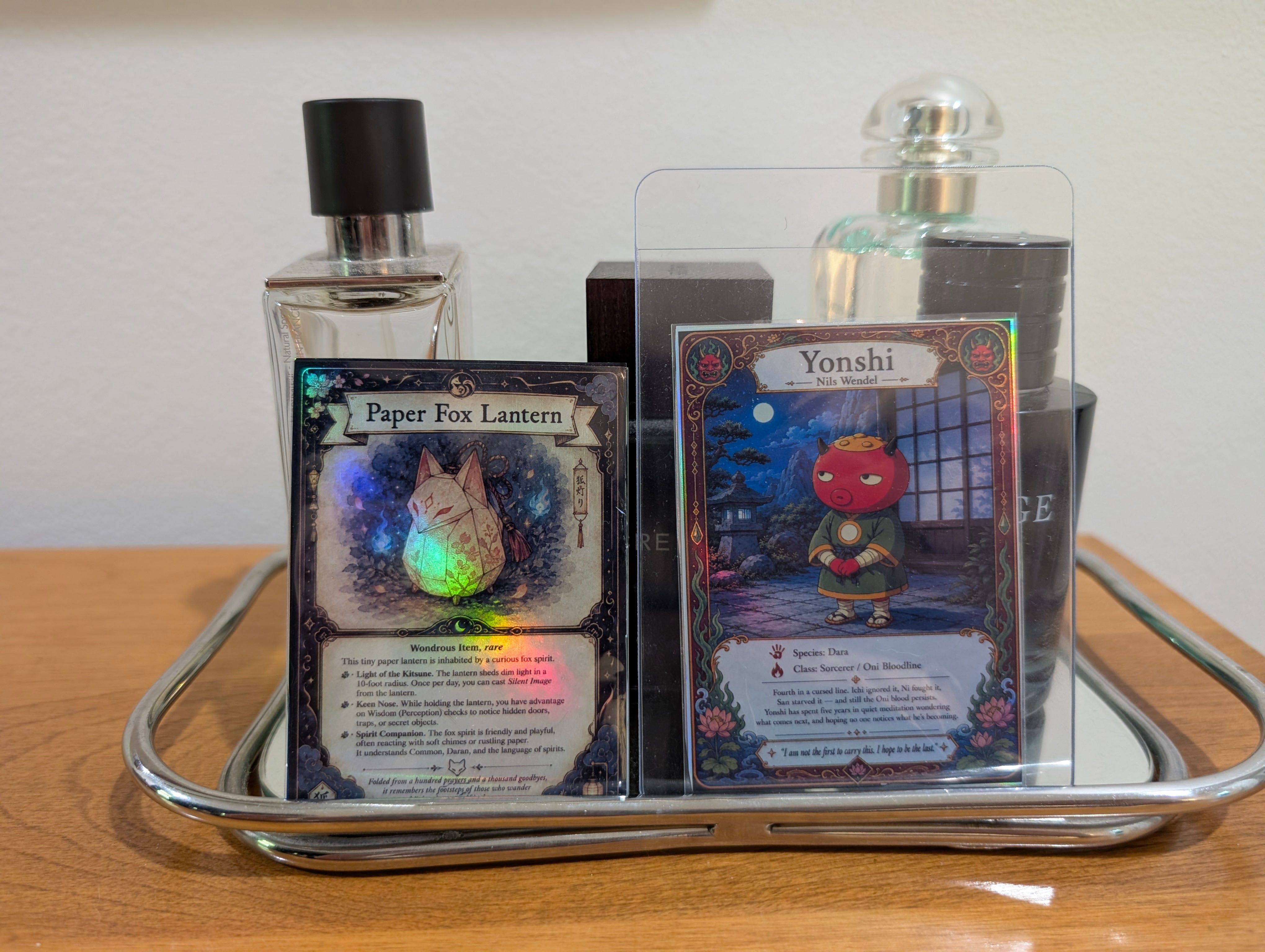
We also played an immensely fun social-deduction game called Blood On the Clocktower that I cannot recommend enough!
Again, something I paid attention to, but underestimated its importance. You will probably be interacting with them more frequently than you expect, and it is important that you feel that you can trust them to not just be out for themselves. I am glad that I can!
With the impending birth of my first child, I have started to feel the pull to stop playing so many video games narrow down my professional interests to some degree. I am nowhere near as prolific as a Scott Alexander or Awais Aftab now, and I am not all that optimistic about effects of chronic insomnia on my free time.
Suffice to say, I am not happy about this realization. Part of what I enjoy about my intellectual life — which is, in a way, something I enjoy about how I see myself — is that I have a lot of varied interests. I find it fun and fulfilling to learn new things and new skills. Maybe it’s figuring out how to do some basic electrical work around the house, the field of personality theory, or how to not make my niece cry when I hold her (she does not like men who don’t have facial hair). I also think that having broad interests helps me to better relate to my patients, which I think is a cornerstone of doing this work effectively.
At the same time, I cannot deny that I have a desire to try and make some sort of mark on my field, and that to do so I will probably have to narrow down what I spend my time reading, thinking, and writing about to gain the sort of expertise and notoriety required.
Whether I am willing do that is another question and the jury is very much still out on that one.
I was going to make an It’s Always Sunny joke here about the implication, but the implication that I might be referring to the implication in regards to a resident was not the sort of implication that I would want anyone to assume that I was implying, so I have decided to write this footnote to let you all know that there is no intended implication of the implication in this essay, though I of course cannot prevent you from your own interpretations of any possible implications of my words.
Comments
Nothing yet. Say the first thing.
Sign in to join the conversation.