
Hello,
I have a confession.
This Poetry Book Club post is very late (I’d planned to send it on the last Sunday of the month). I can’t claim that it didn’t go out because I hadn’t written it. It wasn’t a time thing. Instead, the truth is, I hadn’t finished the actual book!
For the first time this year, I haven’t finished the poetry book we’d set out to read in November. I decided that I’d try and race through the final quarter and catch up. I’m sure I won’t be alone in having done this many times before for a book club. To a certain degree this is what I enjoy about being part of a book club - that encouragement to keep on reading. For me it keeps reading a priority when I could easily reach for my phone or put away some washing instead.
And for the majority of the year, having a deadline has indeed kept me reading poetry. And kept me reading full collections of poetry. I’ve read TONS (how about you?) I’d like to do another post sharing some favourites - there have been additional pamphlets I’ve read beyond book club too. I’d love to hear your favourites. I’ll try and do that.
But THIS poetry book in particular, refused to be rushed. Which I’ve realised is kind of a review post in itself (I should have just sent this out on that Sunday after all). Each ‘first reading’ of a poem was so intensely powerful and so layered that it required me to go back in for a second. Perhaps that’s the thing with a ‘best of’ collection - there are no filler poems, no ‘move the narrative forward’ poems, there are quite literally no ‘duds’. Obviously ‘duds’ being a subjective term. Or maybe that’s the thing with June Jordan full stop (in my mind, anyway) - there are no duds!!
As I mentioned in the post announcing this as a book club choice, many of these poems were written in the 70’s and 80’s and yet read as if they could have been written in 2025. There is a point here about the incredible timelessness of her writing, as well as the despicable truth that society has not moved on as much as I’m sure she must have hoped. It made me reflect on what, as a writer, you want for your writing to become in future. In terms of any change you are wanting to see happen, I guess, ‘no longer current,’ might be one thing. Still essential, but essential in a different way. ‘Poem about Police Violence’ feels so entirely current and urgent and devastating. Here’s the beginning:
The first two stanzas in this poem also become the last two.
‘A Short Note to My Very Critical and Well-Beloved Friends and Comrades’ - is another poem that struck me for how her writing spans across the decades. I like the form of this one, how the list relentlessly mirrors how she simply cannot win and then how it suddenly switches at the very end, stressed by the line break, to, “And I said.”
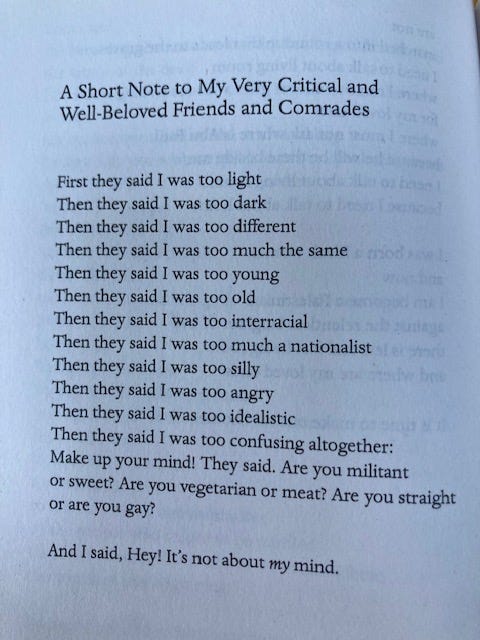
The tone of voice in this poem is one that I’ve got to know well in reading this book. There are plenty of times that the reader is addressed directly, there is such realness to the writing, you can feel her fury, her frustration, her care, which drives it home. I felt like I could hear her reading it out loud to me. I looked this up and discovered that June Jordan was passionate about spoken word. That she was known for her manipulation of grammar, her deliberate ‘rule’ breaking. And that she was also committed to using Black English, treating it as its own language and an important outlet for expressing Black culture. What a distinctly personal voice she has, one that once you’ve read you can’t stop thinking about, you can’t stop wanting to hear again, there is a richness to it that is so masterful.
This poetry book did that other thing for me, that some poetry does. Particularly poetry with a heavy political slant, I’d imagine. It teaches. Not in the way that a history book or class teaches history. But still, it teaches. It demanded that I as the reader educate myself and ask questions that I might not have asked before. Which is another reason this poetry collection is taking me a little longer. I want to learn.
There are SO many poems ‘FOR’ people. Some of these people I am aware of - below is a tanka for Alice Walker (what a poem this is). But many I’d never heard of. I’ve been looking these people up (the poet David Henderson, for example, co-founder of the Black Arts Movement in the 1960s). And I’ve been researching the background which led to some of these poems being written. It’s not completely necessary I don’t suppose, to enjoy the poems. But there is so much to be gained by doing so. And June Jordan demands the sort of respect that gets you doing this ‘essential’ work. I’m so grateful for that.
And it hasn’t just been the more political poems that have taught me. There is a lot of the personal in this book too. There is a lot of vulnerability, a lot of empathy, an acknowledgement of all that is unknown.
These lines are taken from the start and end of the poem, ‘These Poems.’ I really love this one:
Text within this block will maintain its original spacing when published
These Poems
These poems
they are things that I do
in the dark
reaching for you
whoever you are
and
are you ready?
......
I am a stranger
learning to worship the strangers
around me
whoever you are
whoever I may become.
Amongst all these rightly challenging poems which cast a light upon the vast and often violent injustices in the world; Civil War, racism, the complicity of the US in atrocities across the world, brutal gender injustices, crimes against human rights, amongst all of this, there is also such a wealth of love.
There are love notes to other Black women, love notes to Black working class folks, to Black culture, to ‘home’. Which creates this sense of being unafraid, hmm, no, not unafraid, but rather unstoppable, unrelenting, that she will attempt to say the unspeakable, even in, or rather especially in, the face of such horror. That she will demand your attention and your action and that she will also remind you what hope looks like.
It is so satisfying to have these poems in one place, all these poems that are collected not in chronological order (that would have changed the feel of this book entirely) but mixed together, which I think mirrors the breadth and depth of her work. It’s an all-encompassing read and it is in no way a breezy, ‘easy’ read. I’ve had to put it down and take a deep breath a few times. But wow, has it been a book I’m glad to have found.
Even without finishing this collection I feel immersed in her determination. Completely inspired by the way June Jordan approaches poetry with guts and commitment and raw passion; the latter for language and the art of writing as well as the topic she is writing about.
So of course I haven’t finished it. It hasn’t wanted rushing and I haven’t wanted to rush. I will, I plan to keep making my way through this book until I reach the end. As I say, it feels like essential poetry reading for me. But also, I know this is one of those books that I will return to time and again. I’ve got a book here by one of the greats. A woman who made her mark on history through her literature. What a privilege that is to hold. To read. To be writing about.
Here’s the blurb from GoodReads, which I think sums up what I’ve felt about this book far better than I can:
“The Essential June Jordan honors the enduring legacy of a poet fiercely dedicated to building a better world. In these poems of great immediacy and radical kindness, humor and embodied candor, readers will (re)discover a voice that has inspired generations of contemporary poets to write their truths. June Jordan is a powerful voice of the time-honored movement for justice, a poet for the ages.”
This has been my first time reading June Jordan, and it will obviously not be my last. When I read poetry, I sometimes read it out loud to myself and with some of these poems I found I couldn’t not. These poems feel like they are made to be spoken aloud. There is an electricity to her language, the words vibrate on the page, her rhythm and flow is incomparable.
And perhaps that is a good point to end on. These poems weren’t meant to go quietly, they weren’t ever going to be forgotten. Perhaps she had the foresight (or the inner knowing) to recognise that written pages can be destroyed. These poems were created as a way to demand something better - loud and clear - and they are still doing that to this day.
Thank goodness for that.
Nelly x
P.s I couldn’t photograph this one for the post but ‘Moving Towards Home’ is another incredible poem in the book. You can read it on The Poetry Foundation website here, if you haven’t already.
P.P.S I also really enjoyed reading this piece about June Jordan’s legacy, written by Sriram Shamasunderin in YES Magazine. The more I read about her the more I am totally enamoured.
P.P.P.S Please talk to me about your experiences with the book. Did you finish it? Was this your first time reading June Jordan? Did you have similar views to mine or not? I’d love to hear from you.
No posts
Comments
Nothing yet. Say the first thing.
Sign in to join the conversation.