
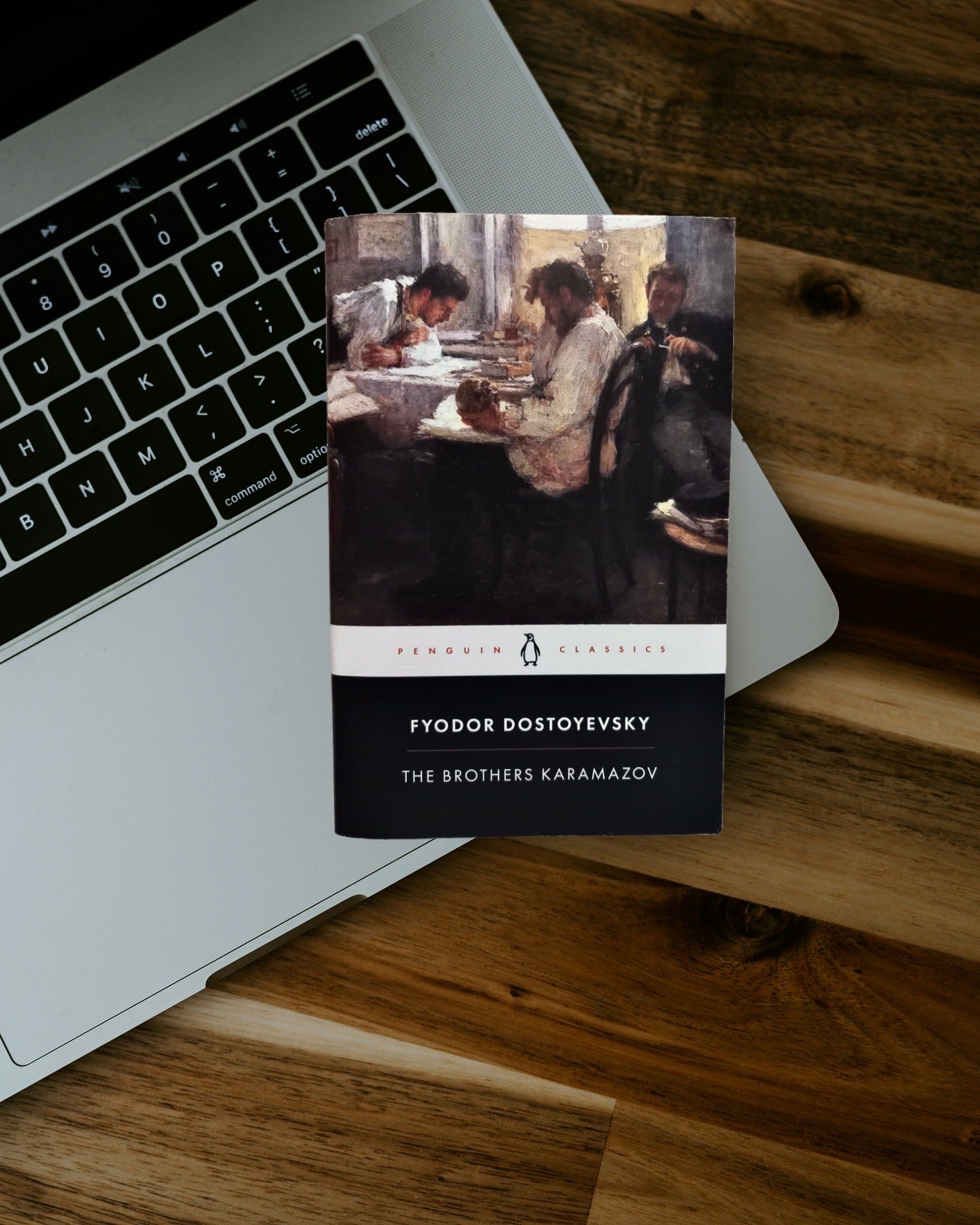
Fyodor Dostoevsky’s The Brothers Karamazov is a philosophical novel that offers not just a story of a patricide, but a profound exploration of human nature, morality, faith, and free will. Unique among novels of its time—and perhaps even now—it resists the mould of a single protagonist. Instead, Dostoevsky crafts a narrative centred around three distinctly drawn brothers: Dmitri, Ivan, and Alyosha Karamazov. Though Dostoevsky himself has claimed that Alyosha is the “hero” of the novel, the true strength of the story lies in how it refracts truth through each brother’s perspective, making the novel not only a theological and moral investigation but also a character study of rare depth.
At the centre of the novel is the fractured Karamazov family. Fyodor Pavlovich Karamazov, the negligent, debauched patriarch, is the gravitational force around whom his three sons orbit—and often collide. His moral failings and absence of paternal care plant the seeds of discord that drive the plot forward.
Dmitri, the eldest, is a man consumed by his passions. Wild, reckless, and ruled by impulse, Dmitri embodies the sensualist, a man torn between spiritual yearning and carnal desire. His longing for Grushenka—a woman he loves with near-destructive intensity—and his bitter resentment over his father’s manipulations regarding both love and inheritance set him on a dangerous path. His inner conflict mirrors the classic battle between instinct and restraint, emotion and reason.
Ivan, the middle brother, stands in stark contrast to Dmitri. A brilliant intellectual and a rational skeptic, Ivan is deeply troubled by theological and moral questions, especially the existence of evil in a world governed by a benevolent God. His philosophical musings culminate in the famed “Grand Inquisitor” chapter, where he delivers a scathing critique of institutional religion and divine justice. Yet, Ivan is not without compassion; his torment stems not from nihilism, but from his overwhelming love for humanity and his inability to reconcile that love with the suffering he sees in the world.
Alyosha, the youngest, is the spiritual anchor of the novel. Deeply committed to his Christian faith and mentored by the elder monk Father Zossima, Alyosha seeks to live a life of humility, love, and service. Though young and unworldly, his moral clarity and gentle wisdom offer a quiet counterbalance to his brothers’ turbulent paths. Alyosha’s trials are more spiritual and emotional, as he navigates grief, disappointment, and the limitations of institutional religion. Ultimately, he emerges as a symbol of hope and redemption—proof that goodness can endure even amid chaos and despair.
The novel’s central crisis—Fyodor Pavlovich’s murder—acts as a crucible for each brother. Dmitri, already suspect in motive and action, is charged with the crime despite a lack of evidence. Ivan wrestles with guilt, especially after a chilling series of conversations with the family’s enigmatic servant, Smerdyakov, who ultimately confesses to the murder. Alyosha, removed from the worldly ambitions of his brothers, becomes a witness to their suffering and a spiritual guide to others, particularly the young and impressionable.
Dostoevsky structures the novel like a psychological mystery, not merely to ask “Who killed the father?” but “Why does anyone do evil?” The crime becomes a lens through which the reader examines the eternal conflict between free will and moral responsibility. Each brother's arc dramatises a different aspect of that dilemma: Dmitri’s physical and emotional impulsivity, Ivan’s mental and philosophical torment, and Alyosha’s spiritual reckoning.
The falling action and conclusion of The Brothers Karamazov do not offer tidy resolutions. Dmitri is sentenced to hard labor in Siberia, though there is talk of escape and future redemption. Ivan, shattered by guilt and existential despair, descends into madness, cared for only by the remorseful Katerina. It is Alyosha who emerges with a clear, if modest, victory—not through conquest, but through quiet perseverance. In the novel’s closing pages, his speech to a group of grieving boys at the funeral of his friend Ilyusha affirms the power of kindness, memory, and shared human experience.
Ultimately, The Brothers Karamazov endures because it asks the hardest questions and refuses to answer them simplistically. Dostoevsky doesn’t provide a neat moral judgment but instead presents the human condition in all its contradiction and complexity. Through the Karamazov brothers, we are shown the full spectrum of belief, doubt, love, hatred, guilt, and grace.
A philosophical epic disguised as a murder mystery, The Brothers Karamazov is Dostoevsky’s crowning achievement and a cornerstone of world literature—an endlessly rich text that continues to challenge, haunt, and move readers nearly 150 years after its publication.
No posts
Comments
Nothing yet. Say the first thing.
Sign in to join the conversation.