
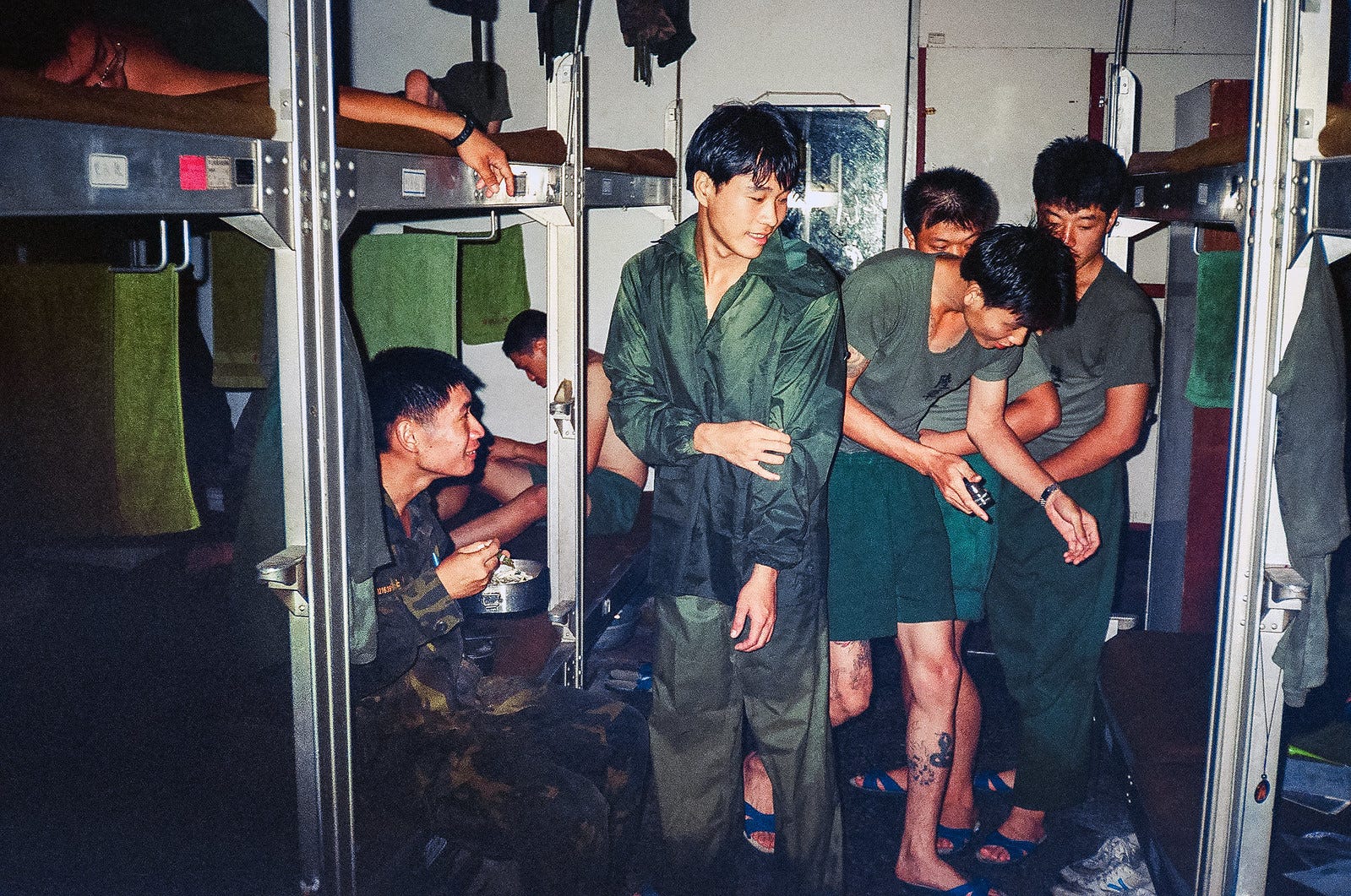
It was the summer of 1996, and I was just settling in to being a member of the Guard Company at an army infantry base in the mountains outside of Miaoli. The Company was infamous as being full of rough, intimidating types, would-be and ex-gangsters, and a literacy rate such that even I was called upon to help some of my fellow soldiers with writing their political warfare assignments.
Though photography was prohibited on base, it seemed even more criminal to me to not document at least some of that world, hidden away as it was from civilian view. As a rookie Private Second Class, my schedule was packed with the worst assignments, including dead-of-night successive guard duty shifts, garbage disposal, and other unenviable tasks in addition to the usual hazing from senior soldiers. But as I got the hang of things, I eventually felt confident enough to bring to base one of the disposable Kodak cameras that were available for purchase at most Taiwanese convenience stores at the time, flimsy plastic-and-cardboard things with a simple lens, ASA400 Kodak Gold film, a tiny 30mm lens fixed at f10, and a basic flash. It was small enough that I could hide in a pocket in my fatigues.
Just bringing the camera onto base felt like something a spy would do, and even though I didn’t dare take it out at first, I was constantly aware of its presence, hidden at the bottom of my duffel bag as rookies’ lockers were still subject to “earthquake” inspections where all the contents would be thrown violently onto the barracks floor.
As July came to a close, Super Typhoon Herb decided to pay us a visit, unleashing torrential rain and catastrophic winds across northern Taiwan. Our mountain base lost water and electricity, and when it was too dangerous to be outside (other than guard duty and other training, of course), we were all packed into the musty, un-air-conditioned barracks that were ancient long before then. It was impossible to stay dry, fans didn’t work, and the wind and rain beat at the windows constantly in the gloom. The whole place smelled of wet soldier and fallen trees.
Though I’d been extremely hesitant about taking photos on base up to that point, the surreal atmosphere convinced me to finally take out the little disposable camera and take a quick shot of one of the lieutenants engaging in a particularly potent round of trash talk with a soldier who was getting ready to go on guard duty, smiling in appreciate over his bento box. Just as I pressed the shutter, however, another soldier with gangsterly tattooed legs pushed roughly past the officer, searching for something with a small flashlight. Other soldiers lay asleep on the upper bunks amid wet uniforms hanging up in a fruitless attempt to dry them. A soldier’s protective Buddhist amulet hung from a bunk footrest.
I held my breath for a moment after the flash fired, brighter than I’d expected in the dark of the barracks as it bounced off the dirty barracks mirror. Would I be caught, I wondered; what would they do?
To my relief, nobody paid any attention, perhaps assuming it was lightning, if they noticed it at all in that era long before ubiquitous mobile phones. Perhaps the thought of anyone taking a photograph in such a situation was so ludicrous that they simply dismissed the possibility. I quickly slipped the little Kodak back into my bag; I wouldn’t see the photo for a month or more, when I had enough leave to travel up to Taipei to get the roll developed.
After the storm passed, we were assigned cleanup/rescue duty in the area, which was a mess, but led to more interesting stories and photos later on. Later on in my army career, in 1997/98, I had enough seniority to be able to bring my Pentax K1000 onto base for “official” photography in addition to recording more daily life, though such photographs were still officially prohibited.
I’m glad I decided to make this photograph, as words can’t quite describe the feeling of life in those tumultuous, odiferous, wind-driven days.
No posts
Comments
Nothing yet. Say the first thing.
Sign in to join the conversation.