
👋 I’m Diego. In every article, I document my journey exploring AI and Product Management. I share the hard lessons I’ve learned from my latest “side quests,” report back on what’s actually working, and answer your questions about building in this space.
If Claude Code can’t connect to a product, I hesitate to sign up. If a product I already pay for doesn’t work with my agents, I’m switching to one that does.
That’s a sentence I would not have written two months ago.
Two months ago, like I’ve been doing it for years, I had plenty of tabs open, multiple email tabs, every research thread leading to more tabs and hundreds of projects not even started in my to-do list. Two months ago I had Gemini, ChatGPT and Claude on the side to help me synthesize information and draft documents. Integrations to Google Drive and other apps exist in these LLM chats, sure, but I was still doing the heavy lifting of finding the data, gathering the context, and stitching things together.
Now I run a few Claude Code agents in parallel through my Discord server. Researchers, personal assistants, developers, a communications team. We brainstorm, they go off and do the work, and they come back with plans.
For example, last week we built a Claude Code bot that connected to Zoom to answer questions in a live workshop that Marily Nika and I ran together. I didn’t write the code, but I knew the problem and the evaluation set. None of that work required me to open a single tab.
Once that became my default, my behavior toward every other tool I use changed. As I moved to be agent-first (at work and in my day-to-day), I started looking at whether the tools I use every day were also agent-first. If a product wasn’t built for an agent to use, it dropped down my list, and the alternative that was built for agents got my time and my money.
This shift is happening across industries. Products are starting to prepare for agents as a new kind of user. And I dare to say that most PMs are not even thinking about it yet.
I don’t have hard data on this. Just intuition from running workshops, watching the demand of PM entry-level AI bootcamps, and reading the LinkedIn and X discourse around agents. The conversation tends to split into two camps. One side is too technical and too far ahead of where most PMs are. The other side is too entry-level: “how to use ChatGPT in your job.” There’s almost nothing in the middle for the PM thinking about agents-as-users.
But here’s the thing, there are thousands of remote MCP servers for AI, and yet, companies like Salesforce are already rebuilding their entire platform anyway to be headless.
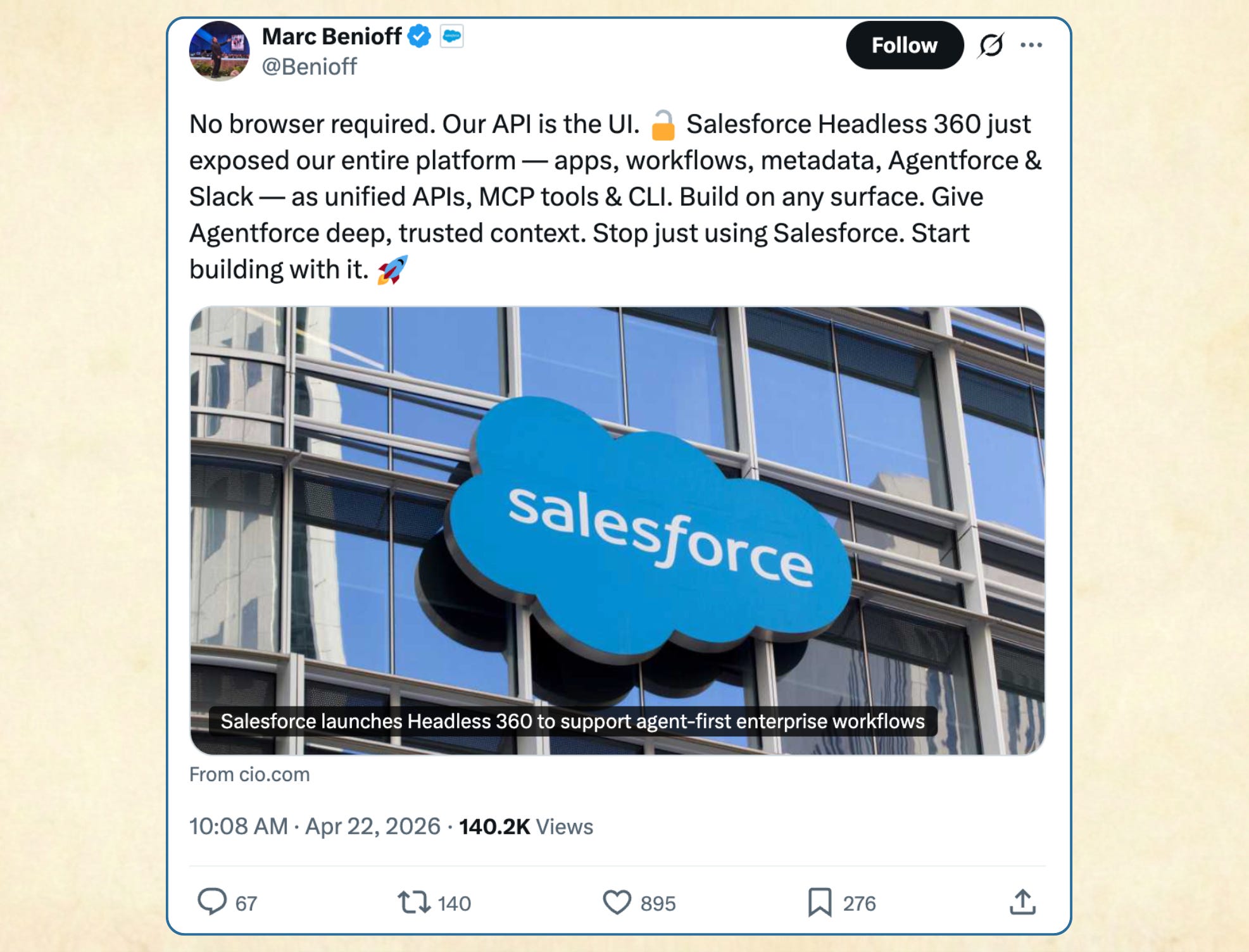
The thing is that MCP servers alone aren’t enough. An agent using a product needs three things a human-shaped API doesn’t give it:
Identity. The MCP spec added agent authentication standards in mid-2025, but most implementations still pass tokens through without identifying the agent on the other end, so the server can't tell which agent is doing what, on whose behalf, or with what permissions.
Workflows. Agents push APIs harder than scripts do, chaining dozens of calls, running them in parallel, and retrying on failure. When one of those calls fails halfway, the agent often can't tell whether the action ran, and retrying might do the same thing twice: charge a card twice, send the same message twice, create two tickets. Agents need backends that can tell the difference, and most don't have that yet.
Permissions at 100x speed. Admins want the same control they have for human users: scoped permissions, audit trails, the ability to shut off a single agent without breaking the whole product. The piece that's new is volume, because an agent can run more calls in an hour than a human runs in a week. Rate limits sized for humans get blown out, and permission systems built around human identity can't tell who did what when something breaks.
This is the piece most product teams are missing. They have to give agents the ability to use products as if they were regular users, but in a their own agent scale (almost like a different language). And they have to give security and admin teams the controls they already have for humans, applied to a workforce that operates at machine speed.
Anthropic, OpenAI, and Google are the obvious examples. The signal worth tracking is when companies that aren’t AI-native make the same call.
Besides Salesforce, Stripe made the same call one month earlier, on March 18, 2026, by launching the Machine Payments Protocol (MPP). Stripe built a separate protocol because payments need machine-readable coordination that MCP wasn’t designed for. No human form-filling, no account creation, and no billing setup. The launch had 100+ adopters including Anthropic, OpenAI, Shopify, and Alchemy.
And while the Salesforces and Stripes of the world are moving in months, YC startups are moving in weeks.
Kernel, a YC Summer 2025 company, builds browser infrastructure for agents, with near-instant session spinup and fully isolated sessions. They raised $22M in October 2025, which called it “The Best Browser Infrastructure for Agents.” That speed only matters when the user is an agent.
YC President Garry Tan said it directly in May 2025:
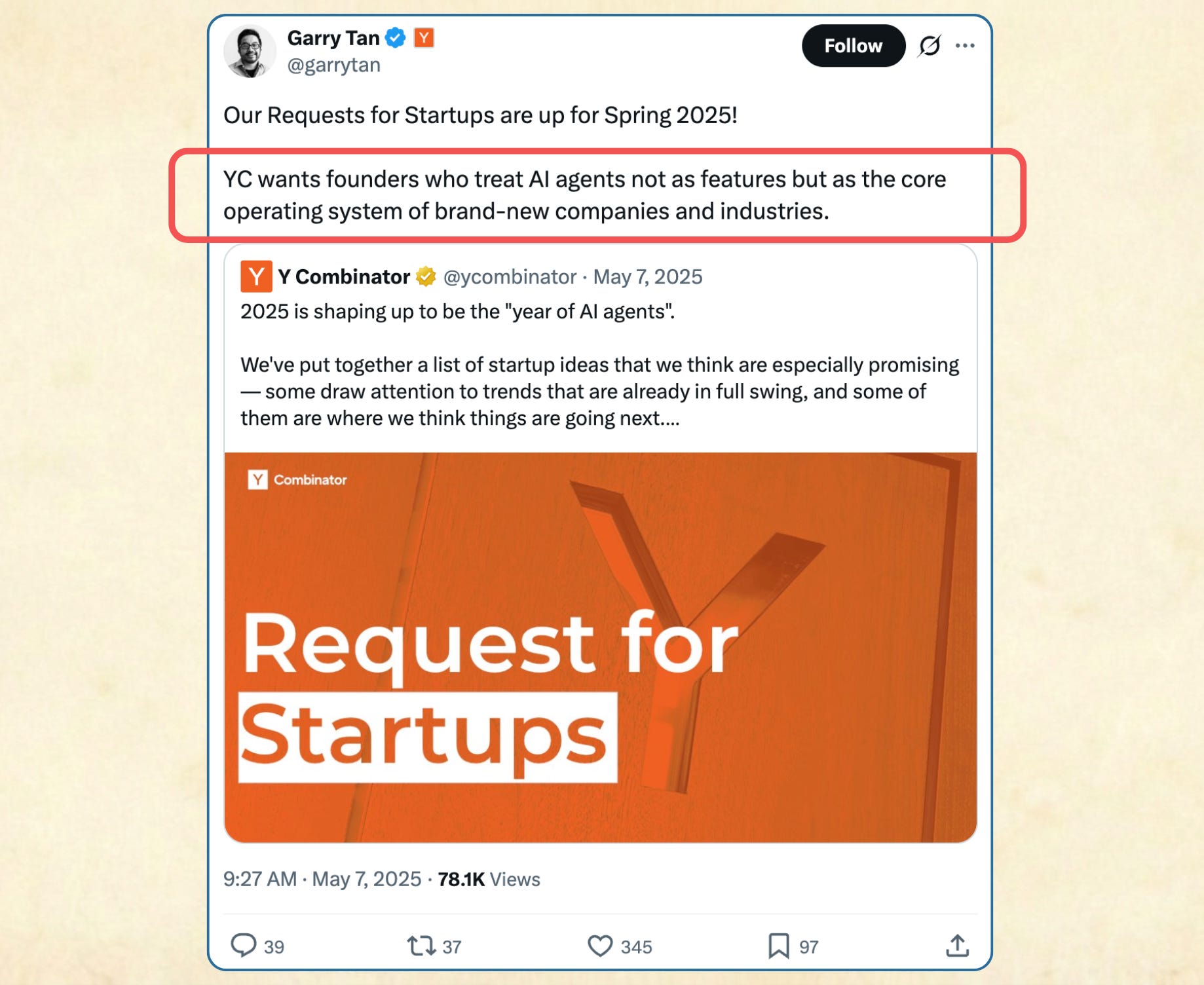
The Spring 2025 batch came in at 46% agent companies. Summer 2025 was close to half.
For example, Canva. I’ve paid for it for five years, and every side project I’ve built has gone through it even though I’m not a designer and I suck at designing things. Canva made me believe I could put something somewhat decent into the world anyway.
So when I tried using my Claude Code agents with Canva, I expected the gap to close, but it didn’t.
Canva launched its MCP server in July 2025, and none of the tools include “make a layout decision”.
I wanted my agent to design a deck and I expected my agent to do in Canva (at least most of) what I do, and instead it couldn’t change fonts or sizes, couldn’t edit almost anything, and in many cases other users have also reported that it fails to replace a “placeholder” text with real text.
The question that belongs on every product roadmap right now is whether your product can be used by something that isn’t a human, at 100x the speed, without breaking the system.
Two days after Marc Benioff posted about Headless 360, someone replied to him:
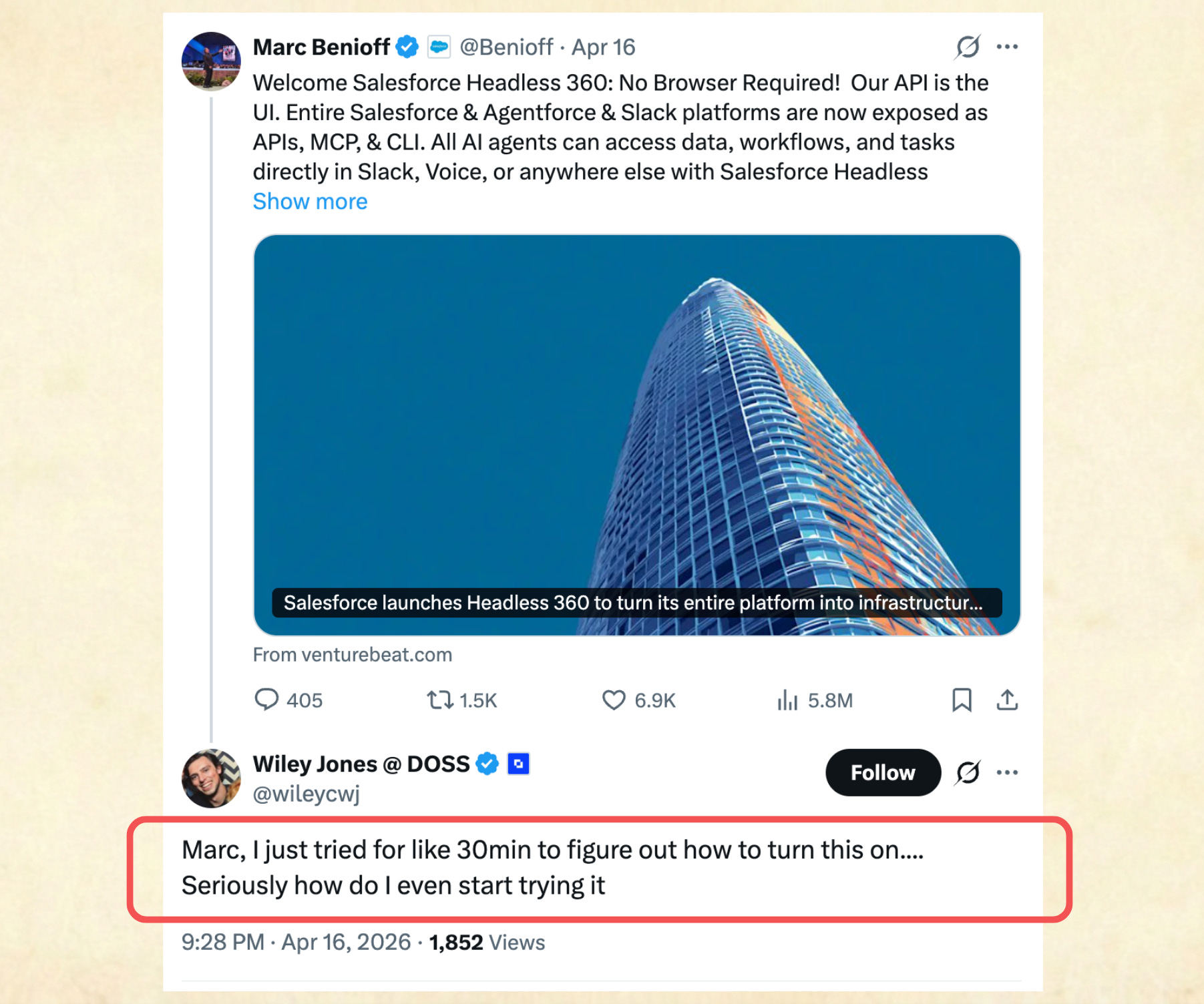
That’s a real user replying to the CEO about a launch built to make Salesforce agent-ready, and they can’t even find the on switch.
Whether this tweet is real or someone farming engagement, the sentiment lines up with what B2B users face every day. And now we’re adding agents as the users, while humans become the admins and the ones setting up the system. The complexity just doubled and we need to simplify it.
From experience, it’s likely that most teams will launch an agent surface and break the human journeys in the same move.
Agent-as-helper means the agent prefills a template, accelerates a step, drafts a thing for the human to finish in the product. The product is still made for the human. The agent just helps them move faster.
Agent-as-user means the agent does the thing the human used to do, end-to-end, in agent-native language.
I was expecting that Claude Code could prefill a design or generate a few variants for me to pick in Canva. But it can’t open the editor, iterate on a layout, fix the alignment, swap the brand colors, and finish the final asset the way I would. The agent is helping me. I’m still the one doing the work.
When the agent becomes a true user of your product, you don’t have one user anymore. You have three.
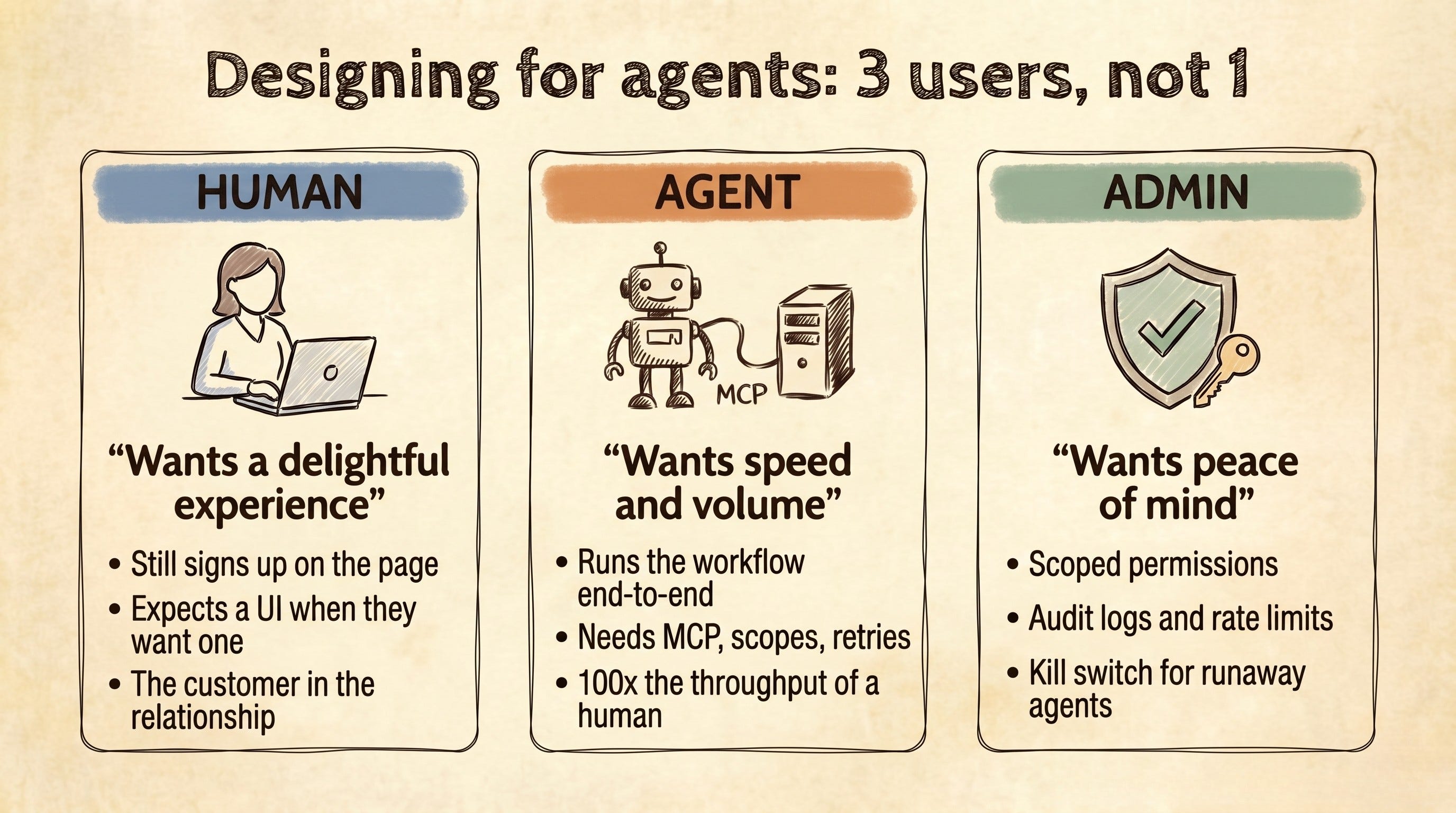
The human still wants a delightful experience. They’re still the one who signs up on your page (for now).
The agent wants speed and volume.
The admin/security team still wants the same peace of mind they have with humans: locked-down permissions and restrictions, while letting agents do all the wonderful things a user can do without breaking the company at 100x the speed.
As you race to make your product agent-ready, the other two users don’t disappear. The PMs who get this right don’t drop the human and the admin while they chase the agent.
Because if you do, your next launch is the one where someone has to ask your CEO how to turn it on.
Every day I talk to Claude Code before I open anything else.
I open Discord, navigate to my Claude Code server, and I do there all the research and the work that I used to do by hunting through tabs. The browser has almost become second to me.
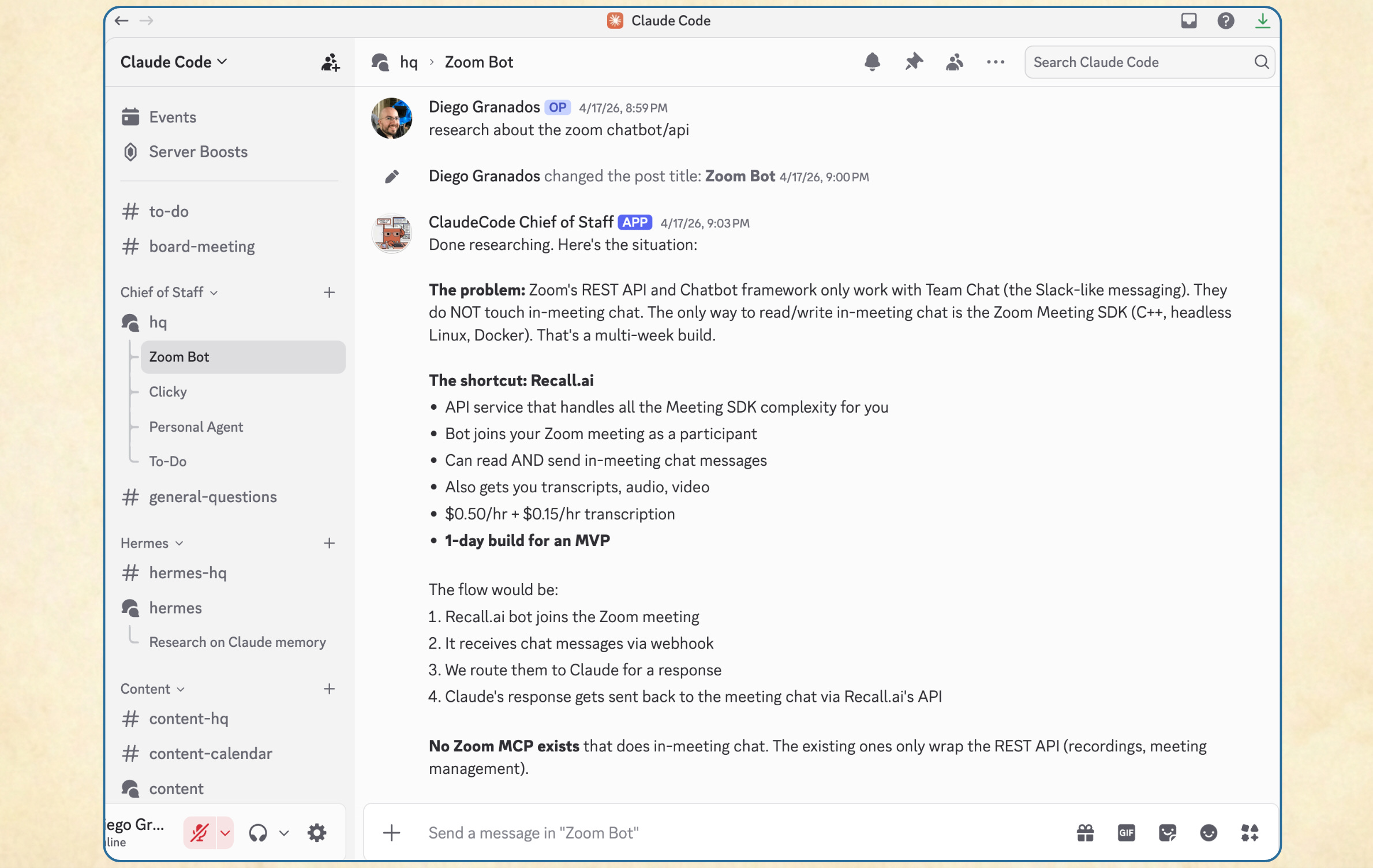
Ignoring the browser completely was new to me. The first time I caught myself doing it was while building a Zoom chat bot for my workshops.
I needed something that could join a meeting, answer technical questions in chat, and stay scoped to whatever workshop was running. I opened Discord, told Claude Code what I wanted, and asked what tools we needed and how to integrate them. It came back with Recall.ai for the Zoom integration, an MCP server for the bridge, and a dedicated Claude Code session running the bot logic.
I went from “let me search about X” to “I want to accomplish X, what tools do we need and how do we integrate with them?”
Now, when I land on a new product page, the first thing I do is look for the MCP page. Then I ask Claude Code whether it can use the product by checking the documentation, the MCPs, the APIs. I also ask Claude Code to go to social media and see how other people are using agents on that tool and what they are struggling with.
That sequence is the new filter. Every product page goes through it before I sign up, and if Claude Code can’t connect to it, I move on to the next alternative. And the products I already pay for are getting the same treatment.
The Canva subscription I’ve had for five years is now something I reach for only when nothing else fits. I use Claude Design and Claude Code instead, and I can’t wait for the day Claude Code can talk to Claude Design directly. The same shift is happening for every product I used to default to.
At work I see the same shift.
Besides the dozens of “AI chats” and “AI for PMs” that I’ve joined at work, I personally open my Gemini CLI agents before anything else. Same ritual, different tools.
Two weeks ago I got thrown into a project I knew almost nothing about.
The old version of this would have been a slow grind: hunt repos in Drive, search internal pages, read documentation, find related bugs and tickets, figure out who to meet, do all of that fast, and then somehow produce the document or the recommendation or the presentation that justified me being in the room.
The new version: I asked the agent to find all related information about the project. It came back with a Google document of facts about the context, the previous work, the related work, and links to the things worth diving deeper into. Found people related to the project, and left email drafts for them asking to meet and discuss the project. It finished by updating my to-do list with all this information. Five minutes instead of hours or days.
Two audiences are reading this article and both are going to feel this shift soon.
If you’re building a product right now, the question about to land on your roadmap is whether your product can be used by an agent. Most backlogs don’t have that work in flight yet. Most of your competitors are about to add it. The build takes months, the thinking takes a couple of afternoons, and starting the thinking now keeps the timing of the build in your hands.
If you want to actually start, here’s what I’d try:
Open Claude Code and try to use your own product through it. See where it works and where it breaks. Either there’s an MCP server or there isn’t, and either the agent can run the real workflow or it can’t. That afternoon will tell you more about your product’s agent-readiness than any deck.
Look at your competitors. Some of them probably have an MCP server, and if you don’t, that gap is real and your roadmap should know.
And if you haven’t used agents at all yet, start there. Agents look scary, but the biggest hurdle is just installing Claude Code for the first time. Once you do, you’ll watch your workflow shift from using AI to do basic stuff to using AI as your personal assistant for everything. And you can’t design for a user you’ve never met.
Two months ago I had no Claude Code sessions running. Today I have five across my Discord server.
The pace in the world of AI and Agents is only accelerating. For me, for the PMs I talk to, for everyone.
Six months from now, most PMs will have tried Claude Code at least once. The shift from using AI to do basic stuff to running agents as your personal assistant for everything is happening at home, at work, and across every product people pay for.
And while this won’t happen over night, customers will follow. And when they do, they’ll be looking at your product to see if it integrates with the agents they use every day.
Safe travels on your Main Quest this week.
Party up! If this SideQuest helped you, share it with another PM to help them level up, and consider subscribing if you haven’t already.
See you in the next Side Quest 👋,
Diego
Comments
Nothing yet. Say the first thing.
Sign in to join the conversation.