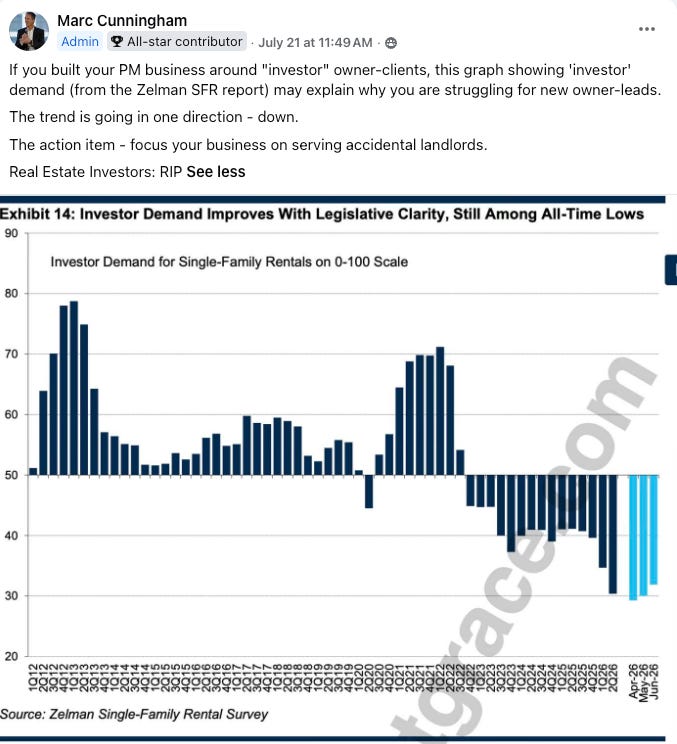
If your business is built around intentional investor clients, I think you’re probably in for a rough few years. And I’m not alone in that view. Marc Cunningham runs a great Facebook group called PM Build that I’m a member of. Last month, he posted the following:
Usually with economics charts nowadays, I can clearly point to everything starting to go wrong right around January 20th, 2025 when Trump took office for his second term. That’s not a political statement, it’s just a statement of fact. Whether it’s inflation, GDP, job creation, etc., it all turns south shortly after that date. Make of that what you will.
But this chart is very different. Everything starts to make it downward slide mid-2022, and by 2023 it’s in full blown negative territory. What exactly is going on here, and what can we expect for the foreseeable future?
First, let’s dig in to what the above chart is actually telling us, because it can be confusing to the non-statistics minded. This is what statisticians call a “diffusion index.” In a diffusion index, people are surveyed on a broad range of questions related to the overall data at question, and 50 on the scale means conditions are perceived to balanced. The closer you get to 100 on the chart, that means that more people perceive that there are signals for widespread growth, and the closer you get to 0, that means that more people perceive that there are signals for contraction or a shrinking market. So the chart doesn’t show raw numbers of investors purchasing properties, it shows what property managers surveyed are telling the researchers about the market conditions they’re encountering.
For almost all of the period from 2012 to 2022, a full decade, those surveyed were indicating that they were seeing strong conditions for growth of investor clients. For those of us who have been in the business for a good while, the data is hardly surprising. You can see that sentiment peaks in 2012-2013, and that’s certainly when I remember our business growing the fastest. We were adding sometimes 30 doors a month back in those days with limited marketing spend and only a single BDM. You almost didn’t need to try. The doors just flowed in one after another.
Then things softened for a while. PM companies were still growing, but as the housing market recovered from the Global Financial Crisis and home prices climbed, investors thinned out. You can see this from 2014-2020 on the chart. It was only in the post-pandemic housing boom when supply was restricted significantly below demand that we finally saw the numbers start to spike again. But it was only short-lived. We got only about two years of that investor enthusiasm as they saw rent prices shooting into the stratosphere (rents climbed as much as 25% in a single year in many markets). But what goes up must always come down.1
And come down it did, and in a big way. As soon as investors realized that those rapid rent increases were not sustainable and were already leveling off as the post-pandemic boom ended, investors backed off and the market retreated to an accidental landlord style market. The bottom of sentiment was reached in April of this year, and it’s only slightly started to recover since then, but still in negative territory indicating perceptions of a continued retracting market.
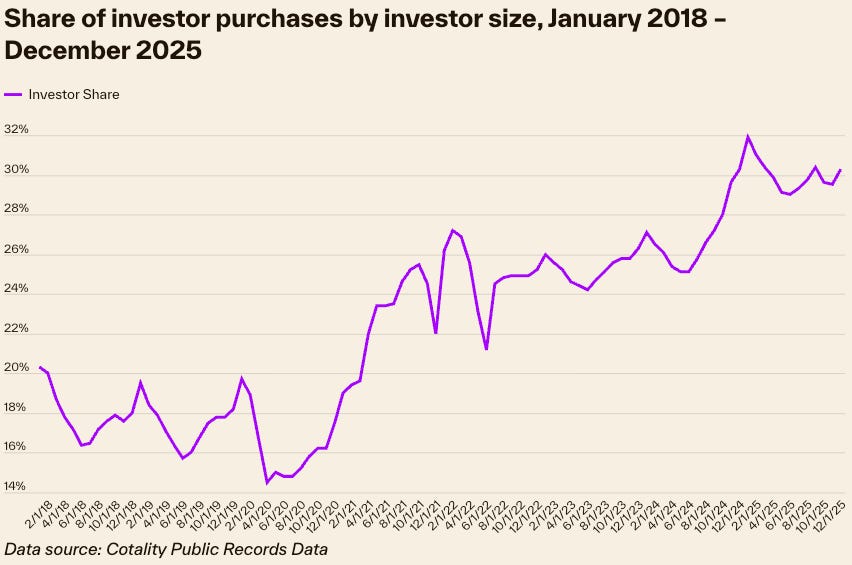
To see what actually happened, we need to look at another chart from another data source. The chart below comes from research firm Cotality, which tracks a massive dataset on property metrics. As you can see, something is weird here. The data goes through the end of last year, which the prior chart showed as already being in a massive drop in sentiment about investors, but this chart shows that the share investor purchases has been climbing for the last few years. How do we reconcile that?
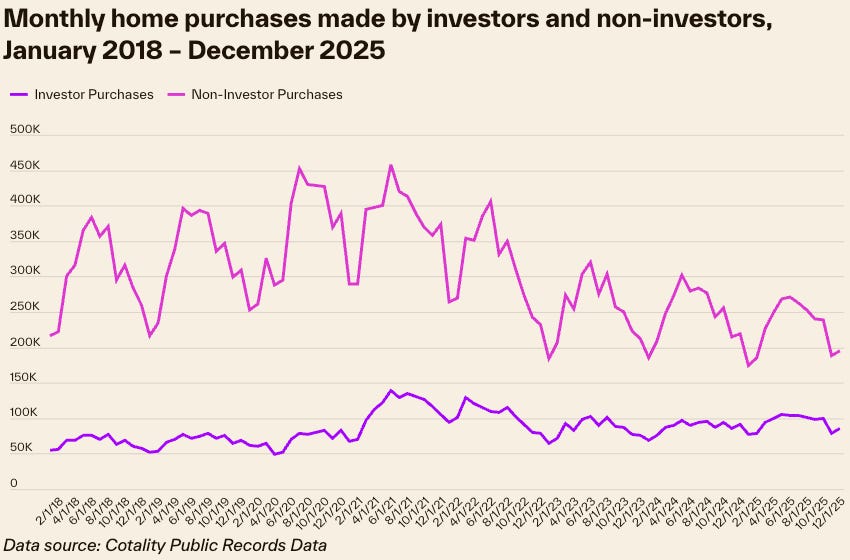
First, we have to remember that these charts are measuring different things. The first chart that Marc posted was about the sentiment of property managers and large SFR companies about investors getting into the market overall. The second chart is about the share of the total market of real estate purchases being made by investor. What’s really going on here becomes a lot clearer when you look at a third chart:
This chart is also from Cotality, and it clarifies the big picture for us. Yes, the share (percentage) of total home purchases that can be attributed to investors has remained roughly steady for the past couple of years, and actually climbs the couple of years prior to that. But the problem is that the total market has been shrinking. As you can see from this third chart, non-investor purchases have dropped like a brick starting in mid-2022, going from a peak of over 450,000 down to under 200,000. It’s no coincidence that this lines up with the same time from the first chart where property manager sentiment was saying that investors were disappearing. What’s happening here is that the investor share of the market is staying the same, but the total market is shrinking. When share stays the same and the market shrinks, then that means investors are shrinking also. They’re just shrinking at the same rate as the overall market. In other words, the number of total homebuyers is dropping, including investors, but investors continue to make up the same 30% of the total market that they were at before.
Most platforms bolt one AI assistant onto a closed system and call it innovation. Yours might be one of them.
Rentvine built it differently. The Rentvine MCP connects Claude, ChatGPT, or any AI assistant straight to your portfolio data, under roles and permissions your team already has.
Here’s what that actually gets you:
Bring your own AI so Claude, ChatGPT, so you connect Claude, ChatGPT, or the agent your team already built, without being stuck with whatever assistant your vendor chose for you.
Ask real questions so “which owners haven’t been paid this month” gets a real-time answer, not a stale report.
Books stay yours so financials are read-only by design. Your AI analyzes, your team still posts every entry.
Included for every customer, not a premium tier or per-seat upcharge.
Rentvine ranked the #1 property management software in the 2026 VPI Category Report. Most AI pitches sound the same. Watch this one before you assume Rentvine’s does too.
There are three main reasons that your investor lead flow has dried up:
New investor formation stopped cold. The truth is that most new owner signups are not established investors. When you get leads for investor clients, they are typically new investors, or investors who own a few houses they’ve slowly been building up over time and it’s now reached the level where they can’t manage them themselves. So when new investors stop entering the market and only the existing investors are left, your flow of investor leads almost entirely disappears. Most investors are not churning through property managers very often. They’ve found the PM that they like, and they’re sticking around.
Existing investors stopped transacting. Not totally. Like we said above, they’re still 30% of the total market in terms of transactions. But when the total number of transactions craters and investors stick at 30% of the total, that means the raw number of investor transactions has also cratered. So if you have existing intentional investors as part of your portfolio, you used to be able to reliably count on those investors to keep buying new homes to add to your door count. But that’s slowed down or stopped now. Most of those investors are just holding on to their existing portfolio. A stable investor base means that your portfolio of managed homes for them isn’t shrinking, but it also means that new leads aren’t coming in and new homes aren’t being purchased by existing clients. In other words, the lock-in effect isn’t just for owner-occupants; it’s also for investors.
The composition of investors has changed. All of this regulatory chaos has scared bigger investors. When Trump came out and said that institutional investors shouldn’t be allowed to purchase homes, and the rest of the Republicans jumped on in support of his comments (as they always do), there was panic in the investor community. This was supposed to be a position held only by the extremist left-wing radicals who proudly wear the “democratic socialist” moniker. Why was a Republican president supporting it and why were Republican lawmakers backing him? There was no longer any policy stability that could be counted on by investors. As a result, intentional investors with larger portfolios started getting worried and shifted their investing strategy to other asset classes. This meant that while the 30% share of total purchases were still investor purchases, it was all smaller investors. Realtor.com did a study on this in 2025 and found that 60% of investor purchases in that year were by mom-and-pop investors. And as we all know in the PM world, many mom-and-pop investors are cheapskates who don’t want to pay for management services. And since they are small, they don’t have to worry about scalability and can make self-management work (until it doesn’t and things go terribly wrong). So these small investor purchases are not resulting in many new PM leads.
What this basically means in the end is that there is basically no difference between “investor” purchases and accidental landlord purchases. We tend to lump any owner into the “accidental landlord” bucket when they only have a house or two or three, but the data aggregators are categorizing them by intent, not by scale. When they say that 30% of the market is investor purchases, they’re including the brand new landlord who just bought his first investment property.
But these are very different owners from a PM’s perspective. An intentional investor who owns 10 houses and has owned them for a decade is a much different animal than the first-time investor, even though both of them purchased with an investor intention. The newbie investor still looks and acts like an accidental landlord. He’s emotionally invested in the house; he’s buying frequently on “vibes” rather than on complicated spreadsheet math and projections; he doesn’t have his risk spread around, so any big expense can kill his entire year’s profits and make him skittish.
What this means at the end is that the entire industry has basically shifted to a B2C (business to consumer) industry. While Cotality is still saying that 30% of the market is investors, the reality from a PM’s perspective is that those investors are really just glorified accidentals. And that means that we need to be marketing to an accidental landlord mindset. Getting led astray by numbers that say that 30% of purchases are by investors will lead to you marketing to clients who no longer really exist, producing no results. We need to remember that the only available client now is either truly an accidental landlord, or such a small time investor that they effectively act no differently than an accidental and have the same concerns and objections as an accidental.
Leads come in at all hours. The ones that wait go elsewhere.
BoomCRM responds immediately, captures every inquiry, and carries qualified prospects to an approved resident.
Everything you need to run leasing: 📥 Capture leads from calls, ILSs, marketplaces, and listing pages 🤖 Answer every call 24/7 with an AI Leasing Agent ✅ Pre-screen income, credit, and identity before a tour 🗓️ Book tours self-guided with lockboxes or agent-led with calendar sync 💬 Manage emails and texts in one unified inbox ⚡️ Route leads to the right person, automate follow-up 📝 Carry pre-screened prospects into a BoomScreen application, no re-entry 📊 See pipeline and conversion analytics across every property
While Donald threw a little temper tantrum and refused to sign the ROAD To Housing Act last month, it ultimately became law anyway because the Constitution says that any bill not vetoed within ten days (excluding Sundays) automatically becomes law. This means that we now have a permanent 350 home cap on the number of homes that any investor can purchase.2 And the drafters of that bill were pretty thorough. I tried to find loopholes, and there really aren’t many. I thought for sure they would have accidentally left open the possibility of these big companies just putting properties under multiple subsidiaries held in a big holding company, but they were smart and included an indirect control clause in the bill, which means that you are capped at 350 homes even if they’re owned by multiple subsidiaries or sister companies. The only real loophole was put there intentionally, and it allows for BTR (built-to-rent) investments, not existing home purchases.3
What this means is that we likely aren’t looking at a cyclical shift here. The federal government, on both sides of the aisle, came together and stood against big investor ownership of rental properties. The votes on this bill were insane in the current political environment. The House voted 358-32. The Senate was 85-5. We never see margins like this on substantive legislation in the modern era.
Not only does this legislation put a cap at 350 doors now, which covers large individual owners as well as institutionals, it also puts fear into smaller investors that that number could creep lower. If Republicans were willing to put a 350 door cap in place, what would a Congress do if AOC is Speaker? That’s not an outlandish possibility. AOC is currently the favorite on both Polymarket and Kalshi for the 2028 Democratic nomination for president. The Democrats are currently pushing a 90% probability of taking control of the house both in predictions markets and in Nate Silver’s very reliable statistical model. If she wants the job, AOC can probably be Speaker of the House next year. If that happens, I expect a lot of housing-related legislation to be getting votes in the House. And since we’ve already seen Republicans willing to sign on to these kinds of restrictions, investors are worried that they will continue to be a target. Not only when it comes to ownership of rental properties, but also on things like fee revenue, rent control, mandatory Section 8 acceptance, etc. Why would investors put their money into this risky basket when they have wild west unregulated growth industries like AI to invest in instead?
So, I don’t think this is a short-term thing. We likely aren’t ever going to see another surge in large investor purchasing of rental properties again in our lifetimes. Instead, institutionals will likely focus on BTR strategies, and third-party management by small and medium sized PM firms isn’t a typical component of a BTR strategy. Most BTR communities are managed by large SFR firms that cater to institutionals specifically, or they’re managed internally in a vertically integrated operation.
So with all of this in mind, what should you be doing as the broker/owner of a small to mid sized PM company who wants to grow? Here are my recommendations:
Refocus your lead funnel. If you have been focusing on lead sources like BiggerPockets, turnkey operators, and REIA meetings, then you likely need to change your entire marketing strategy. Instead, you need to be focused on AIO (AI optimization) as well as traditional SEO, Realtor referrals, direct mail, and absentee landlord records. This is how you can target the beginning investor and the accidental landlord. Those other channels are going to be thin at least for the foreseeable future, if not permanently.
Change your pitch. This is where Ray Hespen and I keep disagreeing. He keeps talking about ROI, and I keep telling everyone that it doesn’t matter. These small time investors are emotional creatures, not finance nerds. You need to be selling peace of mind and tenants paying down your mortgage, not cap rates and NOI. Refer back to my article on the PM Trends Report. Tons of good data there.
Redouble your efforts on boosting your RPU. When you’re growing by ten doors with every PMA signed, you tend to care a little less about your RPU (revenue per unit). After all, you’re not just growing by one door’s worth of revenue when that PMA is signed, you were growing by 10x that. When a PMA signed equals $2,000/mo of new revenue, that looks pretty good to you, even when it’s only $200/door. But when a PMA signed equals only $200/mo in revenue, it starts to look like a lot more work to grow your revenue. If you get your RPU up to where mine is, it’s only four new doors to get to $2,000/mo again instead of ten. However, focus that revenue effort mostly on tenant ancillary fees. These small investors are very cost-conscious in many cases.
Prepare and plan for higher churn. Intentional larger investors rarely churn units. And if they do, it’s only because they’re leveraging it into acquiring better doors that they’ll probably also let you manage. But small time investors and accidentally landlords have a limited shelf-life. Even if they got into it intentionally as an investor, most of these small timers have a hard time convincing themselves to hold a door after they’ve achieved significant capital appreciation. When the house they paid $350k for is suddenly worth $550k, they see dollar signs, and then it’s only one small hiccup like a busted HVAC system to be the final nail in the coffin that gets them to sell. If your churn was 10% for an intentional investor portfolio, expect it to be more like 20-30% for accidentals and small landlords. That’s not a problem, but it needs to be priced in. In other words, that RPU we’re talking about above becomes even more important, because you need to make all of your money on that door in a shorter time horizon.
All of this being said, like most things, this isn’t a universal truth. This data is all coming in the aggregate across the entire country, and as we all know, real estate is a hyper-local business.
If you follow ResiClub at all (and you should), you already know that there are big regional variations in this picture. The midwest and the northeast are bucking the trend in the rest of the country, primarily because they never participated in the post-pandemic housing boom. My family is all from Ohio and West Virginia. These were dead markets where nobody had been building new homes and creating new supply in decades. As a result, home prices there have been stagnant for a long time, leaving the prices of these homes at levels that can still cash flow in many cases. The median price of a home in Akron, OH (where I used to live and where my father is from) is still only $150k. I couldn’t buy a single-wide trailer in the suburbs of Atlanta for that price nowadays. Many of these rental homes are still meeting the 1% rule4 that is nothing but a distant memory in most of the rest of the country. So, if you’re a property manager in Columbus, OH or Detroit, MI, you still have real investor demand.
But even in other markets there are still small pockets where bigger investors are players. The GAO found this year that institutional investors own around 22% of SFR rental homes in Jacksonville, FL, for example. Now, I expect most of these institutional players to start divesting these homes in the near future on a controlled basis since we’re now living in the wake of the ROAD to Housing Act, but for now, they’re still dominant landlords in these small pockets. If you cater to big investors, you still might have a little bit of runway left in these pockets.
Of course, we all live in the shadow of interest rates. I keep telling everyone that interest rates are going nowhere (I believe I first predicted in this publication back in 2024 that they wouldn’t go below 5% for years), and the Federal Reserve keeps proving me right. Despite Trump’s continual demands that they cut rates, the Fed is not a political organization, and they will do what the data indicates that they should do. With all current economic metrics, there is simply no justification for cutting rates. In fact, doing so would likely lead to runaway inflation. That said, we live in a dynamic world, and the best of prognosticators can still turn out wrong on occasion, so there’s always a small possibility that mortgage rates will drop to 5%. If that happens, that seems to be the resistance level where sales will pick up again. That would be the worst case scenario for most property managers. True investors have already dried up, they are unlikely to return even with favorable interest rates due to the regulatory environment, and lower interest rates would spur current owner clients to start selling en masse. Again, I find this scenario incredibly unlikely for the foreseeable future. I think interest rates stay above 5.5% basically indefinitely. Remember, the average interest rate for over half a century has been 7.75%. People tend to forget that since we had a few years of rock bottom rates, but those were the aberration.
Finally, I’ll point out that I do have a bit of bias on this question of accidental vs intentional investors. My own PM business is focused purely on accidental landlords and small investors. I don’t like dealing with professional investors, and institutional investors make my skin crawl. I don’t think this bias factors into my analysis of the data, but it’s always worthwhile to point it out in the interest of full disclosure.
I’m not telling you that you’ll never close another big investor lead again. Obviously that’s not the case. My point in writing this article is instead to get those of you who have built a business focused on investors and have been frustrated at the stagnation for the last few years to really look honestly at the data and realize that you might need to adjust your business model. Again, not everywhere. If you’re in Columbus, OH, you might be able to keep trucking along for a while targeting mostly investors. But for the vast majority of us, that lead channel is likely gone.
The smart PM in most parts of the country is structuring their business for the ordinary consumer with one or two rental houses. If you haven’t gotten to that same conclusion yet, I would encourage you to really sit down and look at the numbers honestly. If your lead funnel is still flush with leads, then by all means, keep cooking! But if things have been down, and you’ve been struggling to understand why, now you know. Take the appropriate steps to responsibly shepherd your business.
Have you heard the great news? NARPM is finally returning to Vegas for the National Convention this year in October! I’ve been complaining about it ever since the Broker/Owner conference left Vegas years ago, so I’m thrilled to see us go back. This year we’ll be at the Mandalay Bay Resort & Casino, and I have it on good authority that we’ve secured a big name for a celebrity keynote. In addition, I’ll be presenting again at a NARPM National event for the first time in a few years! Property Meld CEO Ray Hespen and I will be talking about maintenance and using data to make outcomes predictable. This should be a fantastic conference, so don’t miss it. And don’t forget to book your rooms at the resort when you book your registration! The room block is limited, and people are always disappointed when trying to book rooms last minute.
Are you an experienced PM industry employee looking for work? Or are you a PM company or vendor seeking the best talent? Send me your info and I’ll feature it here!
Each week we also feature a Remote Team Member available through VPM Solutions. See this week’s below! Click on the image to get more info:
We always have ad slots available for industry vendors. Sign up for an ad or ad package here. Pricing and ad details can also be found at that link. Questions about advertising? Email abio@propertymanagerassist.com or book a time here.
Disagree with my take here? Have a different perspective? There’s nothing I love more than a good debate or even just an intelligent conversation. If you’d like to jump on a podcast recording with me to discuss this topic, please let me know!
The views expressed in this publication are the views of the author only and not any advertisers, sponsors, partners, affiliates, or organizations that the author may be a member of.
There is a small workaround here. If you buy all 350+ homes in your own name as an individual, you can avoid the cap. But owning that many homes in your own name is a liability nightmare, so it’s obviously not a realistic workaround even if it’s a technical one.
There are other exclusions in the cap, but not for investors. For example, the bill allows for banks to own more than 350 REO properties, but these are not investments.




Comments
Nothing yet. Say the first thing.
Sign in to join the conversation.