A new white paper was released late last month jointly by BetterWho, Property Meld, and PM University. While the paper is a little bit too “salesy” for my taste, trying to sell you the services of the three sponsoring vendors as solutions to the discussed problems rather than just presenting the information, it also contains some fantastic data.
More importantly, it reaffirms a decision I made long ago to stick to third-party vendors rather than in-house maintenance. I’ve said before in this publication that that decision was based largely just on personal preference: I don’t like managing blue collar workers. It’s just too much of a pain in the ass. But this white paper gives me actual financial justification for that decision: at our size, it just doesn’t make financial sense to in-source maintenance technicians. It’s always nice when personal preference is backed up by actual data.
I recommend reading the full white paper and not just relying upon this article, but I did want to give our audience my own thoughts, because while I agree with the overall thesis of the paper, I also have some areas of disagreement.
Let’s be honest, I’m the worst offender on this. I simply didn’t want to deal with the hassles of managing blue collar workers, so I made a decision to structure my PM company around third-party vendors without ever bothering to run the numbers and see what made more financial sense for us. But I’m hardly unique on this.
Most PM companies just ended up on a maintenance structure by default. It’s not anything they’ve ever actually sat down and thought about in any real way. Some companies start out with in-house maintenance purely because the broker/owner is a general contractor and has experience in maintenance. Some companies bring in their first in-house tech at 150 doors just based on “vibes.” Some companies are pushing 2,000 doors and still using all third-party vendors simply because that’s how they’ve always done it. None of these are good reasons to be doing something that is such an enormous part of your business. As I frequently say, maintenance is the most important part of property management. It shouldn’t be something that gets such little thought from us. It deserves real strategy.
I do want to start off by flagging that all of the data is obviously coming from vendors who are looking to sell their services. That’s always something we should keep in mind, but it’s also not disqualifying.
BetterWho is selling their RTM placement services. I’ve used BetterWho in the past to place my Marketing Manager (who is fantastic). But I should also disclose that PMAssist has a partnership with VPM Solutions, and that’s who I currently source all of my RTMs through. Property Meld is obviously selling their maintenance software. Meld is also a PMAssist Partner, and I’ve been using Meld in my own PM company for probably about a decade now. I was one of Meld’s very early customers, and I’m very much a cheerleader of their product. Finally, PM University is selling their training materials to train your maintenance coordinators. I have no personal experience with PM University, so I can’t personally vouch for the quality of their product, but I’ve heard good things, and I have good friends who provide training courses through their platform.
When it comes to maintenance data, while Meld is obviously trying to sell their services, they are also THE biggest dataset in the industry for maintenance. I’ve talked about this before. It really doesn’t matter who else arrives on the scene, and how obsessed they are with data, because Meld has a 10 year head start. And Ray is a very smart man who’s been saying for as long as I’ve known him that data is the new oil, so his company has been meticulously collecting and structuring that data since basically the very beginning. You simply can’t find a better source of information on maintenance for the SFR industry.
Now let’s get into the meat of this: the math. Everyone thinks of maintenance technicians simply in terms of their hourly rate, but this is incredibly deceiving. When I was a labor union negotiator, we always estimated that whatever the salary or hourly rate of an employee, their actual cost to the company would end up being around 30% higher than that due to benefits, taxes, unemployment insurance, “soft time,” etc. But we were calculating for professional employees at airlines. When it comes to blue collar tradespeople, the math is far more extreme.
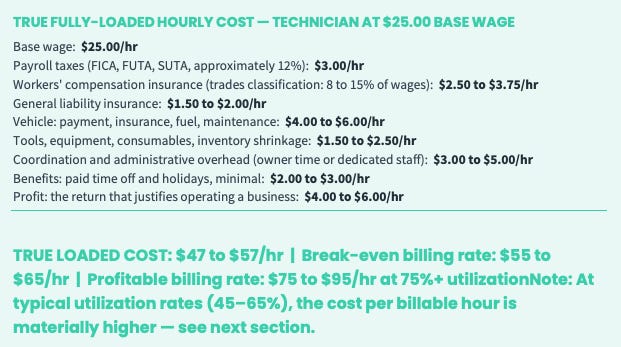
Yes, you still have the same items I used to include. Payroll taxes, paid time off, health insurance or stipend, etc. But you also have items that are unique to maintenance employees. Just workers’ comp insurance alone tacks on as much as an additional 15% over the hourly cost of the labor. And that number can be higher if you’re doing things like roofing work. Then you need vehicles, gas, oil changes, vehicle maintenance, etc. Then what the industry affectionately calls “shrinkage,” which is really just technicians losing or stealing inventory items. Yes, this is such a big problem that it literally adds up to 10% of the inventory cost.
Page 11 of the white paper
All in all, a $25/hr maintenance technician is going to cost you closer to double that amount, maybe a bit more. So in order to just break even, with full utilization of your technicians (basically impossible, as we’ll discuss below), you need to be charging $55/hr for a $25/hr technician. Again, that is break even, not profitable, and that’s with perfect utilization.
Stay focused on your properties, and let Enterprise Bank & Trust handle your banking. Property management companies from across the country partner with Enterprise for:
Competitive analysis program to offset bank fees and third-party invoices
Property management trust account experts with dedicated support teams to help you open and manage your accounts
Streamlined loan process for simple or complex lending needs
Watch to learn more about our tailored solutions for property managers and their accounts:
“Holding your trust account with the property management team at Enterprise is a no-brainer. Allison understands all of the regulations involved with property management trust accounts. When I transferred my trust accounts over, the team was very involved and made it a seamless process. The credit system they provide is awesome as well. This banking team is hands-down the best option for trust accounts in the property management industry.”
Mike Catalano General Partner and Co-Founder PURE Property Management
This is the most important section of this article and the original white paper, so pay close attention here. This is what almost every PM with in-house maintenance is getting wrong and why they’re almost all losing money on maintenance (and most of them don’t even realize it).
Utilization means the number of billable hours you are collecting for maintenance of the total hours the technician is working in a day. So your technician is working 8 hours per day, but let’s say he’s only billing on average 5 hours per day. Do the math (5 divided by 8) and you get a utilization rate of 62.5%.
Now, let’s figure out what that means for our actual hourly cost of the technician. Remember, we said above that a tech who is making $25/hr for his actual pay rate is actually costing you closer to $50/hr all-in. But that’s assuming full utilization. In order to get the real number that he costs you, you have to factor in actual utilization. To do that, take your all-in actual cost of the tech and divide by the utilization rate. So in our example, $50 divided by 0.625 = $80/hr. That is what that technician is actually costing you for the work he’s actually performing.
So here’s the key problem: the market won’t support that pay rate in most parts of the country. And in the parts of the country that will support that rate, you can’t find a technician at only $25/hr. In California, for example, a basic handyman who can’t do any complicated HVAC, plumbing, or electrical can make as much as $40/hr base rate. So now your actual cost of that technician is exceeding $100/hr, and once again, the market won’t support that rate.
The point of all of this is that you simply can’t have in-house maintenance unless your utilization rate is excellent. Back when I was doing a lot of consulting work, I had a fantastic client up in Oregon managing about 1,000 doors. She had one of the best in-house maintenance departments I’ve ever seen, and she had an 87.5% utilization rate. That rate is almost unheard of in the industry. So you can think of that as basically the upper limit of what is achievable, with something close to 60% as average. At 87.5%, my former client is making money on maintenance hand over fist. It’s an enormous profit center. But at 60%, you are hemorrhaging money.
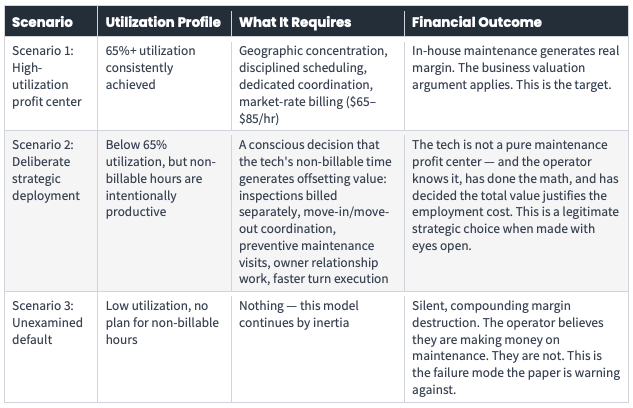
Page 16 of the white paper
I really like this above table that they provided in the report. It gives you a basic decision matrix here. Since the typical reader of this publication is an average PM company broker/owner (about 250 doors on average), you are basically limited to options 2 and 3, because you simply don’t have enough doors to reach peak utilization in option 1. There just isn’t enough maintenance to do for even one technician.
Obviously, option 3 is a non-starter. But it’s also the most common scenario for the average PM company with in-house maintenance. Most of you are losing money quietly and not even aware of it. If you aren’t on the NARPM Accounting Standard, then the losses are likely hidden in the numbers, because they’re being subsidized by your PM income. You are losing money on every single maintenance call and you don’t even know it.
So the only real choice here is option 2 for most PM companies. Very few PMs have enough doors for option 1 to be viable, so you HAVE TO make option 2 work if you want to have in-house maintenance. That means you are accepting the reality that your utilization rate is going to be sub-optimal because you simply don’t have enough doors to reach peak utilization. And it means you are also having to do the things listed in the “what it requires” column in the table above. Your tech’s time when he’s not doing service tickets will need to be spent doing things like inspections, move-in/move-out reports, etc. If you aren’t doing that, then it means you’re falling back into option 3 and losing money. I’m sorry, that’s simply the math. Unless you have more than about 500 doors, it is just incredibly difficult to make in-house maintenance even break-even, let alone profitable.
Let’s get back to all of those additional costs that have to get tacked on to the hourly rate of the technician. The reason for all of those additional costs is that this is basically a completely separate and distinct business. Maintenance is not just something you tuck under PM and consider part of your PM operations. There’s a good reason that the NARPM Accounting Standard breaks it out and doesn’t include it in PM revenue or expenses. PM is one business, maintenance is another.
We can clearly see that in the additional costs that the white paper has calculated. Workers’ comp for PM employees is dirt cheap, because they spend most of their time at a computer and the worst injury they’re likely to encounter is carpal tunnel syndrome. But maintenance techs actually get hurt. And that means worker’s comp insurance is expensive. If you go out and hire someone to replace the roof on your house, about 30% of the bill you’ll receive is just to cover the workers’ comp insurance that the roofer has to have. Not with margin. Just straight cost. Basic handyman work is still about 10% of the bill, and other specialities fall in between that range. If you are used to PM workers’ comp rates, you will fall off of your chair when you get your first bill for your in-house maintenance tech’s insurance. Again, this is an entirely different business.
And then there’s “shrinkage.” PM isn’t an inventory business. We don’t sell product, we sell services. So lost inventory and theft is not something you’ve likely ever dealt with before. But it’s a very real part of managing maintenance techs. Sometimes they’ll use parts and materials and forget to bill for them. Sometimes they’ll just forget some spare materials and leave them at a job site. And sometimes they’ll just straight up steal them for their own use (have I mentioned that I hate managing blue collar workers?).
What about compliance? I had a consulting client who got hit with a series of OSHA violations because a disgruntled maintenance tech filed a complaint over things like MSDS forms. And if you don’t know what an MSDS is, that is exactly why you don’t want to be in this entirely separate business. It’s hard enough to maintain compliance with state license law and landlord/tenant law, do you now want to become an expert in OSHA regulations also?
The list goes on and on. PM is not maintenance. If you want to bring maintenance in-house, then you need to understand that this is truly a completely different business that requires a completely different expertise. You will either need to develop that expertise yourself while continuing to run your PM company, or you’ll need to bring someone else in who already has that expertise. Sound expensive? Yeah, it is.
I think it’s pretty obvious by this point that I don’t endorse in-house maintenance unless you’ve got a quite sizable PM company. While I can’t give you an exact door count, since it’s really all about the number of work orders which can vary by market and portfolio, I personally wouldn’t even start looking at the numbers until hitting 500 doors so as to give myself a decent margin for error. And that’s if you have very low portfolio concentration. If you’ve got 500 doors and two owners account for 150 of those doors, that’s still too risky. Once you hit 500 doors, you can start running the numbers to see if it makes sense for you, but assume worst case. Don’t go into it expecting to get 80% utilization. I would bet my life that you won’t hit that number for at least a couple of years, and only then if you have someone laser focused on it.
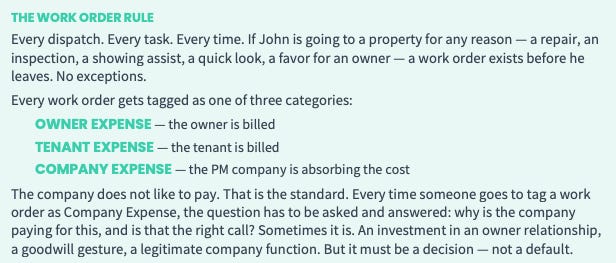
So if you’re going to do in-house maintenance, the real necessity here is to force utilization to be at the highest possible level. How do you do that? The paper has a good suggestion: the Work Order Rule.
Put simply, the Work Order Rule says that a technician is not allowed to go anywhere for any reason without there first being a work order in the system attached to a property, and every work order needs to be tagged as either an owner, tenant, or company expense.
What this rule will do is make it a lot easier to hold yourself and your technicians accountable for the hours being paid. The biggest problem in the industry with in-house maintenance is that companies simply aren’t tracking utilization at all. Don’t let that be you. Use this system and then watch the numbers.
Page 17 of the white paper
While I generally think this is a fantastic white paper, I also have a few areas of important disagreement with their recommendations.
First, charging a flat fee instead of a percentage as a maintenance coordination fee is a big mistake, and the authors of the paper kill their own argument for why you should use one. They state “a percentage-based fee creates a genuine or perceived conflict of interest: the owner can reasonably question whether the PM company is incentivized to select more expensive vendors.”
I am not kind to arguments about conflicts of interest in general. We discussed this a long time ago with my disagreements with Mark Brower about how he thinks things like leasing fees and project management fees are a conflict of interest because the PM is making money when the owner is not. Frankly, these arguments just don’t hold water. The PM is incentivized to keep his owner clients, and the PM does that by keeping their costs in line. As this very same white paper points out, churn goes up when maintenance expenses go up. It doesn’t do a PM any good to hire more expensive vendors just to get a few extra dollars on coordination fees if he then loses that client entirely. So there is no genuine conflict of interest. Period. Can there be a perceived conflict of interest? I would argue not often. We charge a 10% coordination fee at my PM company, and while we occasionally get owner pushback on it, it’s not common. Owners just don’t perceive this to be a problem nearly as often as consultants like BetterWho argue that they’ll perceive it as a problem. It’s an imagined issue. But the really funny thing is that the authors argue against their own argument on the very next page of the report with their proposed “project management fee.” This is just a maintenance coordination fee by another name, and they specifically tell you to make it a percentage of the total bill. Why? Because it compensates for the additional work of bigger projects. You know, just how a percentage-based coordination fee would already do. There is nothing magic about a $1,000 dividing line for making something a “project” rather than just a basic work order. A toilet replacement is not any more work for my PM company than a water heater replacement is, but one costs $300 and the other costs $1,400. The authors would have me charge a flat rate for the former and a percentage for the latter. It’s just silliness and unnecessary complexity. Does the water heater take more work on our part than the toilet? No, but neither does managing a $2,000/mo rental take more work than managing a $1,000/mo rental, but you’re still charging a percentage-based management fee. Charging a percentage is simply accepted by the market and makes operations a lot easier. And then it does account for the actual projects that require more work like big turnover jobs.
Next, invoice sharing. The authors state that you should provide the original vendor’s invoice to the property owner. I couldn’t hate a piece of advice any more than I hate this one. I’ve written previously about the crazy owner who saw an original vendor’s invoice and then went down to their office because he was angry with their pricing and then ended up getting arrested. Vendors aren’t looking to have 1,000 different customers when working with you. If the vendor is working with you, they expect to be working with YOU. Not the owner. The owner should have no involvement whatsoever with the vendor, and has no reason to even know who the vendor is. If I hire someone to build a pool at my house, the pool company will use half a dozen different vendors as subcontractors for that job, and they won’t give me a single damned invoice from those vendors. Nobody ever bats an eye at this, but for some reason some PMs have convinced themselves that they’re obligated to do differently. Both Deb Newell and I have long argued that PMs should not be sharing original invoices with owners. I stand by that. Ignore this advice from the white paper.
Last, but not least, I’m not 100% sold on this idea of AI maintenance dispatching. Yes, I think AI is a first line of defense. Let the AI answer the late night maintenance calls. The AI can help troubleshoot and even help to determine whether something is an emergency or not. I’m a big believer in Property Meld and their MAX AI offering. But I still believe that you need to have a human backstop to all of this. If someone is on the phone and screaming about something being an emergency, even if the AI doesn’t think that it is, I want the AI to transfer that call to a human operator. And I don’t want my team to have to deal with it, so I use EZRepair Hotline (disclosure: I own a small stake in this company). My advice is to use AI, yes, but only as the front line. Have the AI setup so that it will revert to a human when necessary. Your customers aren’t going to like it if the AI isn’t working well for them at midnight with a maintenance emergency, and neither will your state regulators or your E&O carrier. Remember, YOU are always still responsible in the end, even when using AI.
Something else I’ll flag on that, even though it’s not an area of disagreement, is that Meld is bragging about a 30% reduction in work orders when using AI dispatch. That’s fantastic. But it’s also a reduction in your revenue that you need to account for. If you have Meld and you activate MAX, expect that Meld’s numbers are correct and your work orders will be reduced by 30% as a result. What will that do to your maintenance coordination revenue? You need to make sure that you’re accounting for this in your budget. I’m not telling you not to do it. You should do it. Do whatever it takes to keep maintenance costs down for your owners, because that’s what will reduce churn. But don’t just ignore the fact that you need to make up for that revenue elsewhere, or just absorb the loss.
Speaking of keeping owner repair costs down, that brings me to the preventative maintenance section of the report. If you aren’t already doing any form of preventative maintenance, you need to really read this section and pay close attention to it. This a huge way to drive down churn and drive up revenue at the same time.
The paper cites third-party research showing that $1 invested in preventative maintenance returns $4-$6 in avoided repair costs for the owner down the road. That is HUGE. This cannot be overemphasized. Remember, almost all owner churn can be directly tied to one of two things: vacancy, or big repair bills. Owners don’t start thinking about terminating your management until the house is vacant or they get hit with a big bill. It’s really that simple. So you want to avoid vacancies and avoid big bills. The funny thing is, preventative maintenance helps solve both problems. If you’re on top of maintenance and preventing emergency repairs, then your tenants are far less likely to leave, because poor maintenance is the number one reason that tenants don’t renew.
The paper argues for an annual planning meeting for maintenance. I think this is a fantastic idea. Combine this with your annual account review that I’ve talked about previously that you can help facilitate with Blanket’s platform (disclosure: Blanket is a PMAssist Partner). While going over your owner’s financials during that annual meeting, also discuss how they can avoid big future bills with some preventative maintenance.
I’m also planning on incorporating AI into this in the near future. We are going to be loading all major appliance and systems data into our vibe-coded platform (makes, models, serial numbers) and having the AI put together projections on replacement dates. AI can easily use data on the systems and appliances in each house combined with publicly available data on unit lifetimes, including adjustments for things like home square footage, and generate remarkably accurate predictions on this stuff. Imagine doing an annual meeting with an owner and being able to tell him “we estimate that your HVAC system is going to fail in the next 2-4 years, so you should probably start planning on an expense of around $9k in that timeframe.” Do you think that owner is more or less likely to terminate when they get that bill in 3 years after they’ve had the time to plan for it and you literally predicted it like magic? Not only did you help them prepare, but you look like a damned genius.
Even though I had some disagreements with the authors’ conclusions, I really loved this white paper. Maintenance just doesn’t get enough love in this industry. And I get it, I hate maintenance myself. Nobody gets into real estate because they love maintenance. Maintenance is a necessary evil that just goes along with the territory. But if you want your PM company to be working at peak efficiency and profitability, then you absolutely must focus on maintenance.
Spend some time really reading this entire white paper and putting significant thought into which model makes the most sense for your company. And be honest with yourself about your own capabilities. If you don’t have the spare time to focus on managing technicians and keeping utilization rates above 65% while also managing the rest of your PM company, then you need to recognize that and take it seriously rather than just going full speed ahead into in-house maintenance territory. In-house maintenance can be very tempting and convince you that it’s a new profit center, but in reality, it’s a money loser for the vast majority of PM companies out there. Only go that path if you’ve done the numbers, put into place the proper systems, and are prepared to effectively manage it all.
Are you an experienced PM industry employee looking for work? Or are you a PM company or vendor seeking the best talent? Send me your info and I’ll feature it here!
Each week we also feature a Remote Team Member available through VPM Solutions. See this week’s below! Click on the image to get more info:
We always have ad slots available for industry vendors. Sign up for an ad or ad package here. Pricing and ad details can also be found at that link. Questions about advertising? Email abio@propertymanagerassist.com or book a time here.
Disagree with my take here? Have a different perspective? There’s nothing I love more than a good debate or even just an intelligent conversation. If you’d like to jump on a podcast recording with me to discuss this topic, please let me know!
The views expressed in this publication are the views of the author only and not any advertisers, sponsors, partners, affiliates, or organizations that the author may be a member of.




Comments
Nothing yet. Say the first thing.
Sign in to join the conversation.