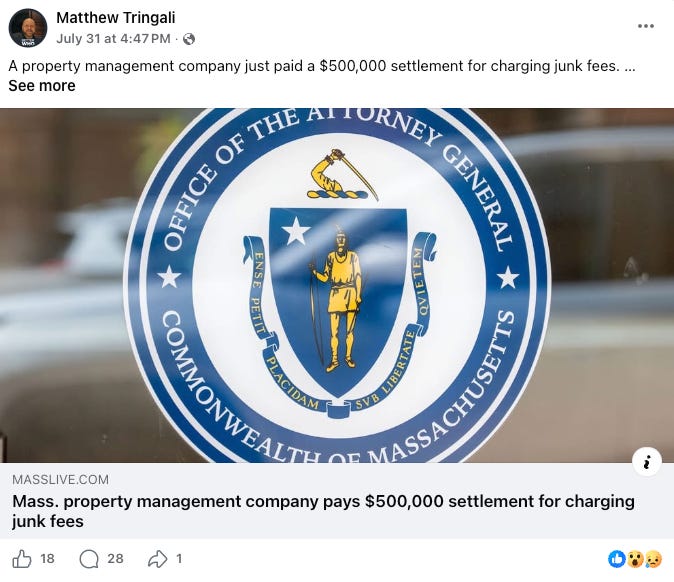
Matt Tringali of BetterWho posted an interesting article on Facebook last week that caused a bit of a stir among property managers about ancillary fees:
Since we regularly advocate for charging ancillary fees in this publication, it’s important that we discuss this case and why it doesn’t apply to the vast majority of property managers, but also point out why some of you in certain jurisdictions need to be careful.
Half a million dollars for a company managing only about 350 doors is not a small amount of money. Any broker/owner’s eyes would bleed looking at that big of a bill. But it’s important that we recognize the reality of this case: Massachusetts outlaws virtually every sort of tenant fee you can imagine, and that’s not new. Most of the alleged violations in this case are tied to a law that dates back to the first term of the Nixon administration before most readers of this article were even born.
This case all takes place in Massachusetts, a notoriously anti-landlord state in the notoriously anti-landlord region of New England. And to be clear, when I say “case,” I’m not referring to a court case, because there wasn’t one. There was no formal complaint, no litigation, and no verdict. The state attorney general simply ran an investigation that they are authorized to run under state law, and the property manager voluntarily entered into an “Assurance of Discontinuance” in lieu of litigation. As part of that, they expressly denied any legal violations and did not admit to any wrongdoing. However, they did agree to pay $500k, split into three installments over six months. So admission of wrongdoing or not, this one still hurt!
The core statute referenced by the attorney general in their investigation was G.L. c. 186 § 15B(1)(b), which specifically places extreme limits on what a landlord or property manager is allowed to collect at or before the start of a lease. Basically, that law only allows four things to be charged: 1) first month’s rent; 2) last month’s rent at the same rate; 3) a security deposit limited to no more than one month’s rent; and 4) the actual cost of a new lock and keys including installation costs (no margin on top of that).
Now, this statute is obviously insane and unreasonable. But remember, we’re talking about Massachusetts here. I don’t think anyone who’s been paying attention for the past century or so would be surprised that Massachusetts has overbearing regulations, especially on landlords. But the law is the law. If you choose to do business as a property manager in that state (something I sure as hell would never do), then you have to abide by the state’s draconian laws. And this one in particular has been in effect since 1970. I’ve seen some property managers referring to a new statute in reference to this situation, but that wasn’t the basis of this investigation. This is about a statute that pre-dates the new one by 55 years.
Here’s what the state attorney general alleged:
Charging fees at or before lease start for lease preparation, move-in, priority move-in, lockbox move-in, and roommate additions
Broker fees charged to tenants (broker fees are a weird anomaly of New York and New England)
Charging full last month’s rent when only a partial month is included in the lease term
A mandatory RBP that included no tangible benefits (allegedly it only included things like no fee to pay rent, an emergency repair hotline, and a landlord reference without a fee); from what I could find, this did not seem like a normal Second Nature style RBP with benefits like insurance, filters, etc.
Charging both actual and liquidated damages to break a lease
Charging both actual and liquidated damages for holding over
Charging late fees before the statutory grace period and charging legal fees and court costs without a judgment
Applying payments to late fees before rent
Water submetering without a Board of Health certificate (like I said, Massachusetts is wild, folks)
Filing evictions in court without a law license
Various other lease terms related to liability waivers
Some of these things probably seem odd to most of you. After all, what’s wrong with applying payments to last month’s late fee first before applying it to this month’s rent? Most of us would do the same. But I’ll remind you: Massachusetts. If you choose to do business in these batshit crazy states, you have to bend at the knee to their insanity. That’s why I always tell everyone not to do PM in these places. It’s just not worth it. Move, or find another industry. Being a landlord in Massachusetts is about as crazy as trying to sell hamburgers in India.
But to be clear, there was no court ruling here, and nothing about this is precedent-setting for anyone other than the PM who entered into the settlement voluntarily. So if you’re in Massachusetts and providing an RBP through a legitimate vendor like Second Nature, then this case does not say that this is unlawful.
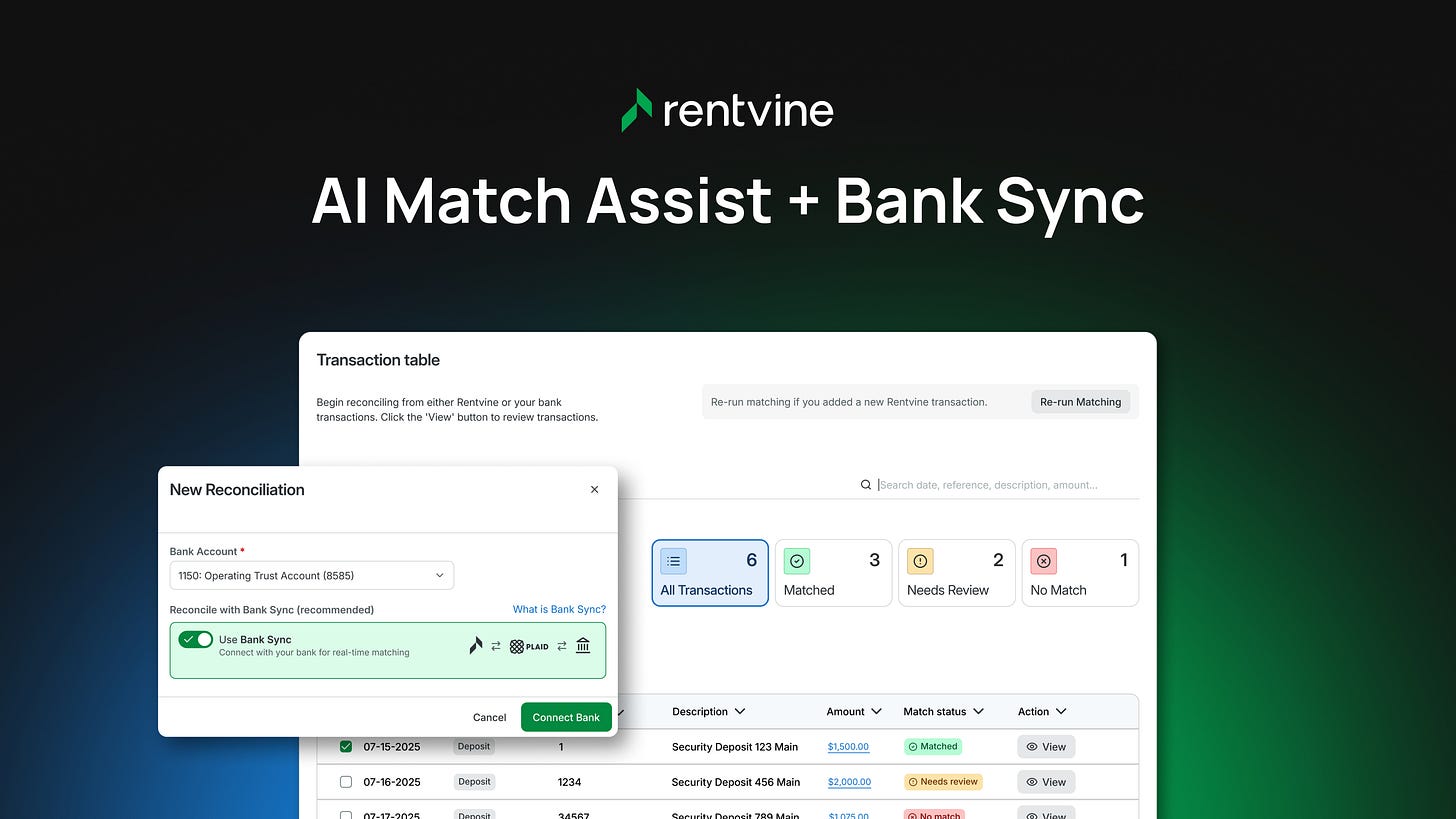
Most reconciliation tools guess and move on. Ours checks its work. Bank sync pulls every transaction in automatically, then Rentvine’s new AI Match Assistant scans five signals on each one at once: amount, date, reference number, description, and type.
- Split rent payments. Combined deposits. A check that cleared four days late. The stuff your old tool missed, matched automatically. - Every suggestion gets a reason. Match, needs review, or no match, so you know exactly why before you approve. - You still make the call. Nothing closes without your sign-off. The AI does the digging, not the deciding. - Customers are closing the books in up to 50% less time.
I reiterate, the state AG did not rely upon any new “junk fees” statute for this investigation. This entire thing rested almost entirely upon the old 1970 law.
And that law is absolutely draconian. It prohibits ANY kind of fee “at or prior to the commencement of any tenancy” other than the four specific amounts I listed above. In addition to that big limitation, it also:
Prohibits any sort of interest or penalty for unpaid rent until 30 days after it was due (basically the state thinks that rent due dates are completely optional)
Prohibits taking anything from a security deposit on move-out except for unpaid rent or water charges and repair damages that have to be verified with actual evidence of the cost within 30 days
Prohibits taking ANY part of a security deposit for even the above approved reasons if your lease has any provision that conflicts with the statute (in other words, if the AG thinks you’re charging a fee in your lease that isn’t allowed, then now you aren’t even allowed to deduct repair costs from the deposit)
Imposes treble damages (3x actual damages) plus court costs and attorneys fees, plus interest, for any violations (funny how treble damages only apply to landlords and never to deadbeat tenants)
In a 2025 amendment, the law specifically authorized the state’s housing authority to promulgate a new regulation for security deposit alternatives, but the limitations on it are so draconian that even if they ever do finalize the rules for it, it will be effectively useless and unprofitable
It’s not just the statute that is crazy, either. Case law has upheld the craziness of this statute. In Perry v. Equity Residential Management, LLC way back in 2014, this statute was reviewed all the way up at the federal court level and upheld, finding further that even application fees are unlawful under this law. Massachusetts is one of only two states (the other being Vermont in the same region) that bans application fees. Starting to see why I think you have to be nuts to do business in this state?
Almost all of this is specific to the insanities of Massachusetts. But not all of it. There are some things that the PM in question was alleged to have done that could be issues in other places also, so let’s cover those:
Double-dipping on damages is a big no-no. That’s true just about everywhere. If your lease contains a provision for liquidated damages, then the entire purpose of liquidated damages is that you and the tenant have agreed up front on what the damages will be. You can’t then ALSO charge actual damages on top of that. You’re effectively charging twice for the same damages in that case. You have to pick one or the other. Now, in most states, you can charge both administrative fees and damages. But that’s different, and it’s not allowed in Massachusetts where pretty much everything is prohibited.
In most states you can apply payments to the oldest charges first, unlike Massachusetts. But you should definitely have a provision in your lease that specifically states that this is how you will do it. Don’t leave it ambiguous.
Having an RBP with no actual tangible benefits is just asking for trouble. While I disagree with the AG’s assertion in this case that that makes it “extra rent”, it’s still just bad optics. Your benefits package should contain actual benefits, not just stuff that you would be providing anyway. It’s fine to list those things, as they are benefits that you offer that others might not, but that shouldn’t be the entire extent of your RBP. At a bare minimum you should be offering filter delivery and renter’s insurance. Just do this through Second Nature and they’ll make sure you’re compliant with your jurisdiction’s laws. They have an entire legal team that focuses on this all the time.
You really shouldn’t be handling your own court actions. I know a lot of PMs try their own cases in eviction court, and the judges in some jurisdictions are pretty lenient about this, but it’s really not open for debate that this is an illegal practice of law. Just because the judges you’ve dealt with have looked the other way on this doesn’t mean that they’ll keep doing so or that another judge will do the same. If you don’t have a license to practice law, then it is illegal in all 50 states for you to represent someone else in court. Period. The tenant doesn’t rent from you, the tenant rents from the landlord, so when you go into court to enforce a lease, you are representing the owner. That’s illegal unless you’re a licensed attorney. Stop it right now and hire a good eviction attorney. Bill it back to the owner. Every time you go into court yourself, you are risking sanctions.
If your lease contains a penalty for the tenant talking directly to the owner (and I generally advocate for this provision), then you need to make sure that your state doesn’t have a statute that specifically protects tenants when making complaints of things like code violations to landlords. In Massachusetts, they have a law that protects tenants when complaining to landlords about any code violation or suspected code violation. I’m not sure if I agree with the AG’s interpretation here, as I would say that a lease that specifically names the PM as the agent for the landlord means that the complaints need to go to the PM, but since this case didn’t make it to court, we don’t know how a court would have viewed the AG’s interpretation. But since it’s Massachusetts, I’m betting the anti-landlord courts would have sided with the AG. So be sure to review your state’s laws in this area, factor in how anti-landlord your courts are, and talk to your legal counsel.
Because of how this situation was resolved, with a voluntary settlement instead of a court ruling, there are still some items from the AG’s claims that are up in the air. I already mentioned the penalty above for contacting the landlord directly, but that’s not the only one.
For example, the AG has interpreted the statute to prohibit lease renewal fees. I think that’s an obvious stretch and a misreading of the law that even a Massachusetts court likely wouldn’t have agreed with. The controlling statute here specifically uses the language “At or prior to the commencement of any tenancy…”, not “prior to the commencement of any lease.” These are very different ideas. A tenancy begins when the tenant’s first lease begins. A lease renewal is not a new tenancy. In my view, the AG trying to extend the prohibition on up-front fees to a lease renewal is an extreme overreach. So if you’re in Massachusetts, talk to your favorite landlord/tenant attorney and see what they recommend for these fees.
I also think the AG’s claim that the RBP in this case was “extra rent” is a stretch. Yes, I don’t think it’s a good idea to have an RBP without any tangible benefits. Do it the right way through Second Nature. But a lack of tangible benefits doesn’t mean it’s “extra rent.” Rent is rent, specifically defined as the rent amount in the lease. Other amounts listed as fees are fees, whether a pompous AG thinks they’re justifiable or not. The AG calling this “rent” is like calling an ATM fee charged by a bank “theft.” It’s absurd on its face.
Remember, this was not a court order. It was a voluntary settlement, and one without any admission of guilt at that. While the PM company in this case did agree to a whole lot of things like not charging renewal fees or RBP fees, that doesn’t mean that such things are prohibited in Massachusetts for everyone. Talk to your attorney. While some things are clearly not allowed by the statute, other things the AG alleged here are some pretty big stretches by a very anti-landlord AG.
The other thing that would be wise to do here is check your E&O insurance policy. The AG was trying to tie some things to consumer protection laws in this situation, and many E&O policies only cover you on license law and landlord/tenant law, with specific exclusions for consumer protection laws. Every year when I get my E&O renewal, I always make sure to read the details. And nowadays I run it through Claude for a review. You want to make sure that your policy covers you for fair housing and consumer protection. If it doesn’t, see if you can get a specialty rider for them added to your policy. If not, find a new policy. These activist AGs and class action attorneys are increasingly looking to bend consumer protection laws to try to use them against landlords and property managers.
The original post from Matt that started this article contains some people in the comments jumping to conclusions and panicking. Don’t be that guy.
This case was almost entirely a Massachusetts problem. So unless you’re cursed with doing business in one of the most anti-landlord states in the country, you generally don’t need to worry about what happened here.
That said, this sort of thing is always a good reminder to review your legal documents with a solid landlord/tenant attorney in your jurisdiction. From my original fee maxing course to our regular articles here, I’m always quick to remind you to consult with a landlord/tenant attorney where you do business before implementing any new fee or policy. Every state is different, and even the pro-landlord states like Georgia still have their own weird idiosyncrasies. Just because I or someone else am able to get away with charging a certain fee or having a certain lease provision doesn’t mean that you can where you do business. Some of this stuff isn’t just state-specific, even, it can be city- or county-specific. So it’s always important to get strong legal review.
Beyond that, don’t panic. This is not a reason to suddenly stop collecting ancillary revenue and watching your profitability crater. Let the chicken littles destroy their businesses with panic. You should be more calm and measured.
Are you an experienced PM industry employee looking for work? Or are you a PM company or vendor seeking the best talent? Send me your info and I’ll feature it here!
Each week we also feature a Remote Team Member available through VPM Solutions. See this week’s below! Click on the image to get more info:
We always have ad slots available for industry vendors. Sign up for an ad or ad package here. Pricing and ad details can also be found at that link. Questions about advertising? Email abio@propertymanagerassist.com or book a time here.
Disagree with my take here? Have a different perspective? There’s nothing I love more than a good debate or even just an intelligent conversation. If you’d like to jump on a podcast recording with me to discuss this topic, please let me know!
The views expressed in this publication are the views of the author only and not any advertisers, sponsors, partners, affiliates, or organizations that the author may be a member of.


Comments
Nothing yet. Say the first thing.
Sign in to join the conversation.