
Monogamy is often seen as the default relational structure in society, yet many people don’t question the expectations or assumptions that come with it. We at once idealize and romanticize lifelong commitment and sexual fidelity to one person, while also feeling the weight of the expectation to fulfill all of our partner’s emotional, physical, intellectual, spiritual, and sexual needs—an unrealistic burden that often leaves partners feeling dissatisfied.
Ironically, the nuclear family structure, which is rooted in monogamy, can lead to a paradox of enmeshment and isolation. While people may spend time with extended family, meaningful friendships and community networks can fade in the hustle of daily life, further disconnecting us from the potential for fulfilling relationships with others.
For some, the idea of opening a relationship may be unthinkable; complete sexual openness with others might feel like a threat to the foundations of their committed relationship. However, relationship dynamics exist on a spectrum, with infinite possibilities for how we can structure and style our relationships in ways that feel appealing to us. The reality is people change. Our desires change, our needs, preferences, sexuality, sexual orientation, gender identity, gender expression, all of these facets of our identities may change, and the reality is the same thing can happen with our partners. Why then, would we expect our relationships to stay the same?
In fact, there are a myriad of ways we can infuse consciousness, creativity, and malleability into our monogamous relationships while still finding a balance between exclusivity and expansion, from exploring being “monogamish,” a term coined by sex columnist and relationship expert Dan Savage, or exploring other forms of creative monogamy, introduced by other relationship experts like Dr. Joli Hamilton. Creative monogamy may be worth exploring if you and or your partner might be interested or curious in restructuring your long-term relationship, and if there are already solid foundations of trust and communication.
So, what is creative monogamy exactly? How is it different from other open relationship styles like polyamory? And why might versions of creative monogamy be worth discussing or exploring with your partner(s)?
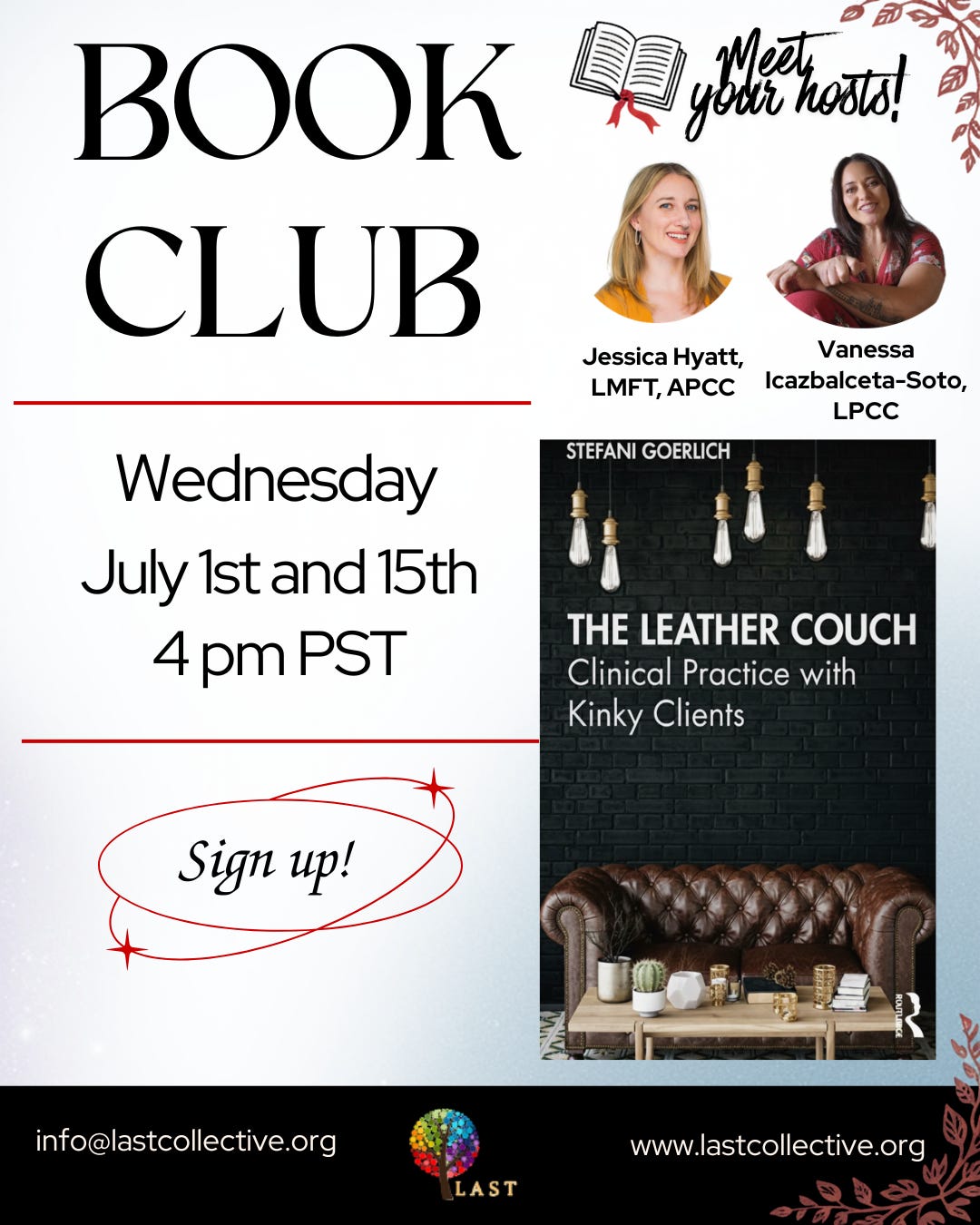
Join LAST Therapists Jessica Hyatt and Vanessa Icazbalceta-Soto to read Stefani Goerlich’s The Leather Couch Clinical Practice with Kinky Clients.
The Leather Couch provides a comprehensive overview of the BDSM and kink community and guides clinicians on how to meet the unique relational and mental health needs of its members.
The text offers a 101-style introduction to BDSM before delving into topics ranging from intersectionality within the kink community, to conducting a kink-affirming risk assessment and how to discern between domestic violence and consensual power-exchange. The author explores differential diagnoses and clinical concerns that are relevant to health care providers, including social workers and therapists as well as primary care physicians and sex educators.
Interwoven throughout with real-world case studies, each chapter presents practical suggestions, tools, and handouts the reader can use to inform their practice and serve clients in ways that meet the needs of each individual, couple, or partnership.
Written in a conversational, accessible style for clinicians and members of the BDSM community alike, The Leather Couch is the go-to resource for any mental health professional or educator looking to transform their practice from kink aware to kink affirming.
Wednesday, July 15
4 pm PST!
$25 drop in fee
Comments
Nothing yet. Say the first thing.
Sign in to join the conversation.