
When conversations about nonmonogamy come up, I tend to hear the same responses.
“I don’t see how that could ever work.” “I could never share my partner.” “I’m too jealous for that.” Or perhaps the most common misconception of all: that nonmonogamous people are simply sex obsessed or incapable of commitment (definitely not true!)
These assumptions are rooted in the cultural narratives many of us have inherited. We live in a society where monogamy is positioned as the default relationship structure, allonormativity assumes that everyone experiences sexual attraction, and amatonormativity teaches us that a single, exclusive romantic relationship should be the center of our lives.
When one model is treated as the only legitimate option, every other relationship structure becomes invisible, misunderstood, or stigmatized.
For many nonmonogamous people, that stigma creates real challenges. Some choose to remain private about their relationships because it feels safer. Others struggle to find examples of healthy nonmonogamous relationships because representation is still limited. We simply are not taught that families, partnerships, and love can take many different forms.
The reality is that relational diversity has always existed. As education, visibility, and awareness continue to grow, more people are discovering that relationships can be intentionally designed around the people involved rather than around cultural expectations.
Nonmonogamy is an umbrella term that includes many different relationship structures. Polyamory is one form of ethical nonmonogamy, and even polyamory encompasses many different ways of practicing love and connection.
The word poly comes from the Greek meaning “many,” while amor means love. At its core, polyamory describes the capacity or desire to cultivate multiple loving relationships with the knowledge and consent of everyone involved.
Today, I’d like to introduce you to three common approaches to polyamory. These aren’t rules or categories people must fit into. They’re simply frameworks that can help us understand the many ways people choose to build relationships.
Parallel polyamory describes relationships where metamours, your partner’s partner, have little to no relationship with one another.
Each person has an independent relationship with their shared partner, but those relationships remain separate, much like parallel railroad tracks that never intersect.
For some people, this arrangement provides clarity, autonomy, and emotional ease. While one metamour may enjoy building a friendship with another, the other person may not have the interest, desire, or capacity for another relationship, and that is completely valid.
Parallel polyamory still requires communication, mutual respect, and healthy boundaries. A lack of interaction should never become pretending another partner doesn’t exist. A simple introduction, occasional acknowledgment, or basic respect may be all that everyone desires.
Like every relationship agreement, the people involved get to decide what feels supportive.
Garden Party Polyamory, sometimes called Birthday Party Polyamory, describes metamours who comfortably see one another during occasional shared events.
Maybe it’s a birthday celebration, holiday gathering, barbecue, or another milestone with their mutual partner.
Outside of those events, they generally don’t maintain much of a relationship.
For many people, this style offers a comfortable middle ground. There’s friendliness without expectation of deep friendship.
If you’re preparing to meet a metamour for the first time at a large social event, you might even consider meeting beforehand for coffee or a casual conversation. Taking away the pressure of a first meeting can help everyone feel more comfortable.
As always, there is no obligation. You get to decide what level of connection feels right for you.
Kitchen Table Polyamory describes a dynamic where partners and metamours enjoy spending time together on a more regular basis.
The image of a kitchen table symbolizes people who feel comfortable sharing a meal, conversation, or everyday moments together.
This style is often celebrated as the “healthiest” version of polyamory because everyone appears connected and gets along. However, Kitchen Table Polyamory is not inherently healthier than any other approach.
When it’s idealized, it can unintentionally create pressure for metamours to become friends even when that connection doesn’t develop naturally.
Some metamours become close friends. Others remain acquaintances. Some enjoy spending time together only with their shared partner, while others prefer one on one friendships as well.
Whatever the dynamic, it’s important to communicate openly about boundaries, privacy, emotional capacity, and what topics feel appropriate to discuss. Everyone deserves agency in deciding how connected they want to be.
Are these the only styles of polyamory?
Absolutely not.
Do you have to choose one of these models?
Not at all.
Relationships are creative. Many people borrow elements from several different approaches, creating what some call a “relationship smorgasbord.” With communication, consent, respect, and ongoing collaboration, you can build relationships that reflect your values rather than someone else’s expectations.
Beyond the stigma, misinformation, and cultural stereotypes surrounding nonmonogamy, many people discover greater authenticity, deeper connection, and a richer understanding of themselves. They begin to move away from ideas rooted in scarcity, ownership, and possession, and toward relationships grounded in freedom, trust, intentionality, and love.
If you’re curious about ethical nonmonogamy or polyamory, know that you don’t have to navigate your questions alone. There are affirming communities, support groups, coaches, therapists, and educators who can help you explore what resonates with you right here at LAST!
Meet the Therapists and Coaches at LAST!
Whether you're a professional seeking a new career, a student wanting to make an impact, a therapist wanting to add coaching for added income and less burnout, a coach seeking a sex & intimacy niche to reach for more impact, or simply seeking to do some personal growth, find out if this program is the one for you.

The program includes twice monthly coaching calls, hosted by Kelly Jones, LMFT & Sex Therapist and Wayne LeSane, CSRC Resident Non Monogamy Coach, both highly skilled Pleasure Psych facilitators here to help you:
reconnect to desire
understand intimacy deeply
and build your own coaching pathway
This 3 step method is created by Moushumi Ghose, MFT, sex therapist for over 20 years.

💫 Step I: This program will help you work through your own blocks while also building your sex positive knowledge and repertoire.
💫Step 2: Start working with clients via coursework, master classes, practice sessions, team classroom support with coach facilitators, (Wayne and Kelly)
💫 Step 3: Build your business, your brand, your way.
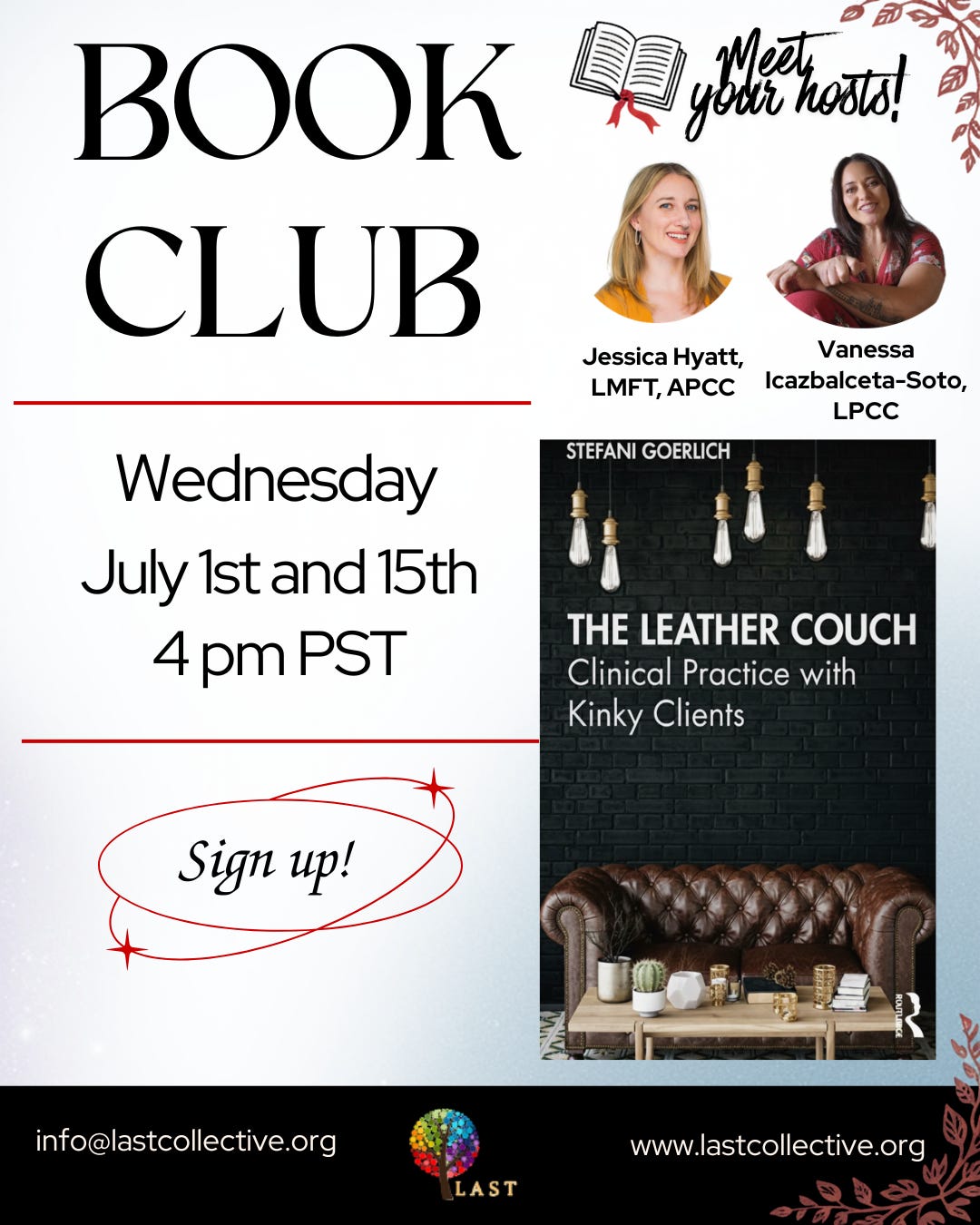
Join LAST Therapists Jessica Hyatt and Vanessa Icazbalceta-Soto to read Stefani Goerlich’s The Leather Couch Clinical Practice with Kinky Clients.
The Leather Couch provides a comprehensive overview of the BDSM and kink community and guides clinicians on how to meet the unique relational and mental health needs of its members.
Written in a conversational, accessible style for clinicians and members of the BDSM community alike, The Leather Couch is the go-to resource for any mental health professional or educator looking to transform their practice from kink aware to kink affirming.
Wednesday, July 15
4 pm PST!
$25 drop in fee
Comments
Nothing yet. Say the first thing.
Sign in to join the conversation.