
Welcome to "Donut Break the Internet", Donutz Digital’s weekly newsletter dedicated to digital marketing news. Here, you'll find a roundup of must-know updates, practical tips, and in-depth analyses on marketing.
This week's Donutz:
Free experiences beat free products 🎟️
What the world searched for in 2025 🔍
YouTube tests image carousels in Shorts 🖼️
AI images get better by looking worse 🤖
If you haven’t already, make sure to subscribe! Until then, enjoy your read. 🚀
Science Says breaks down a counterintuitive but powerful idea: giving away experiences creates more value than giving away products.
Across multiple behavioral studies, participants who received experiential rewards (events, access, moments) reported higher satisfaction, stronger emotional memory, and greater brand attachment than those who received tangible items of similar or even higher monetary value. People prefer experiences (e.g. a kitchen tour) up to 4x more than physical objects (e.g. a free dessert) as rewards.
Why? Experiences are processed socially and emotionally, they become stories people tell, not objects that fade into the background.
Even anticipation plays a role: the wait for an experience generates dopamine before the reward even happens, extending the brand’s impact over time.
Crucially, experiences are harder to compare on price, which protects brands from value erosion and discount addiction. The takeaway isn’t to stop product sampling altogether, but to rethink incentives: access, behind-the-scenes moments, learning opportunities, or shared rituals often outperform “free stuff” in loyalty and recall.
In a time of infinite promotions, memory is the scarce asset, and experiences are memory machines.
Read: Free experiences > free products

Google’s Year in Search 2025 is less about curiosity and more about coping.
Globally, search trends reflect a year shaped by uncertainty, acceleration, and emotional recalibration. People searched less for “how to win” and more for “how to understand,” “how to fix,” and “what does this mean.”
AI remains dominant, queries around generative tools shifted from “what is” to “how to use,” “best for,” and “alternatives.”
Culture-wise, sports, elections, climate events, and viral moments drove spikes, but the underlying pattern is intent compression: users want fast clarity, not endless exploration.
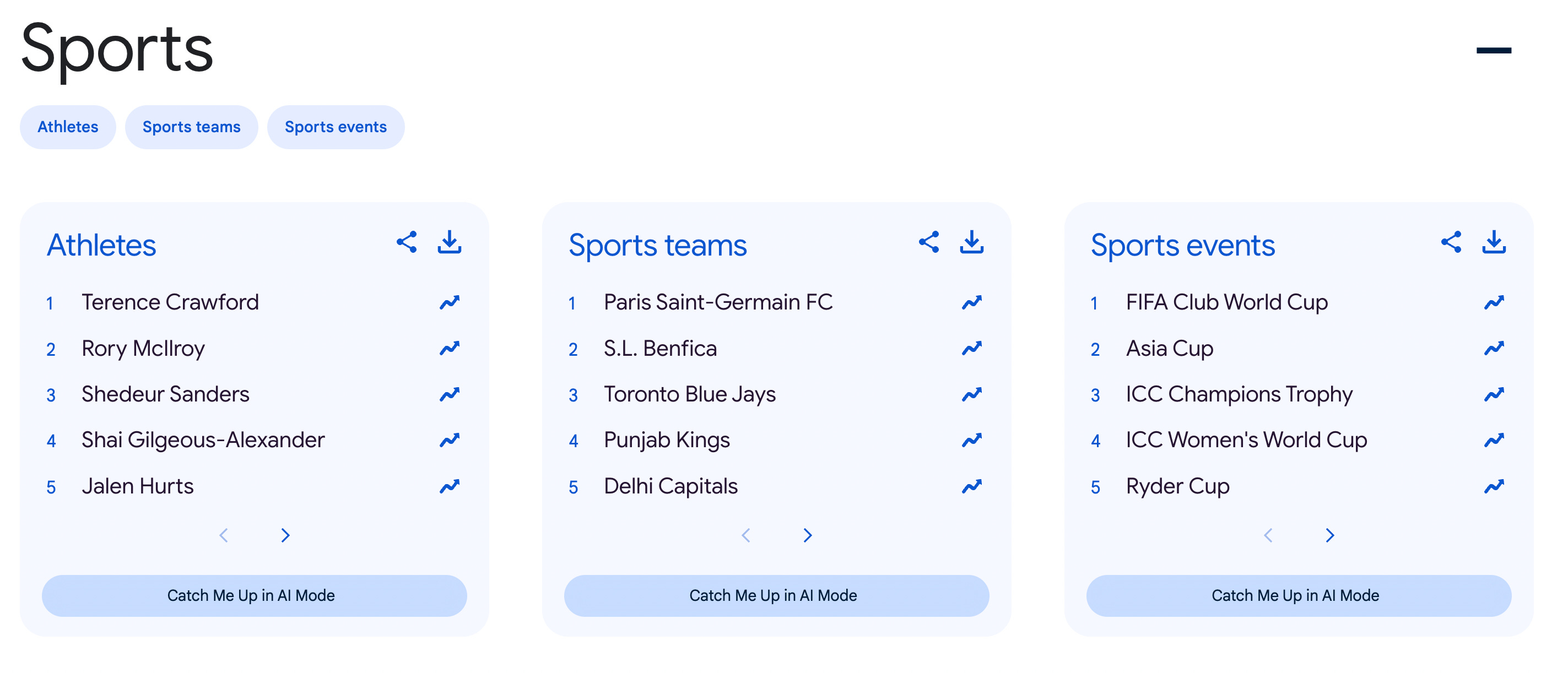
For marketers, this reinforces the move toward answer-first content and utility-driven storytelling. Search is no longer just a discovery channel, it’s a reassurance engine. Brands that reduce friction, explain complexity, and provide calm authority are the ones earning repeat attention.
Search intent is maturing. If your content still chases clicks instead of clarity, you’re already behind. Donutz can realign your SEO and content strategy to how people actually search now.
Read: Year in Search 2025
YouTube is experimenting with still-image carousels embedded directly into the Shorts feed, a notable shift for a format built on motion.
The test allows creators (and potentially advertisers) to swipe through multiple static images within a Short, blurring the line between video, Stories, and social display ads.
The rationale is clear: not all messages need motion, and some ideas land better with clarity than speed. For brands, this opens new creative lanes: product breakdowns, before/after sequences, step-by-step visuals, or catalog-style storytelling, all inside a feed optimized for impulse consumption.
It also signals YouTube’s intent to compete more directly with Instagram and TikTok on flexible creative formats. If rolled out broadly, expect new performance benchmarks and creative best practices: the winning Shorts may soon look less like micro-films and more like swipeable narratives.
Read: YouTube Tests Still Image Carousels Within Shorts Feed
TechBuzz highlights an unexpected trend in generative visuals: the most effective AI images are becoming less “perfect.”
Hyper-polished, ultra-realistic outputs are giving way to rougher, grainier, more human-looking aesthetics.
Why? Because imperfection signals authenticity. As audiences grow more AI-literate, glossy perfection now triggers skepticism, while visual noise, asymmetry, and stylistic flaws feel real and trustworthy.
Designers and marketers are intentionally prompting for “mistakes”: odd lighting, awkward framing, even low-resolution textures.
This mirrors past shifts in photography and design, where realism eventually gave way to character.
The implication is big: the value of AI imagery won’t come from realism alone, but from taste, direction, and cultural awareness. Tools are commoditized, judgment is not.
Read: AI Image Generators Get Better by Looking Worse
Thanks for reading! If you enjoyed this newsletter, share it with your network.
Make sure to subscribe to stay updated on our next editions. Have questions, topic suggestions, or insights to share? Reach out, we value your feedback!
Carla from Donutz Digital 🍩
No posts
Comments
Nothing yet. Say the first thing.
Sign in to join the conversation.