
This is part 3 (of 4) of Class Discussion, which has kept me busy for…has it really been three months? I’m gonna ignore that.
Today, I’m answering three questions that had more of an ironic tone. I’ll start with Jim Mander, who asked:
Yeah I got a question, man, why don't you make your students play REAL games like Doom and Quake and grapple with more important themes like how to kill a fiend in a tiny room or why the Sandy Peterson levels suck? Doing a class on videogames and then only doing glorified short stories is like doing an English Lit class and only covering The Very Hungry Caterpillar. Shouldn't a baseline competency be expected for registration? We're trying to expand perspectives here, not lower standards. Make everyone finish Hedon in Bearzerker mode for finals. What did you learn this semester? 'Melee only in a shooter can be cool if its cool and sexy.'
This gave me a good laugh. If you don’t know Jim’s style, you should check him out. Love the Hedon mention (it’s an indie FPS that looks like a 90s Doom-clone and with very hot characters). I’m imagining a classroom full of people trying to conquer the Bearzerker mode (hardest difficulty).
Off the top here, I’ll admit: yes, students should have some competency with playing games by the time they leave a game studies class, in the same way that more difficult works of literature help to make us better (and more attentive) readers.
But putting that aside, let me overthink Jim’s question here. I’m going to take this seriously. My answer has three sections: first, on what we usually mean by “real game” (requires dexterity); second, on my classes specifically and why it’s different; and third, on what difficulty means for mastering gameplay.
Why don’t I assign Doom and Quake? We actually do cover these in class, sometimes with gameplay but other times in video. They’re important for context and getting used to genre conventions. It’s probably obvious that we teach across the gamut.
I can also dismiss the “glorified short story” as a way to describe the games I’ve assigned. That has to do with timing. In my 200-level adventure games class, for example, we simply don’t have enough time in a semester to play the really impactful storygames1 that take 20-60 hours to get through (adventures tend to be short, anyway). I try to keep playtime between 1 and 2 hours between class sessions, and I’d rather dive deep into a few games than have to take a surface-level view of a single larger one. It should go without saying that everything I teach has oceans of value worth examining greater than The Very Hungry Caterpillar.
Games like Kentucky Route Zero and The Drifter fit well because they are somewhere in the 10-15 hour range. That’s about 2-3 weeks’ worth of homework for my 200-level class. I’m actually replacing KRZ with The Drifter in the fall semester.

Now, games with heavy dexterity requirements for progressing are absolutely possible to teach. We sometimes call these “hardcore” games: they require skill, patience, good reflexes, and willingness to fail and try again. I have had a few of my classes play several of these (though, remember that I’m in an English department, so naturally we look at games with heavy a emphasis on story).
Usually, this looks like: I bring in my PS5 or use our department-owned PS4 (or Steam Deck, or Switch; anything that hooks up to the computer at the front of the classroom), and I pass around the controller so that we all go through the game together. This has worked very well so far; it makes sure that people new to games don’t have to get good (yet), and it keeps the class engaged. Not dissimilar to a film class viewing the film together. I’ve done this with the predictable suspects, from interactive fictions (Colossal Cave Adventure, Zork, Deadline) to newer storygames (The Last of Us, God of War). It always gives us plenty to analyze, and we discuss the combat and other gameplay mechanics just as much as the story itself.
Plus, there are instructors who aren’t me who teach these things more often. At my institution, we have classes that discuss games like Hades, Stardew Valley, Smash Bros., and mountains of action-adventure and esports titles.
In short: yes, we do teach real games (all games are real—in this case, we mean games that require dexterity).
There are two reasons why hardcore games don’t make up a large amount of my syllabus. The first is that some of my students have no experience with gaming outside MarioKart; I’ve had a few who had never heard of Steam before. I ask students to play in groups to cut down on cost and so that people without a good amount of gaming history don’t feel to intimidated. We have a “game room” as well to make sure students can always access what they need to.
The second is that my classes mostly cover adventure games and interactive fiction, which are not genres that require any dexterity. They’re still real games, and the kinds of experiences they provide cannot be delivered in a medium other than that of a videogame. Let me be clear: I don’t teach games with obtuse logic puzzles, not even the Monkey Island games. We focus on narrative-heavy games with approachable puzzles, usually quite easy, since we’re focused on the cerebral side of gameplay and analyzing the play and the dialogue and themes at the same time. Other departments and classes cover other games; all of us together make sure our students grow in their playing.
Jim points to a real concern, about halfway through the paragraph: “Shouldn’t a baseline competency be expected for registration?” I take seriously a worry that we shouldn’t lower standards, that gaming analysis requires that we play tough games, and that expanding horizons is a good goal—often through discomfort, almost always through exposure to new texts and ideas.
So, Jim, I’ll answer you: Yes. There should be a baseline, and it shouldn’t just be “I click ‘next’ to see the next image.” Plus, our students should get better at playing over time. That’s how all skills work. Adventures have a simple solution to this: the gameplay happens in your head.
That “baseline competency” is usually understood to refer to dexterity-based mechanics, but the critical thinking required to notice and understand difficult themes is a competency as well. So too is the method by which we need to interpret adventure game puzzles in order to know how to move through the game. Scholars have called this the euphoria of these sorts of games. Finally realizing a puzzle solution is an incredible moment.
The gameplay is in your head because you still have to figure out what to do next and how to solve the puzzle. There is skill. There is considerate and careful thought. Yes, even in the games without traditional or difficult puzzles. You need to pay attention and take notice of important details (including taking notes, which I do require).
Traditional point-and-clicks are great for this as long as the puzzles emerge naturally out of the story instead of requiring some moon logic. I recently taught Loom, which does require some true puzzle-solving. My students were greatly frustrated, but by the end they had a new appreciation for what the game was saying and how the game inspired those feelings in them. We looked at it as an artistic experience. They got through the puzzles, which they are not used to having to deal with in modern storygames (in which all plot is delivered through cutscenes or in a cozy atmosphere). Expanding perspectives.
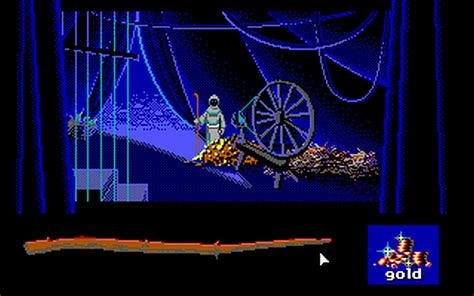
The same applies when we look at interactive fiction works in class, or when we go through the prologue of The Last of Us.
Finally, I’ll add a point to the virtue and value of difficulty in gaming. Scholars like Jane McGonigal, Bo Ruberg, and Jesper Juul have long built careers (in part) off of discussing the fact that gaming is difficult and gamers are uniquely okay with loss and failure. The key thing here is that failing a dexterity challenge, like a boss fight or a run-and-jump escape sequence, affects the brain the same way that failing an intellectual challenge, like weaving the wrong draft in Loom, does. We have to be patient, accept defeat, and try again.
I make sure to introduce my students to forms of gaming and gameplay that are worth analysis and consideration but aren’t super popular. I’m not worried about their ability to play and seriously engage with Fifa or Mass Effect.
This comes from my friend Dean, who asked:
Oh, so you’re a fan of video games? Name all of them.
All games are just Colossal Cave Adventure or Spacewar! in different clothing. So there are really only two games.
The last one for today comes from The Video Game Storyteller:
Do you have a video game hot take you like to pull out at parties while nursing a glass of scotch?
Not as a trend. I had to think about this one. I don’t think there’s been a specific opinion or concept that I’ve gone to a lot. Maybe my wife can correct this (I will edit this if she does).
I’ll go with this: Most negative reviews for games have to deal with unmet expectations rather than the game’s quality. This is not necessarily a scholarly consensus, though I know many scholars of gaming cultures who hold this view.
Those expectations can come from false advertising or hyperbolic hype (ha). A significant amount, though, can come from our own preconceptions of what that game is (and games in general are) allowed to be.
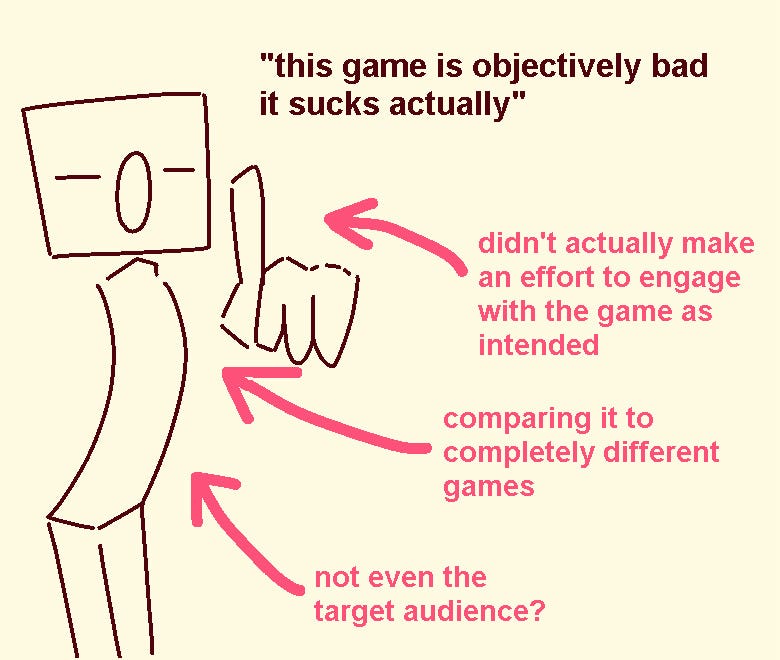
For digital experiences like Her Story, and very often for adventure games as a genre, folks use “not a real game” as a criticism, but this misses the point. 1, you’re coming to the text with assumptions of interesting and meaningful gameplay instead of engaging with the systems as they are. 2, who cares what we call it? Don’t deflect from interesting themes and conversations based only on what you enjoy playing for fun. Sometimes, art requires we question the form.
Obviously, there are some games that are just terrible, but they’re a minority, and they almost never become popular.2 People are also allowed to dislike certain games or experiences. Not everything is fun.3 But “fun” is not always the goal; sometimes, examining themes and pushing boundaries can be fun in their own way. We all have different tastes, so it’s important to let the games speak for themselves and admit that not everything is for everyone. We shouldn’t define what they can and cannot be before we even experience them ourselves.
I have many other rants, including daylight saving time (summer time), people who complain about “woke” games, and how little people pay attention to the lessons they’ve tacitly learned from the games they play. But I’ll save those.
That’s all for now. Have peace and rage. Join the Good Game Lobby discord: https://discord.gg/GYXdCnCNC where you can hang out with me and several other wonderful people. We have a gaming club. This month, we’re playing Chants of Sennaar, a puzzle adventure game about translation. It’s a great time.
The term “storygame” as a single word is sometimes used in scholarship to talk about games that primarily serve a narrative interest, like text adventures. The term is sometimes also applied to adventure games and action-adventures with frequent and important cutscenes. They can have changing narratives but usually don’t. Some big names that are often called “storygames” are Zork, The Last of Us, God of War, and The Walking Dead. The Drifter and Dispatch are the two newest well-known additions.
Of course, there is no objective way to call a game “good” or “bad,” but that’s a dead horse. There are popular games without any serious themes, but that doesn’t make the playing of those games a waste of time. Entertainment is still good. There are also unpopular games with fascinating mechanics or themes, begging for analysis. Genuinely “terrible” games are those without anything interesting to say and are deeply unfun, no matter how you cut it.
This can begin an entirely new conversation on what it even means for a game to be “fun.” If my students are to be believed, shelving books, fishing, intense combat, dialogue options, and lore hidden within full-motion videos are all fun to one person or another.
Comments
Nothing yet. Say the first thing.
Sign in to join the conversation.