
We did it! It’s the end of Class Discussion! It only took 4 months. And in the meantime, we’ve added over 40 more people to our little corner.
I’m covering the three final comments, which together asked six questions.
Without too much done, let’s jump into these final questions that I’ve been stewing over since December. Read to the end for a couple personal updates and announcements! This one is long.

Our first question today comes from Trip Harrison (a good person):
So, since you're an institutionally recognized scholar, I bet you'll have an opinion on this: who do you reckon is doing the best and/or most important original research on gaming right now?
I suppose my institution recognizes me, yeah. It’s funny that a PhD should feel like the end of a long road, but for me it’s basically like taking my first step. I can finally do the things I’ve been wanting to do for over a decade.
Anyway, original research. This is a rich question. Obviously, I could name 10 people for you from around the world whose stuff I’ve really enjoyed recently.
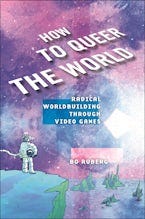
Bo Ruberg just released a new book via NYU Press called How to Queer the World.1 Ruberg’s writing is both precise and expansive; they’re talking about difficult and abstract concepts with clarity and exactness I could only dream of. They present interesting discussions across their scholarship, and this new book is no different.
Other huge names worth mentioning, of whom I am a fan, are Anastasia Salter,2 Patrick Jagoda,3 and Alenda Y. Chang.4 Most important for my own scholarly interests is Robert Houghton, who has written several pieces about the Middle Ages in games, including his 2024 book aptly named The Middle Ages in Computer Games.5
These scholars are best known for their monographs (book with a single author) or edited collections (they edited a bunch of chapters by other people into a single volume). There are so many academic publications putting out new gaming research all the time that aren’t academic tomes, though. Eludamos and Gamevironments are both open-access journals, which means they don’t charge anything. JSTOR lets you make a free account.
Next, we’ve got four questions from my friend The Video Game Storyteller — which, by the way, if you haven’t read our collab piece on grief and God of War Ragnarok, please go do that at some point:
Anyway, he asks:
Firstly, how do I get your job?
Firstly, I have no clue. I’m not even properly a game studies teacher; about half of my time is still ENG 101 and introductory literature courses. My games classes are things I’ve eked out because of student demand and because of support from our larger “Videogaming and Esports Studies” initiatives on my campus.
My path was pretty traditional: undergraduate philosophy, master’s in literature with some media theory, and doctorate in literature with game studies on the side. You do not need a traditional path in order to live a good life or examine the media in your life with good methods. One of my goals online is to share those methods.
It’s tough out here, man. I’m lucky to have a full-time teaching job in America’s current academia landscape. My job security is better than most, and it’s still not great.
However, I’m not going to advise people not to go to graduate school or become an academic. If you can make it work, then do it. We just need to be up front that you can’t go into academia right now thinking that you’ll get a job. Go for the sake of going, and make sure they pay you. It’s still the best life I can imagine.
Even so, as long as you’re starting interesting conversations, holding yourself accountable, and willing to spend your time searching for nebulous Truth, then you’re doing my job.
Can great stories in visual novels be considered great video game stories if the level of interactivity is minimal beyond simply scrolling through text?
I enjoy academic-sounding nonsense as much as the next guy, so forgive the title.6 The short answer is yes.
First, let me assert the possibility that visual novels (indeed, kinetic novels, which have no player choice) can conceptually still be considered videogames (sorry bud, I use the one-word variant). The level of interactivity I think is a contingent aspect of what it means to be a videogame, not sufficient or required. By “contingent” here, I mean in the metaphysical tradition of “it can be an important aspect for some items within this category, but not all items in this category need it in order to belong.” That is, while some games are identifiable as games based on their interactivity, there are other games that—while having very little—are still themselves videogames.7
Sharing enough other aspects can still allow visual novels into the larger videogame umbrella. For simplicity, let me borrow Riccardo Fassone’s two-part description for what a videogame is: “digitally-mediated game” (i.e., the play is most important, and it’s easily identified as a pure game put into code, Civilization, SimCity, chess dot com, Animal Crossing) or “designed procedural experience” (i.e., the computer is taking me on a journey via my button presses, and so includes the player choice spectrum from kinetic novels and Dear Esther to the choice-based Telltale and Detroit: Become Human to the difficult Silksong and Elden Ring).8 This is not a strict binary: plenty of games are both. For the sake of this topic, we’re talking “designed procedural experiences.”

To your main question. I suppose this depends on whether a “great video game story” is a great story put inside a videogame (think Uncharted, maybe: could have been movies, but I’m glad they weren’t) or if it’s a story made great by virtue of playing/controlling/revealing it ourselves (think Uncharted,9 the story of which is enhanced by its relatively simple combat, exploration, and puzzles).
Sorry, I’m being cheeky. I actually think these are the same thing when done well. A great story within a game will be made greater by the playing. Even in a visual novel, there is something about being in control of that “next” button that feels more important than flipping a page in a book. It isn’t, not in itself; it’s the same type of movement and engagement. It’s a comic book or manga with a soundtrack, and sometimes good voice acting. But I don’t know, man. The transition on the screen and the animation of static sprites really seem to affect their players.10
So yeah, I think they can still be great video game stories despite belonging on the lower end of the interactivity spectrum. Steins;gate and Misericorde are the two that come to my head right now with pretty interesting stories. I’m not a big visual novel guy, so I can’t give too many recs there. The most powerful stories that visual novels have brought to me have come via combinations with other genres (I’m the alchemy guy, I love me some conjunction and solution): Ace Attorney, Citizen Sleeper, Doki Doki Literature Club, and Coffee Talk all bring some VN ideas with them (DDLC being the most VN of these).
What’s your go-to response for people who say that video games aren’t art or a serious art form?
They are just so obviously art. Graphic design, narrative design, intricate modes of interactivity and engagement, acting, prose, structure/progression, … I could go on. Every minuscule aspect of videogames as we create and enjoy them are art forms in their own right.
Fun things can be art. I mean, there’s like colors and stuff. There’s words. I realize I’m preaching to the choir.
I also try to mention that there’s real craft and careful consideration in the creation and development of game systems, mechanics. We don’t often think about them as artistic expression, but we should.
How do you develop your class outlines?
Slowly, then all at once.
I start with the large structure and the types of assignments I know a class like mine needs to have. For example, in the 300-level that just ended, I knew I needed to assign a final research essay with a drafting and revision stage. I built backward from that: final thing due at the end, one-on-one meetings to discuss their drafts in the weeks preceding, so I knew that by the beginning of April I needed to have official instructions and discussions about the research.
For lower level classes without a strict final project like that, we can have more fun. For those, I tend to start with what games we’re using as case studies (I teach based on themes and concepts, rather than time periods or from a specified canon).11 For the 200-level adventure course in the fall coming up, we’re going to use A Short Hike, Night in the Woods, and The Drifter as our main out-of-class games; in-class, we’re going to look at Colossal Cave Adventure, Christminster, The Secret of Monkey Island, Telltale’s The Walking Dead, and a lot more. So I start there, and I plan out how long it’ll take us to play and discuss each game. I’m aiming for 3 weeks for The Drifter, since it has 9 chapters and we meet 3 times per week. One chapter per class meeting is a little too easy of a break-down to ignore.
Readings, lecture materials, and anything else that needs to be scheduled gets filled in after that. I try to make sure we hit good introductory and approachable texts for the literary study of games and for examining games in their own right (as a cross-listed course between English and Videogaming and Esports Studies, we ride the fence).
And finally, here we are. The last question comes from Christena Maurer:
How do mental processing differences like aphantasia and anendophasia affect gaming experience?
I’ll be real: I’ve not a clue. This is where I admit my ignorance. I’ve done a little research into these over the last couple months, and I know a little about how aphantasia affects it (from stories of a dear friend). But I’m not finding enough stuff conclusive.
This topic requires a lot more discussion from people who actually have these themselves.
If you don’t know, aphantasia is the lack of picturing an object when asked to imagine it. Anendophasia is the lack of an inner voice. The articles, friends, and studies I’ve relied on to learn about these conditions have not helped when it comes to gaming. Christena, next time we talk, let’s get more into this, because I’m pretty lost.
I’d be surprised if either of these conditions affect gaming experiences a lot, outside of text-based games, since videogames are pretty forward on the phenomenological engagement (i.e., we approach them as appearance and can only understand them insofar as they appear to us). What you see and hear is what there is, so there’s not a large room for different imaginative processes to create different experiences. Just different interpretations, I’d think. Maybe immersion could suffer with aphantasia. Colorblindness and face-blindness probably have more to offer here? I’m open to possibilities; there definitely needs to be a study.
We did it. Great job slogging through all of that!
I have things to share with you! First, join the Good Game Lobby discord server: https://discord.gg/u9QWuthz
We have a Gaming Club that chooses a game to play each month and has a discussion about that game at the end. This month, we’re playing Disco Elysium. In June, we’re playing Tunic. We just finished Chants of Sennaar, one of my favorites, in April. Come, hang out, and play.
Second, I’m going to publish more frequently now that it’s summer! You can expect some reviews, some more medieval stuff, and some more topic deep-dives in future weeks.
Third, and finally, I’m gonna let you all in on some early plans. To help my own motivation and my goal of spreading scholarly info as far as possible, I’ll be doing videos soon. A couple friends and I have been talking, and we’re excited. Not sure exactly what form those videos will take yet, but I’ll let you all know as those plans get realized.
Good things are coming.
Ruberg has been a major voice in queer game studies for about 10 years. Their book Video Games Have Always Been Queer (2019) is really influential—both on the field as a whole and on me, personally.
Salter is one of the biggest names in adventure and adventure-descendants. She co-wrote Adventure Games: Playing the Outsider (2020), which I’ve cited here before. She recently wrote a short book on Undertale for the University of Chicago Press’s new Replay series.
I’ve cited his Experimental Games (2020) before. Excellent book, through and through, though it is dense for folks not used to academic interrogations of neoliberal economic principles and some media theory. I recently had the opportunity to meet Jagoda (and many others) at a conference to discuss a new “introduction to game studies” textbook he’s working on. I’ll be excited for its release when he and his co-author Chris Carloy are able to finish it.
Chang’s Playing Nature (2019) really is special. Great prose, fascinating topics explained well, and a voice of obvious concern without getting preachy.
These words can be useful in appropriate contexts; I just couldn’t resist misusing them.
I follow most scholars in believing that criticisms like “not a real game” are not useful or constructive.
This description comes from the beginning of his book Every Game Is an Island (2017). It’s just one guy’s attempt to sum up all of videogaming in just two descriptors, but I think it does a good job. I can’t think of anything that we know is a videogame that doesn’t fit those concepts, and I think it’s fine if something could technically be a “designed procedural experience” and not exactly be a “videogame” (like that SB Nation web-interactive-article-book-thing 17776). Like all other terms we try to fit onto a complex reality, we know it when we see it. I think visual novels are definitely still videogames. We interact with them the same way; they appear the same way; they do the same things and are run with the same equipment.
Ha! Got you! Gameplay is narration, babyyyyy.
All of my students who love visual novels have said something along these lines. These games are still more engaging and impactful than films and books. The combination of required attention and visuals seems to be the thing, but I can’t definitively say: every player is different, after all.
The prospect of a “canon” within game studies is its own topic. Might touch on that in a while.
Comments
Nothing yet. Say the first thing.
Sign in to join the conversation.