
One could say that this study is about if plants can hear.
One isn’t supposed to put it that way, of course, though headlines like this one about this study did. Plants are not people. Hearing, for people, is not just a biological function. It’s shot through with other meaning, such as conversations with people you love (or hate), or maybe your favorite piece of music. Thus the standard warning for reading about research like this is, “Try not to assign human experiences to stuff that’s not human.”
Having said that, I think a little anthropomorphizing can go a long way toward making something more interesting. So let’s mix up plant and human experiences a little bit. We can call it phytopomorphizing. That is, imagine you’re a plant. One that flowers—no ferns or pine trees, please. And pick one that doesn’t blow pollen up everybody’s noses. Pick something that makes people go, “Ooh, look at that pretty flower.”
Your choice is probably among the roughly 90% of flowering plants that need animals to pollinate them. Which means you’re going to dedicate a lot of energy to attracting those animals. You might choose a specific color for your flower, maybe form it into a specific shape—one shaped like a hummingbird’s beak, perhaps. You might paint, evolutionarily speaking, a little runway for a bee that shows where the nectar is. You might even have a way to warm the air right above your flower to make a little sauna for early season pollinators (thermogenesis, but also this cool mechanism involving yeast).
All of these are sort of like a marketing campaign you spend your whole life developing to get bees and moths and flies, etc. to come visit. But when you’re done making all these colors, shapes, smells, and textures, you just have to sit there and wait. And hope. “Please, somebody notice me! I have delicious nectar! I’m very pretty!” Etc.
Wouldn’t it be cool if there was something you could do? An action you could take to get a bee’s attention? But you’re a flower. You don’t do behaviors. Right?
A group of researchers at Tel Aviv University thinks maybe you can do behaviors. They hypothesized that if plants could detect the sound of wingbeats from flying pollinators, they could actually react to them in the moment. And flowers do often look a little like those old-fashioned gramophones with the big horn sticking out. So maybe they can detect sound. Maybe they can hear.
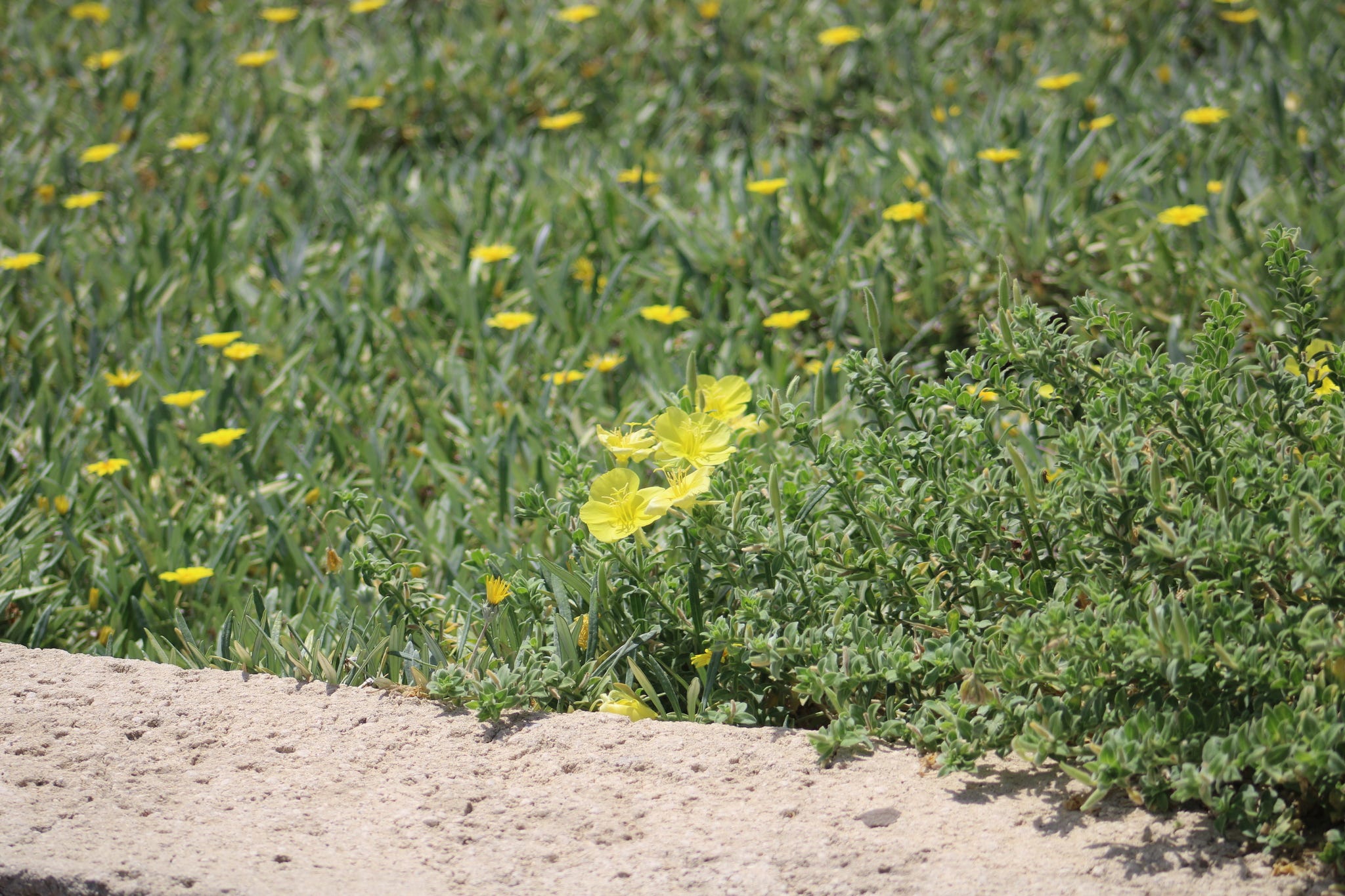
The plant this study focused on was beach evening-primrose (Oenothera drummondii), native to Mexico and the southern U.S. (especially Texas and Louisiana). It grows on coastal dunes and other sandy areas. It blooms year round in these warm climates, a fact that I, a New Englander, find shocking.
It has the typical traits of the evening-primrose family (Onagraceae), 4 petals and 4 sepals, 8 stamens, and an X-shaped (or cruciform) stigma. It’s usually yellow, though apparently its color and shape change after it’s pollinated. Which is cool, but a story for another time.
It’s known for being pollinated by sphinx or hawk moths, a group of moths whose ability to hover while they nectar resembles that of hummingbirds.
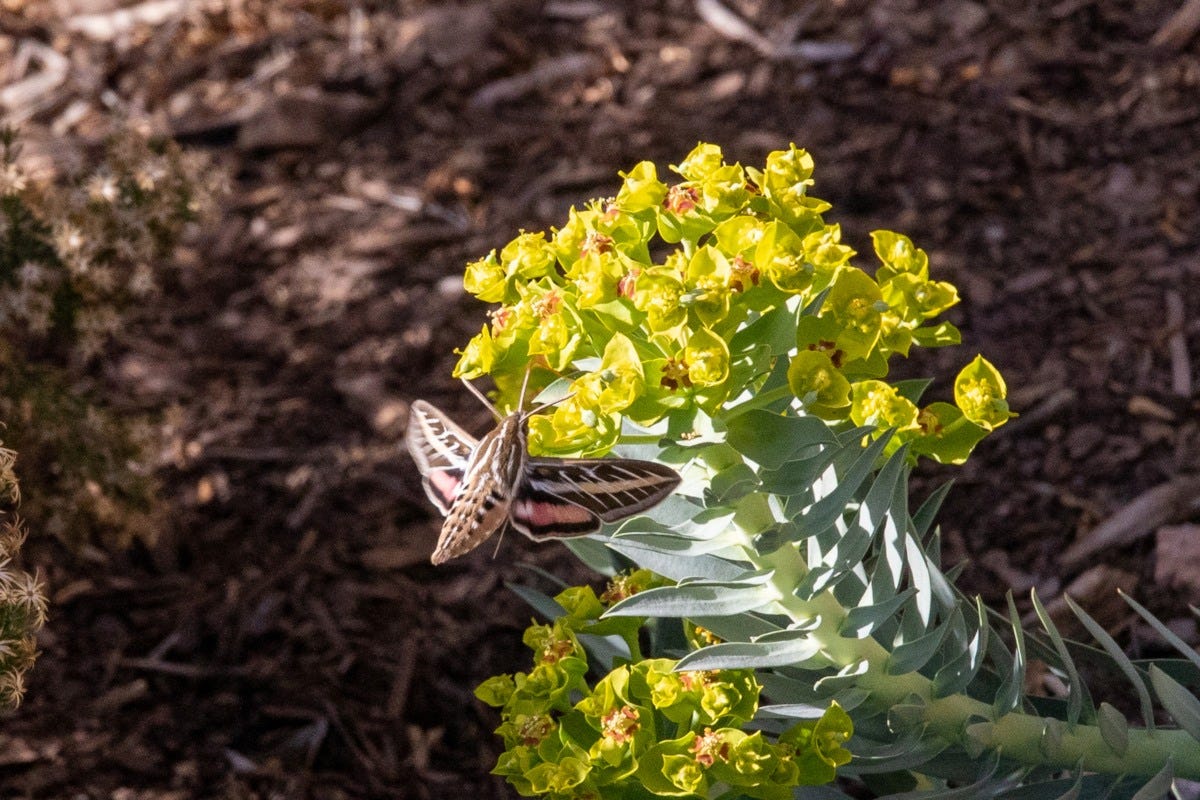
If you want to learn if plants can hear, one method is to make them listen to music and see if they dance. Well, not exactly music, and not exactly listening, and not really dancing. But not not those exactly, either.
This study consisted of 3 groups of experiments.
Playing sounds for plants and measuring if they made sweet nectar in response.
Checking if flowers vibrate in response to detecting sound. Physical objects are “tuned” to respond when sound waves of the right frequency exert pressure on them. This is how eardrums work, for example.
Checking if a pollinator arriving predicts that more pollinators will arrive. The main reason a plant would act upon hearing a pollinator is that more pollinators are likely to show up, too. Essentially, the plant is preparing not for the one it “hears,” but for the next few minutes.
In the nectar experiments, researchers removed all the nectar from the flowers, exposed them to different “soundtracks,” and then measured how much sugar was in the new nectar the plant made. They waited 3 minutes to measure the new nectar because that’s how long it took for the plant to make enough that they could measure it. They measured it with a tool called a refractometer, which is for checking how much of something, like sugar, a liquid contains.

To understand this experiment, it’s helpful to know that a hertz (Hz) is a unit for measuring how often things repeat per second, and a kilohertz (kHz) is 1,000 Hz. Lots of hertz gives you something higher pitched, and fewer hertz gives you something lower pitched. For example, a flute is between 261 Hz and 2.1 kHz, and a tuba’s between 41 and 262 Hz.
Here are the soundtracks they tested:
Silence, as a control for the experiment (or perhaps because they’re big John Cage fans).
“Bee.” This was a recording of a honey bee from 10 centimeters away (i.e. hovering above a flower).
“Low,” a 10-second track that ranged from 50 to 1000 Hz, which apparently is the range most pollinators’ wings beat in.
“Intermediate,” a 10-second track that ranged from 34 to 35 kHz, which is about the range of a dog whistle (and inaudible to humans).
“High,” a 10-second track ranging from 158 to 160 kHz. This is super high frequency, like in the range that bats need for echolocation. It served as a second control, helping them check if flowers responded to the speaker’s electromagnetic fields. (All electrically charged objects generate electromagnetic fields.) The assumption is that this is such a high frequency track that it’s basically silence plus an electromagnetic field.
They played these tracks across 4 nectar measuring experiments, each with a different flavor of design. It’s not clear what question each experiment was designed to anwer.
The nectar experiments measured if plants responded within 3 minutes of detecting sound. But 3 minutes is kind of a long time. A bee that appears right now is unlikely to be there 3 minutes later. Unless it’s taking a nap, which bees sometimes do on flowers. But that’s unrelated to this paper.
So what’s the point of making new, sweeter nectar if the pollinator you heard is already gone by the time you make it? One possibility is that pollinators come in clusters. Honeybees and bumblebees, for example, are known to forage in groups. Honeybees even do a form of interpretive dance to tell their buddies where the food is.
To make sure that pollinators visit in groups, researchers filmed a bunch of flowers at dusk and checked if one pollinator arriving meant another one would come soon after. I’d like to report that they watched these films with a bowl of popcorn in one hand and a stopwatch in the other, but the reality was much more technical and careful.
Researchers used something called laser vibrometry to measure if petals moved in response to a soundtrack. This involves measuring the shift in a laser beam caused by a vibrating surface. Sorcery, more or less.
There’s less detail about the “soundtracks” for these vibration experiments, which were different than in the nectar measuring experiments. They were:
Silence
A recording of a bee
A recording of a moth
“Low” (1,000 Hz)
“Intermediate” (35 kHz)
“High” (160 kHz)
A live bee held by tweezers several centimeters from the flower! (exclamation mine)
Though the paper refers to multiple vibration experiments, it doesn’t say what was different about each.
Beach evening-primrose flowers produced about 20% more sugary nectar 3 minutes after they “heard” the bee soundtrack and the “low” soundtrack (the one with the range that pollinators’ wings beat in). Previous research suggested that bees can tell the difference when the sugar increase is as small as 1-3%, apparently, so this is a big boost.
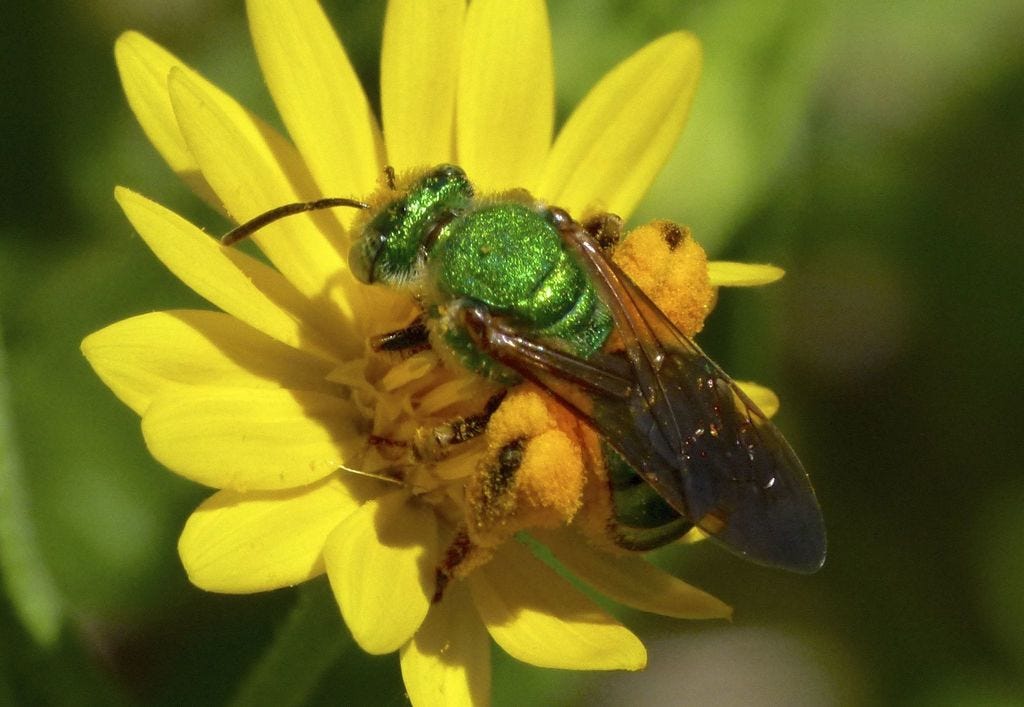
These results didn’t change regardless of growing conditions, e.g. grown indoors vs. outdoors, different seasons etc. Flowers didn’t produce more sugar when they heard the “intermediate,” “high,” or “silence” soundtracks.
As a reminder, “3 minutes” comes from how long it took for the flowers to get enough nectar for them to measure sugar concentration. It doesn’t actually tell us the exact speed of nectar refilling, or when a pollinator would begin to notice it. But it is fast—fast enough for the next pollinator who arrives.
And pollinators do cluster their visits. Researchers found that pollinators are much more likely to show up if another pollinator had been there within 6 minutes. This means that it’s probably worthwhile for plants to up the sugar in their nectar on hearing a wingbeat, since another bee or moth is likely on the way.
Researchers found that the flowers vibrated in response to the bee recording, moth recording, and the bee held (gently, one hopes) by tweezers. The vibration experiment also showed that flowers vibrated more when they had more petals. Removing petals decreased the vibrations. This suggests it’s the petals that are doing the “listening.”
So in sum, the flowers seem “tuned” to the frequencies of pollinators’ wings. This could help them filter out, for example, wind frequencies, which are lower.
First things first: this study shows plants responding in the moment and quickly to sound. That seems fundamentally different from evolving a flower with a specific color or shape. It’s a behavior. I don’t know about you, but I think about behaviors as things animals do, not plants.
Also, the fact that the flower itself is functioning as an ear is startling. We think of flowers as things we look at and smell, not as organs that are constantly eavesdropping on the world. (“Is there a bee around now? How about now? What about now?”)
It seems like quite a lot that we learn about flowers comes down to, “That’s a thing that helps them reproduce.” This is no exception, but it is a totally new type of “thing.”
There are two components of the new thing. One is that plants can hear pollinators. The other is that they can respond by sweetening their nectar. This is cleverer than it might seem. It’s probably obvious that sweeter nectar might attract pollinators. But if that’s true, why not just have sweeter nectar all the time?
Because producing sweeter nectar can be expensive. And nectar that’s just sitting there waiting can be eaten by microbes and “robbers.” Nectar robbing is an actual technical term where insects that don’t pollinate plants show up and drink their nectar. Sometimes they even bite a hole in the bottom of the flower to get at it.
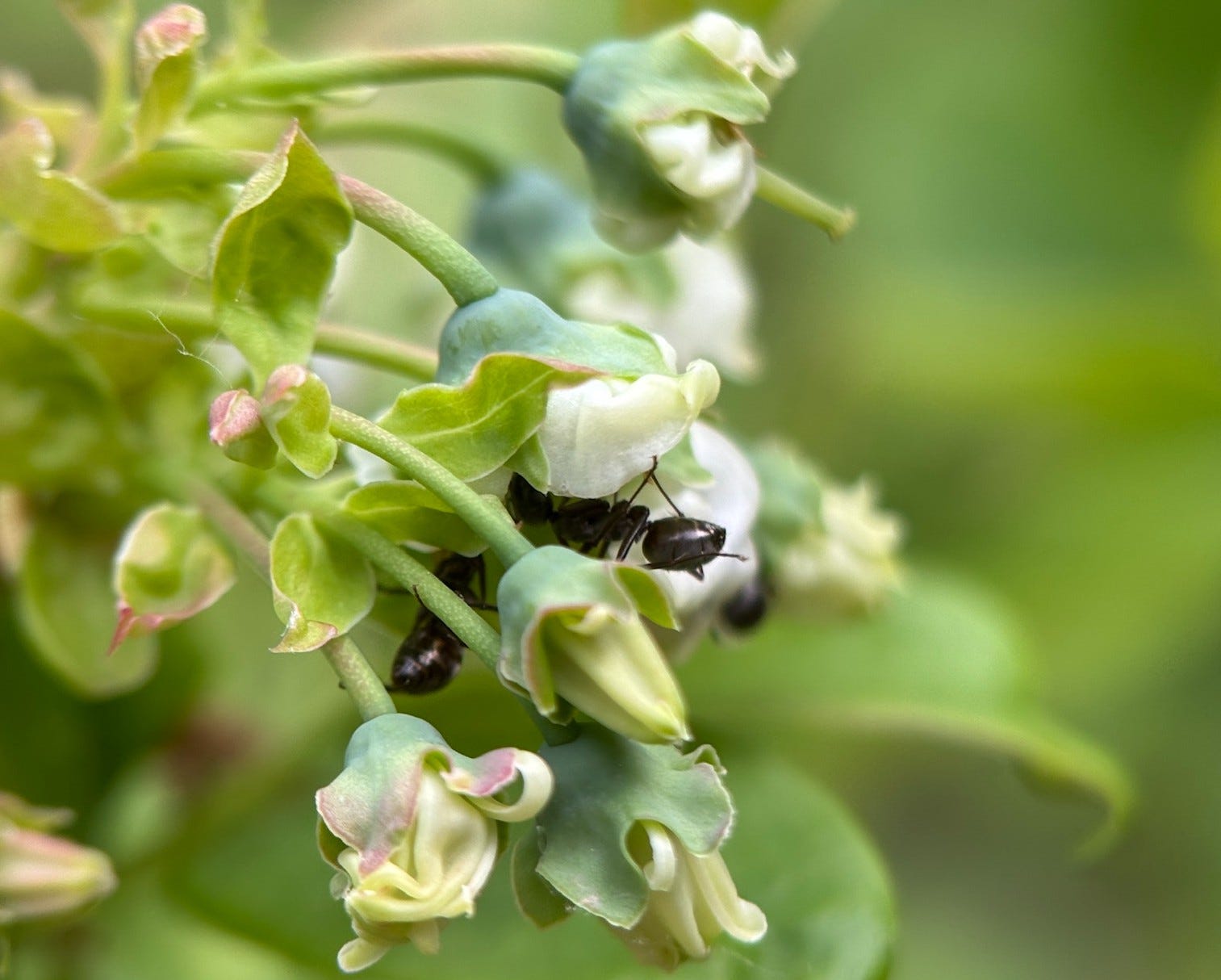
You don’t want to attract nectar robbers if you’re a plant. You want to attract something that will contribute to reproduction. And so you reserve the good whiskey for when your real friends come over. Or you only take the little blue pill at the opportune moment. Or…
…perhaps that’s enough comparisons. The point is that it’s advantageous for plants to wait to sweeten their nectar until the right moment. Being able to “hear” lets them do that.
This paper claims that it’s “the first step in a new field,” phytoacoustics. I’m not sure if it was the first, but it certainly was a landmark. Other studies that have helped establish this new field include a 2017 paper that found that plants were able to use vibrations, or “acoustic cues” to find water, and a 2025 paper that asked if “windmill-like” noise affected pea plants’ growth as well as the insects that feed on them.
There was also a 2023 study that suggests that plants actually make sound when they’re stressed (at a frequency people can’t hear). Which is also very cool. One could say this means that not only can plants listen to music, they can play it, too.
Well, not exactly music, and not exactly play. But not not those exactly, either.
Plants in Plain Language is free. Subscribe to get fun and plant nerdery in your inbox.
You can also help me rationalize spending even more time on this—writing, researching, trying to get photos of very spontaneous bees—by buying me a coffee or becoming a monthly sponsor.
No posts
Comments
Nothing yet. Say the first thing.
Sign in to join the conversation.